Tanzania
Top Sights & Landmarks
The Cradle of Mankind
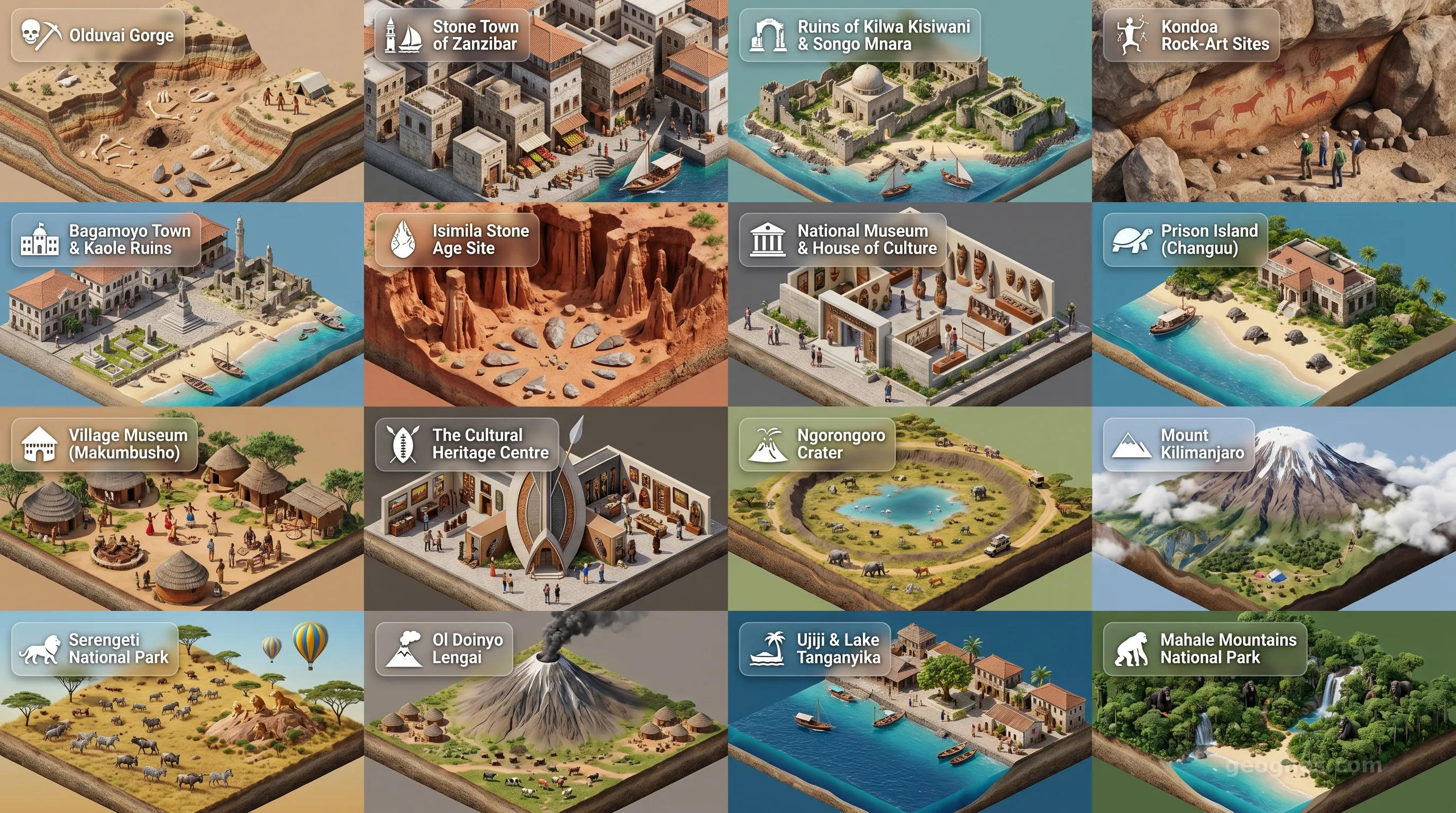
Olduvai Gorge is one of the most important paleoanthropological sites in the world. It is essential for students and travelers seeking to understand human evolution, as it holds the earliest evidence of the existence of human ancestors, famously excavated by Mary and Louis Leakey. The site showcases fossilized hominid footprints and tools dating back millions of years. The best season to visit is during the dry months from June to October when the terrain is easily accessible. Tourist tip: Be sure to spend ample time in the onsite Olduvai Gorge Museum to view the fascinating fossil casts and artifacts before looking out over the stark, historic ravine.
Zanzibar's Historic Heart
A remarkable manifestation of coastal Swahili trading towns, Stone Town reflects a unique fusion of Arab, Persian, Indian, and European elements spanning over a millennium. It is highly significant historically as a primary hub for the East African spice and slave trades. Students of history and architecture will marvel at the carved wooden doors and coral stone buildings. The best time to visit is from June to October or December to February, avoiding the heavy rains. Tourist tip: Lose yourself in the labyrinthine alleys, and don't miss the Forodhani Gardens night market for authentic Zanzibari street food.
Ancient Swahili Trading Empire
Located on two islands off the southern coast, these ruins are the remnants of what was once the most powerful trading port on the East African coast. From the 13th to the 16th century, Kilwa commanded the gold, ivory, and slave trades, creating immense wealth that funded magnificent coral and lime structures like the Great Mosque and the Palace of Husuni Kubwa. It is a profound study site for Islamic architecture and pre-colonial African economics. Best visited from June to October. Tourist tip: Access requires a permit from the local antiquity office and a short dhow ride from the mainland town of Kilwa Masoko.
Millennia of Rock Art
Spanning over 150 shelters within the Maasai escarpment, the Kondoa Rock-Art Sites offer a spectacular, albeit lesser-known, glimpse into ancient human creativity. The paintings depict the lives of hunter-gatherers and later agro-pastoralist societies over several millennia, making it a goldmine for anthropologists and art historians. The artwork details hunting scenes, symbolic rituals, and shifting climatic conditions. The best season to visit is the dry season (July to October) to ensure road accessibility. Tourist tip: The sites are widely dispersed; hiring a knowledgeable local guide is absolutely mandatory to find the best-preserved paintings.
Gateway of the Slave Trade
Bagamoyo's name translates to 'lay down your heart', a tragic nod to its history as a major terminal for the 19th-century ivory and slave trade. It was also the first capital of German East Africa. Nearby sit the Kaole Ruins, featuring a 13th-century mosque and coral-rag tombs, highlighting the early Islamic presence. The town is vital for studying colonial impacts and Swahili maritime history. Best visited from June to October. Tourist tip: Visit the Catholic Mission Museum to see artifacts from the slave trade era and the very place where David Livingstone's body rested before being shipped to England.
Stone Age Tools and Sandstone Pillars
Located near Iringa, Isimila is one of Africa's most significant Stone Age sites. Excavations have uncovered an extraordinary wealth of Acheulean tools—including hand axes and cleavers—dating back nearly 100,000 years. Adjacent to the archaeological beds is a breathtaking canyon filled with dramatic, towering sandstone pillars formed by millennia of erosion. It offers a perfect blend of paleontology and geology. Best season to visit is May to November. Tourist tip: Combine a morning hike through the eerie sandstone pillars with an afternoon reviewing the artifact displays at the visitor center.
Keeper of Tanzania's Heritage
Situated in Dar es Salaam, this museum is the principal repository of Tanzania's cultural, historical, and archaeological treasures. It houses the original fossils of Paranthropus boisei found at Olduvai Gorge, extensive exhibits on the Shiraz trading era, the tragic history of the slave trade, and artifacts from the colonial German and British periods. It is an indispensable starting point for any student looking to contextualize the nation. Can be visited year-round. Tourist tip: Allocate at least two to three hours here, and check out the collection of vintage cars used by Tanzania's first president, Julius Nyerere.
Quarantine Station turned Tortoise Haven
Originally built by the British as a prison for rebellious slaves and later used as a quarantine station for yellow fever cases, Prison Island is steeped in dark coastal history. Today, the island is most famous for its sanctuary of endangered Aldabra giant tortoises, some of which are over 150 years old. It perfectly merges historical education with wildlife conservation. Best season is June to October. Tourist tip: Bring snorkeling gear, as the coral reefs surrounding the island are beautiful, and always treat the ancient tortoises with immense respect.
Traditional Dwellings of Tanzania
Located in Dar es Salaam, this open-air museum is an ethnographic wonder. It features authentic, full-scale replicas of traditional homes representing dozens of Tanzania's diverse ethnic groups. It allows students and tourists to step inside and examine the architectural ingenuity, materials, and domestic setups of different tribes. This site is pivotal for understanding the country's immense ethnic diversity. Open year-round. Tourist tip: Try to visit on a weekend afternoon to witness lively traditional 'Ngoma' dance and drumming performances.
A Tribute to African Art
Located in Arusha, this iconic structure is designed to resemble an African drum, shield, and spear. The Centre boasts the largest contemporary and traditional African art gallery on the continent, featuring masks, sculptures, and paintings from local and pan-African artists. It celebrates the continuing cultural vitality of the region and is a focal point for understanding modern African artistic expression. Best to visit year-round. Tourist tip: The facility also houses an extensive tanzanite collection; it is the most reliable place to learn about and purchase this rare, locally-mined gemstone.
Eden of Africa
The Ngorongoro Crater is the world's largest inactive, intact, and unfilled volcanic caldera. Beyond its staggering geological magnitude, it is culturally significant as a multiple land-use area where indigenous Maasai pastoralists coexist with incredible densities of wildlife, including the endangered black rhino. It offers profound lessons on conservation, geology, and sociology. Best visited from June to October for optimal game viewing. Tourist tip: The crater rim is at a high altitude and gets incredibly cold in the early mornings, so dressing in warm layers is highly recommended.
The Roof of Africa
Standing as a powerful cultural and geographical symbol, Mount Kilimanjaro is the highest free-standing mountain in the world and the tallest peak in Africa. Historically home to the Chagga people, the mountain encompasses five distinct ecological zones from base to summit, making it a living laboratory for biologists and environmental students tracking climate change effects (such as its receding glaciers). Best seasons for climbing are January to March and June to October. Tourist tip: Do not rush the ascent; choose a longer route like Lemosho or Machame to allow for proper acclimatization.
The Great Migration
The Serengeti ('endless plains' in the Maasai language) is an ecological masterpiece. It hosts the Great Migration, the largest overland wildlife migration on earth, involving millions of wildebeest, zebras, and gazelles. The park is a primary site for zoological and ecological research. It is also deeply intertwined with Maasai heritage. The best time to visit is from December to July depending on the migration's location. Tourist tip: Consider a dawn hot air balloon safari for an unparalleled, educational perspective of the ecosystem's vast scale.
Mountain of God
Ol Doinyo Lengai is a geological anomaly: it is the only active volcano in the world that erupts natrocarbonatite lava, which is cooler than typical lava and turns white upon contact with moisture. Revered by the local Maasai as the 'Mountain of God' (the dwelling place of their god, Engai), it holds immense spiritual and geological significance. Best visited from June to September. Tourist tip: The climb is exceptionally steep and challenging, typically starting at midnight to avoid the harsh daytime sun. Trekking poles are essential.
Livingstone's Famous Meeting Place
Ujiji is the oldest town in western Tanzania and an essential historic site as the terminus of the ancient Arab trade route from the coast. It is world-renowned as the location where explorer Henry Morton Stanley famously uttered, 'Dr. Livingstone, I presume?' in 1871. Set on the shores of Lake Tanganyika, the world's longest and second-deepest freshwater lake, it boasts incredible aquatic biodiversity. Best season is June to October. Tourist tip: Visit the Livingstone Memorial Museum, then enjoy a sunset boat ride on the lake to witness its endemic cichlid fish.
Chimpanzee Trekking in the Wild
Set against the backdrop of Lake Tanganyika, the Mahale Mountains are a pristine wilderness and one of the best places in the world for chimpanzee behavioral study and observation. The park is home to a wild population of approximately 900 chimpanzees, offering unparalleled evolutionary and primatology insights popularized by Japanese researchers and Jane Goodall's nearby work in Gombe. Best time to visit is the dry season from July to October. Tourist tip: The park has no roads and is only accessible by boat or light aircraft, ensuring a highly exclusive and undisturbed experience.