Uganda
Top Sights & Landmarks
Burial Grounds of the Buganda Kings
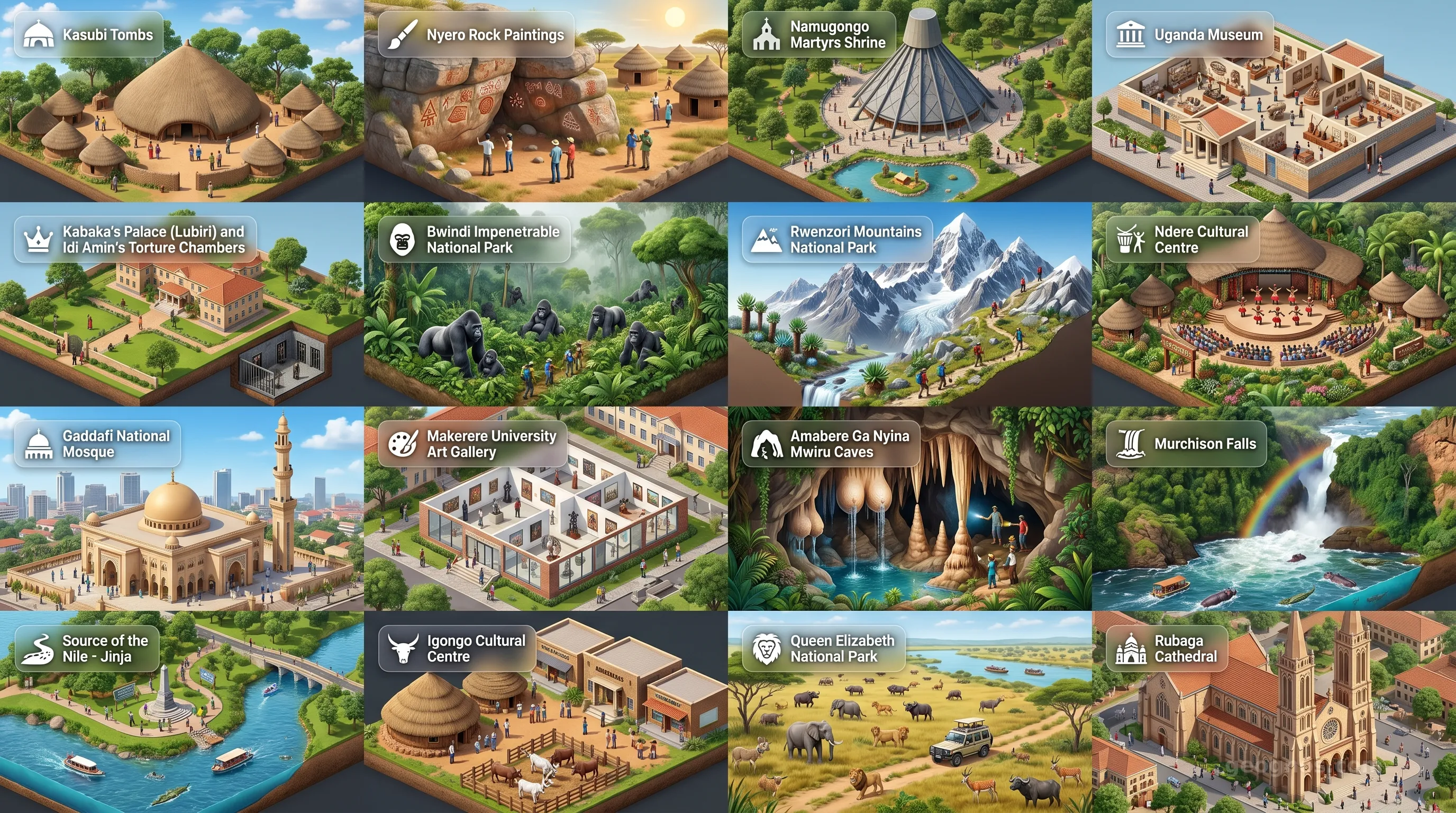
The Kasubi Tombs represent the spiritual and political heart of the Buganda Kingdom, housing the remains of four former Kabakas (kings). This site is essential for students of African history, anthropology, and traditional architecture, as it features a massive dome structure constructed entirely from organic materials like wood, thatch, reed, and wattle. Historically significant as a symbol of Buganda identity, it offers profound insights into pre-colonial African governance. The best time to visit is year-round, though the dry seasons (December-February and June-August) make outdoor exploration easier. Tourist Tip: Visitors must remove their shoes before entering the main tomb (Muzibu-Azaala-Mpanga) and should dress modestly out of respect for this sacred ground.
Ancient Geometric Rock Art
Dating back to the Later Iron Age, the Nyero Rock Paintings comprise three prominent rock shelters adorned with red geometric and abstract art. Attributed to early hunter-gatherer societies (possibly ancestors of the Batwa), it is a vital site for archaeology and anthropology students studying ancient human expression and migration in East Africa. The intricate concentric circles and canoe-like shapes provide a fascinating window into prehistoric cognitive evolution. The dry season (December to March) is the best time to visit, as rain can make the rocky terrain slippery. Tourist Tip: Hire a local guide on-site to fully understand the historical context and the mythical narratives surrounding the site.
Monument to the Ugandan Martyrs
This stunning basilica, built in the shape of a traditional African hut supported by 22 copper pillars, stands on the exact site where 32 young Christian converts were burned alive in 1886 by order of Kabaka Mwanga II. It is an incredibly important location for theology and history students analyzing the intersection of early Christian missionary work and African royal authority. The site exudes a solemn, reflective atmosphere. June 3rd is Uganda Martyrs Day, drawing millions of pilgrims; while historically fascinating, tourists who prefer quiet should avoid this specific date. Tourist Tip: Explore the man-made lake on the grounds, which has profound historical ties to the executioners' cleansing rituals.
East Africa's Oldest Museum
Founded in 1908, the Uganda Museum in Kampala is a treasure trove of the country's cultural, paleontological, and natural history. It is highly recommended for students of ethnography and paleontology, featuring extensive exhibits of traditional musical instruments, hunting equipment, and a fossilized skull of an ancient ape (Ugandapithecus major). The museum traces the country's timeline from the Stone Age to contemporary statehood. It is an excellent year-round indoor destination. Tourist Tip: Do not miss the interactive music gallery where attendants play traditional instruments, and take a stroll through the cultural village outside, which showcases indigenous housing from various Ugandan tribes.
Royal Heritage and Dark Tourism
The Lubiri is the official residence of the King of Buganda, spanning a vast hilltop in Kampala. While the palace itself is a grand historic facade, the grounds house the infamous subterranean torture chambers built by Idi Amin in the 1970s. This juxtaposition makes it a critical site for studying political science, post-colonial African history, and human rights. Walking through the dark, concrete chambers provides a sobering reality of Uganda's turbulent past. The site is accessible year-round. Tourist Tip: Although you cannot enter the main palace building, a guided walking tour of the grounds and chambers is highly educational and emotionally moving; prepare for a heavy, thought-provoking experience.
Sanctuary of the Mountain Gorillas
A biological masterpiece dating back 25,000 years, Bwindi Impenetrable Forest contains nearly half of the world's remaining endangered mountain gorillas. This site is unparalleled for biology, ecology, and primatology students seeking to understand biodiversity and conservation efforts. The dense, mist-covered canopy is also a sanctuary for endemic butterflies and birds. The best seasons for trekking are June to August and December to February, when the trails are drier. Tourist Tip: Gorilla trekking permits must be booked months in advance through the Uganda Wildlife Authority. Wear sturdy hiking boots, gardening gloves (to protect against thorny flora), and waterproof clothing.
The Mystical Mountains of the Moon
Known as the 'Mountains of the Moon', this legendary mountain range features snow-capped peaks, glaciers, and unique alpine flora right near the equator. It is a premier destination for students of geology, geography, and climate science, particularly to observe the retreat of equatorial glaciers. The sheer diversity of vegetation zones—from bamboo forests to alien-looking giant lobelias—is a botanical wonder. Trekking is best done during the dry spells of December-February and June-August. Tourist Tip: Climbing the highest peak, Mount Stanley, requires technical mountaineering skills and a high level of fitness, but lower-elevation day hikes offer incredible botanical and bird-watching experiences for regular tourists.
A Celebration of Ugandan Performing Arts
Ndere Cultural Centre is the vibrant home of traditional Ugandan dance, music, and storytelling. For cultural exchange students and tourists alike, it serves as a dynamic living classroom showcasing the heritage of Uganda's 56+ ethnic tribes. Through high-energy performances, visitors learn about the history, courtship rituals, and agricultural cycles of various tribes. Shows run year-round, primarily on Wednesday, Friday, and Sunday evenings. Tourist Tip: Arrive early to secure a good seat, and enjoy the traditional barbecue dinner served during the performances. The founder's interludes between dances provide brilliant, humorous, and deeply historical context.
Kampala's Crowning Minaret
Officially known as the Uganda National Mosque, this colossal structure sits atop Old Kampala Hill and can accommodate up to 15,000 worshippers. Gifted to Uganda by Colonel Muammar Gaddafi, it is a magnificent example of modern Islamic architecture interwoven with African influences. The mosque is an important site for students of religious studies and modern African socio-politics. Visitors are welcome year-round. Tourist Tip: Climbing the hundreds of steps up the minaret is a must; it rewards you with an unrivaled 360-degree panoramic view of Kampala's original seven hills. Women will be provided with a headscarf and abaya at the entrance.
The Intellectual Heart of East Africa
Housed within Makerere University—one of Africa's oldest and most prestigious universities—the Makerere Art Gallery (Margaret Trowell School of Industrial and Fine Arts) holds an invaluable collection of contemporary East African art. It is a vital study ground for fine arts, post-colonial literature, and political history, showcasing how Ugandan artists documented the country's turbulent socio-political shifts through visual mediums. The campus itself features iconic mid-century educational architecture. Tourist Tip: Combine your gallery visit with a walking tour of the university campus to soak in the academic atmosphere that groomed many African independence leaders.
Caves of Myth and Geology
Located near Fort Portal, these limestone caves are famous for their stunning stalagmites and stalactites, which resemble breasts. According to local Batooro folklore, they are the breasts of Nyinawiru, a legendary princess of the Chwezi dynasty, making this a fascinating site for both geology students and anthropologists studying African mythology. The site perfectly illustrates how local cultures explain geological phenomena through oral history. The best time to visit is during the dry season to avoid slippery trails. Tourist Tip: Follow your cave visit with a hike up the nearby Kyeganywa Hill to view the spectacular explosion crater lakes scattered across the rift valley.
The World's Most Powerful Waterfall
At Murchison Falls, the mighty Victoria Nile is forced through a narrow 7-meter gorge before plunging 43 meters with terrifying power. It is an exceptional location for hydrology and wildlife biology students, as the river subsequently widens into a serene delta teeming with hippos, crocodiles, and elephants. The site holds historical significance tied to early European explorers like Samuel Baker. The dry seasons (December to March) are best for wildlife viewing. Tourist Tip: Take the upstream boat cruise to the base of the falls, then hike the steep trail to the top for a sensory experience of the ground shaking beneath your feet.
Birthplace of the Mighty Nile
Jinja marks the point where the world's longest river begins its epic 6,650-kilometer journey to the Mediterranean Sea. The site is critical for geography students and those studying the history of the 19th-century European quest for the Nile's source, notably involving John Hanning Speke. Today, it represents a vibrant mix of historical colonial significance and modern eco-tourism. The location is excellent to visit year-round. Tourist Tip: Hire a motorized wooden boat to the exact bubbling source where Lake Victoria meets the river, and pair this historical visit with world-class white-water rafting downstream for a thrilling adventure.
Heritage of the Ankole Kingdom
Situated just outside Mbarara, the Igongo Cultural Centre is the ultimate repository for the history and heritage of the peoples of south-western Uganda, particularly the Ankole. For ethnography and cultural studies, its museum ('Eriijukiro') provides a superb, meticulously curated timeline of the region's pastoralist history, royal regalia, and evolutionary social structures. It is accessible year-round. Tourist Tip: It serves as an ideal lunch stopover when traveling to Queen Elizabeth National Park. Be sure to try 'Eshabwe', a traditional Ankole ghee-based delicacy served at the centre's restaurant, and hike up to the nearby Eclipse Monument.
Savanna Majesty and Tree-Climbing Lions
Uganda's most popular savannah reserve, Queen Elizabeth National Park, features a remarkable diversity of ecosystems ranging from crater lakes and open savannahs to the forested Kyambura Gorge. It is a prime study area for ecology, conservation biology, and zoology—most famous for the rare tree-climbing lions in the Ishasha sector. The park is best visited in the dry seasons (January-February and June-July). Tourist Tip: The Kazinga Channel boat cruise is an absolute necessity; it boasts one of the highest concentrations of hippos in the world and offers incredibly close encounters with elephants and over 600 bird species.
The Mother Church of Roman Catholicism in Uganda
Saint Mary's Cathedral Rubaga sits majestically on one of Kampala's original hills. Built in the early 20th century, this twin-towered Romanesque cathedral was constructed on land donated by the King of Buganda to early Catholic missionaries. It is an excellent site for theology and architecture students studying the spread of Catholicism in East Africa and the architectural adaptation of European styles in colonial Africa. The cathedral is open daily. Tourist Tip: Visit the memorial to the first African Catholic bishop, Joseph Kiwanuka, located inside, and enjoy the tranquil gardens which offer a peaceful retreat from Kampala's bustling streets.