🇦🇪

United Arab Emirates
Middle East Countries
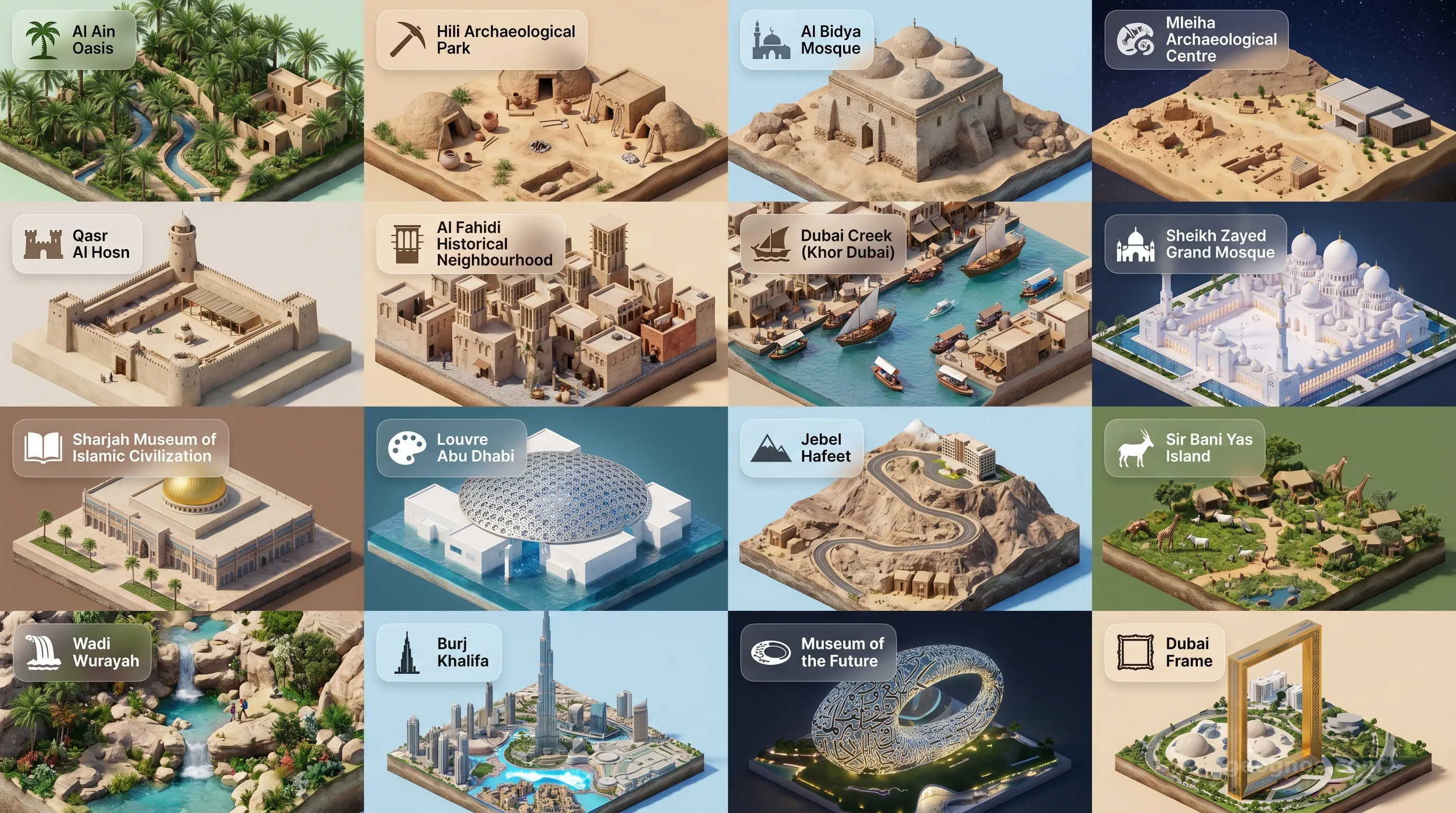
United Arab Emirates - Panoramic Places of Interest Atlas including Al Ain Oasis, Hili Archaeological Park, Al Bidya Mosque, Mleiha Archaeological Centre, Qasr Al Hosn, Al Fahidi Historical Neighbourhood, Dubai Creek (Khor Dubai), Sheikh Zayed Grand Mosque, Sharjah Museum of Islamic Civilization, Louvre Abu Dhabi, Jebel Hafeet, Sir Bani Yas Island, Wadi Wurayah, Burj Khalifa, Museum of the Future, Jebel Jais

Top Sights & Landmarks

01

Al Ain Oasis

Ancient Agricultural Marvel

02

Hili Archaeological Park

Bronze Age Necropolis

03

Al Bidya Mosque

The UAE's Oldest Mosque

04

Mleiha Archaeological Centre

Cradle of Ancient Migration

05

Qasr Al Hosn

Abu Dhabi's Oldest Stone Building

06

Al Fahidi Historical Neighbourhood

19th-Century Wind-Tower Architecture

07

Dubai Creek (Khor Dubai)

Historic Trading Lifeline

08

Sheikh Zayed Grand Mosque

Masterpiece of Modern Islamic Architecture

09

Sharjah Museum of Islamic Civilization

Hub of Islamic Heritage

10

Louvre Abu Dhabi

Universal Museum of Art and History

11

Jebel Hafeet

Craggy Peak and Ancient Tombs

12

Sir Bani Yas Island

Wildlife Sanctuary and Historic Monastery

13

Wadi Wurayah

Biodiverse Mountain Wadi

14

Burj Khalifa

The World's Tallest Building

15

Museum of the Future

Architectural Torus of Innovation

16

Jebel Jais

The UAE's Highest Peak

Background

The Trucial States of the Persian Gulf coast granted the UK control of their defense and foreign affairs in 19th-century treaties. In 1971, six of these states -- Abu Dhabi, 'Ajman, Al Fujayrah, Ash Shariqah, Dubayy, and Umm al Qaywayn -- merged to form the United Arab Emirates (UAE). Ra's al Khaymah joined in 1972. The UAE's per-capita GDP is on par with those of leading West European nations. For more than three decades, oil and global finance drove the UAE's economy. In 2008-09, the confluence of falling oil prices, collapsing real estate prices, and the international banking crisis hit the UAE especially hard. The UAE did not experience the "Arab Spring" unrest seen elsewhere in the Middle East in 2010-11, partly because of the government's multi-year, $1.6-billion infrastructure investment plan for the poorer northern emirates, and its aggressive pursuit of advocates for political reform. The UAE in recent years has played a growing role in regional affairs. In addition to donating billions of dollars in economic aid to help stabilize Egypt, the UAE was one of the first countries to join the Defeat ISIS coalition, and to participate as a key partner in a Saudi-led military campaign in Yemen. In 2020, the UAE and Bahrain signed a peace agreement (the Abraham Accords) with Israel -- brokered by the US -- in Washington, D.C. The UAE and Bahrain thus became the third and fourth Middle Eastern countries, along with Egypt and Jordan, to recognize Israel.

Location

Latitude
24° N
Longitude
54° E
N S W E
World Map Location
Geographic Location

Middle East, bordering the Gulf of Oman and the Persian Gulf, between Oman and Saudi Arabia

Map Reference
Middle East

Area

Total Area
83,600 sq km
Land (100%)
Land: 83,600 sq km
Water: 0 sq km

Elevation

Highest Point
Jabal Bil 'Ays
Jabal Bil 'Ays 1,905 m
Lowest Point
Persian Gulf
Persian Gulf 0 m
Mean Elevation
149 m

Detailed Geography Information

Coastline

1,318 km

Geography - note

strategic location along southern approaches to Strait of Hormuz, a transit point for crude oil; Abu Zaby (Abu Dhabi) and Dubayy (Dubai) together account for over 90% of UAE's area and two-thirds of the population

Irrigated land

940 sq km (2022)

Land boundaries

Total boundary: 1,066 km
Oman 609 km

Maritime claims

territorial sea: 12 nm contiguous zone: 24 nm exclusive economic zone: 200 nm continental shelf: 200 nm or to the edge of the continental margin

Natural hazards

frequent sand and dust storms

Natural resources

petroleumnatural gas

Terrain

flat, barren coastal plain merging into rolling sand dunes of vast desert; mountains in east

Population & Growth

+0.60% Growth
10,093,593
Total inhabitants (2025 est.)
Male: 67.7% (6,831,802) Female: 32.3% (3,261,791)

Age Distribution

0-14 years
16.4%
~1,655,349
15-64 years
81.4%
~8,216,185
65 years
2.2%
~222,059
Note: 2024 est.

Demographic Longevity

Median Age
35.8 years
Male
38.1 yrs
Female
29.8 yrs
Life Expectancy
79.9 years
Male
78.6 yrs
Female
81.4 yrs

Vital Dynamics

Birth Rate
10.65
births per 1,000 people
Death Rate
1.73
deaths per 1,000 people
Net Migration
-2.67
migrants per 1,000 people
Fertility Rate
1.6
children born per woman

Detailed People & Society Information

Alcohol consumption per capita

2.03 liters of pure alcohol (2019 est.)

Currently married women (ages 15-49)

67.4% (2018 est.)

Dependency ratios

total dependency ratio: 23.4 (2025 est.) youth dependency ratio: 20.4 (2025 est.) elderly dependency ratio: 3 (2025 est.) potential support ratio: 33.4 (2025 est.)

Education expenditure

3.9%

3.9% of GDP (2021 est.) 14.8% national budget (2021 est.)

Ethnic groups

Emirati
11.6%
South Asian (includes Indian
59.4%
Bangladeshi
9.5%
Pakistani
9.4%
other
2.3%
Egyptian
10.2%
Filipino
6.1%
other
12.8%

Gross reproduction rate

0.78 (2025 est.)

Health expenditure

5.3%

5.3% of GDP (2021) 12.1% of national budget (2022 est.)

Hospital bed density

2 beds/1,000 population (2021 est.)

Infant mortality rate

total: 4.9 deaths/1,000 live births (2025 est.) male: 5.5 deaths/1,000 live births female: 4.4 deaths/1,000 live births

Languages

Literacy

total population: 98.8% (2024 est.) male: 99% (2024 est.) female: 98.4% (2024 est.)

Major urban areas - population

3.008 million Dubai, 1.831 million Sharjah, 1.567 million ABU DHABI (capital) (2023)

Maternal mortality ratio

3 deaths/100,000 live births (2023 est.)

Nationality

noun: Emirati(s) adjective: Emirati

Obesity - adult prevalence rate

31.7% (2016)

Physician density

2.99 physicians/1,000 population (2023)

Population distribution

population is heavily concentrated to the northeast on the Musandam Peninsula; the three largest emirates -- Abu Dhabi, Dubai, and Sharjah -- are home to nearly 85% of the population

Refugees and internally displaced persons

Total Displaced & Vulnerable Persons
7,634 individuals
Refugees
100.0%
7,634
7,634 (2024 est.)

Religions

Muslim (Sunni
74.5%
Shia
6.7%
other
4.4%
Christian
12.9%
Hindu
6.2%
Buddhist
3.2%
agnostic
1.3%
other
1.9%

School life expectancy (primary to tertiary education)

total: 16 years (2023 est.) male: 15 years (2023 est.) female: 16 years (2023 est.)

Sex ratio

at birth: 1.06 male(s)/female 0-14 years: 1.05 male(s)/female 15-64 years: 2.47 male(s)/female 65 years and over: 3.25 male(s)/female total population: 2.13 male(s)/female (2024 est.)

Tobacco use

total: 10.7% (2025 est.) male: 13.9% (2025 est.) female: 2.4% (2025 est.)

Climate & Issues

Climate Profile

desert; cooler in eastern mountains

Key Environmental Issues
air pollution water scarcity lack of natural freshwater resources land degradation and desertification waste generation, beach pollution from oil spills

Land Cover

Coverage Distribution
Other (90%)
Arable: 0.7%
Crops: 0.6%
Pasture: 4.2%
Forest: 4.6%

Air & Carbon Emissions

Annual CO2 Output 2023 est.
271.703 million
Coal (5%) Oil (46%) Gas (49%)
PM2.5 Exposure 38.9 µg/m³
0 5 (WHO Limit) 15 25 35+
Methane Emissions
energy: 1,573.7 kt (2022-2024 est.)

Water Resources & Use

Renewable Water Resources 150 million cubic meters (2022 est.)
Annual Water Withdrawal
municipal: 2.297 billion cubic meters (2022)
Municipal (48%) Ind (1%) Agri (51%)

Detailed Environmental Information

International environmental agreements

BiodiversityClimate ChangeClimate Change-Kyoto ProtocolClimate Change-Paris AgreementComprehensive Nuclear Test BanDesertificationEndangered SpeciesHazardous WastesMarine Dumping-London ConventionOzone Layer ProtectionShip PollutionWetlands

Urbanization

urban population: 87.8% of total population (2023) rate of urbanization: 1.5% annual rate of change (2020-25 est.)

Waste and recycling

municipal solid waste generated annually: 5.618 million tons (2024 est.) percent of municipal solid waste recycled: 24.5% (2022 est.)

Capital & State Profile

Capital City
Abu Dhabi
24.4667° N, 54.3667° E
Timezone UTC+4
Government Type
federation of monarchies
Independence 1971-12-02
National Holiday 12-02

Executive Branch

Chief of State
President MUHAMMAD BIN ZAYID Al Nuhayyan (since 14 May 2022)
Head of Government
Prime Minister and Co-Vice President MUHAMMAD BIN RASHID Al Maktum (since 5 January 2006)
Last Election unscheduled election held on 14 May 2022, after the death of President KHALIFA bin Zayid Al-Nuhayyan
Next Election 2027
Cabinet Council of Ministers announced by the prime minister and approved by the president

Legislative Branch

unicameral
Legislature Name Federal National Council (Majlis Watani Itihadi)
Seats & Term
40 (20 indirectly elected; 20 appointed) seats / 4 years
Women in Chamber
50% Representation
Electoral System other systems

National Identity & Symbols

National Flag Description

three equal horizontal bands of green (top), white, and black, with a wider vertical red band on the left side

Symbolic Meaning the flag incorporates all four pan-Arab colors, which in this case represent fertility (green), neutrality (white), oil (black), and unity (red); red is a traditional color that was part of all the emirates' flags before their unification
National Symbol golden falcon
National Colors green, white, black, red
National Anthem Nashid al-watani al-imarati (National Anthem of the UAE)

Detailed Government Information

Administrative divisions

7 emirates (imarat, singular - imarah); Abu Zaby (Abu Dhabi), 'Ajman, Al Fujayrah, Ash Shariqah (Sharjah), Dubayy (Dubai), Ra's al Khaymah, Umm al Qaywayn

Citizenship

citizenship by birth: no citizenship by descent only: the father must be a citizen of the United Arab Emirates; if the father is unknown, the mother must be a citizen dual citizenship recognized: no residency requirement for naturalization: 30 years

Constitution

history: previous 1971 (provisional); latest drafted in 1979, became permanent May 1996 amendment process: proposed by the Supreme Council and submitted to the Federal National Council; passage requires at least a two-thirds majority vote of Federal National Council members present and approval of the Supreme Council president

Country name

conventional long form: United Arab Emirates conventional short form: none local long form: Al Imarat al Arabiyah al Muttahidah local short form: none former: Trucial Oman, Trucial States abbreviation: UAE etymology: self-descriptive country name; the name Arabia can be traced back at least as far as the ancient Egyptians, who referred to the region as "Ar Rabi;" "emirates" derives from amir, the Arabic word for "commander," "lord," or "prince;" the former name, Trucial States, refers to a maritime truce from 1820 between the British and the Arab sheikhdoms

International law organization participation

has not submitted an ICJ jurisdiction declaration; non-party state to the ICCt

International organization participation

Judicial branch

highest court(s): Federal Supreme Court (consists of the court president and 4 judges; jurisdiction limited to federal cases) judge selection and term of office: judges appointed by the federal president after approval from the Federal Supreme Council, the highest executive and legislative authority consisting of the 7 emirate rulers; judges serve until retirement age or the expiration of their appointment terms subordinate courts: Federal Court of Cassation (determines the constitutionality of laws); the emirates of Abu Dhabi, Dubai, and Ra's al Khaymah have parallel court systems; the other 4 emirates have incorporated their courts into the federal system note: the Abu Dhabi Global Market Courts and the Dubai International Financial Center Courts, the country’s two largest financial free zones, adjudicate civil and commercial disputes

Legal system

mixed system of Islamic (sharia) law and civil law

National heritage

total World Heritage Sites: 2 ( both cultural) selected World Heritage Site locales: Cultural Sites of Al Ain (Hafit, Hili, Bidaa Bint Saud, and Oases Areas); Faya Palaeolandscape (c)

Political parties

note: political parties are banned; all candidates run as independents

Suffrage

limited note: rulers of the seven emirates each select a proportion of voters for the Federal National Council (FNC) that accounts for about 12 percent of Emirati citizens

Economic Overview

high-income, oil-driven Middle Eastern economy; fastest GDP growth of Gulf states; diversification through tourism, construction, and services; strong foreign direct investment orientation; continued government investment and business-friendly reforms

Size & Performance

Real GDP (PPP)
$745.994 billion
Latest available estimate (2024)
2023: $718.95 billion2022: $693.842 billion
Real GDP Growth
3.8% (2024 est.)
+3.8%
GDP Per Capita (PPP)
$68,600
2023: $68,6002022: $68,900

GDP Sector Breakdown

Agriculture: 0.7%Industry: 47.7%Services: 51.6%
Origin GDP %
Agriculture 0.7%
Industry 47.7%
Services 51.6%

Trade Balance

Trade Position
Trade Surplus
$76.55 billion
Total Exports
$558.402 billion (2023 est.)
Total Imports
$481.852 billion (2023 est.)
Exports (54%) Imports (46%)

Budget Balance

Budget Position
Budget Surplus
+$3.90 billion
Revenues
$23.248 billion (2023 est.)
Expenditures
$19.349 billion (2023 est.)
Revenues (55%) Expenditures (45%)

Export Profile

Top Export Partners

11.0%
11.0%
10.0%
6.0%
Note: 2023; top five export partners based on percentage share of exports

Major Export Commodities

crude petroleumrefined petroleumgoldbroadcasting equipmentnatural gas

Import Profile

Top Import Partners

19.0%
7.0%
6.0%
4.0%
Note: 2023; top five import partners based on percentage share of imports

Major Import Commodities

goldbroadcasting equipmentcarsrefined petroleumdiamonds

Labor & Employment

Total Labor Force 7.09 million (2024 est.)
General Unemployment Rate 2.2%
Youth Unemployment (Ages 15-24) 6.4%

Income Inequality

Gini Coefficient (Family Income) 26.4
0 (Perfect Equality) Low Inequality 100 (Perfect Inequality)

Family Income / Consumption Share

Lowest 10%: 2.8% (2018 est.) Highest 10%: 20.5% (2018 est.)
Inequality Gap: Top 10% holds 7.3x the share of the bottom 10%.

Detailed Economic Data

Agricultural products

datescucumberscamel milkgoat milktomatoeschickengoat meateggsmilkcamel meat

Exchange rates

Emirati dirhams (AED) per US dollar - Exchange rates: 3.672 (2024 est.) 3.672 (2023 est.) 3.672 (2022 est.) 3.672 (2021 est.) 3.672 (2020 est.)

GDP - composition, by end use

Industrial production growth rate

0.8% (2023 est.) note: annual % change in industrial value added based on constant local currency

Industries

petroleum and petrochemicalsfishingaluminumcementfertilizercommercial ship repairconstruction materialshandicraftstextiles

Inflation rate (consumer prices)

1.7% (2024 est.) 1.6% (2023 est.) 5.3% (2022 est.) note: annual % change based on consumer prices

Public debt

19.7% of GDP (2017 est.) note: central government debt as a % of GDP

Reserves of foreign exchange and gold

$237.931 billion (2024 est.) $189.491 billion (2023 est.) $138.433 billion (2022 est.) note: holdings of gold (year-end prices)/foreign exchange/special drawing rights in current dollars

Taxes and other revenues

0.6% (of GDP) (2023 est.) note: central government tax revenue as a % of GDP

Grid Infrastructure

Electricity Access 100%
Capacity 44.462 million kW (2023 est.)
Consumption 157.974 billion kWh (2023 est.)
Exports 613 million kWh (2023 est.)
Imports 501.067 million kWh (2023 est.)
Grid Losses: 7.914 billion kWh (2023 est.)

Generation Mix

Percentage Share of Production
fossil fuels 75.3%
nuclear 19.9%
solar 4.8%

Fossil Fuels Production

Petroleum
Production 4.146 million bbl/day (2023 est.)
Consumption 846,000 bbl/day (2023 est.)
Proven Reserves 97.8 billion barrels (2021 est.)
Natural Gas
Production 55.8 billion cubic meters (2023 est.)
Consumption 67.734 billion cubic meters (2023 est.)
Exports 6.863 billion cubic meters (2023 est.)
Imports 18.938 billion cubic meters (2023 est.)
Proven Reserves 6.091 trillion cubic meters (2021 est.)
Coal
Consumption 5.411 million metric tons (2023 est.)
Exports 82,000 metric tons (2023 est.)
Imports 5.512 million metric tons (2023 est.)

Intensity & Nuclear

Energy Consumption Per Capita 450.432 million Btu/person (2023 est.)
Nuclear Power Profile
Operational Reactors 5.35GW (2025 est.)
Total Power Share 19.7% (2023 est.)

Digital Access

.ae
Internet Usage 100%

Active internet users as a percentage of the total population.

Fixed Broadband

Penetration Rate 37 / 100
Total Subscriptions 3.95 million (2023 est.)

Mobile Cellular

Penetration Rate 203 / 100
Total Subscriptions 22.4 million (2024 est.)

Broadcast Media

most TV and radio stations state-owned, but many private organizations now operating in media free zones in Abu Dhabi and Dubai; widespread use of satellite dishes to access pan-Arab and other international broadcasts (2022)

Aviation

A6
Airports
42
As of 2025
Heliports
204
As of 2025

Ports & Harbors

Ports Count 20
Hover for breakdown & key ports As of 2024

Merchant Marine

Commercial Fleet
655 ships
Hover for vessel types breakdown As of 2023

Military Expenditures

GDP Allocation 4%
4% of GDP (2024 est.) 4.3% of GDP (2023 est.) 4% of GDP (2022 est.) 4.5% of GDP (2021 est.) 6.1% of GDP (2020 est.)

Active Duty Strengths

approximately 65,000 active Armed Forces (45,000 Land Forces; 3,000 Navy; 5,000 Air Force; 12,000 Presidential Guard) (2025)

Refers to active military personnel.

Service & Defense Details

Military and security forces

United Arab Emirates Armed Forces: Land Forces (Army), Navy, Air Force, Presidential Guard (includes special operations forces), National Guard (includes Coast Guard) (2025) note: each emirate maintains a local police force called a general directorate, which is officially a branch of the federal Ministry of Interior; all emirate-level general directorates of police enforce their respective emirate’s laws autonomously; they also enforce federal laws within their emirate in coordination with one another under the federal ministry; the State Security Directorate (SSD) in Abu Dhabi and Dubai State Security (DSS) have primary responsibility for counterterrorism law enforcement efforts; local, emirate-level police forces, especially the Abu Dhabi Police and Dubai Police, are the first responders in such cases and provide technical assistance to SSD and DSS

Military deployments

maintains a few hundred troops in Somalia and Yemen (2025)

Military equipment inventories and acquisitions

the military is equipped with mostly modern imported armaments, and a smaller amount of domestically produced weapons; foreign suppliers have included China, France, Germany, Israel, Italy, Russia, South Africa, South Korea, Türkiye, and the US; the UAE's domestic defense industry produces or co-produces such items as armored vehicles, naval vessels, precision munitions, and unmanned aerial vehicles/drones for both internal use and export (2025)

Military - note

the UAE Armed Forces (UAEAF) are responsible for defending the state, its resources, and territory, preserving internal security, and supporting the UAE's foreign policy objectives; key security concerns include regional stability and cross-border threats, such as piracy and terrorism; in recent years, the UAE has undertaken a military modernization program to go along with an assertive security policy which has included military involvements in Afghanistan, Libya, Somalia, Syria, and Yemen the UAE has close security ties to France and the US; it hosts a multi-service French military base, which includes the French naval command for the Indian Ocean (ALINDIEN); the UAE has a defense cooperation agreement with the US and hosts thousands of US military troops, mostly air and naval personnel; it also has defense ties with a number of other countries, including Australia, China, Egypt, Israel, Jordan, Malaysia, South Korea, and the UK, as well as NATO and fellow members of the Gulf Cooperation Council, particularly Saudi Arabia the UAEAF traces its origins to the establishment of the Trucial Oman Scouts in 1951, a joint UK-Abu Dhabi organization modeled after Jordan’s Arab Legion, which became the Abu Dhabi Defense Force in 1965; the modern UAEAF were formed in 1976 (2025)

Military service age and obligation

18-40 for voluntary service; 18-30 years of age for compulsory national service for men with a 36-month service obligation for those without a secondary education and 11 months for secondary school graduates; women may volunteer for national service (11-month service obligation regardless of education) (2025) note 1: compulsory service may be completed in the uniformed military, the Ministry of Interior, or other security institutions designated by the military leadership note 2: the UAE military employs a considerable number of foreign personnel on contracted service

Space Agency

UAE Space Agency (created in 2014); Mohammed bin Rashid Space Centre (MBRSC; established 2006) (2025)

Program Overview

has an ambitious and growing national space program; focused on satellite development, including communications, remote sensing, and navigation, as well as deep space exploration; is building expertise, infrastructure, technology, and research and development capabilities; has elected to use foreign partners to launch payloads from spaceports abroad; has looked to invest in foreign commercial space companies and develop global partnerships; has a foreign-assisted astronaut training program; seeking to establish UAE as an international hub for space education; founding member of the Arab Space Cooperation Group; works with major global and regional players, including China, Egypt, the ESA, France, Germany, India, Japan, Russia, South Korea, Turkey, the UK, and the US; sees its commercial space industry as a key to diversifying and developing the country’s non-oil economy; dozens of space companies operate in the UAE, including international and start-ups, plus several space-science research centers (2025)

Program Milestones

1997 initiated a national space sector
2009 first remote sensing (RS) satellite (DubaiSat-1) developed jointly with South Korea and launched by Russia
2017 announced Mars 2117 project, which included building a “Mars Science City” as the first step to establishing a human settlement on Mars within 100 years
2018 first domestically produced RS satellite (KhalifaSat or DubaiSat-3) launched by Japan
2019 first UAE astronaut (trained by Russia and US) in space on the International Space Station
2020 signed US-led Artemis Accords for space and lunar exploration
2021 became first Arab country to successfully place a probe (al Amal or Hope) in Mars orbit; announced plans to launch a probe in 2028 to land on an asteroid between Mars and Jupiter
2025 domestically produced advanced RS/Earth imaging satellite (MBZ-SAT) launched by US