Saudi Arabia
Top Sights & Landmarks
The Holiest Site in Islam
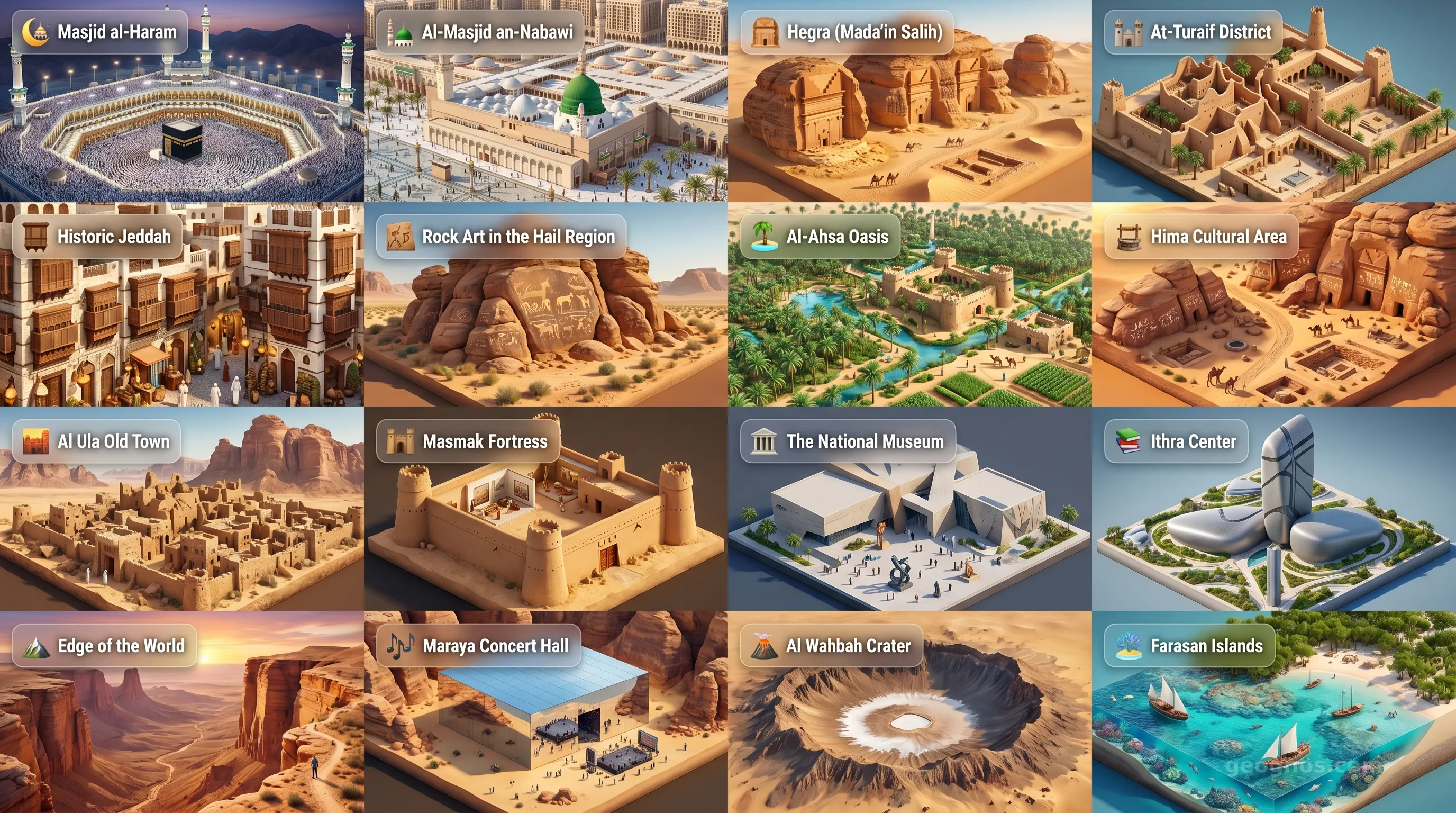
Enveloping the Kaaba, Masjid al-Haram holds the highest historical and cultural importance in the Islamic world. It is a vital subject of study for Islamic theology, history, and monumental architectural engineering. While the city of Makkah is strictly restricted to Muslims, its continuous expansions over centuries make it an incredible focus for urban development studies. For Muslim pilgrims, the best season to visit is during the cooler months of November to March. Tourist tip: Non-Muslims cannot enter Makkah, but students of history can explore its legacy in national museums across Saudi Arabia; pilgrims should prepare for massive crowds during Hajj and Ramadan.
The Prophet's Resting Place
Located in Medina, this is the second-holiest site in Islam, established by the Prophet Muhammad. Its historical significance is unparalleled, serving as the socio-political center of early Islam. Scholars study its architectural evolution, from a simple palm-trunk structure to a sprawling complex with mechanized sliding domes and iconic green umbrellas. The best time to visit is winter (December to February). Tourist tip: While the mosque's central areas and the Prophet's tomb are restricted to Muslims, the city of Medina has recently opened many of its outer areas and historic sites to non-Muslim tourists.
Ancient Nabataean Necropolis
Hegra is Saudi Arabia's first UNESCO World Heritage site, boasting over 110 remarkably preserved monumental tombs with elaborate facades carved directly into sandstone outcrops. Historically, it was the southern capital of the Nabataean Kingdom, making it an essential site for studying ancient trade routes and pre-Islamic Arabian history. The best season to visit is between October and March to avoid extreme desert heat. Tourist tip: Book a guided 'Rawi' (storyteller) tour well in advance, and visit at sunrise or sunset for the most dramatic lighting on the tombs.
Birthplace of the Saudi State
Founded in the 15th century, At-Turaif was the original seat of power of the Al Saud family and the capital of the First Saudi State. It is crucial for studying Najdi architectural style, characterized by mud-brick structures adapted to the harsh desert environment, and the political unification of the Arabian Peninsula. The cooler months from November to March are ideal for a visit. Tourist tip: The site has been beautifully restored into an open-air museum with immersive digital projections at night; combine your visit with a meal at the adjacent Bujairi Terrace.
The Gateway to Makkah
Al-Balad is the historic center of Jeddah, established in the 7th century as a major port for Indian Ocean trade routes and the gateway for Muslim pilgrims arriving by sea. It is a masterpiece of Red Sea architectural tradition, famous for its towering coral stone houses adorned with intricate wooden latticework balconies (roshans). It is a fantastic place to study cultural integration through historical trade. The best time to visit is winter. Tourist tip: Wander through the alleyways in the late afternoon, sip traditional mint tea at a local historic cafe, and don't miss the Naseef House.
Prehistoric Desert Petroglyphs
Comprising the sites of Jabel Umm Sinman at Jubbah and the Jabal al-Manjor at Shuwaymis, this area holds some of the most prominent rock art in the Middle East. It is a vital site for studying the environmental shifts of the Arabian Peninsula, showing how ancient populations hunted and lived when the region was a lush savannah 10,000 years ago. The best time to explore is from October to April. Tourist tip: The locations are remote and require a 4x4 vehicle; hiring a local guide is highly recommended to easily locate and interpret the detailed carvings of humans and extinct fauna.
The World's Largest Oasis
With over 2.5 million date palms, Al-Ahsa is a breathtaking manifestation of human settlement in the desert, continuously inhabited since the Neolithic period. It offers deep insights into ancient agricultural techniques, traditional water management (aflaj systems), and Gulf history. The best season for visiting is from December to February. Tourist tip: Climb the Al Qarah Mountain for spectacular panoramic views of the palm canopies and explore its naturally cool, winding limestone caves, which offer relief from the sun.
Ancient Caravan Waystation
Located in arid southwestern Saudi Arabia, Hima was a major conduit for the ancient incense trade routes. The site is a library of rock art and inscriptions spanning 7,000 years, written in scripts like Musnad, Aramaic-Nabatean, South-Arabian, and early Arabic. It is a prime location for epigraphy and linguistic studies. The weather is best between November and March. Tourist tip: Take time to visit the ancient Bi'r Hima wells, which were dug thousands of years ago and still produce fresh water today.
Labyrinth of Mudbrick Heritage
Inhabited from the 12th century until the 1980s, Al Ula Old Town consists of nearly 900 tightly packed mud-brick houses and 400 shops built along the ancient pilgrimage and spice trade routes. It provides incredible study material on medieval Islamic urban planning and communal desert living. Best visited from October to April. Tourist tip: Stroll down the revitalized Incense Road market area for local crafts and dining, and be sure to hike up to the Musa bin Nusayr Fort for a commanding view of the oasis.
The Citadel of Riyadh
Built in 1865, this clay and mud-brick fort played a pivotal role in the unification of Saudi Arabia when King Abdulaziz captured it in 1902. Today, it stands as a museum of Saudi history and a quintessential example of traditional Najd military architecture. It is an excellent educational stop for modern Middle Eastern political history. Visit during the cooler months from November to March. Tourist tip: Examine the original wooden gate where the tip of a spear from the 1902 battle remains lodged in the door.
A Journey Through Arabian Time
Located in the King Abdulaziz Historical Centre in Riyadh, this state-of-the-art museum offers a comprehensive journey through the history of the Arabian Peninsula, from the universe's creation to the modern Saudi state. It is the best starting point for students and tourists wanting a holistic cultural, historical, and geological overview of the country. It is an indoor attraction suitable for year-round visits. Tourist tip: Allocate at least 3-4 hours to properly experience the eight expansive galleries, and enjoy the beautifully landscaped gardens outside.
Architectural Marvel of Knowledge
Situated in Dhahran, where commercial oil was first discovered in Saudi Arabia, Ithra is a striking, futuristic structure designed to resemble Zen stones. It functions as a cultural hub, housing a library, theater, museum, and galleries. It is highly worth studying for its modern architectural engineering and its role in Saudi Arabia's post-oil cultural renaissance. Visit year-round. Tourist tip: Check their event calendar in advance for international art exhibitions, film screenings, and interactive workshops.
Dramatic Desert Escarpment
Part of the massive 1,000-kilometer Tuwaiq Escarpment, the Edge of the World provides breathtaking, uninterrupted views of the desert plains below. Historically, these cliffs overlooked ancient trade routes. It is a fantastic site for geologists studying tectonic uplifts and Jurassic-era marine fossils found in the desert rock. The best season is autumn and winter (October to March). Tourist tip: Access requires a rugged 4x4 vehicle. Travel in a convoy, carry plenty of water, and leave before sunset to safely navigate the desert tracks in daylight.
The World's Largest Mirrored Building
Set against the stunning desert landscape of Ashar Valley in Al Ula, Maraya is a structural masterpiece entirely covered in mirrors. It perfectly reflects the surrounding sandstone cliffs, making it a unique study of how modern architecture can harmoniously blend with nature. Best visited between October and April. Tourist tip: Even if you are not attending a concert, book a reservation at the rooftop restaurant to gain access to the building and enjoy the spectacular sunset reflections.
Volcanic Wonder with a Salt Heart
Measuring 2 kilometers across and 250 meters deep, the Al Wahbah Crater is a massive volcanic maar crater featuring a blindingly white sodium phosphate salt pan at its center. It is a premier site for studying volcanology and geological formations in the Arabian shield. The best time to visit is during the winter months, as summer temperatures are dangerously high. Tourist tip: The hike down to the crater floor takes about 45 minutes but the ascent is steep and strenuous; attempt it only early in the morning and carry abundant water.
Pristine Red Sea Archipelago
An archipelago of over 170 islands in the southern Red Sea, Farasan is renowned for its incredible marine biodiversity, mangrove forests, and pristine coral reefs. Historically, it was a hub for pearl diving and features an old Ottoman fort. It is perfect for marine biology studies and eco-tourism. The best time to visit is from November to March. Tourist tip: Take the free government ferry from Jizan (book well in advance) and hire a local boat to spot the rare Farasan gazelle and swim in crystal-clear waters.