Yemen
Top Sights & Landmarks
Ancient Rammed-Earth Metropolis
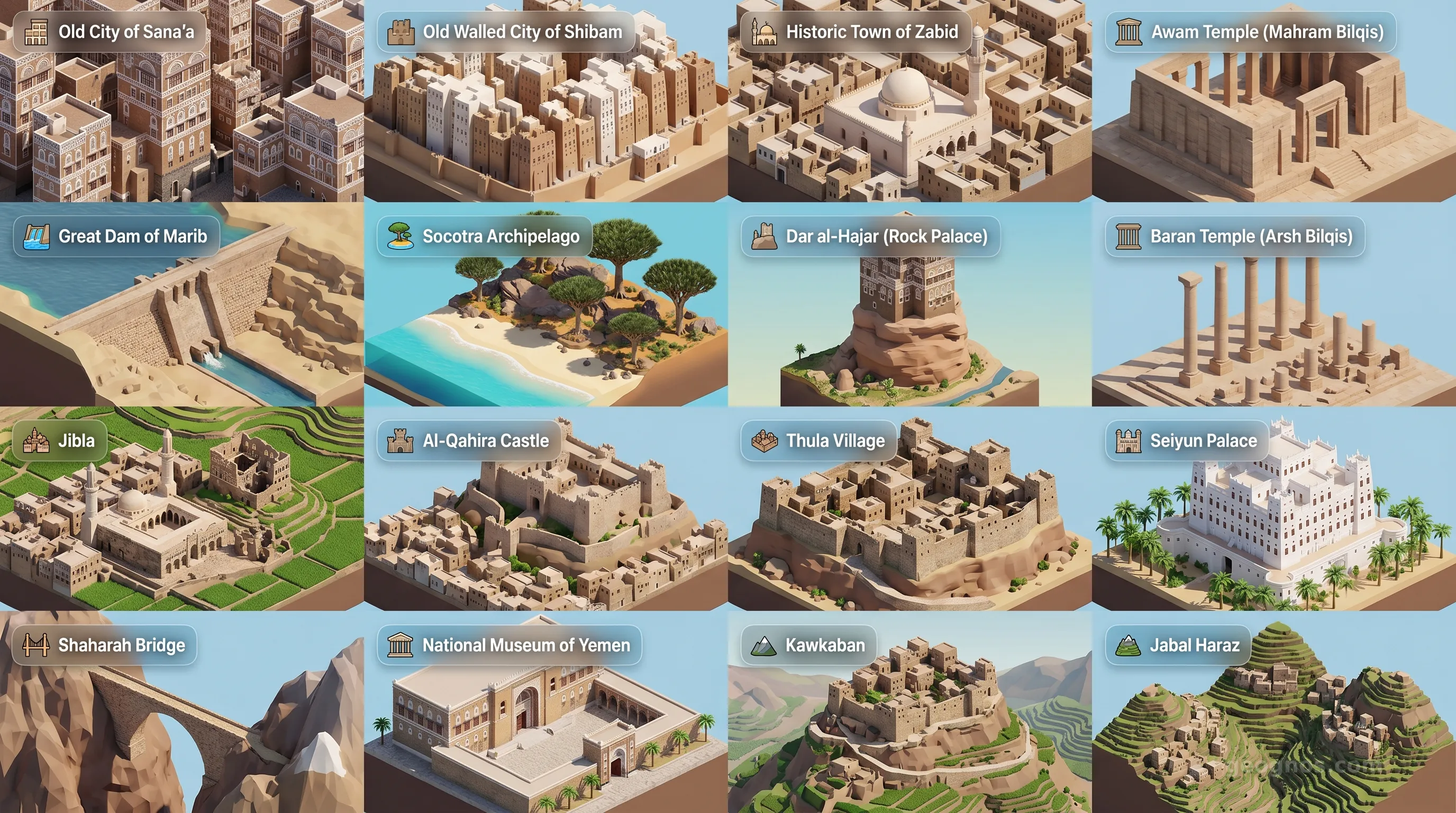
Inhabited for more than 2,500 years, the Old City of Sana'a is a breathtaking living museum. Students of architecture and history will be mesmerized by its unique multi-story rammed-earth tower houses, adorned with intricate geometric gypsum patterns and stained-glass fanlights (qamariyahs). It became a major Islamic center in the 7th and 8th centuries. The best season to visit is from October to April when the weather is mild. Tourist tip: Wander through the ancient Souq al-Milh to experience a traditional Arabian market, but always stay updated on local security advisories before traveling.
The Manhattan of the Desert
Shibam is an extraordinary testament to ancient urban planning, famously dubbed the 'Manhattan of the Desert.' Rising out of the Hadhramaut Valley cliff, this 16th-century walled city consists of towering mudbrick skyscrapers, some up to seven stories high, built to protect inhabitants from Bedouin attacks. It offers an unparalleled case study in sustainable, traditional high-rise architecture. The ideal time to visit is during the cooler months from November to February. Tourist tip: Hike up to the nearby southern hills just before dusk for a spectacular panoramic view of the sun setting against the mudbrick facades.
Cradle of Islamic Scholarship
Zabid was Yemen's capital from the 13th to the 15th century and is globally significant for its historic Islamic university. It played a paramount role in the spread of Islamic sciences and mathematics—it is even claimed that algebra was invented here by Al-Khwarizmi. Architectural students will appreciate its unique domestic and military brick architecture. The best season for a visit is winter, as the Tihamah coastal plain is extremely hot in summer. Tourist tip: Take time to study the intricate, highly decorated brickwork of the local mosques and traditional courtyard houses.
Sanctuary of the Sabaean Kingdom
The Awam Temple, dedicated to the Sabaean moon god Almaqah, is one of the most vital archaeological sites in the Arabian Peninsula. Dating back to the 1st millennium BC, it is deeply associated with the legendary Queen of Sheba (Bilqis). For students of antiquity, the massive limestone enclosures and ancient South Arabian inscriptions provide invaluable insights into pre-Islamic trade and religion. Winter is the best season to explore Marib's desert climate. Tourist tip: Access to Marib requires strict security clearances; coordinate with verified local guides and authorities.
Engineering Marvel of Antiquity
The Great Dam of Marib is considered one of the engineering wonders of the ancient world. Originally constructed around the 8th century BC, it sustained the wealthy Sabaean civilization by turning the desert into a lush oasis. Its catastrophic collapse in the 6th century AD triggered the legendary mass migration of Arab tribes. Students of hydrology and ancient history will find the surviving monumental sluice gates fascinating. Winter is the best time to visit. Tourist tip: View both the ancient ruins and the modern dam built nearby in the 1980s to understand the continuous reliance on water management in the region.
The Galapagos of the Indian Ocean
An isolated paradise of immense ecological and historical value, Socotra is home to over 700 endemic species of flora and fauna, most famously the umbrella-like Dragon's Blood Tree. Historically, it was a crucial stopover on the ancient Indian Ocean trade routes, yielding frankincense and aloe. Biologists and nature lovers consider it a masterclass in island biogeography. The best season to visit is from October to April, avoiding the fierce monsoon winds. Tourist tip: Eco-tourism is the primary way to visit; tread lightly, respect the delicate ecosystem, and camp under the stars.
Iconic Palace Atop a Rock
Perched dramatically on a tall natural rock spire in Wadi Dhar, Dar al-Hajar is the iconic symbol of Yemen. Built in the 1930s by Imam Yahya as a summer residence on top of an older structure, it exemplifies traditional Yemeni architecture. Students of structural design will marvel at how the building seamlessly integrates with the natural geological formation. It is pleasant to visit year-round due to the valley's mild climate. Tourist tip: Explore the labyrinthine interior, which features ancient cooling systems, hidden staircases, and stunning stained-glass windows.
The Throne of Bilqis
Known locally as the 'Throne of Bilqis', the Baran Temple is another monumental Sabaean sanctuary in Marib. Its most striking feature is the six towering limestone monolithic pillars that rise dramatically from the desert sands. It offers exceptional opportunities for archaeological study of pre-Islamic ceremonial complexes and architectural proportions. Visit during the winter months for comfortable exploration. Tourist tip: The temple is most visually striking in the early morning light, which highlights the ancient inscriptions carved into the stone.
Capital of the Queen Arwa
Jibla is an enchanting historical town that served as the capital of the Sulayhid dynasty in the 11th and 12th centuries under the remarkable Queen Arwa al-Sulayhi. The town is built on basalt rocks and features winding streets and tall stone houses. Historians and feminists alike study Queen Arwa's progressive reign, a rarity in medieval history. The climate is temperate and ideal for visiting between October and April. Tourist tip: Visit the Queen Arwa Mosque, which she commissioned and where her beautifully inscribed tomb remains a site of reverence.
Fortress Overlooking Taiz
Dominating the skyline of Taiz, Al-Qahira (Cairo) Castle is an imposing historic fortress on the northern slope of Mount Sabir. Originating during the Sulayhid era and expanded by the Rasulids, it has been a seat of power, a prison, and a military stronghold. It is a vital site for studying Yemen's medieval military architecture and political history. The best time to visit is during the winter. Tourist tip: After exploring the restored gardens and ramparts, enjoy the unmatched, sweeping panoramic views of Taiz city from the uppermost towers.
Preserved Stone Fortress Town
Thula is one of Yemen's most beautifully preserved historic towns, enclosed by ancient walls and situated at the base of a pink sandstone cliff. Dating back to the Himyarite period, its tightly packed, multi-story stone houses and paved alleys offer a masterclass in highland defensive architecture and community planning. The weather is best in Spring and Autumn. Tourist tip: Walk the complete circuit of the ancient defensive walls and observe the ancient Himyarite cisterns still in use today.
The Sultan's Mudbrick Marvel
Located in the heart of the Hadhramaut Valley, Seiyun Palace is one of the world's largest mudbrick structures. Originally a fort, it was transformed into the majestic residence of the Kathiri sultans in the 1920s. Today, it functions as a museum detailing the region's rich history, customs, and ancient trade routes. It is a fantastic site to study Hadhrami cultural evolution. Visit between November and February to escape the severe summer heat. Tourist tip: Do not miss the early photography collection on the upper floors, which captures the valley's history over the past century.
A Leap Across the Abyss
Built in the 17th century by a local architect to connect two mountainous villages, the Shaharah Bridge is a breathtaking limestone arch suspended 200 meters above a deep gorge. It was constructed to withstand Ottoman invasions, serving as a strategic chokepoint. Engineering students will find its gravity-defying construction without modern machinery awe-inspiring. October to April offers the clearest skies. Tourist tip: Reaching Shaharah requires a rugged 4x4 journey up steep, winding mountain paths, so hire an experienced local driver.
Custodian of Yemeni Antiquity
Situated in Sana'a within Dar al-Saada (Palace of Happiness), a former royal residence, the National Museum is the definitive repository of Yemen's heritage. Its collections span from ancient South Arabian kingdoms (Sabaean, Minaean, Himyarite) to the Islamic era and traditional folklore. For academics and history enthusiasts, the array of bronze statues and inscribed stelae is unparalleled. It can be visited year-round. Tourist tip: Museum hours can be highly irregular due to the current climate; always verify opening times with local contacts in advance.
Fortress in the Clouds
Perched on a sheer cliff at an altitude of 2,800 meters, Kawkaban is a fortified city that historically served as an impregnable refuge for Yemen's imams during Ottoman invasions. The town's historic mosques, ancient cisterns, and red stone houses are remarkable. It offers students of military history a vivid example of natural topography utilized for defense. Summer and Autumn offer spectacular dramatic clouds around the plateau. Tourist tip: Hike the ancient, steep stone pathway from the lower town of Shibam Kawkaban for a truly rewarding physical and historical experience.
Terraced Mountains and Ismaili Heritage
The Haraz Mountains boast some of the most spectacular mountainous landscapes in the Arabian Peninsula, characterized by steeply terraced slopes carved for coffee and qat cultivation. It is the cultural heartland of the Ismaili sect, featuring fortress-like villages like Al Hajjarah built directly onto rocky outcrops. It offers a prime study of sustainable mountain agriculture and sectarian history. Spring is vibrant and green. Tourist tip: Visit the village of Al Hajjarah to see multi-story stone houses that appear to grow organically out of the cliffs.