Qatar
Top Sights & Landmarks
Qatar's First UNESCO World Heritage Site
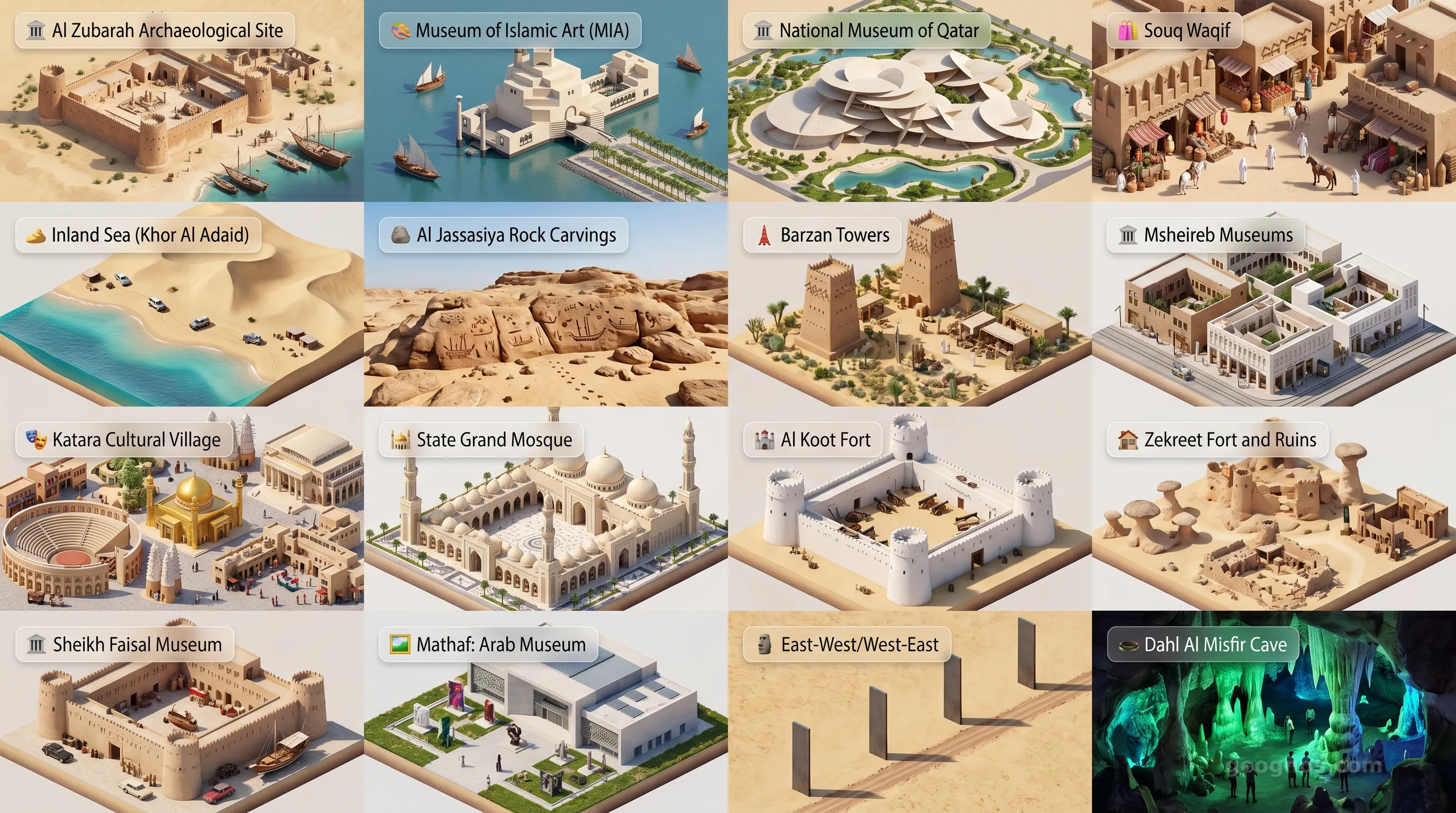
Once a thriving pearl fishing and trading port in the 18th and 19th centuries, Al Zubarah is now the most substantial archaeological site in Qatar. It offers students and tourists an unparalleled glimpse into the urban history, traditional architecture, and socioeconomic dynamics of the pre-oil Gulf region. The site features the remains of palaces, mosques, streets, and courtyard houses, guarded by the iconic Al Zubarah Fort. Best season to visit is during the cooler winter months (November to March). Tourist tip: The site is highly exposed to the sun; bring plenty of water, wear sunscreen, and book a guided tour to fully appreciate the historical context of the ruins.
Masterpiece of Islamic Art and Architecture
Designed by Pritzker Prize-winning architect I.M. Pei, the MIA stands on a purpose-built island off the Corniche. It houses a magnificent collection of Islamic art spanning 1,400 years and three continents. For students of art, history, and architecture, it is an invaluable educational resource showcasing textiles, ceramics, glass, and manuscripts from the Islamic world. The building itself is culturally significant, drawing inspiration from the Ibn Tulun Mosque in Cairo. Best visited year-round as it is indoors. Tourist tip: Visit in the late afternoon to enjoy the galleries, then step out into the adjacent MIA Park to watch a spectacular sunset over the Doha skyline.
The Desert Rose Unveiled
Architect Jean Nouvel designed this visually striking museum inspired by the naturally occurring desert rose crystal. The museum tells the comprehensive story of Qatar from its geological formation to its modern era, making it an essential stop for anyone wanting to understand Qatari heritage and culture. Interactive exhibits and oral histories provide a deep educational dive into Bedouin life and the pearling industry. Best season to visit is year-round. Tourist tip: Allocate at least 3-4 hours for your visit, and do not miss the beautifully restored palace of Sheikh Abdullah bin Jassim Al Thani located in the museum's central courtyard.
The Traditional Qatari Market
Built on the site of Doha's century-old trading market, Souq Waqif was meticulously restored to preserve traditional Qatari architectural techniques using mud-rendered walls and exposed timber beams. It is the beating cultural heart of Doha, perfect for studying traditional commerce and social gatherings in the Arab world. Visitors can explore labyrinthine alleys filled with spices, textiles, handicrafts, and falcons. The best season to visit is between November and April. Tourist tip: The Souq truly comes alive after sunset. Arrive around 6 PM to enjoy dinner, traditional tea, and the vibrant, bustling atmosphere.
Where the Desert Meets the Sea
Khor Al Adaid is a rare and stunning natural phenomenon where the Arabian Gulf encroaches deep into the heart of the desert, creating a tidal embayment surrounded by massive sand dunes. Recognized as a UNESCO natural reserve, it holds immense ecological and geological significance, boasting unique flora and fauna, including turtles and dugongs. It is a prime location for environmental studies and geographical research. Best visited between November and April. Tourist tip: The area is completely inaccessible by road; you must book a 4x4 desert safari with an experienced driver to navigate the towering dunes safely.
Ancient Petroglyphs of Qatar
Discovered in 1957, Al Jassasiya is Qatar’s most impressive and extensive rock-carving site, featuring nearly 900 petroglyphs spread out across a limestone quarry. Students of archaeology and ancient history will be fascinated by the intricate carvings of cup marks, rosettes, dhow ships, and footprints, some dating back to the Neolithic period. These carvings provide cryptic clues about the daily lives and pastimes of the early inhabitants of the peninsula. Best visited in winter. Tourist tip: Since the carvings can be hard to spot in bright midday sunlight, it is best to visit in the early morning or late afternoon when shadows add depth to the petroglyphs.
Historic Watchtowers of Umm Salal
Constructed in the late 19th and early 20th centuries by Sheikh Mohammed bin Jassim Al Thani, the Barzan Towers were built to serve as watchtowers to protect local water sources and track the lunar calendar. Towering at 16 meters high, their unique T-shape and traditional coral-rock-and-limestone construction make them a prime subject for architectural study. They offer immense historical insight into Qatar's defense and observation strategies prior to modern urbanization. Best visited from November to March. Tourist tip: Climb to the top of the towers to enjoy sweeping views of the surrounding landscape, and check opening hours as they can occasionally close for maintenance.
Echoes of Old Doha
Situated in Msheireb Downtown Doha, this complex comprises four restored historic heritage houses: Bin Jalmood House, Company House, Mohammed Bin Jassim House, and Radwani House. Together, they document Qatar's rapid transformation from a pearling and fishing village to a modern metropolis, while tackling profound subjects like the global history of slavery (Bin Jalmood House). This is a premier educational destination for sociologists, historians, and culture enthusiasts. Visit year-round. Tourist tip: Download the Msheireb Museums app for an interactive audio guide, and allocate at least half a day to fully absorb the wealth of information provided.
A Beacon of Art and Heritage
Katara was purposefully built to reflect Qatar's cultural heritage while promoting international art, theater, and literature. Its impressive architecture includes a stunning open-air amphitheater overlooking the sea, two magnificent mosques (one adorned with blue and gold tiles, the other a pigeon tower style), and numerous art galleries. It is a fantastic study ground for contemporary Arab culture and Islamic architecture. Best visited from October to April. Tourist tip: Check Katara's event schedule before visiting; the village frequently hosts free international art exhibitions, traditional music performances, and culinary festivals.
Qatar's Largest Place of Worship
Reflecting traditional Islamic architectural principles and local Qatari design, the State Grand Mosque is a colossal and awe-inspiring structure capable of holding over 30,000 worshippers. Its stark, imposing exterior features 93 domes and preserves the aesthetic of older Qatari forts, providing architectural students a perfect example of traditional design scaled to monumental modern proportions. Open year-round. Tourist tip: Non-Muslims are welcome to visit during non-prayer times. Modest dress is strictly required, and traditional garments are available to borrow at the entrance.
The 19th Century Military Fort
Located adjacent to Souq Waqif, Al Koot Fort (Doha Fort) was built in 1880 during the Ottoman period. Originally serving as a police station and later as a prison, it stands today as an important symbol of early Doha's military and civil administration. Its robust square layout, thick walls, and traditional crenellations offer historians and architects a textbook example of Gulf military architecture. Best visited from October to April. Tourist tip: It is exceptionally photogenic at night when lit up against the backdrop of the traditional souq and modern city.
18th-Century Desert Settlement
The Zekreet Fort ruins lie on the rugged west coast of Qatar and date back to the late 18th or early 19th century. Built uniquely without towers in its initial phase, it offers archaeological insight into historical Gulf coastal defense and tribal settlements. The surrounding area is famous for its haunting, mushroom-shaped limestone rock formations carved by wind erosion. Best visited in winter. Tourist tip: Combine a trip here with a visit to the nearby Film City and Richard Serra's desert sculpture. A 4x4 vehicle is highly recommended to traverse the rocky terrain.
A Personal Collection of Global Heritage
Located in a traditional Qatari fort on a sprawling farm, this private museum houses an astonishing collection of over 15,000 artifacts compiled by Sheikh Faisal. Spanning Islamic art, classic cars, rare coins, and Qatari heritage pieces, it is an eclectic treasure trove for students of history and anthropology. The museum highlights the personal passion of a prominent Qatari figure and the history of global trade. Visit year-round. Tourist tip: It is located about 20km west of Doha, so arrange reliable transportation. The sheer volume of items requires at least a 2-hour visit.
A Hub for Contemporary Arab Art
Situated in Education City, Mathaf offers an unparalleled perspective on modern and contemporary art from the Arab world and its diaspora. With a collection of over 9,000 works spanning the 1840s to the present, it is an essential site for art students and cultural scholars aiming to understand the modern Arab identity, sociopolitical narratives, and artistic evolution. Visit year-round. Tourist tip: Take advantage of the free Mathaf bus that shuttles visitors between the Museum of Islamic Art and Mathaf, making it easy to see both in one day.
Monumental Desert Art
Conceived by world-renowned sculptor Richard Serra, this breathtaking art installation consists of four towering steel plates spanning over a kilometer in the Brouq Nature Reserve. It represents a profound dialogue between modern art and the ancient desert landscape, making it a spectacular case study for art and design students. The changing color of the steel as it rusts in the harsh desert environment reflects the passage of time. Best visited in winter. Tourist tip: Visit at dawn or sunset; the interplay of long shadows against the limestone cliffs and steel plates is a photographer’s dream.
Phosphorescent Gypsum Cave
Dahl Al Misfir is one of Qatar's most accessible natural sinkholes, dropping roughly 40 meters deep into the earth. It is a geological marvel known for the fibrous gypsum crystals that line its walls, which occasionally give off a faint, moon-like phosphorescent glow. It provides an excellent field trip for geology students studying karst landscapes and mineral formations in arid regions. Best visited during cooler months. Tourist tip: Wear sturdy hiking shoes and bring a powerful flashlight. Be very careful near the edges as there are no guardrails.