Japan
Top Sights & Landmarks
Japan's Sacred Stratovolcano
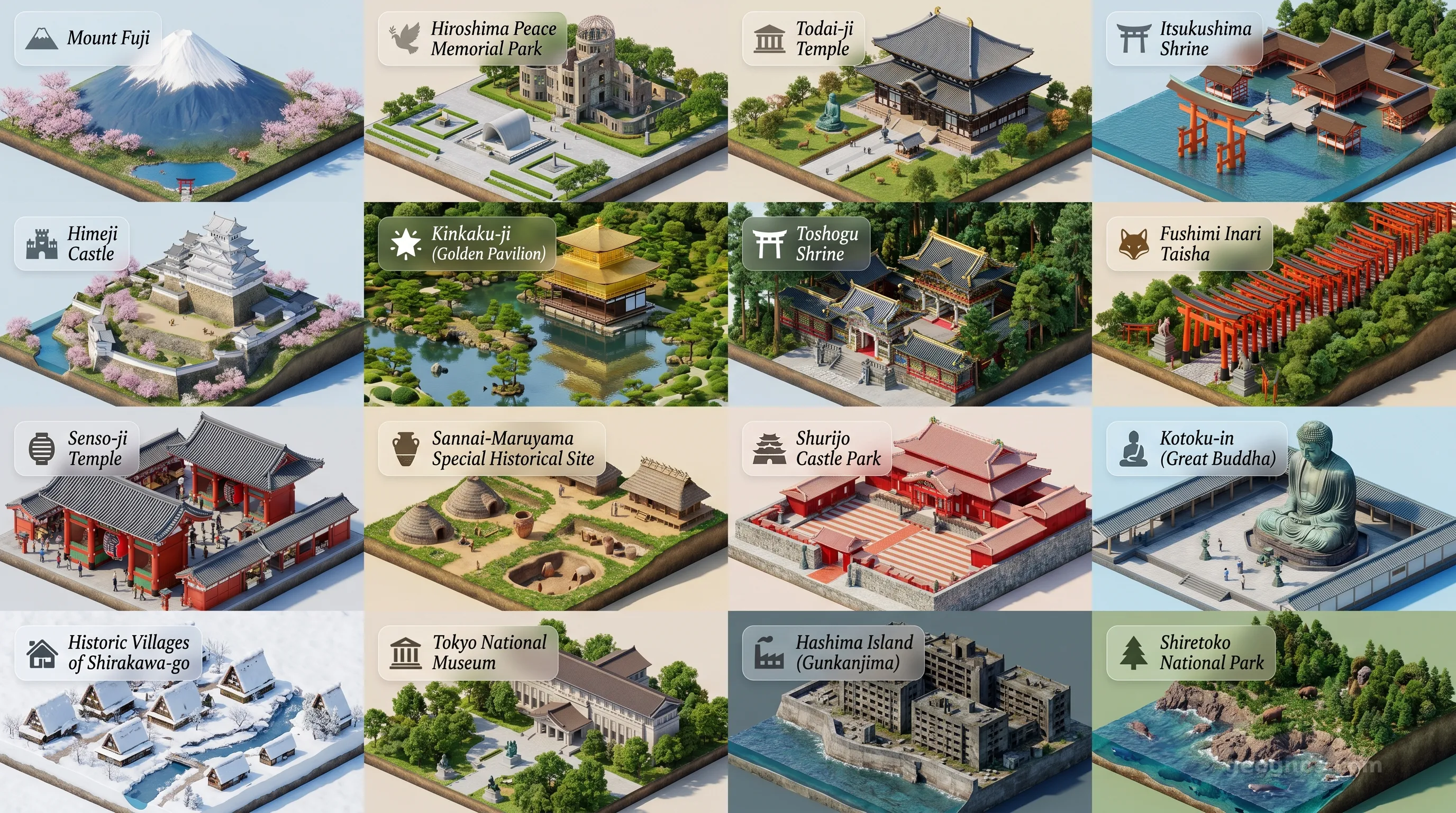
Mount Fuji is the timeless symbol of Japan, offering an unparalleled intersection of geological majesty and deep spiritual significance. Historically, it has inspired centuries of art and literature, most notably Katsushika Hokusai's ukiyo-e prints, and served as a sacred pilgrimage site for Shinto practitioners. Students of geology and culture alike will find its perfectly symmetrical cone fascinating. The best season to visit is during July and August for the official climbing season, though viewing it from afar is often best in the crisp, clear winter months. Tourist tip: For the most iconic photographs, visit the Chureito Pagoda or Lake Kawaguchiko at sunrise to catch the mountain's reflection.
Monument to Global Peace
A poignant testament to the devastating impact of the first atomic bomb deployed in human history on August 6, 1945. The Genbaku Dome, the only structure left standing near the hypocenter, serves as a stark physical reminder of atomic warfare, while the adjacent museum provides deeply moving personal histories and artifacts. It is an essential site for students of modern world history and international relations. Autumn and spring offer a temperate climate for walking the extensive park grounds. Tourist tip: Dedicate at least a half-day to fully absorb the museum's exhibits and the surrounding monuments, including the Children's Peace Monument; maintain a respectful, quiet demeanor throughout your visit.
Ancient Colossal Wooden Temple
Serving as the crown jewel of Japan's ancient capital, Nara, Todai-ji was constructed in 752 CE and remains one of the world's largest wooden structures. It houses the Daibutsu, a massive 15-meter-tall bronze Buddha statue that required the mobilization of over two million people to forge. The temple represents the zenith of state-sponsored Buddhism and architectural engineering in the Nara Period. Spring (cherry blossoms) and autumn (vibrant foliage) are the best seasons to visit. Tourist tip: Beware of the friendly but assertive roaming deer in Nara Park; buy special 'shika senbei' (deer crackers) to feed them, but hide paper maps as they might try to eat them.
The Floating Torii Gate
Renowned globally for its iconic 'floating' vermilion torii gate, Itsukushima Shrine dates back to the 12th century under the patronage of the powerful warlord Taira no Kiyomori. Built over the water to protect the island's sacred soil from human footprints, it is a masterclass in Shinto architecture blending seamlessly with the natural landscape. Autumn is spectacularly beautiful here, particularly the changing leaves at the nearby Momijidani Park. Tourist tip: Check the local tide charts before you arrive. High tide provides the famous floating illusion, while low tide allows you to walk right up to the base of the massive gate.
The White Heron Castle
Himeji Castle is Japan's most spectacular and best-preserved feudal fortress, surviving wars, earthquakes, and time since the 14th century (with major expansions in the early 17th century). Nicknamed the 'White Heron Castle' for its brilliant white exterior and elegant winged rooflines, it offers invaluable insights into advanced Japanese defensive architecture and samurai culture. Spring is incredibly popular—and crowded—due to the hundreds of cherry trees bursting into bloom. Tourist tip: Arrive as early as possible to avoid long queues, and wear easily removable walking shoes, as you must navigate steep, slippery wooden stairs in your socks inside the main keep.
Zen Temple Bathed in Gold
Originally built as a retirement villa for the powerful shogun Ashikaga Yoshimitsu in 1397, Kinkaku-ji was later converted into a Zen Buddhist temple. Its top two floors are completely covered in gold leaf, creating a stunning reflection in the adjacent Kyoko-chi (Mirror Pond). The structure beautifully encapsulates the extravagant Kitayama culture of the Muromachi period. It is breathtaking in winter when blanketed in pure white snow, or in autumn against fiery maple leaves. Tourist tip: The site gets notoriously busy by mid-day; aim to visit right at opening time to capture a serene, undisturbed photo of the pavilion's golden reflection.
Ornate Mausoleum of the Shogun
Nestled in a dense cedar forest, Toshogu is the final resting place of Tokugawa Ieyasu, the founder of the Tokugawa shogunate that ruled Japan for over 250 years. Unlike the minimalist aesthetic typical of Japanese shrines, Toshogu is lavishly decorated with gold leaf, intricate wood carvings, and vibrant colors, showcasing the immense wealth and power of the Edo period. Autumn is ideal for a visit, as the crisp air and colorful foliage perfectly frame the majestic architecture. Tourist tip: Don't miss the famous 'See no evil, hear no evil, speak no evil' monkey carving, and combine your trip with a visit to the nearby Kegon Falls.
A Thousand Vermilion Gates
Dedicated to Inari, the Shinto god of rice, commerce, and prosperity, this shrine's origins trace back to 711 AD. It is most famous for its 'Senbon Torii'—thousands of bright vermilion gates that straddle a network of trails winding up the sacred Mount Inari. It provides a highly atmospheric study of Japanese religious syncretism and modern corporate patronage, as each gate is donated by a Japanese business. The cooler months of spring and autumn offer the most comfortable hiking conditions. Tourist tip: Most tourists stop at the lower levels; hike further up the mountain (about a 2-3 hour round trip) for a crowd-free, deeply spiritual experience.
Tokyo's Oldest Buddhist Temple
Founded in 628 AD, Senso-ji is Tokyo's oldest and most significant Buddhist temple, dedicated to Kannon, the bodhisattva of compassion. The entrance is marked by the imposing Kaminarimon (Thunder Gate) and its massive red lantern, leading to the bustling Nakamise shopping street, which has provided pilgrims with snacks and souvenirs for centuries. It is an excellent place to study the intersection of ancient tradition and hyper-modern Tokyo life. The temple is stunning year-round, particularly in May during the spectacular Sanja Matsuri festival. Tourist tip: Visit at night when the main hall and pagoda are brilliantly illuminated, and the crowds have completely dispersed.
Window into the Jomon Period
Sannai-Maruyama is one of Japan's largest and most complete Jomon period (3900–2200 BC) archaeological sites. Discovered during a baseball stadium survey in 1992, it completely revolutionized historical understanding of Japan's prehistoric hunter-gatherers, revealing advanced architecture and community planning. It is an unparalleled destination for archaeology students. Summer is the best season to explore the outdoor reconstructed pit dwellings and massive wooden pillar structures. Tourist tip: Take advantage of the free volunteer guided tours and spend ample time in the adjacent Sanmaru Museum to see intricate clay figurines (dogu) and ancient pottery.
Heart of the Ryukyu Kingdom
For over 400 years, Shurijo Castle served as the administrative and cultural center of the Ryukyu Kingdom, a flourishing maritime trade hub connecting Japan, China, and Southeast Asia. Its distinct crimson architecture blends Japanese and Chinese styles, offering a fascinating contrast to mainland Japanese castles. Despite a tragic fire in 2019, the ongoing reconstruction provides a unique educational opportunity to witness traditional Ryukyuan craftsmanship in action. Winter and early spring provide a pleasant escape from Okinawa's intense summer heat. Tourist tip: Check the reconstruction schedule; observing the meticulous, historic rebuilding process is currently one of the site's most unique draws.
The Great Bronze Buddha
Cast in 1252, the Kamakura Daibutsu is a monumental bronze statue of Amida Buddha standing 11.4 meters tall. Originally housed inside a massive wooden hall that was washed away by a tsunami in the 15th century, the statue has serene stoicism as it sits in the open air. It is a masterpiece of Kamakura-era Buddhist art and metallurgy. The site is particularly enchanting during the spring cherry blossom season and autumn. Tourist tip: Pay the small nominal fee (usually around 20 yen) to step inside the hollow interior of the statue—a rare chance to study ancient bronze-casting techniques from the inside out.
Traditional Gassho-zukuri Farmhouses
Isolated in the rugged mountains of Gifu, Shirakawa-go is famous for its traditional 'gassho-zukuri' farmhouses, some of which are over 250 years old. The steep thatched roofs, designed to resemble hands clasped in prayer, are an architectural marvel engineered to withstand massive winter snowfalls and cultivate silkworms in the attics. The village provides a living study of traditional Japanese agricultural society. Winter transforms the village into a magical snowy wonderland, while summer offers vibrant green rice paddies. Tourist tip: Stay overnight in a converted farmhouse (minshuku) for an authentic, immersive experience featuring traditional irori (sunken hearth) dinners.
Japan's Oldest and Largest Museum
Established in 1872, the Tokyo National Museum houses the most comprehensive collection of Japanese art and antiquities in the world, comprising over 120,000 items, including dozens of National Treasures. From ancient samurai armor and legendary katana swords to delicate ukiyo-e woodblock prints and intricate ceramics, it is the ultimate starting point for anyone studying Japanese cultural history. The museum is a fantastic year-round, weather-proof destination. Tourist tip: The complex is vast, consisting of six different buildings; prioritize the Honkan (Japanese Gallery) if you are short on time, and download the audio guide app for detailed historical context.
The Abandoned Battleship Island
Once the most densely populated place on Earth, Hashima Island was a thriving undersea coal mining facility during Japan's rapid industrialization in the Meiji era. Abandoned completely in 1974 when petroleum replaced coal, the island now resembles a ghostly, decaying concrete battleship. It offers an unforgettable, albeit haunting, look into rapid industrial growth and sudden obsolescence. Spring and autumn provide the calmest seas for the required boat journey. Tourist tip: Access is strictly regulated and highly dependent on weather and ocean conditions; always book your specialized boat tour well in advance and prepare for potential cancellations if the sea is rough.
Japan's Last Pristine Wilderness
Located on the remote northeastern tip of Hokkaido, Shiretoko is one of Japan's most untouched natural environments. The peninsula's name derives from the Ainu word 'sir etok', meaning 'the end of the Earth'. It boasts an extraordinary ecosystem where marine and terrestrial food webs intertwine, supporting brown bears, deer, and endangered Blakiston's fish owls. It is a premier destination for ecological studies and wildlife observation. Summer is best for hiking and bear-watching cruises, while winter offers incredible drift ice walks. Tourist tip: Take a scenic cruise from Utoro to view the spectacular coastal cliffs and waterfalls, and always carry bear bells if hiking.