Kuwait
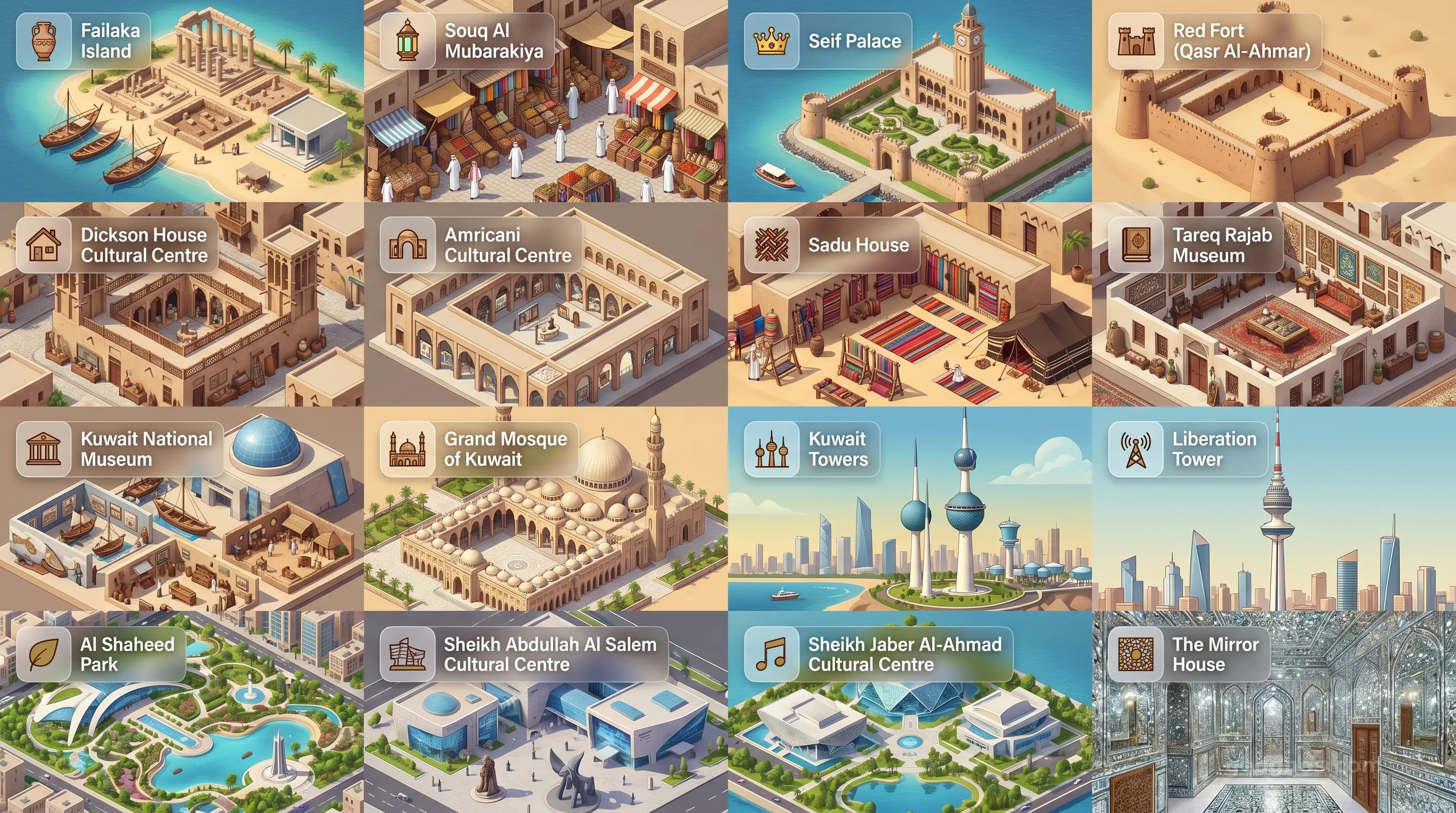
Top Sights & Landmarks
Ancient Dilmun and Hellenistic Outpost
Discover the ancient roots of the Arabian Gulf at Failaka Island, an unparalleled archaeological site holding ruins from the Dilmun civilization (2000 BCE) and Hellenistic outposts (known as Ikaros) established by Alexander the Great's forces. Students of history and archaeology will find the island to be a living laboratory of Bronze Age trade routes. Historically, it served as a crucial maritime hub before being largely abandoned during the 1990 Gulf War, the scars of which remain a poignant reminder of modern conflict. The best time to visit is during the cooler months from November to March. Tourist Tip: Ferry services depart from Salmiya; book tickets in advance and hire a local guide to fully grasp the layered ancient and modern historical contexts.
Kuwait's Oldest Traditional Market
Souq Al Mubarakiya is the bustling, historic heart of Kuwait City, offering a vibrant glimpse into the nation's pre-oil era. Established over 200 years ago, it remains a thriving center of commerce where students of cultural anthropology can observe traditional Arabian market dynamics. The historic facades and winding alleys house vendors selling everything from Persian carpets and rich perfumes to fresh dates and traditional spices. It is historically significant as the traditional center of Kuwaiti life and trade. Visit between November and April for the most comfortable weather. Tourist Tip: Come in the late afternoon or evening when the market comes alive, and don't miss dining at the open-air food courts for authentic Kuwaiti cuisine.
The Historic Seat of Kuwaiti Sovereignty
Seif Palace stands as a stunning monument to Kuwait's political history. Built in 1896, it has served as the focal point of the nation's leadership and the official palace of the Emir. Architecture and political science students will marvel at its unique blend of Islamic architecture, featuring original Islamic mosaic tile work and a distinctive watchtower capped with a blue-tiled roof plated in pure gold. It historically represents Kuwait's sovereignty and governance through the 20th century. While the best season to view the exterior is winter, note that the interior is generally closed to the public. Tourist Tip: View and photograph the spectacular facade from the opposite side of the street along the Arabian Gulf Road during the golden hour.
Site of the Historic 1920 Battle of Jahra
Located in the Al Jahra area, the Red Fort is arguably Kuwait's most significant military historical site. Built in the late 19th century using red mud-brick (which gives the fort its name), it was the epicenter of the pivotal 1920 Battle of Jahra, where Kuwaiti forces famously defended against the Ikhwan uprising. For military history students, it is an essential study of desert warfare and traditional Arabian fortification. The museum inside details the battle and historic weapons. The optimal time to visit is October to March. Tourist Tip: Check the opening hours locally as they can be irregular, and combine this trip with a visit to the nearby Jahra Pools Nature Reserve.
A Window into British-Kuwaiti Relations
Dickson House is a vital piece of early 20th-century Kuwaiti-British history. Originally built in 1870 for a Kuwaiti merchant, it became the residence of Colonel H.R.P. Dickson, the British Political Agent, in 1929. Students of colonial and Middle Eastern history will find an absolute treasure trove of archives, photographs, and artifacts documenting the political dynamics of the era. The building itself is a beautiful example of traditional Kuwaiti architecture with wooden colonnades. It is best visited during the pleasant winter months. Tourist Tip: Take time to read Dickson's wife's (Violet Dickson) accounts of Bedouin life displayed inside, offering a rare anthropological perspective of 1930s Arabia.
Historic Missionary Hospital Turned Museum
The Amricani Cultural Centre originally served as the American Mission Hospital, built in the early 1900s to introduce modern medicine to the region. Today, it stands as a beautifully restored historic facade housing the prestigious Dar al-Athar al-Islamiyyah (The Al-Sabah Collection). Art and history students must visit to study one of the world's finest collections of Islamic art, featuring stunning metalwork, ceramics, and illuminated manuscripts spanning centuries. It is an excellent year-round destination as the exhibits are indoors. Tourist Tip: Allocate at least two hours to fully appreciate the rotating exhibitions, and visit the gift shop for high-quality, culturally relevant literature.
Preservation of Traditional Bedouin Weaving
Nestled near the National Museum, Sadu House is dedicated to preserving, documenting, and promoting the rich cultural heritage of Bedouin weaving (Al Sadu). Built in 1936, the traditional Kuwaiti house is a phenomenal educational resource for textile students and anthropologists interested in the nomadic lifestyle of the desert. The intricate geometric designs tell stories of tribal life, survival, and artistry in a harsh environment. Visitors can observe local artisans at work and learn about the dyeing and weaving processes. Open year-round. Tourist Tip: The gift shop here is arguably the best place in Kuwait to buy authentic, locally crafted souvenirs that directly support the artisan community.
A Hidden Gem of Islamic Art and Ethnography
Tucked away in the residential area of Jabriya, the Tareq Rajab Museum houses a staggering private collection of Islamic art, ethnography, and antiquities. Amassed by Kuwait's first Minister of Antiquities and his British wife, it is a masterclass for students of Islamic history and art. The collection includes thousands of pieces of silver jewelry from across the Middle East, magnificent textiles, early Qur'an manuscripts, and rare ceramics. Because it is fully indoors, it's perfect for visiting at any time of the year. Tourist Tip: The museum is split into two parts (the main museum and the calligraphy museum located a short walk away); ensure you ask for directions to see both.
The Repository of the Nation's Heritage
Designed by French architect Michel Écochard, the Kuwait National Museum is the primary institution for safeguarding the country's history. Though it suffered severe looting and damage during the 1990 invasion, it has been painstakingly restored. It is crucial for students wanting a comprehensive overview of Kuwait's transition from a pearl-diving community to an oil-rich nation. It houses archaeological finds from Failaka Island, a planetarium, and a heritage section depicting pre-oil Kuwaiti life. Suitable for year-round visits. Tourist Tip: Don't miss the traditional dhow (Al-Muhallab) displayed in the courtyard, which is a masterpiece of historical Arabian ship-building.
The Pinnacle of Modern Islamic Architecture
The Grand Mosque is the largest and official mosque in Kuwait, capable of hosting up to 10,000 worshippers. For architecture and theology students, it is a magnificent example of modern Islamic design, featuring a massive central dome decorated with the Asma al-Hosna (the 99 names of God), intricate Persian woodwork, and Moroccan zellige tilework. It serves as the cultural and religious heartbeat of the country. Visits are best arranged outside of prayer times. Tourist Tip: Free guided tours are available and highly recommended; they are conducted in English and provide deep insights into Islamic culture. Modest dress is required, and women are provided with an abaya and headscarf upon entry.
The Iconic Symbol of Modern Kuwait
Rising majestically on the edge of the Arabian Gulf, the Kuwait Towers are the ultimate symbol of the nation's post-oil economic boom. Designed by Swedish architect Sune Lindström and opened in 1979, the three towers blend modern engineering with traditional Islamic minaret and mosque dome motifs. Engineering and urban planning students should study its dual function as both a water tower system and a cultural landmark. The viewing sphere offers a 360-degree panorama of the city and the sea. Best visited on a clear day during winter or spring. Tourist Tip: Time your visit for late afternoon to catch the spectacular sunset over the city skyline from the rotating observation deck.
Monument to Freedom and Resilience
Standing at 372 meters, the Liberation Tower is one of the tallest telecommunication towers in the world. Originally began before the 1990 invasion, it was renamed upon completion in 1993 to symbolize Kuwait's liberation and resilience. It is an important site for modern history students studying the Gulf War's impact and the rapid reconstruction of the nation. The architecture is a marvel of late-20th-century engineering. Tourist Tip: Access to the observation deck is highly restricted and usually only open to the public on special occasions like National Day (February 25), so plan accordingly or enjoy the striking exterior views from the city center.
Kuwait's Largest Urban Oasis and Memorial
Al Shaheed Park is a groundbreaking urban park that brilliantly integrates lush, unique landscapes with national memorials. It features botanical gardens, a lake, and two excellent museums: the Habitat Museum (focusing on local ecology) and the Remembrance Museum (honoring Kuwait's martyrs). Urban design and environmental students will appreciate how the park utilizes cutting-edge green infrastructure in an arid climate. It is historically vital for its poignant storytelling of national sacrifice. Best visited from November to April. Tourist Tip: The park is impeccably maintained and completely pedestrian-friendly. Enjoy an evening stroll when the fountains are illuminated and the weather is cool.
A Mega-Complex of Science and Culture
One of the world's largest museum complexes, the ASCC is a triumph of modern educational infrastructure. It houses four distinct museums: Natural History, Science and Technology, Fine Arts, and Arabic Islamic Science. Students of all disciplines will be captivated by the state-of-the-art interactive exhibits, from animatronic dinosaurs to deep-space exploration modules. The complex celebrates both global scientific achievement and the Golden Age of Islam. Perfect for year-round visits due to its expansive indoor environment. Tourist Tip: The complex is massive. Allocate a full day if you wish to see everything, and take advantage of the on-site cafes for resting in between museum blocks.
The Jewel of Kuwait's Performing Arts
Informally known as the Kuwait Opera House, JACC is an architectural masterpiece designed to resemble complex geometric jewels reflecting light across the Gulf. It serves as the paramount venue for performing arts, theater, and music in the country. Architecture and arts students must study its intricate titanium shell and acoustic engineering. Historically, it represents Kuwait's 21st-century cultural renaissance. The surrounding plaza features dancing fountains and a lively dining scene. Best visited in the evening. Tourist Tip: Book tickets for a performance well in advance. Even if you don't attend a show, dining at one of the restaurants overlooking the mesmerizing musical fountain is a must.
A Visionary's Mosaicked Masterpiece
The Mirror House is a spectacularly unique gallery and the private residence of Italian-Kuwaiti artist Lidia al-Qattan. Following the passing of her husband, pioneer Kuwaiti artist Khalifa al-Qattan, Lidia transformed the entire interior and exterior of the house into a glittering mosaic of mirrors. Art and design students will be fascinated by the sheer dedication and thematic rooms (like the 'Sea World' or 'Planet Earth' rooms). It is an incredibly intimate dive into the local contemporary art scene. Tourist Tip: You absolutely must book a tour in advance, as visits are personally guided by the artist herself, offering an unforgettable and deeply personal narrative of the artwork.