Germany
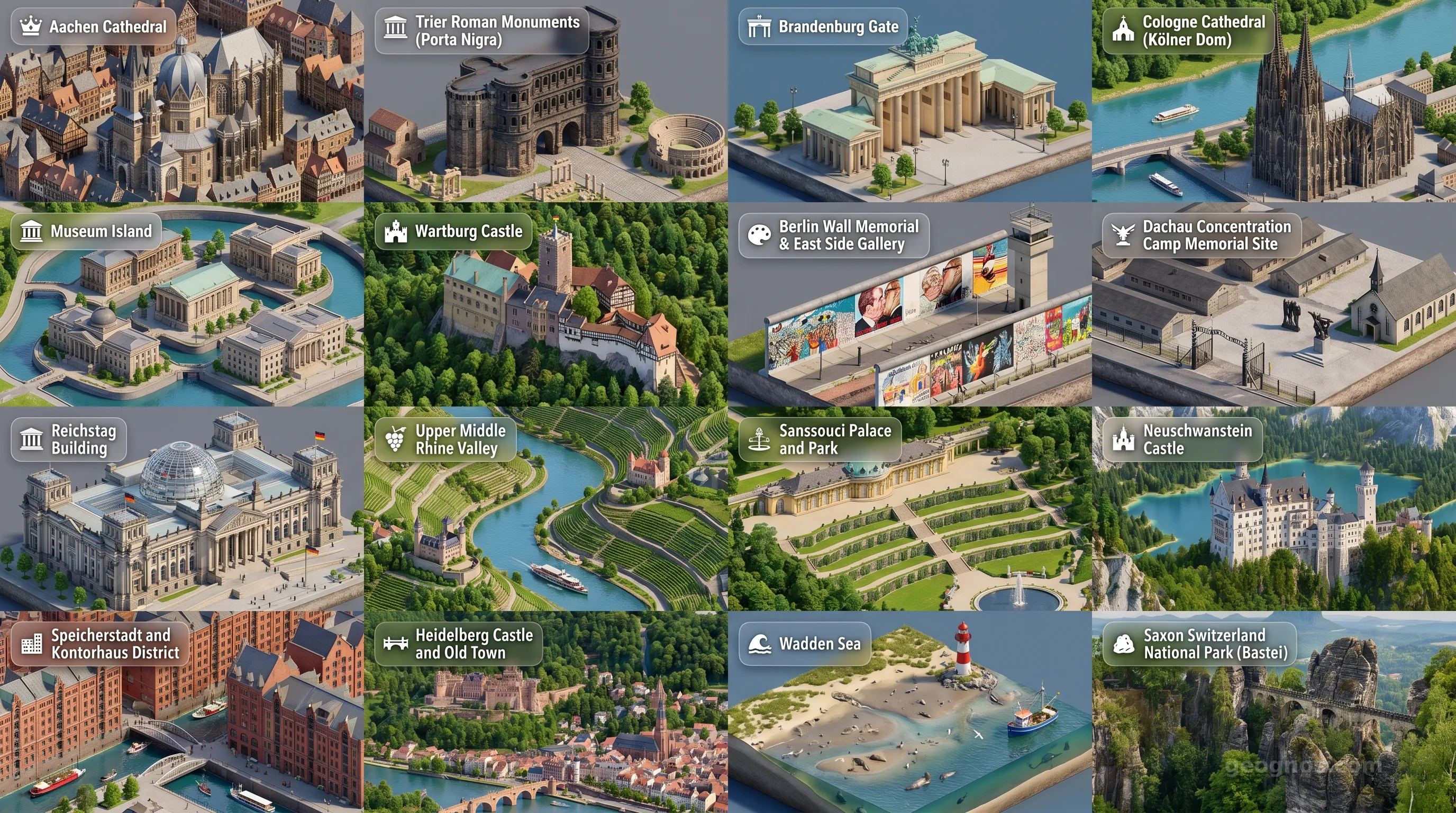
Top Sights & Landmarks
Charlemagne's Imperial Church
Constructed by order of Emperor Charlemagne in 796 AD, Aachen Cathedral is a monumental symbol of the Holy Roman Empire and was the first German site to be granted UNESCO World Heritage status. Historically, it served as the coronation church for 31 German kings and 12 queens. Students of architecture and medieval history will be fascinated by its seamless blend of Classical, Byzantine, and Gothic elements, particularly the stunning Palatine Chapel. The best time to visit is during spring or early autumn to avoid heavy crowds. Tourist tip: Do not miss the cathedral treasury, which houses one of the most important collections of medieval church artworks in Europe.
The Oldest City in Germany
Trier, established in 16 BC, was once one of the largest cities in the Roman Empire. Its unparalleled collection of Roman structures includes the magnificent Porta Nigra (the largest Roman city gate north of the Alps), the Imperial Baths, and the Amphitheater. It provides an exceptional open-air classroom for students of classical antiquity and archaeology. Visiting in late spring or summer allows for pleasant walking weather between the widespread archaeological sites. Tourist tip: Purchase an 'Antiquity Card' from the local tourism office for discounted entry to all the major Roman ruins in the city.
Symbol of German Unity
Built in the late 18th century as a neoclassical triumphal arch, the Brandenburg Gate has stood witness to Germany's tumultuous history, from Napoleonic parades to the division of the Cold War and the joyous reunification in 1989. It is the definitive starting point for anyone studying modern European history and geopolitics. The monument is spectacular year-round, but visiting during the Festival of Lights in October provides a breathtaking visual experience as the gate is illuminated with vibrant projections. Tourist tip: Visit early in the morning to capture photographs without the massive crowds, or late at night for a beautifully lit, solemn atmosphere.
A Gothic Masterpiece
Taking over 600 years to complete, Cologne Cathedral is a masterpiece of High Gothic architecture and survived multiple bombings during WWII. It is historically profound for housing the Shrine of the Three Kings, drawing pilgrims since the 12th century. For students of art history and engineering, its soaring twin spires and enormous stained-glass windows are exemplary. The holiday season (November to December) is highly recommended, as the spectacular Cologne Christmas markets surround the cathedral base. Tourist tip: Climb the 533 stone steps of the South Tower for an incredible panoramic view of the city and the Rhine River.
Epicenter of Global Artifacts
Located in the heart of Berlin on the Spree River, Museum Island is a complex of five internationally significant museums, including the Pergamon Museum and the Neues Museum. Built under Prussian kings, it embodies the Enlightenment ideal of making art and science accessible to the public. Students of history, art, and archaeology can study original artifacts like the Bust of Nefertiti and the Ishtar Gate. Summer is wonderful for strolling along the riverbanks between museums. Tourist tip: Buy a Museum Island pass to grant access to all five institutions, and book a timed entry ticket well in advance.
Cradle of the German Language
Perched above the town of Eisenach, Wartburg Castle is arguably the most historically consequential castle in Germany. It was here in 1521 that Martin Luther, while in hiding, translated the New Testament into German, fundamentally shaping the modern German language and the Protestant Reformation. It is a pivotal study destination for history, theology, and linguistics students. Autumn is breathtaking as the surrounding Thuringian Forest turns into a sea of red and gold. Tourist tip: Explore the exact room (Lutherstube) where Luther worked, but be prepared for a steep walk up from the parking area.
Remnants of the Iron Curtain
The East Side Gallery is a 1.3 km long remnant of the Berlin Wall covered in over 100 murals painted by artists from around the globe in 1990, while the nearby Memorial at Bernauer Straße preserves the terrifying reality of the border strip. It is an essential site for understanding the socio-political impact of the Cold War and the triumphant spirit of artistic expression following oppression. Spring and autumn offer the best weather for walking the extensive outdoor stretch. Tourist tip: Start at the Memorial for historical context, then head to the East Side Gallery to appreciate the pop-culture and artistic legacy.
A Somber Reminder of the Holocaust
Opened in 1933, Dachau was the first regular concentration camp established by the Nazi regime and served as a model for all subsequent camps. Today, it stands as a solemn place of remembrance and education. For students of 20th-century history, human rights, and ethics, a visit here is a deeply moving and educational experience that underscores the imperative of 'Never Again'. It can be visited year-round, though the starkness of winter aligns with the solemn nature of the site. Tourist tip: Take a guided tour provided by the memorial's educational department; their insights offer crucial context that self-guided walks often miss.
The Seat of German Democracy
The Reichstag is the meeting place of the German parliament (Bundestag). It has witnessed the proclamation of the Republic, a mysterious fire in 1933 that catalyzed Nazi power, brutal fighting in 1945, and the official reunification ceremony in 1990. Sir Norman Foster's modern glass dome represents political transparency, making it a brilliant study in architectural metaphor and political science. Summer evenings are perfect for visiting the dome at sunset. Tourist tip: Admission to the glass dome and terrace is free, but you must register on the official Bundestag website several weeks in advance.
The Romantic Rhine
A 65-kilometer stretch of the Rhine River, this valley is dotted with over 40 hilltop castles, terraced vineyards, and historic towns. It has been a crucial transport route between the Mediterranean and northern Europe for two millennia and inspired the 19th-century German Romantic movement. Geography and literature students will revel in the lore of the Lorelei rock. Late summer to early autumn is ideal for visiting, aligning with the regional wine harvests. Tourist tip: The best way to experience the valley is by taking a KD river cruise from Rüdesheim to Koblenz, allowing you to see the densely packed castles from the water.
The Prussian Versailles
Designed in the mid-18th century as a summer retreat for Frederick the Great, King of Prussia, Sanssouci ('without a care') is a marvel of Rococo architecture. The intimate palace and its expansive terraced gardens reflect the philosophical and artistic ideals of the Enlightenment. It is a fantastic site for studying European monarchical history and landscape architecture. Spring and summer are spectacular when the terraced vineyards and botanical gardens are in full bloom. Tourist tip: Only a limited number of tickets are sold per day to enter the palace; book online ahead of time and allow at least a half-day to explore the massive surrounding park.
The Fairytale Castle
Commissioned by the enigmatic King Ludwig II of Bavaria in 1869, Neuschwanstein was designed as a romanticized homage to medieval chivalry and the operas of Richard Wagner. While less historically pivotal than older fortresses, it is culturally massive, directly inspiring Disney's Sleeping Beauty castle. It provides students an excellent case study in 19th-century Romanticism and architectural revivalism. Winter offers a magical, snow-covered backdrop, while early autumn provides vibrant foliage. Tourist tip: Walk up to Queen Mary's Bridge (Marienbrücke) for the classic, unobstructed panoramic view of the castle.
City of Warehouses
Located in Hamburg, the Speicherstadt is the largest contiguous warehouse complex in the world, built on oak timber piles in the late 19th century. Together with the adjacent Kontorhaus district, it stands as an outstanding example of the Hanseatic League's legacy and the rapid growth of international maritime trade. Students of economics, urban planning, and maritime history will find it highly educational. Summer is great for boat tours through the canals. Tourist tip: Take a twilight canal cruise through the district; the neo-Gothic red brick buildings are beautifully illuminated at night.
Heart of German Romanticism
Dominating the city's skyline, the ruins of Heidelberg Castle are among the most important Renaissance structures north of the Alps. The town is also home to Germany's oldest university (founded in 1386). The dramatic ruins and the picturesque Altstadt below inspired countless poets and artists, making it a rich study site for literature and Renaissance history. Autumn is beautiful, offering a vibrant contrast between the red sandstone ruins and the changing leaves. Tourist tip: Make sure to see the Heidelberg Tun, an enormous wine vat housed in the castle cellar that holds over 220,000 liters.
The World's Largest Tidal Flats
Stretching across the North Sea coast, the Wadden Sea is the largest unbroken system of intertidal sand and mudflats in the world. It is an ecosystem of unparalleled global importance, supporting millions of migratory birds and diverse marine life. For students of marine biology, ecology, and environmental conservation, it is an indispensable living laboratory. Summer is the safest and most comfortable time for a guided mudflat hike (Wattwanderung). Tourist tip: Never venture into the tidal flats without a certified local guide, as the returning tides are fast and highly dangerous.
Elbe Sandstone Mountains
Characterized by its bizarre and monumental sandstone rock formations, Saxon Switzerland National Park is a geological marvel. The most famous landmark is the Bastei Bridge, which seamlessly integrates into the towering rock pinnacles high above the Elbe River. It is a brilliant destination for geography, geology, and photography students. Spring and autumn are the best times to visit for hiking, avoiding the intense heat and summer crowds. Tourist tip: Arrive at the Bastei Bridge at sunrise to experience the mist rolling over the Elbe River, providing an ethereal, tourist-free experience.