Czechia
Top Sights & Landmarks
The Historic Seat of Bohemian Kings
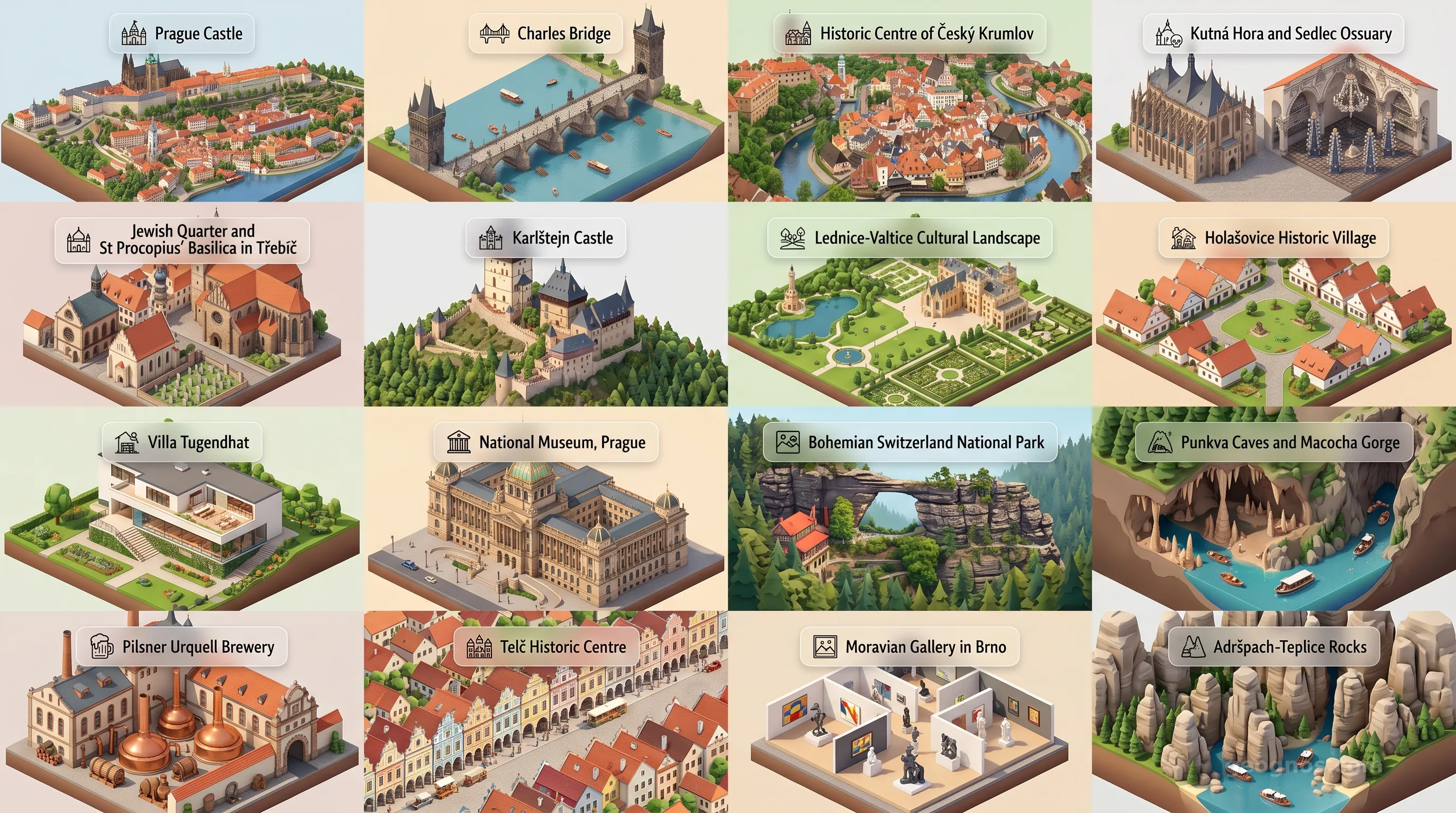
Prague Castle is an absolute must-study for European history enthusiasts. Recognized by the Guinness Book of Records as the largest ancient castle complex in the world, it has been the seat of power for kings of Bohemia, Holy Roman Emperors, and modern Czech presidents. Its architectural evolution spans from Romanesque to Gothic, Renaissance, and contemporary designs, offering a tangible timeline of Central European architectural history. The best time to visit is during spring (May) or early autumn (September) to enjoy the sprawling palace gardens in full bloom. Tourist tip: Arrive precisely at 6:00 AM or late in the afternoon to wander through the picturesque Golden Lane without the dense crowds.
Iconic 14th-Century River Crossing
Commissioned by King Charles IV in 1357, this stone Gothic bridge is central to Prague's historical narrative and urban development, effectively linking the Old Town with the Lesser Town. For art and history students, its avenue of 30 mostly Baroque statues offers a masterclass in religious iconography and 17th-century sculptural aesthetics. The bridge served as a vital trade route between Eastern and Western Europe. Winter mornings or misty autumn dawns provide the most atmospheric and photogenic conditions. Tourist tip: Visit at sunrise; not only will you avoid the overwhelming midday tourist throngs, but you will also experience the bridge in a serene, almost mystical light.
A Perfectly Preserved Renaissance Jewel
Situated on the meandering bends of the Vltava River, Český Krumlov is an extraordinary example of a small Central European medieval town. It holds massive value for urban historians due to its peaceful evolution over five centuries, retaining its original street layout and a stunning collection of Gothic, Renaissance, and Baroque buildings. The massive 13th-century castle complex features an exceedingly rare Baroque theater. Late spring and early autumn are the most pleasant times to visit. Tourist tip: Climb the colorful Castle Tower for the best panoramic view of the red-roofed town, and consider renting a raft to view the stunning historic facades from the river.
The Silver City and the Bone Church
Historically competing with Prague for economic and political dominance, Kutná Hora grew immensely wealthy due to its silver mines in the Middle Ages. It is an unparalleled site for studying the economic history of the Holy Roman Empire. The magnificent St. Barbara's Church showcases late Gothic architectural mastery. The nearby Sedlec Ossuary—a small chapel adorned with the bones of an estimated 40,000 to 70,000 people—serves as a poignant memento mori. Autumn is a wonderful time to visit when the surrounding vineyards are harvested. Tourist tip: Buy a combined ticket for St. Barbara's, the Ossuary, and the Cathedral of the Assumption to save money and bypass separate lines.
A Monument to Cultural Coexistence
This site is remarkably important for cultural and religious studies, as it represents one of the best-preserved Jewish ghettos in Europe alongside a Christian basilica. It stands as a powerful testament to the close, albeit sometimes tense, coexistence of Jewish and Christian cultures from the Middle Ages to the 20th century. The intricate layout of narrow alleys, historic houses, and synagogues provides a window into centuries of daily life. The summer months are ideal for walking tours. Tourist tip: Take a guided tour of the Rear Synagogue and the historic Jewish cemetery, one of the largest of its kind in Europe.
The Royal Treasury of Charles IV
Founded in 1348 by Emperor Charles IV, Karlštejn was built not just as a royal residence but specifically as a highly fortified treasury to safeguard the Imperial Regalia and the Bohemian Crown Jewels. It is a key location for students of medieval political power and defensive architecture. The Chapel of the Holy Cross, adorned with semi-precious stones and panel paintings by Master Theodoric, is an artistic marvel. Early autumn brings spectacular foliage to the surrounding dense forests. Tourist tip: The exclusive Tour II, which grants access to the Chapel of the Holy Cross, is heavily restricted; you must book tickets several weeks in advance.
The Garden of Europe
Over several centuries, the ruling Liechtenstein family transformed their massive South Moravian estate into one of the largest artificial landscapes in the world. Integrating Baroque, Classical, and Neo-Gothic architecture with romantic English-style parks, this area is a masterclass in landscape architecture and aristocratic history. The region is stunning in late summer and early autumn during the Moravian wine harvest. Tourist tip: Rent a bicycle to explore the vast grounds between the two main chateaux, discovering hidden follies like the Minaret and John's Castle hidden in the woods.
A Masterpiece of South Bohemian Folk Baroque
Holašovice provides an exceptionally complete and well-preserved example of a traditional Central European village. It is vital for students of vernacular architecture and rural history. The village is renowned for its 'Folk Baroque' style—farmsteads with elaborately decorated stucco facades dating primarily from the 18th and 19th centuries. The summer season, particularly late July, brings local historical festivals. Tourist tip: Respect the locals, as these beautiful farmhouses are still private homes. Enjoy a traditional Czech meal at the village tavern to soak up the authentic atmosphere.
A Masterpiece of Modernist Architecture
Designed by the legendary architect Ludwig Mies van der Rohe in 1928, Villa Tugendhat in Brno is a pioneering prototype of modern architecture in Europe. It is an essential pilgrimage site for architecture and design students. The building introduced revolutionary concepts like the free-flowing floor plan, massive retracting windows, and the use of exquisite materials like onyx and tropical woods instead of traditional decor. Any season is suitable, though sunny days best illuminate the famous onyx wall. Tourist tip: Tickets often sell out 3 to 4 months in advance; book immediately once your travel dates are set.
The Heart of the Czech National Revival
Dominating the top of Wenceslas Square, the National Museum is a monumental neo-Renaissance structure that serves as the cultural and historical vault of the Czech nation. Founded during the Czech National Revival, studying here offers deep insights into the 19th-century movements that shaped modern Central European identities. The museum houses extensive collections ranging from paleontology to modern 20th-century history. Winter, particularly around the holidays, is an excellent time for indoor museum visits. Tourist tip: Do not miss the spectacular newly restored Pantheon dome and the connecting multimedia tunnel to the New Building.
Europe's Largest Sandstone Arch
This national park features mystical pine forests, deep valleys, and towering sandstone formations. Its centerpiece, Pravčická brána, is the largest natural sandstone arch in Europe. For students of geology and environmental science, the park is a prime example of continuous cretaceous sandstone erosion. It was even featured in the film 'The Chronicles of Narnia'. Autumn is spectacular here, offering cool hiking weather and vivid foliage. Tourist tip: Stay on the marked trails to protect the fragile ecosystem, and take the romantic boat ride through the Edmund Gorge.
The Subterranean Wonders of the Moravian Karst
The Moravian Karst is one of the most important karst areas in Central Europe. The Punkva Caves are famous for their magnificent stalactite and stalagmite formations and the underground Punkva River. The tour culminates at the bottom of the breathtaking 138-meter-deep Macocha Abyss. It is a fantastic site for speleology and geology studies. Summer is the best time for the boat rides, as underground temperatures remain a steady, cool 8°C (46°F). Tourist tip: Pack a warm jacket regardless of the outside temperature, and book your cave tour well in advance during peak summer months.
The Birthplace of Modern Pilsner
Located in Plzeň, this brewery changed the world of beer forever in 1842 when Josef Groll created the first pale lager. It holds profound cultural and industrial significance, offering students of culinary history and industrial engineering a look into 19th-century brewing innovations that now account for over 70% of the world's beer consumption. The site is vibrant year-round, especially during October's Pilsner Fest. Tourist tip: Take the official tour to access the historic underground cellars, where you can taste unfiltered, unpasteurized Pilsner Urquell straight from the oak barrels.
A Fairytale Renaissance Square
Telč boasts what is arguably the most beautiful town square in Czechia. After a fire in 1530, the town was rebuilt in the Italian Renaissance style, resulting in a continuous arcade of pastel-colored houses with high gables. It serves as a textbook example of Renaissance urban planning and architectural harmony. The adjoining water chateau and ponds complete the picturesque setting. Summer evenings provide a magical, golden-hour glow on the facades. Tourist tip: Rent a rowboat on the Štěpnický pond for a unique, incredibly photogenic perspective of the chateau and town reflections.
The Nexus of Czech Fine and Applied Arts
The Moravian Gallery is the second-largest art museum in the Czech Republic and unique because it collects and exhibits fine art alongside applied arts, design, and architecture. Spread across several historical buildings in Brno, it is a crucial resource for art historians and design students tracking the evolution of Central European aesthetics, including Czech Cubism and Modernism. Spring and autumn are excellent times to visit, tying in with various international design biennials hosted here. Tourist tip: Enjoy a coffee at the gallery's beautifully designed café and don't miss the interactive exhibits in the Museum of Applied Arts building.
A Labyrinth of Towering Rock Formations
This bizarre and majestic 'rock city' consists of thousands of isolated sandstone pillars, some reaching up to 90 meters high. Shaped by wind, water, and frost over millions of years, the area is a fascinating living laboratory for geomorphology students. Deep gorges, a turquoise quarry lake, and hidden waterfalls add to the site's surreal beauty. Late spring and early autumn offer the best hiking weather without the severe summer crowding. Tourist tip: Start your hike right at dawn to experience the monumental silence of the rocks before the tour buses arrive.