Italy
Top Sights & Landmarks
Heart of the Roman Empire
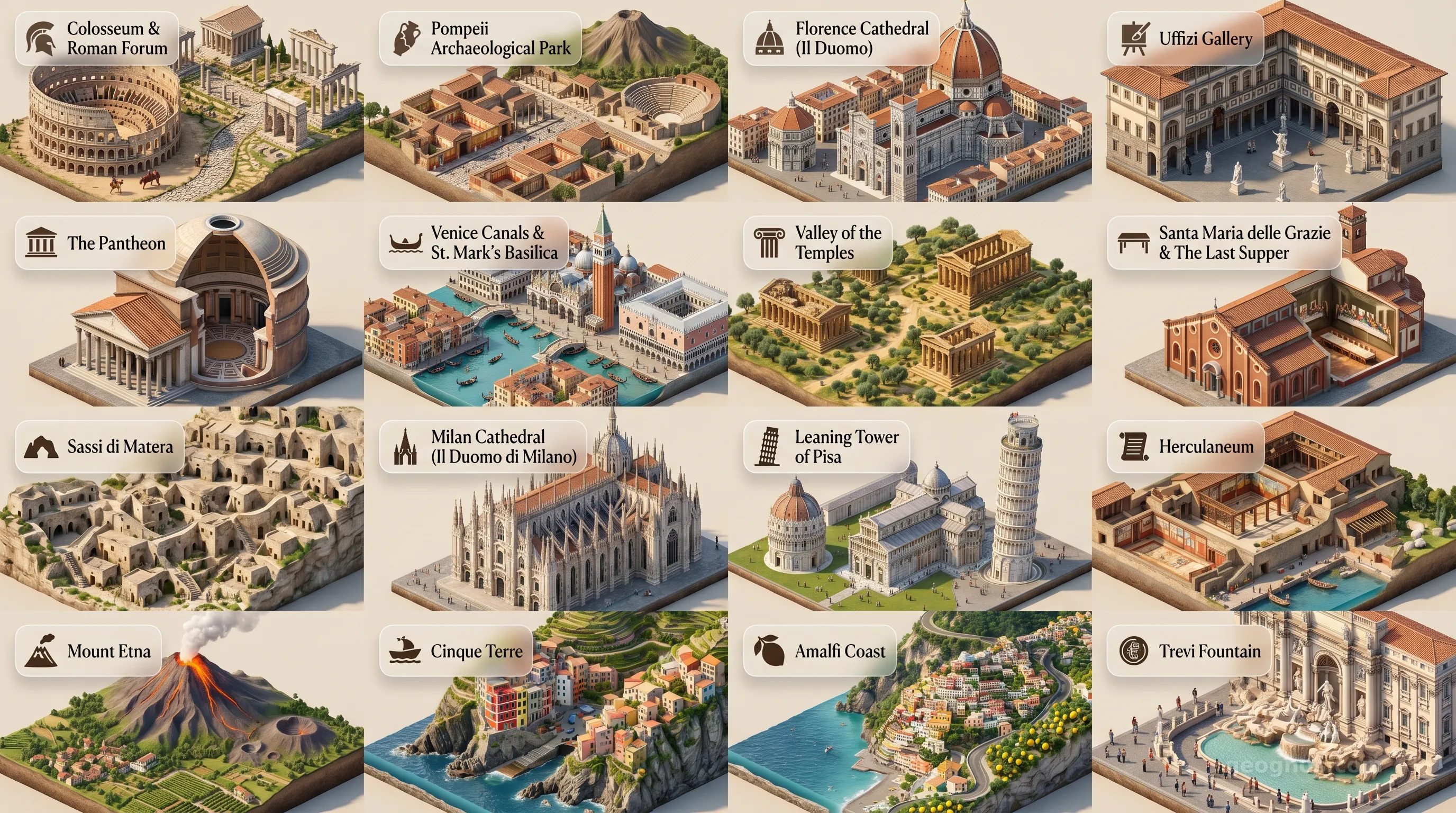
A profound testament to the engineering prowess and socio-political complexities of ancient Rome, the Colosseum and adjacent Forum are essential for anyone studying classical history. Commissioned in AD 72, the massive amphitheater hosted spectacular gladiatorial contests and mythological reenactments, while the Forum served as the empire's bustling center of government and commerce. The best seasons to visit are Spring (April-June) and Autumn (September-October) to avoid extreme heat. Tourist tip: Purchase a combined, skip-the-line ticket well in advance, and consider booking an underground hypogeum tour to see where gladiators and exotic animals awaited their fate.
The City Frozen in Ash
Pompeii offers an unparalleled, remarkably intact snapshot of daily Roman life exactly as it was before the catastrophic eruption of Mount Vesuvius in AD 79. For historians and archaeologists, the well-preserved frescoes, bathhouses, and haunting plaster casts of victims provide an invaluable primary source for studying antiquity. The site is vast and fully exposed to the elements, making Spring or early Autumn the most comfortable times to explore. Tourist tip: Hire a licensed archaeological guide at the entrance or download a comprehensive audio guide to truly grasp the context of the ruins, and bring a refillable water bottle.
Cradle of the Renaissance
Dominating the Florentine skyline, the Cathedral of Santa Maria del Fiore is a masterpiece of early Renaissance architecture and a symbol of Florence's historical wealth. The crown jewel is Brunelleschi's magnificent dome, an engineering marvel that revolutionized architectural design in the 15th century. Students of art and engineering flock here to study the transition from Gothic to Renaissance aesthetics. Visit in late Autumn or early Spring for a quieter experience. Tourist tip: Climbing the 463 steps of the dome requires a pre-booked time slot; do this at sunset for awe-inspiring views of the Tuscan capital.
Pinnacle of Renaissance Art
Originally built as magistrate offices for the ruling Medici family, the Uffizi is now home to the world's finest collection of Italian Renaissance art. It serves as an essential visual timeline of artistic evolution, featuring iconic masterpieces like Botticelli's 'The Birth of Venus' and works by Leonardo da Vinci, Michelangelo, and Raphael. Art history students will find the progression from Byzantine styles to High Renaissance realism perfectly laid out room by room. Winter is a fantastic time to visit to avoid the massive crowds. Tourist tip: Booking priority entry tickets months in advance is practically mandatory to avoid hours in line.
Ancient Rome's Perfect Dome
The Pantheon is the best-preserved building from ancient Rome and a continuous source of inspiration for architects globally. Originally built as a temple to all gods by Hadrian around AD 126, its unreinforced concrete dome remains the largest of its kind in the world, featuring a central oculus that perfectly aligns with the sun and seasons. Its later conversion into a church saved it from destruction. Visit early in the morning year-round to experience the sanctuary in peace. Tourist tip: Entry now requires a small fee and weekend visits must be booked online in advance; visit when it's raining to see water dramatically pour through the oculus.
The Floating Maritime Republic
Venice is an extraordinary triumph of human adaptation, built on a lagoon that served as the heart of a powerful medieval maritime republic. St. Mark's Basilica highlights the city's historical trade connections to the East with its stunning Italo-Byzantine mosaics and architectural opulence. Urban studies and history students will be fascinated by how this fragile, car-free city functions through a complex network of canals. The shoulder seasons (April-May and September-October) offer beautiful light and fewer crowds. Tourist tip: Avoid gondola traffic jams by exploring the quieter, atmospheric canals in the Cannaregio or Dorsoduro districts.
Magnificence of Magna Graecia
Located in Agrigento, Sicily, this expansive ridge contains some of the most outstanding examples of Greater Greece's art and architecture. The remarkably preserved Doric temples, particularly the Temple of Concordia, provide vital insights into ancient Greek religious practices and Mediterranean colonial history. It is a brilliant open-air classroom for classics scholars. Springtime is spectacular when the surrounding almond trees are in full bloom. Tourist tip: Visit during the late afternoon to witness the temples glowing a brilliant gold in the setting sun, and stay until dusk when they are dramatically illuminated.
Da Vinci's Fragile Masterpiece
This Dominican convent in Milan houses one of the most studied and iconic artworks in human history: Leonardo da Vinci's 'The Last Supper'. Painted directly onto the refectory wall in the late 15th century, the mural is a masterclass in psychological realism and single-point perspective. Due to Da Vinci's experimental fresco technique, the painting is incredibly fragile, making its preservation a modern scientific marvel. It can be visited comfortably year-round. Tourist tip: Tickets are released in batches every few months and sell out within minutes; if you miss out, look for official guided city tours that include guaranteed entry.
The Ancient Cave Dwellings
Matera is one of the oldest continuously inhabited cities in the world, with complex networks of cave dwellings (the Sassi) carved into the limestone ravine dating back to the Paleolithic period. Once a symbol of intense poverty in the mid-20th century, the revitalized Sassi now offer an incredible sociological and architectural study of ancient human survival and modern urban regeneration. Autumn and Spring are ideal to explore the steep, winding stairways without the brutal summer heat. Tourist tip: Sleep in one of the boutique cave hotels for a truly immersive experience and visit the Casa Grotta to see how families lived here just 70 years ago.
A Gothic Masterpiece
Taking nearly six centuries to complete, Milan's Duomo is an awe-inspiring example of flamboyant Gothic architecture. Adorned with over 3,400 statues, 135 gargoyles, and magnificent stained glass windows, it chronicles centuries of shifting architectural tastes and religious devotion. It is an absolute must-visit for students of religious architecture and masonry. Clear, crisp winter days provide stunning visibility. Tourist tip: Take the elevator (or stairs) up to the terraced roof to walk among the soaring marble spires and enjoy a panoramic view of Milan, with the snow-capped Alps visible on a clear day.
The Happy Engineering Accident
Famous globally for its unintended tilt, the Campanile of Pisa is actually part of a magnificent Romanesque cathedral complex (the Square of Miracles). The 12th-century tower began to sink during construction due to soft ground, making it a legendary case study in geotechnical engineering and historic preservation. Beyond the iconic photo-ops, the adjoining Cathedral and Baptistery are spectacular works of medieval art. Best visited in shoulder seasons to avoid massive summer crowds. Tourist tip: Only a limited number of people are allowed to climb the leaning steps at once; book your ticket in advance and leave bags at the mandatory check-in.
Pompeii's Wealthier Neighbor
While Pompeii is larger and more famous, the smaller coastal town of Herculaneum was buried by a different pyroclastic surge during the AD 79 eruption, which carbonized and preserved organic materials. Students can marvel at preserved wooden roofs, beds, doors, and even food, offering an incredibly intimate look into the daily lives of Rome's wealthier elite. It is far more compact and easier to navigate than Pompeii. Spring and Autumn are the best seasons to visit. Tourist tip: Combine a morning visit to Herculaneum with an afternoon hike up the nearby crater of Mount Vesuvius to understand the geological force that destroyed it.
Europe's Highest Active Volcano
Dominating the eastern coast of Sicily, Mount Etna is deeply woven into Greek mythology and modern volcanology. It is a phenomenal living laboratory for Earth science students, featuring an ever-changing landscape of hardened lava flows, smoking craters, and unique volcanic agriculture. The rich volcanic soil produces some of Italy's finest wines. Visit between May and October for accessible hiking, or in Winter for a unique chance to ski on an active volcano. Tourist tip: Take the cable car from Rifugio Sapienza, then join a guided 4x4 jeep tour to safely explore the higher, active crater zones.
Five Villages on the Edge
Comprising five vibrantly colored fishing villages clinging to the rugged cliffs of the Italian Riviera, Cinque Terre is a testament to centuries of agricultural adaptation. Locals meticulously carved out terraced vineyards into the steep hillsides, making this a fascinating study of human-environment interaction and sustainable historic farming. To avoid the suffocating peak summer crowds, travel in late September or October when the sea is still warm and the grape harvest begins. Tourist tip: Skip the driving entirely; the villages are best navigated using the local train pass or by hiking the scenic (though sometimes challenging) coastal trails linking them.
Italy's Most Dramatic Coastline
With its plunging cliffs, lemon groves, and pastel-colored towns cascading down to the Tyrrhenian Sea, the Amalfi Coast is breathtakingly beautiful. Beyond its stunning landscape, Amalfi was once a powerful maritime republic in the Middle Ages, holding immense trading power across the Mediterranean. Its history is palpable in the Moorish-influenced architecture and historic paper mills. May and September offer gorgeous weather and slightly fewer tourists. Tourist tip: The narrow, winding coastal road is notoriously difficult to drive; opt for the frequent ferries to hop between towns like Positano and Amalfi for incredible views from the water.
A Baroque Theatrical Masterpiece
The Trevi Fountain is the largest and most ambitious Baroque fountain in Rome, seamlessly integrated into the facade of the Palazzo Poli. Designed by Nicola Salvi, it depicts the taming of the waters under the command of Oceanus. For art historians, it represents the theatricality and grandeur of the Baroque period, as well as the ancient Roman mastery of aqueducts, as it is still fed by the Aqua Virgo constructed in 19 BC. Year-round viewing is possible, but it is heavily crowded. Tourist tip: Visit at dawn to experience the fountain in complete, magical silence, and don't forget to toss a coin over your left shoulder to ensure your return to Rome.