Spain
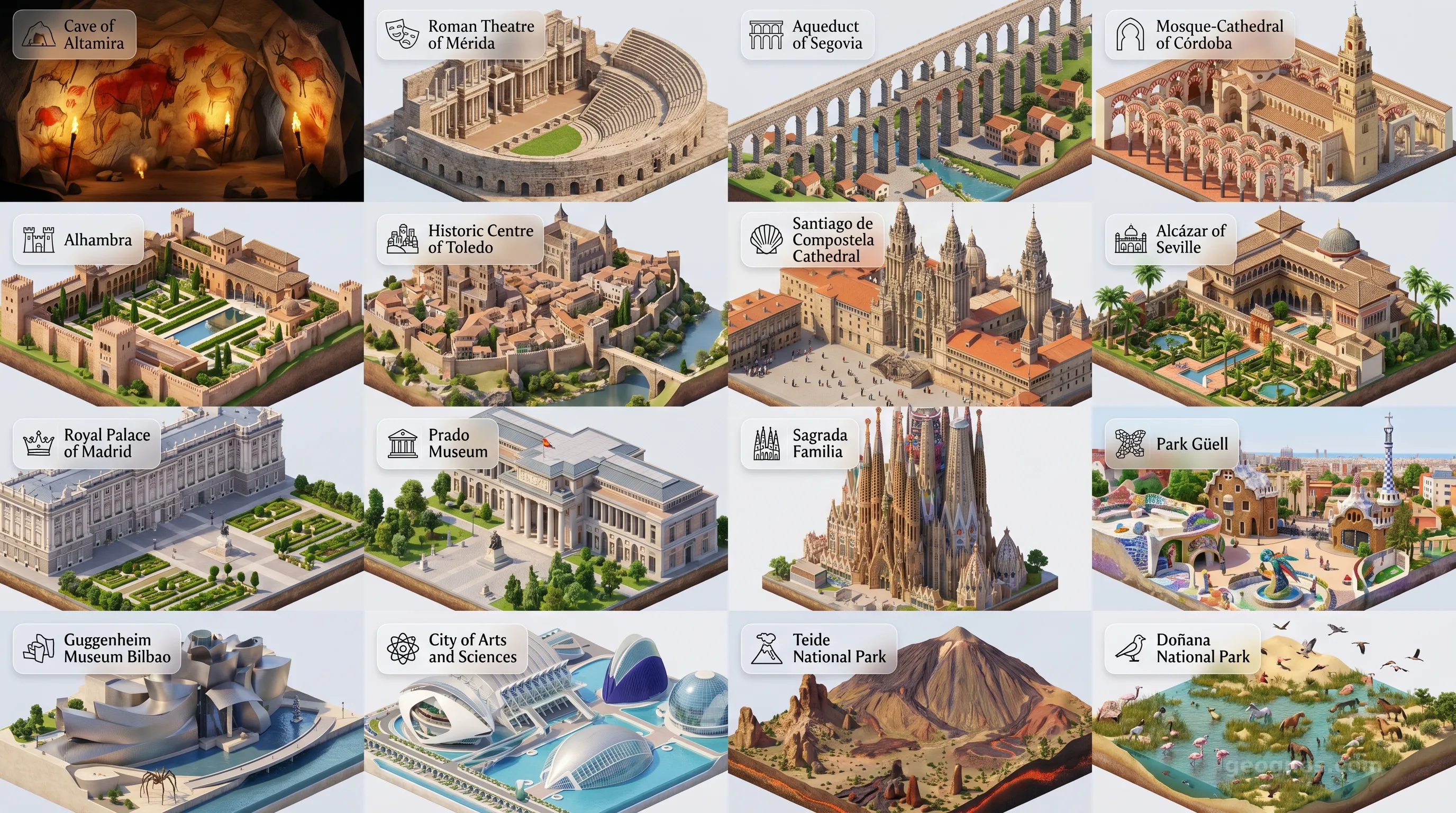
Top Sights & Landmarks
Sistine Chapel of Paleolithic Art
Experience the pinnacle of Upper Paleolithic cave art. Altamira holds immense historical significance as the first cave where prehistoric paintings were discovered, revolutionizing our understanding of early human culture and artistic capability. The vibrant charcoal and polychrome paintings of bison and deer date back up to 36,000 years. Best season to visit is Spring or Autumn. Tourist tip: To protect the fragile microclimate, access to the original cave is strictly limited via a lottery system. However, the exact replica at the site, the Neocave, offers an incredibly immersive and accessible educational experience without the wait.
Spain's Grandest Roman Legacy
Built in 15 BC by order of Agrippa, this exceptionally well-preserved amphitheater highlights Roman imperial power and urban planning in Hispania. Studying its architecture provides profound insights into classical acoustics and civic life in the ancient world. Best season to visit is Summer, specifically July and August, when the site hosts the International Classical Theatre Festival, allowing you to experience the acoustic mastery firsthand. Tourist tip: Buy a combined ticket to explore the nearby National Museum of Roman Art and the adjacent amphitheater for a comprehensive historical journey.
Marvel of Roman Engineering
An iconic Roman structure built entirely without mortar, boasting 167 towering arches that have withstood two millennia. It is a masterpiece of civil engineering that historically supplied water from the Frío River to the city, making it an essential study for architecture and history students. Best season to visit is Spring or early Autumn to enjoy pleasant walking weather. Tourist tip: View the aqueduct from Plaza de Azoguejo for the most striking perspective, then climb the stairs next to the structure for panoramic views of both the aqueduct and the Castilian landscape.
Architectural Blend of Faiths
A profound symbol of Al-Andalus, this structure features mesmerizing red-and-white horseshoe arches and an intricate mihrab. Its historical significance lies in its dual identity; it was a grand Islamic mosque later converted into a Renaissance Catholic cathedral, offering a physical timeline of Spain's religious shifts. Best season to visit is Spring, particularly in May during the spectacular Córdoba Patio Festival. Tourist tip: Purchase tickets in advance and visit early in the morning (often free from 8:30 AM to 9:30 AM) for a quieter, more reflective experience before tour groups arrive.
The Moorish Jewel of Andalusia
A breathtaking palace and fortress complex that embodies the zenith of Nasrid art and architecture. Its intricate stucco work, beautifully proportioned courtyards, and advanced hydraulic systems make it a crucial site for understanding Islamic Spain. Best season to visit is Spring or Autumn to avoid the intense Andalusian summer heat and to see the Generalife gardens in full bloom. Tourist tip: Book your Nasrid Palace tickets months in advance, as timed entry slots sell out rapidly, and bring your original passport or ID, which is strictly checked at the entrance.
The City of Three Cultures
Toledo is globally renowned for the historic coexistence of Christian, Muslim, and Jewish traditions. Studying its labyrinthine streets reveals stunning Gothic cathedrals, ancient synagogues, and centuries-old mosques standing shoulder to shoulder. It was also the home of the famous painter El Greco. Best season to visit is Spring or Autumn. Tourist tip: Wear extremely comfortable walking shoes to navigate the steep, cobbled, medieval streets, and consider taking the escalators from the lower parking areas to effortlessly reach the city center.
The Ultimate Pilgrimage Destination
The monumental culmination of the Camino de Santiago, this cathedral is a magnificent blend of Romanesque, Gothic, and Baroque architecture. Historically, it was a vital hub for European Christian pilgrimage, said to house the relics of Saint James the Apostle. Best season to visit is Summer to witness the lively, emotional arrivals of pilgrims in the main square, though Spring offers cooler walking weather. Tourist tip: Check the cathedral's schedule to attend the Pilgrim's Mass, where you might witness the swinging of the giant Botafumeiro (incense burner).
Mudéjar Architectural Masterpiece
A stunning royal palace reflecting centuries of cultural synthesis. Originally developed by Moorish Muslim kings, it was expanded by Christian monarchs in the Mudéjar style. It stands as an exceptional study of how Islamic and Christian artistic traditions merged in Spain. Best season to visit is Spring, particularly around the Feria de Abril or Semana Santa. Tourist tip: Don't miss the intricate Courtyard of the Maidens or the expansive, lush gardens. Book online in advance to skip the massive queues that form outside the Lion's Gate.
Europe's Largest Functioning Royal Palace
Boasting over 3,000 rooms, this opulent Bourbon palace is a treasure trove of Spanish history, armory, and classical art. Built in the 18th century, it replaced the old Alcázar and symbolizes the transition to modern monarchical power in Spain. Best season to visit is Autumn or Spring when Madrid's weather is most accommodating. Tourist tip: The spectacular Changing of the Guard takes place on Wednesdays and Saturdays; arrive early at the Armory Square for a good viewing spot.
Premier European Art Collection
One of the world's most significant art museums, housing unrivaled masterpieces by Velázquez, Goya, El Greco, and Bosch. Studying at the Prado offers a deep dive into the Spanish Golden Age and the European Enlightenment. Best season to visit is year-round, as it is a perfect retreat during rainy or excessively hot days. Tourist tip: Take advantage of free entry hours in the late afternoon (typically 6 PM to 8 PM), but expect queues. Focus your visit on a few specific artists or wings to avoid museum fatigue.
Gaudí's Unfinished Masterpiece
Antoni Gaudí's monumental basilica is an unparalleled synthesis of Gothic and Art Nouveau forms. It profoundly explores biblical narratives through highly complex stone carving and biomimetic structural engineering, making it a living study of architectural evolution. Best season to visit is Spring or Autumn for ideal weather in Barcelona. Tourist tip: Book your tickets online well in advance and opt for a tower access ticket to get breathtaking, close-up views of the ongoing construction and panoramic vistas of the city.
A Whimsical Modernist Park
Originally conceived as a luxury housing development, this public park is a dazzling display of Gaudí's colorful trencadís mosaics and organic architectural forms. It highlights the early 20th-century Modernisme movement's integration with natural landscapes. Best season to visit is Spring or Autumn. Tourist tip: Go during the early morning or late afternoon to avoid the harshest sunlight and the thickest crowds. The monumental zone requires a paid ticket, but the surrounding park trails are free and offer great city views.
Contemporary Titanium Marvel
Frank Gehry's groundbreaking titanium structure completely transformed Bilbao's industrial landscape, coining the 'Bilbao Effect' in urban studies. It houses world-class contemporary art but is fundamentally famous for its deconstructivist architecture. Best season to visit is Summer or early Autumn. Tourist tip: Walk around the entire exterior to fully appreciate the way the titanium plates catch the light, and don't miss the giant 'Puppy' floral sculpture by Jeff Koons guarding the entrance.
Futuristic Cultural Complex
Designed by the internationally acclaimed architect Santiago Calatrava, this futuristic complex represents a pinnacle of contemporary Spanish design. It includes an interactive science museum, an opera house, and Oceanogràfic, the largest aquarium in Europe. Best season to visit is Spring or Autumn to comfortably walk between the massive structures. Tourist tip: Rent a bicycle to navigate the expansive Turia Park, a converted riverbed that leads directly to this stunning complex.
Spain's Highest Peak
Home to Mount Teide, a dormant volcano and the highest point in Spain, this park offers otherworldly, martian-like landscapes. It is a geological marvel essential for volcanology studies and offers incredible atmospheric clarity for astronomical observation. Best season to visit is Spring to see the blooming red bugloss, or Summer for spectacular stargazing. Tourist tip: You must secure a free government permit months in advance if you wish to hike the final stretch to the very summit from the upper cable car station.
Crucial Avian Wetland
A dynamic biodiversity hotspot featuring marshes, shallow streams, and moving sand dunes. It is critically important from an ecological standpoint as a major stopover for migratory birds between Europe and Africa, and it acts as a refuge for the highly endangered Iberian lynx. Best season to visit is Winter and Spring for prime birdwatching. Tourist tip: Access to the core of the park is highly restricted to protect the fragile ecosystem; book an authorized guided 4x4 tour from El Rocío well in advance.