🇵🇹

Portugal

Europe • Countries •
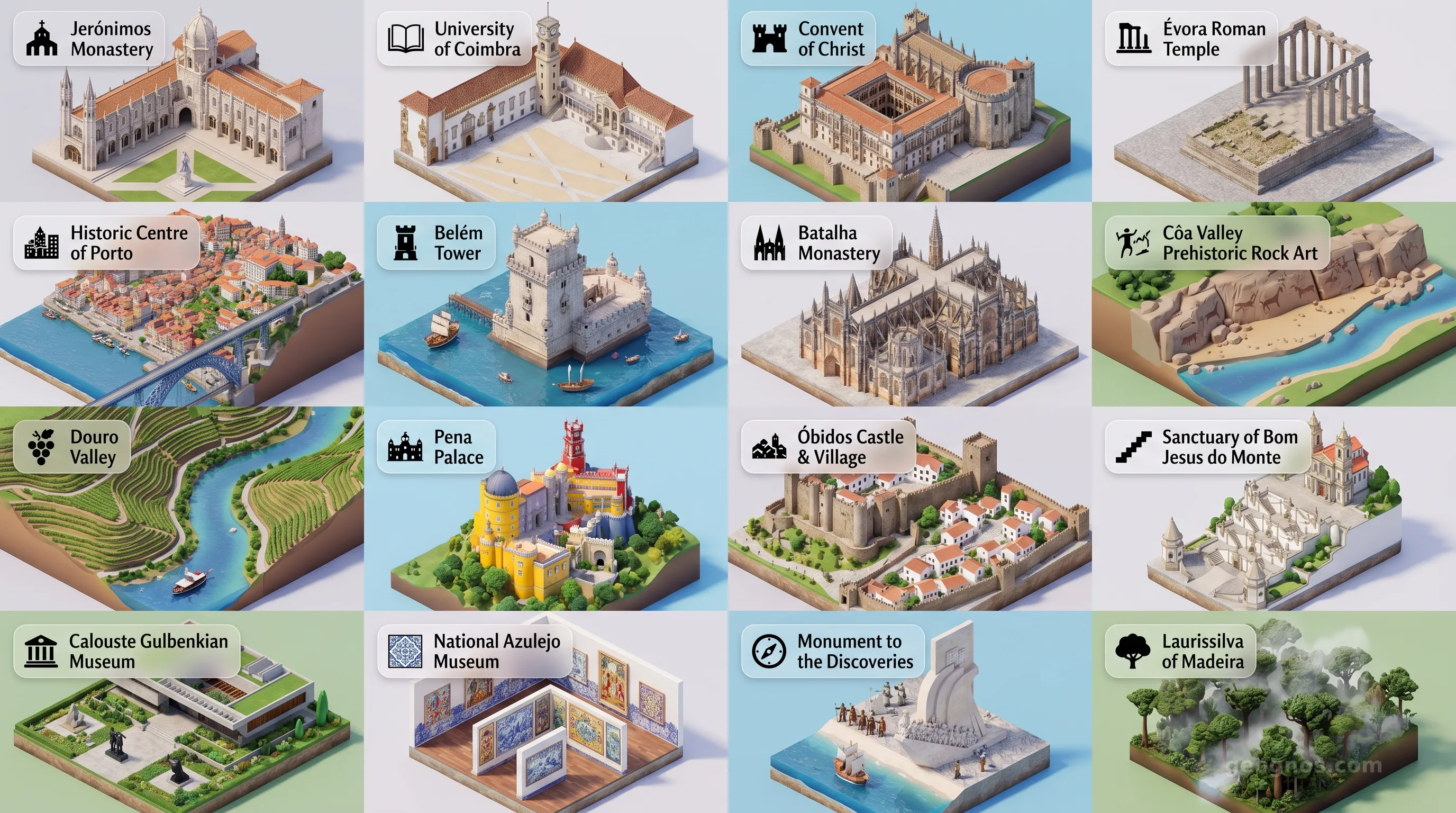
Portugal - Panoramic Places of Interest Atlas including Jerónimos Monastery, University of Coimbra, Convent of Christ, Évora Roman Temple, Historic Centre of Porto, Belém Tower, Batalha Monastery, Côa Valley Prehistoric Rock Art, Douro Valley, Pena Palace, Óbidos Castle & Village, Sanctuary of Bom Jesus do Monte, Calouste Gulbenkian Museum, National Azulejo Museum, Monument to the Discoveries, Laurissilva of Madeira

Top Sights & Landmarks

01

JerĂłnimos Monastery

Epitome of the Age of Discovery

02

University of Coimbra

Historic Epicenter of Portuguese Academia

03

Convent of Christ

Stronghold of the Knights Templar

04

Évora Roman Temple

Ancient Marvel of Roman Lusitania

05

Historic Centre of Porto

The Ancient Roots of Portus Cale

06

Belém Tower

Sentinel of the Tagus River

07

Batalha Monastery

Monument to Portuguese Independence

08

CĂ´a Valley Prehistoric Rock Art

Paleolithic Open-Air Gallery

09

Douro Valley

World's Oldest Demarcated Wine Region

10

Pena Palace

Crown Jewel of European Romanticism

11

Óbidos Castle & Village

The Queens' Medieval Town

12

Sanctuary of Bom Jesus do Monte

A Baroque Stairway to Heaven

13

Calouste Gulbenkian Museum

A 5,000-Year Journey Through Art

14

National Azulejo Museum

The Art of Portuguese Ceramic Tiles

15

Monument to the Discoveries

A Tribute to Portugal's Navigators

16

Laurissilva of Madeira

Ancient Subtropical Rainforest

Background

A global maritime power during the 15th and 16th centuries, Portugal lost much of its wealth and status with the destruction of Lisbon in a 1755 earthquake, occupation during the Napoleonic Wars, and the independence of Brazil, its wealthiest colony, in 1822. A revolution deposed the monarchy in 1910, and for most of the next six decades, repressive governments ran the country. In 1974, a left-wing military coup ushered in broad democratic reforms. The following year, Portugal granted independence to all its African colonies. Portugal is a founding member of NATO and entered the EC (now the EU) in 1986.

Location

Latitude
39.5° N
Longitude
-8° E
N S W E
World Map Location
Geographic Location

Southwestern Europe, bordering the North Atlantic Ocean, west of Spain

Map Reference
Europe

Area

Total Area
92,090 sq km
Land (99%)
Land: 91,470 sq km
Water: 620 sq km

Elevation

Highest Point
Ponta do Pico (Pico or Pico Alto) on Ilha do Pico in the Azores
Ponta do Pico (Pico or Pico Alto) on Ilha do Pico in the Azores 2,351 m
Lowest Point
Atlantic Ocean
Atlantic Ocean 0 m
Mean Elevation
372 m

Detailed Geography Information

Coastline

1,793 km

Geography - note

Azores and Madeira Islands occupy strategic locations along western sea approaches to Strait of Gibraltar; they are two of the four North Atlantic archipelagos that make up Macaronesia; the others are the Canary Islands (Spain) and Cabo Verde

Irrigated land

5,662 sq km (2019)

Land boundaries

Total boundary: 1,224 km
Spain 1224 km

Maritime claims

territorial sea: 12 nm contiguous zone: 24 nm exclusive economic zone: 200 nm continental shelf: 200-m depth or to the depth of exploitation

Natural hazards

Azores subject to severe earthquakes volcanism: limited volcanic activity in the Azores Islands; Fayal or Faial (1,043 m) last erupted in 1958; most volcanoes have not erupted in centuries; historically active volcanoes include Agua de Pau, Furnas, Pico, Picos Volcanic System, San Jorge, Sete Cidades, and Terceira

Natural resources

fishforestsiron orecopperzinctintungstensilvergolduraniummarbleclaygypsumsaltarable landhydropower

Terrain

the west-flowing Tagus River divides the country: the north is mountainous toward the interior, while the south is characterized by rolling plains

Population & Growth

-0.10% Growth
10,194,277
Total inhabitants (2025 est.)
Male: 47.4% (4,831,166) Female: 52.6% (5,363,111)

Age Distribution

0-14 years
12.7%
~1,294,673
15-64 years
65.0%
~6,626,280
65 years
22.3%
~2,273,324
Note: 2024 est.

Demographic Longevity

Median Age
46.8 years
Male
44.3 yrs
Female
48.3 yrs
Life Expectancy
81.9 years
Male
78.8 yrs
Female
85.2 yrs

Vital Dynamics

Birth Rate
8.03
births per 1,000 people
Death Rate
10.92
deaths per 1,000 people
Net Migration
+1.78
migrants per 1,000 people
Fertility Rate
1.46
children born per woman

Detailed People & Society Information

Alcohol consumption per capita

10.37 liters of pure alcohol (2019 est.)

Children under the age of 5 years underweight

0.9% (2016 est.)

Currently married women (ages 15-49)

50.6% (2021 est.)

Dependency ratios

total dependency ratio: 54.3 (2025 est.) youth dependency ratio: 19.3 (2025 est.) elderly dependency ratio: 35 (2025 est.) potential support ratio: 2.9 (2025 est.)

Education expenditure

4.6%

4.6% of GDP (2022 est.) 10.4% national budget (2022 est.)

Ethnic groups

Portuguese ; citizens from Portugal’s former colonies in Africa
95%
and South America and other foreign born
5%

Gross reproduction rate

0.71 (2025 est.)

Health expenditure

10.6%

10.6% of GDP (2022) 14.8% of national budget (2022 est.)

Hospital bed density

3.5 beds/1,000 population (2020 est.)

Infant mortality rate

total: 2.4 deaths/1,000 live births (2025 est.) male: 2.8 deaths/1,000 live births female: 2.1 deaths/1,000 live births

Languages

Major urban areas - population

3.001 million LISBON (capital), 1.325 million Porto (2023)

Maternal mortality ratio

15 deaths/100,000 live births (2023 est.)

Mother's mean age at first birth

29.9 years (2020 est.)

Nationality

noun: Portuguese (singular and plural) adjective: Portuguese

Obesity - adult prevalence rate

20.8% (2016)

Physician density

5.85 physicians/1,000 population (2022)

Population distribution

concentrations are primarily along or near the Atlantic coast; both Lisbon and the second largest city, Porto, are coastal cities

Refugees and internally displaced persons

Total Displaced & Vulnerable Persons
71,218 individuals
Refugees
99.9%
71,166
71,166 (2024 est.)
Internally Displaced Persons (IDPs)
0.0%
21
21 (2024 est.)
Stateless Persons
0.0%
31
31 (2024 est.)

Religions

Catholic
68.1%
not applicable
12.9%
no religion
12.0%
no response
2.2%
Protestant
1.8%
other ; less than : other Christians
1.0%

School life expectancy (primary to tertiary education)

total: 18 years (2022 est.) male: 17 years (2022 est.) female: 18 years (2022 est.)

Sex ratio

at birth: 1.05 male(s)/female 0-14 years: 1.05 male(s)/female 15-64 years: 0.97 male(s)/female 65 years and over: 0.66 male(s)/female total population: 0.9 male(s)/female (2024 est.)

Tobacco use

total: 20.7% (2025 est.) male: 26.1% (2025 est.) female: 15.9% (2025 est.)

Climate & Issues

Climate Profile

maritime temperate; cool and rainy in north, warmer and drier in south

Key Environmental Issues
soil erosion air pollution from industrial and vehicle emissions water pollution, especially in urban centers and coastal areas

Land Cover

Coverage Distribution
Agri (43%)
Forest (37%)
Arable: 10.1%
Crops: 9.6%
Pasture: 23.6%
Forest: 36.6%

Air & Carbon Emissions

Annual CO2 Output 2023 est.
38.272 million
Coal (100%) Oil (0%) Gas (0%)
PM2.5 Exposure 7.6 µg/m³
0 5 (WHO Limit) 15 25 35+

Water Resources & Use

Renewable Water Resources 77.4 billion cubic meters (2022 est.)
Annual Water Withdrawal
municipal: 920.03 million cubic meters (2022 est.)
Municipal (15%) Ind (30%) Agri (55%)

Detailed Environmental Information

Geoparks

total global geoparks and regional networks: 6 (2024) global geoparks and regional networks: Açores; Arouca; Estrela; Naturtejo da Meseta Meridional; Oeste; Terras de Cavaleiros (2024)

International environmental agreements

Air PollutionAir Pollution-Heavy MetalsAir Pollution-Multi-effect ProtocolAntarctic-Environmental ProtectionAntarctic TreatyBiodiversityClimate ChangeClimate Change-Kyoto ProtocolClimate Change-Paris AgreementComprehensive Nuclear Test BanDesertificationEndangered SpeciesHazardous WastesLaw of the SeaMarine Dumping-London ConventionMarine Life ConservationOzone Layer ProtectionShip PollutionTropical Timber 2006WetlandsWhaling

Urbanization

urban population: 67.9% of total population (2023) rate of urbanization: 0.44% annual rate of change (2020-25 est.)

Waste and recycling

municipal solid waste generated annually: 5.268 million tons (2024 est.) percent of municipal solid waste recycled: 23.5% (2022 est.)

Capital & State Profile

Capital City
Lisbon
38.7167° N, -9.1333° E
Timezone UTC 0
Daylight Saving +1hr
Government Type
semi-presidential republic
Independence 1640-12-01
National Holiday 06-10

Executive Branch

Chief of State
President Marcelo REBELO DE SOUSA (since 9 March 2016)
Head of Government
Prime Minister Antonio Luis MONTENEGRO (since 2 April 2024)
Last Election 24 January 2021
Next Election January 2026
Cabinet Council of Ministers appointed by the president on the recommendation of the prime minister

Legislative Branch

unicameral
Legislature Name Assembly of the Republic (Assembleia da Republica)
Seats & Term
230 (all directly elected) seats / 4 years
Women in Chamber
35.7% Representation
Electoral System proportional representation
Parties Composition
Social Democratic Party (PPD/PSD) - Democratic and Social Centre - People's Party (CDS-PP) 88Chega (CH) 60Socialist Party (PS) 58Other 24

National Identity & Symbols

National Flag Description

two vertical bands of green (left side, two-fifths) and red (three-fifths), with the national coat of arms (armillary sphere and national shield) centered on the dividing line

Symbolic Meaning explanations for the color meanings are ambiguous, but a popular interpretation says that green symbolizes hope and red the blood of those defending the nation
National Symbol armillary sphere (a spherical astrolabe for modeling objects in the sky)
National Colors red, green
National Anthem A Portugesa (The Song of the Portuguese)

Detailed Government Information

Administrative divisions

18 districts (distritos, singular - distrito) and 2 autonomous regions* (regioes autonomas, singular - regiao autonoma); Aveiro, Acores (Azores)*, Beja, Braga, Braganca, Castelo Branco, Coimbra, Evora, Faro, Guarda, Leiria, Lisboa (Lisbon), Madeira*, Portalegre, Porto, Santarem, Setubal, Viana do Castelo, Vila Real, Viseu

Citizenship

citizenship by birth: no citizenship by descent only: at least one parent must be a citizen of Portugal dual citizenship recognized: yes residency requirement for naturalization: 10 years; 6 years if from a Portuguese-speaking country

Constitution

history: several previous; latest adopted 2 April 1976, effective 25 April 1976 amendment process: proposed by the Assembly of the Republic; adoption requires two-thirds majority vote of Assembly members

Country name

conventional long form: Portuguese Republic conventional short form: Portugal local long form: Republica Portuguesa local short form: Portugal etymology: name derives from the Roman designation "Portus Cale," meaning "Port of Cale;" Cale was located in present-day northern Portugal, and its name is said to come from the Latin word calere (to be warm) because the harbor never iced over

International law organization participation

accepts compulsory ICJ jurisdiction with reservations; accepts ICCt jurisdiction

International organization participation

Judicial branch

highest court(s): Supreme Court or Supremo Tribunal de Justica (consists of 12 justices); Constitutional Court or Tribunal Constitucional (consists of 13 judges) judge selection and term of office: Supreme Court justices nominated by the president and appointed by the Assembly of the Republic; judges can serve for life; Constitutional Court judges - 10 elected by the Assembly and 3 elected by the other Constitutional Court judges; judges elected for 6-year nonrenewable terms subordinate courts: Supreme Administrative Court (Supremo Tribunal Administrativo); Audit Court (Tribunal de Contas); appellate, district, and municipal courts

Legal system

civil law system; Constitutional Court reviews legislative acts

National heritage

total World Heritage Sites: 17 (16 cultural, 1 natural) selected World Heritage Site locales: Historic Évora (c); Central Zone of the Town of Angra do Heroismo in the Azores (c); Cultural Landscape of Sintra (c); Laurisilva of Madeira (n); Historic Guimarães (c); Monastery of the Hieronymites and Tower of Belém in Lisbon (c); Convent of Christ in Tomar (c); Prehistoric Rock Art Sites in the Côa Valley and Siega Verde (c); University of Coimbra – Alta and Sofia (c); Sanctuary of Bom Jesus do Monte in Braga (c)

Political parties

Democratic Alliance or AD (2024 electoral alliance in the Azores, includes PSD, CDS-PP, PPM) Democratic and Social Center/People's Party (Partido do Centro Democratico Social-Partido Popular) or CDS-PP Ecologist Party "The Greens" or "Os Verdes" (Partido Ecologista-Os Verdes) or PEV Enough (Chega) Liberal Initiative (Iniciativa Liberal) or IL LIVRE or L People-Animals-Nature Party (Pessoas-Animais-Natureza) or PAN People's Monarchist Party or PPM Portuguese Communist Party (Partido Comunista Portugues) or PCP Social Democratic Party (Partido Social Democrata) or PSD (formerly the Partido Popular Democratico or PPD) Socialist Party (Partido Socialista) or PS The Left Bloc (Bloco de Esquerda) or BE or O Bloco Unitary Democratic Coalition (Coligacao Democratica Unitaria) or CDU (includes PCP and PEV) (2024)

Suffrage

18 years of age; universal

Economic Overview

high-income EU and eurozone economy; strong services sector led by tourism and banking; tight labor market; growth driven by private consumption, trade surplus, and public investment from EU funds; declining public debt

Size & Performance

Real GDP (PPP)
$448.226 billion
Latest available estimate (2024)
2023: $439.745 billion2022: $428.547 billion
Real GDP Growth
1.9% (2024 est.)
+1.9%
GDP Per Capita (PPP)
$41,900
2023: $41,6002022: $41,100

GDP Sector Breakdown

Agriculture: 2.0%Industry: 18.4%Services: 66.4%
Origin GDP %
Agriculture 2.0%
Industry 18.4%
Services 66.4%

Trade Balance

Trade Position
Trade Surplus
$7.26 billion
Total Exports
$144.237 billion (2024 est.)
Total Imports
$136.976 billion (2024 est.)
Exports (51%) Imports (49%)

Budget Balance

Budget Position
Budget Surplus
+$3.76 billion
Revenues
$112.802 billion (2023 est.)
Expenditures
$109.044 billion (2023 est.)
Revenues (51%) Expenditures (49%)

Export Profile

Top Export Partners

21.0%
11.0%
8.0%
5.0%
Note: 2023; top five export partners based on percentage share of exports

Major Export Commodities

carsgarmentsvehicle parts/accessoriesunpackaged medicinerefined petroleum

Import Profile

Top Import Partners

Note: 2023; top five import partners based on percentage share of imports

Major Import Commodities

carscrude petroleumvehicle parts/accessoriesrefined petroleumgarments

Labor & Employment

Total Labor Force 5.464 million (2024 est.)
General Unemployment Rate 6.4%
Youth Unemployment (Ages 15-24) 21.2%
Population Below Poverty Line 16.4% (2021 est.)

Income Inequality

Gini Coefficient (Family Income) 36.3
0 (Perfect Equality) Moderate Inequality 100 (Perfect Inequality)

Family Income / Consumption Share

Lowest 10%: 2.5% (2022 est.) Highest 10%: 28.8% (2022 est.)
Inequality Gap: Top 10% holds 11.5x the share of the bottom 10%.

Detailed Economic Data

Agricultural products

milktomatoesolivesgrapesmaizeporkpotatoeschickenapplesoranges

Current account balance

$6.708 billion (2024 est.) $1.624 billion (2023 est.) -$5.356 billion (2022 est.) note: balance of payments - net trade and primary/secondary income in current dollars

Exchange rates

euros (EUR) per US dollar - Exchange rates: 0.924 (2024 est.) 0.925 (2023 est.) 0.95 (2022 est.) 0.845 (2021 est.) 0.876 (2020 est.)

GDP - composition, by end use

Industrial production growth rate

1.2% (2024 est.) note: annual % change in industrial value added based on constant local currency

Industries

textilesclothingfootwearwood and corkpaper and pulpchemicalsfuels and lubricantsautomobiles and auto partsbase metalsmineralsporcelain and ceramicsglasswaretechnologytelecommunicationsdairy productswineother foodstuffsship construction and refurbishmenttourismplasticsfinancial servicesoptics

Inflation rate (consumer prices)

2.4% (2024 est.) 4.3% (2023 est.) 7.8% (2022 est.) note: annual % change based on consumer prices

Public debt

125.7% of GDP (2017 est.) note: data cover general government debt and include debt instruments issued (or owned) by government entities other than the treasury; the data include treasury debt held by foreign entities; the data include debt issued by subnational entities, as well as intragovernmental debt; intragovernmental debt consists of treasury borrowings from surpluses in the social funds, such as for retirement, medical care, and unemployment; debt instruments for the social funds are not sold at public auctions

Remittances

0.6% of GDP (2024 est.) 0.6% of GDP (2023 est.) 0.6% of GDP (2022 est.) note: personal transfers and compensation between resident and non-resident individuals/households/entities

Reserves of foreign exchange and gold

$42.434 billion (2024 est.) $35.243 billion (2023 est.) $32.232 billion (2022 est.) note: holdings of gold (year-end prices)/foreign exchange/special drawing rights in current dollars

Taxes and other revenues

22.8% (of GDP) (2023 est.) note: central government tax revenue as a % of GDP

Grid Infrastructure

Electricity Access 100%
Capacity 25.409 million kW (2023 est.)
Consumption 50.317 billion kWh (2023 est.)
Exports 3.422 billion kWh (2023 est.)
Imports 13.656 billion kWh (2023 est.)
Grid Losses: 5.129 billion kWh (2023 est.)

Generation Mix

Percentage Share of Production
wind 29%
fossil fuels 25.7%
hydroelectricity 24.7%
solar 12.6%
biomass and waste 7.6%
geothermal 0.4%

Fossil Fuels Production

Petroleum
Production 8,000 bbl/day (2023 est.)
Consumption 204,000 bbl/day (2024 est.)
Natural Gas
Consumption 4.325 billion cubic meters (2023 est.)
Imports 4.251 billion cubic meters (2023 est.)
Coal
Consumption 7,000 metric tons (2023 est.)
Exports 1 metric tons (2023 est.)
Imports 6,000 metric tons (2023 est.)
Proven Reserves 3 million metric tons (2023 est.)

Intensity & Nuclear

Energy Consumption Per Capita 73.285 million Btu/person (2023 est.)
No nuclear energy infrastructure or reactor operations reported in this country dossier.

Digital Access

.pt
Internet Usage 86%

Active internet users as a percentage of the total population.

Fixed Broadband

Penetration Rate 44 / 100
Total Subscriptions 4.6 million (2023 est.)

Mobile Cellular

Penetration Rate 124 / 100
Total Subscriptions 12.9 million (2024 est.)

Broadcast Media

Radio e Televisao de Portugal, the publicly owned TV broadcaster, operates 4 domestic channels and external service channels to Africa; roughly 40 domestic TV stations; widespread access to international broadcasters, with more than half of households connected to multi-channel cable or satellite TV systems; publicly owned radio operates 3 national networks and provides regional and external services; several privately owned national radio stations and about 300 regional and local commercial radio stations

Aviation

CR, CS
Airports
128
As of 2025
Heliports
65
As of 2025

Railways

Total Track Length
2,526 km
National Network Data from 2020

Ports & Harbors

Ports Count 18
Hover for breakdown & key ports As of 2024

Merchant Marine

Commercial Fleet
888 ships
Hover for vessel types breakdown As of 2023

Military Expenditures

GDP Allocation 2%
2% of GDP (2025 est.) 1.6% of GDP (2024 est.) 1.3% of GDP (2023 est.) 1.4% of GDP (2022 est.) 1.5% of GDP (2021 est.)

Active Duty Strengths

approximately 25,000 active-duty military personnel (2025)

Refers to active military personnel.

Service & Defense Details

Military and security forces

Portuguese Armed Forces (Forças Armadas Portuguesa): Portuguese Army (Exercito Portuguesa), Portuguese Navy (Marinha Portuguesa; includes Marine Corps, aka Corpo de Fuzileiros or Corps of Fusiliers), Portuguese Air Force (Forca Aerea Portuguesa, FAP) Ministry of Internal Administration: Public Security Police (Polícia de Segurança Pública, PSP) , National Republican Guard (Guarda Nacional Republicana, GNR) (2025) note: the PSP has jurisdiction in cities while the GNR has jurisdiction in rural areas; the GNR is a national gendarmerie force comprised of military personnel with law enforcement, internal security, civil defense, disaster response, and coast guard duties; it is responsible to both the Ministry of Internal Administration and to the Ministry of National Defense; it is not part of the Armed Forces, but may be placed under its operational command in the event of a national emergency

Military deployments

the Portuguese Armed Forces have more than 1,100 military personnel deployed around the world engaged in missions supporting the EU, NATO, the UN, and partner nations; key deployments include 225 troops in the Central African Republic under the UN and about 350 troops supporting NATO's forward presence in Lithuania and Romania; it also participates in NATO air policing and maritime patrolling operations (2025)

Military equipment inventories and acquisitions

the military's inventory includes mostly European- and US-origin weapons systems along with smaller amounts of domestically produced equipment; Portugal's defense industry is noted for its shipbuilding (2025)

Military - note

the Portuguese military is responsible for external defense, humanitarian operations, and fulfilling Portugal’s commitments to European and international security; maritime security has long been a key component of the military's portfolio, and Portugal has one of the world's oldest navies Portugal was one of the original signers of the North Atlantic Treaty (also known as the Washington Treaty) in 1949 establishing NATO, and the Alliance forms a key pillar of Portugal’s defense policy; Portugal is also a signatory of the EU’s Common Security and Defense Policy, and it regularly participates in a variety of EU and NATO, as well as UN deployments around the world; the military’s largest commitments include air, ground, and naval forces under NATO-led missions and standing task forces in the Baltics, Eastern Europe, and the Mediterranean Sea; the military also participates in exercises with NATO partners (2025)

Military service age and obligation

18-30 years of age for voluntary or contract military service for men and women (upper age limit varies by military branch, position, role); no compulsory military service (abolished 2004) but conscription possible if insufficient volunteers available; contract service lasts for an initial period of 2-6 years, and can be extended to a maximum of 20 years of service; initial voluntary military service lasts 12 months; reserve obligation to age 35 (2025)

Space Agency

Portuguese Space Agency (Agência Espacial Portuguesa; aka Portugal Space; established 2019) (2025)

Program Overview

largely focuses on the acquisition and operation of satellites; researches and develops a range of space-related technologies with an emphasis on small satellites for remote sensing (RS), navigational, science/technology, and telecommunications, as well as satellite launch services; space program is integrated with the ESA and involved in a variety of ESA and EU space programs; works with the space agencies and industries of a range of countries, including Algeria, Angola, Brazil, China, India, Japan, Morocco, South Korea, and the US; also cooperates with international organizations and projects such as the Europe South Observatory and the Square Kilometer Array; one of the objectives of the country's national space strategy is to expand its commercial space sector (2025)

Program Milestones

1993 first technology demonstrator microsatellite (PoSat-1) launched on a European rocket
2000 joined the ESA
2020 launched strategic plan for space development (Portugal Space 2030), which included building a spaceport, developing a reusable rocket/satellite launch vehicle, growing the country's domestic commercial space sector, and establishing an Earth observation/remote sensing satellite constellation
2024 first Portuguese communications satellite (PoSat-2) launched by US as part of a planned constellation of 12 ocean-monitoring/maritime communication satellites
2026 signed US-led Artemis Accords outlining best practices for responsible space exploration