Netherlands
Top Sights & Landmarks
The Golden Age Waterways
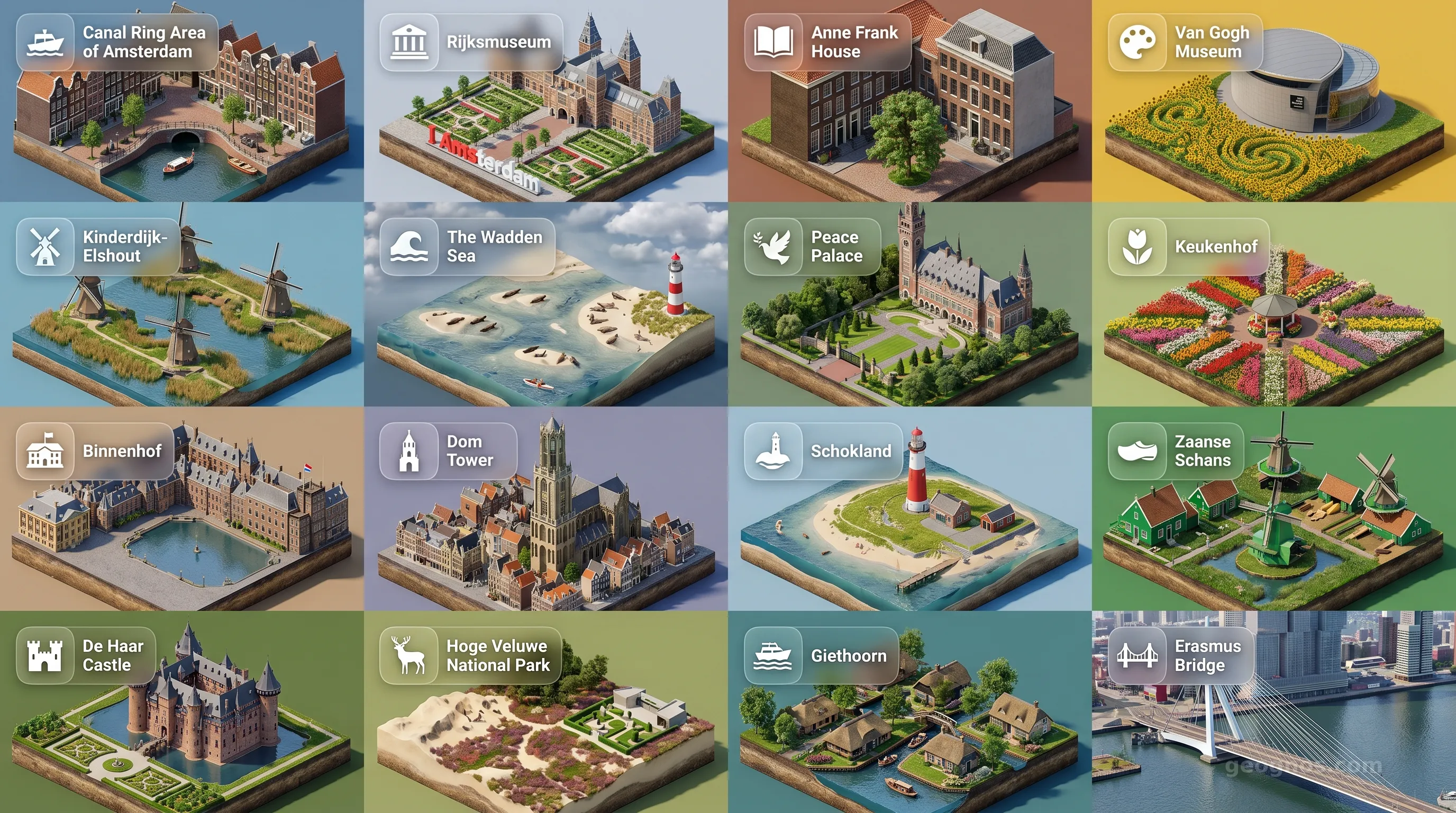
The Grachtengordel (Canal Ring) is the defining physical legacy of Amsterdam's 17th-century Golden Age, a masterpiece of urban planning and hydraulic engineering. For students of urbanism and history, studying this concentric arc of waterways provides unparalleled insight into early modern capitalism, bourgeois culture, and the expansion of the Dutch Republic. Tourists flock here for the quintessential Amsterdam experience, wandering along picturesque waterways lined with leaning, gabled townhouses. The historical significance lies in its revolutionary approach to urban expansion, which influenced city planning globally. Best season to visit is spring or early autumn to avoid the peak summer crowds while enjoying pleasant weather. Tourist tip: Skip the large commercial boats and hire a smaller, electric salon boat for a more intimate and eco-friendly tour of the narrower canals.
Pinnacle of Dutch Art and History
The Rijksmuseum is the premier national museum of the Netherlands, housing an unparalleled collection of art and artifacts from the Middle Ages to the present day. Culturally and historically, it is the beating heart of Dutch heritage, showcasing masterpieces like Rembrandt's 'The Night Watch' and Vermeer's 'The Milkmaid'. For art and history students, it is an essential study ground for understanding the Dutch Golden Age, colonialism, and European art evolution. The building itself, designed by Pierre Cuypers, is a magnificent blend of Gothic and Renaissance styles. The best season to visit is winter, particularly during weekdays, to experience the grand galleries with fewer distractions. Tourist tip: Download the free Rijksmuseum app before your visit; it offers excellent, highly detailed multimedia tours that rival expensive private guides.
A Poignant WWII Memorial
The Anne Frank House is a biographical museum centered around the secret annex where Anne Frank and her family hid from Nazi persecution during World War II. Its historical significance is profound, serving as a visceral reminder of the Holocaust and a global symbol of the fight against discrimination. For students of 20th-century history and human rights, the preserved spaces and original diary on display offer a deeply moving educational experience. It grounds the staggering statistics of WWII into a deeply personal, relatable narrative. The best season to visit is any time of year, as the exhibit is entirely indoors. Tourist tip: Tickets are released exclusively online every Tuesday for a visit six weeks later; they sell out almost instantly, so set an alarm and be prepared to book well in advance.
Iconic Dutch Water Management
Kinderdijk features a spectacular network of 19 authentic windmills built around 1740 to keep the low-lying Alblasserwaard polder dry. It is the ultimate testament to the Dutch struggle and triumph over water, a central theme of the country's national identity. Engineering and environmental students will find this site a brilliant historic case study in hydraulic technology and sustainable land reclamation. Visitors are treated to an iconic, misty Dutch landscape that feels frozen in time. The best season to visit is early autumn or late spring, specifically during the early morning or late afternoon for the best photography lighting. Tourist tip: Rent a bicycle to explore the pathways connecting the mills, and be sure to step inside the working museum mills to see the massive wooden gears in action.
The Heart of Dutch Politics
Located in The Hague, the Binnenhof is a stunning Gothic complex that has served as the center of Dutch politics for centuries and remains one of the oldest parliament buildings in the world still in use. Historically, it was the residence of the Counts of Holland, making it a critical site for political science and history students analyzing the evolution of European governance from monarchy to parliamentary democracy. The intricate Ridderzaal (Knights' Hall) is a centerpiece of architectural splendor. The best season to visit is autumn when the surrounding Hofvijver pond reflects the fall foliage and the grand facades. Tourist tip: While parts of the Binnenhof are undergoing a multi-year renovation, guided tours of the surrounding political district and the visitor center offer deep insights into Dutch democratic traditions.
The World's Largest Intertidal Zone
The Wadden Sea is a globally unique natural environment consisting of extensive tidal mudflats and wetlands stretching along the northern coast of the Netherlands. As a UNESCO World Heritage site, it boasts immense ecological importance, serving as a vital stopover for millions of migratory birds. Biology and environmental science students study this dynamic ecosystem to understand coastal geomorphology and biodiversity. For tourists, it offers a distinct landscape where you can literally walk on the bottom of the sea during low tide (wadlopen). The best season to visit is late spring to early autumn, when guided mudflat walking tours are safest and most enjoyable. Tourist tip: Never attempt to walk the mudflats without a certified guide; the tides shift incredibly fast and can be highly dangerous to the uninitiated.
The Seat of International Law
The Peace Palace in The Hague is the home of the International Court of Justice and the Permanent Court of Arbitration. Funded largely by Andrew Carnegie in 1913, it is the global symbol of international law and peaceful dispute resolution. Law and political science students flock here to study the origins of modern global governance and human rights frameworks. The neo-Renaissance architecture is heavily adorned with gifts from nations around the world, symbolizing global unity. The best season to visit is summer, when the meticulously landscaped gardens are in full bloom. Tourist tip: Access to the interior is highly restricted due to active court sessions. You must book a guided tour well in advance through their official website, which are typically only available on specific weekends.
The Modern Marvel of Flood Defense
Often dubbed the Eighth Wonder of the Modern World, the Delta Works is a massive series of dams, sluices, locks, and storm surge barriers built in the wake of the devastating 1953 North Sea flood. It is the pinnacle of coastal engineering, making it a mandatory study site for civil engineers, environmentalists, and urban planners dealing with climate change and sea-level rise. Geographically located in Zeeland, it showcases how a nation has literally engineered its own survival. The best season to visit is summer when you can combine a visit to the Neeltje Jans visitor center with a sunny drive across the immense Oosterscheldekering. Tourist tip: Take the internal tour of the storm surge barrier to walk inside the concrete pillars and truly grasp the monumental scale of the engineering.
The Island on Dry Land
Schokland was a thriving peninsula that became an island in the 15th century before being evacuated in 1859 due to relentless sea encroachments. When the Noordoostpolder was drained in 1942, Schokland was reclaimed, not as an island, but as an elevated patch of land within a vast agricultural expanse. It is a profound site for archaeological students, containing traces of human habitation dating back to prehistoric times. Culturally, it epitomizes the Dutch historical narrative of battling the sea. The best season to visit is spring or summer to enjoy the cycling paths that outline the ghost island's former shores. Tourist tip: Visit the Museum Schokland first to see the ancient footprints and artifacts recovered from the former seabed, which contextualizes the flat landscape around you.
Roman Roots and Carolingian Might
Situated in Nijmegen, the oldest city in the Netherlands, Valkhof Park is steeped in over two millennia of history. It was the site of a Roman castrum and later a massive palace built by Charlemagne in the 8th century. For history and archaeology students, the park offers a rare glimpse into the Roman Limes (border) and early medieval European power structures. Today, the park features the ruins of the St. Martin's Chapel (Barbarossa ruin) and the intact 11th-century St. Nicholas Chapel. The best season to visit is autumn when the elevated park offers sweeping, colorful views over the river Waal. Tourist tip: Pair your park stroll with a visit to the adjacent Museum Het Valkhof, which houses an impressive collection of Roman antiquities excavated from the very ground you walk on.
The Mind of a Misunderstood Genius
Dedicated to the works of Vincent van Gogh and his contemporaries, this museum in Amsterdam holds the largest collection of Van Gogh's paintings and drawings in the world. It is of monumental cultural importance, offering profound insights into the post-impressionist movement and the tumultuous psychological life of the artist. Students of art history and psychology will find the chronological layout of his life's work a brilliant case study of evolving technique and mental health. The best season to visit is winter to avoid the longest queues and most crowded gallery spaces. Tourist tip: Book your time-slotted ticket weeks in advance. Once inside, don't miss the exhibition of his letters, which provide incredibly touching context to his famous brushstrokes.
Jewel Box of the Golden Age
Located in the heart of The Hague, the Mauritshuis is an intimate art museum renowned for its phenomenal collection of Dutch Golden Age paintings. Housed in a spectacular 17th-century palace, it is historically significant for its ties to Dutch colonial history and culturally vital for preserving works like Vermeer's 'Girl with a Pearl Earring' and Rembrandt's 'The Anatomy Lesson of Dr. Nicolaes Tulp'. Art students appreciate the museum for its focused, highly curated collection that allows for deep study without the overwhelming scale of larger institutions. The best season to visit is early spring. Tourist tip: Look up at the ceiling of the grand staircase; the magnificent murals by Giovanni Antonio Pellegrini are often missed by visitors rushing to see Vermeer's masterpiece.
The Tallest Church Tower in the Netherlands
Standing at 112 meters, the Dom Tower is the iconic symbol of Utrecht. Built between 1321 and 1382, it was separated from the main cathedral when the nave collapsed in a freak tornado in 1674. For students of Gothic architecture and medieval history, it is a fascinating study of ecclesiastical power, structural engineering, and historical disaster. Tourists are rewarded with panoramic views of the city and even Amsterdam on a clear day. The best season to visit is summer or early autumn for the best visibility from the top. Tourist tip: The climb consists of 465 steps with no elevator. Wear comfortable shoes and be prepared for a physically demanding but highly rewarding ascent. Check if the current multi-year restoration scaffolding has been removed before booking.
A Glimpse into 18th-Century Dutch Life
Zaanse Schans is a residential area in Zaandam brought to life as an open-air conservation area and museum. It features a collection of well-preserved historic windmills, distinctive green wooden houses, and traditional craft shops relocated here to preserve the industrial heritage of the Zaan region. It is a living lesson for students of industrial history, demonstrating early mechanized production using wind power for sawing wood, grinding spices, and making paint. The best season to visit is late spring, offering mild weather for outdoor exploration. Tourist tip: Arrive as early as 9:00 AM to beat the massive tour bus crowds. Enjoy a fresh stroopwafel at the bakery and visit the dye mill 'De Kat' for a vibrant sensory experience.
A Subterranean Labyrinth of History
Located beneath Mount St. Pieter in Maastricht, this vast underground limestone quarry features a network of over 20,000 tunnels created by centuries of marl mining. Geologically and historically fascinating, the caves served as a refuge for locals during various sieges, including WWII, where famous artworks like 'The Night Watch' were hidden from the Nazis. Students of geology, history, and art will be captivated by the charcoal murals covering the walls and the stories of wartime survival. The temperature underground remains a constant 11°C (51°F) year-round, making it a great visit in any season. Tourist tip: You must book a guided tour to enter; the labyrinth is completely dark and extremely easy to get lost in. Bring a warm jacket even if visiting in the middle of summer.
The Grandest Castle in the Netherlands
Kasteel de Haar is a spectacular neo-Gothic fairytale castle located near Utrecht. While its foundations date back to the 13th century, the castle was meticulously rebuilt in the late 19th century by master architect Pierre Cuypers, funded by the Rothschild family. It is a perfect case study for students examining 19th-century romanticism, aristocratic lifestyles, and architectural restoration. The opulent interior and immaculate French-style gardens draw tourists looking for a taste of historical luxury. The best season to visit is summer when the extensive rose gardens are in full bloom and outdoor picnics are permitted on the estate grounds. Tourist tip: Pay attention to the intricate woodwork and bespoke tableware; Cuypers designed not just the building, but every single piece of interior decor to match.