Slovakia
Top Sights & Landmarks
Monumental Medieval Fortress Ruins
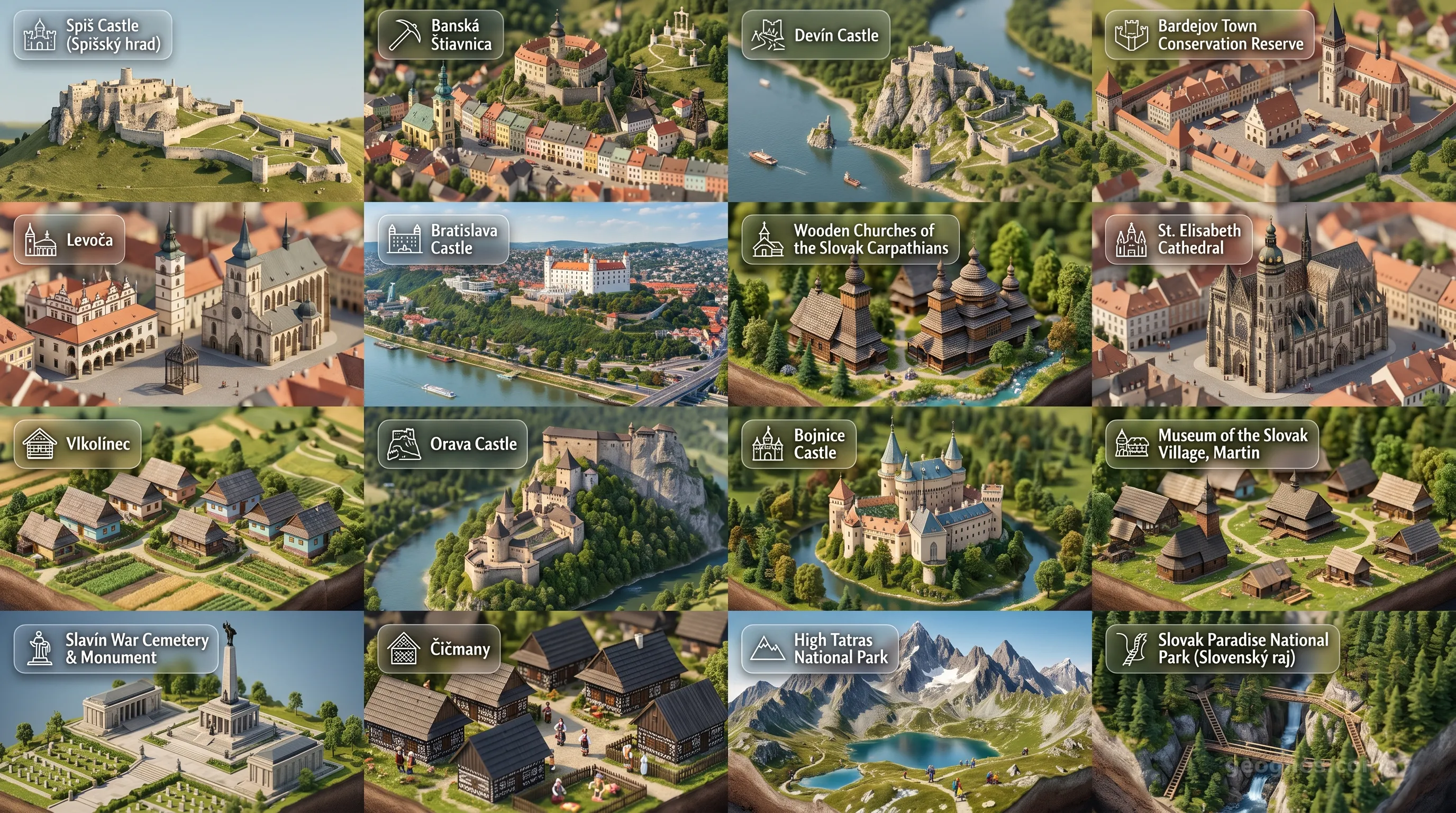
As one of the largest castle compounds in Central Europe, Spiš Castle is a focal point of Slovak history. Built in the 12th century, it served as the political, administrative, and cultural center of the Szepes county. Students of European history will find its evolution from a Romanesque stone castle to a sprawling Gothic and Renaissance complex fascinating. Tourists are rewarded with panoramic views of the surrounding countryside. The best time to visit is from May to September when the site is fully accessible and hosts historical re-enactments. Tip: Wear comfortable walking shoes, as the terrain is steep and rocky, and combine your trip with a visit to the nearby Spišská Kapitula.
Historic Silver Mining Town
Nestled in the caldera of an ancient volcano, Banská Štiavnica was once a leading center of silver and gold mining in the Habsburg Monarchy. In 1762, it became home to the first technical university in the world, making it a critical study destination for the history of science, engineering, and metallurgy. The town boasts incredibly preserved Renaissance palaces, 16th-century churches, and grand squares. Summer is the best season to visit, allowing tourists to swim in the 'tajchy'—a unique system of artificial water reservoirs originally built for mining. Tip: Don't miss the open-air mining museum where you can walk through an authentic 17th-century underground mine.
Symbol of Slavic Heritage
Perched on a massive rock at the confluence of the Danube and Morava rivers, Devín Castle is profoundly important to Slovak national identity. Its history traces back to Celtic settlements, the Roman Empire, and the Great Moravian Empire in the 9th century. Destroyed by Napoleon's troops in 1809, the ruins are now a sublime archaeological and cultural site. For students of archaeology and Slavic history, the onsite exhibitions offer invaluable insights. Late spring and early autumn provide the most pleasant weather and fewer crowds. Tip: Bring a windbreaker as the river confluence can be quite breezy, and enjoy a tasting of the local currant wine in the village below.
Immaculate Medieval Trading Center
Bardejov is one of the most beautifully preserved medieval towns in Slovakia, offering an authentic glimpse into 14th- and 15th-century urban planning. Historically significant as a major trade hub between the Black Sea and the Baltic Sea, its intact fortification system and the stunning Basilica of St. Giles stand as architectural masterpieces. The nearby Jewish suburbia also presents a poignant study of Holocaust history. Spring and summer are ideal for strolling the cobblestone town square. Tip: Climb the tower of the Basilica of St. Giles for a breathtaking bird's-eye view of the burgher houses, and later relax in the nearby Bardejov Spa.
Renaissance Gem with Master Paul's Altar
Levoča is a treasure trove of cultural heritage, enclosed by largely intact medieval town walls. Its crown jewel is the Basilica of St. James, which houses the highest wooden altar in the world, carved by the mysterious Master Paul of Levoča in the 16th century. Art history and theology students will marvel at the exquisite late-Gothic and Renaissance artifacts. The town is best visited in summer during the Mariánska hora pilgrimage, one of the oldest in the country, or in autumn for quiet appreciation. Tip: Photography is heavily restricted inside the basilica; purchase a guidebook to take the imagery home with you.
The Capital's Crown Jewel
Dominating the capital's skyline, the rectangular silhouette of Bratislava Castle overlooks the Danube River. It has served as a strategic frontier post for the Roman Empire, an important fortress of Great Moravia, and the coronation seat of Hungarian kings. Today, it houses the Slovak National Museum. History students will appreciate the profound geopolitical shifts documented within its walls. The castle grounds are beautiful year-round, but spring brings blooming gardens. Tip: The castle terrace offers arguably the best free panoramic view of Bratislava, Austria, and, on clear days, Hungary.
Masterpieces of Timber Architecture
Scattered across northeastern Slovakia, these 16th- to 18th-century wooden churches (such as those in Hervartov, Ladomirová, and Bodružal) represent an exceptional fusion of Western (Latin) and Eastern (Orthodox) Christian architectural traditions. Built entirely without a single iron nail, they are a testament to the incredible craftsmanship of local carpenters. They offer a unique case study in folk architecture and religious assimilation. Summer and early autumn allow for easier navigation on rural mountain roads. Tip: Many of these churches are kept locked to protect their interiors; you will often need to call the local caretaker (number usually on the door) to be let in.
Easternmost Gothic Cathedral in Europe
Located in the heart of Košice, St. Elisabeth Cathedral is the largest church in Slovakia and a masterpiece of High Gothic architecture. Constructed between the 14th and 16th centuries, its intricate stone carvings, gargoyles, and stunning altars command awe. Architecture and art students will find the unique double spiral staircase (one of only five in Europe) particularly captivating. December is magical due to the vibrant Christmas market surrounding the cathedral. Tip: Ensure you explore the underground crypt of Francis II Rákóczi and climb the North Tower for unparalleled views of Košice.
Untouched Traditional Carpathian Village
Vlkolínec is an exceptionally well-preserved settlement of 45 traditional wooden log houses characteristic of the mountainous areas of Central Europe. It has not been heavily altered by modern development, making it a living museum and a profound resource for ethnographers and anthropologists studying rural Carpathian life. The site is stunning under a blanket of winter snow or surrounded by lush summer greenery. Tip: Since this is still an inhabited village, please respect the privacy of the locals. Visit the designated museum houses to see historical interiors.
Dramatic Cliffside Fortress
Orava Castle looks like a fortress out of a fantasy novel, built vertically on a towering limestone rock high above the Orava River. Originally established in the 13th century to protect trade routes to Poland, it features a complex of Romanesque, Gothic, Renaissance, and Romantic styles. It famously served as the filming location for the 1922 silent horror classic 'Nosferatu.' Film students and history buffs alike will love the atmospheric courtyards and medieval weaponry exhibits. Summer offers night tours with theatrical performances. Tip: The tour requires climbing hundreds of steps, so it is not suitable for those with limited mobility.
Fairy-Tale Romantic Castle
Often cited as the most beautiful castle in Slovakia, Bojnice is a romantic, fairy-tale structure reminiscent of the French châteaux of the Loire Valley. The castle's history dates back to the 12th century, though its current spectacular form is the result of late 19th-century reconstruction by Count Ján František Pálffy. It holds significant cultural importance as a repository of historical furniture, art, and artifacts. The International Festival of Ghosts and Spirits held in May makes spring a thrilling time to visit. Tip: Explore the dripstone cave beneath the castle and say hello to the majestic 700-year-old King Matthias Linden tree near the entrance.
Largest Ethnographic Open-Air Museum
Situated near Martin, the Museum of the Slovak Village is the largest open-air museum (skanzen) in Slovakia, featuring over 100 traditional buildings transported from various regions. It offers an immersive educational experience regarding traditional Slovak agricultural practices, social dynamics, and architectural evolution from the 19th and early 20th centuries. It is an indispensable resource for students of folklore and history. Visit between May and October when the museum comes alive with craft demonstrations and folk festivals. Tip: Bring a picnic to enjoy on the expansive, peaceful grounds after completing your tour.
Imposing WWII Memorial
Overlooking Bratislava from a high vantage point, Slavín is a monumental cemetery and memorial for the thousands of Soviet soldiers who fell during the liberation of the city in April 1945. Dominated by a 39-meter obelisk topped with a statue of a victorious soldier, the site is a somber reminder of the vast human cost of WWII. It serves as a vital site for studying 20th-century geopolitical history and socialist-realist memorial architecture. The site is poignant year-round, but late afternoons offer spectacular, contemplative sunset views over the capital. Tip: The walk up is quite steep; you can take public transport part of the way up the hill if needed.
Village of Painted Houses
Čičmany is a globally unique village renowned for its dark wooden timber houses decorated with white geometric folk patterns, originally applied with lime to preserve the wood. These striking designs have become a symbol of Slovak culture, even inspiring the national Olympic team's uniforms. It is an excellent destination for those studying cultural anthropology and graphic design. Winter is particularly magical when the white patterns mimic the snow-covered landscape. Tip: Stop by the Radenov House ethnographic exhibition to learn the meaning behind the specific geometric symbols.
Slovakia's Alpine Majesty
The High Tatras are the tallest range in the Carpathian Mountains, offering dramatic alpine scenery, deep glacial valleys, and soaring peaks like Gerlachovský štít. Beyond their breathtaking beauty, they are ecologically significant, home to rare endemic species such as the Tatra chamois and Eurasian brown bear. Geography and biology students will find a rich field of study here. Hiking is unparalleled in summer and early autumn, while winter transforms the region into a premier skiing destination. Tip: Weather changes rapidly in the alpine environment; always carry a waterproof layer and start your hikes early in the morning.
Ladders, Gorges, and Waterfalls
True to its name, Slovak Paradise is a spectacular karst landscape famed for its deep ravines, cascading waterfalls, and dense forests. The park is uniquely explored via a network of wooden ladders, catwalks, and iron chains traversing over rushing streams. It is a brilliant example of geomorphology and water erosion for geology students. The summer months are best for navigating the wet gorges, though autumn brings vibrant foliage. Tip: The gorge trails are mostly strictly one-way (going up). Wear sturdy, waterproof hiking boots, as you will be walking directly over streams and slippery rocks.