Hungary
Top Sights & Landmarks
Historic Seat of Hungarian Kings
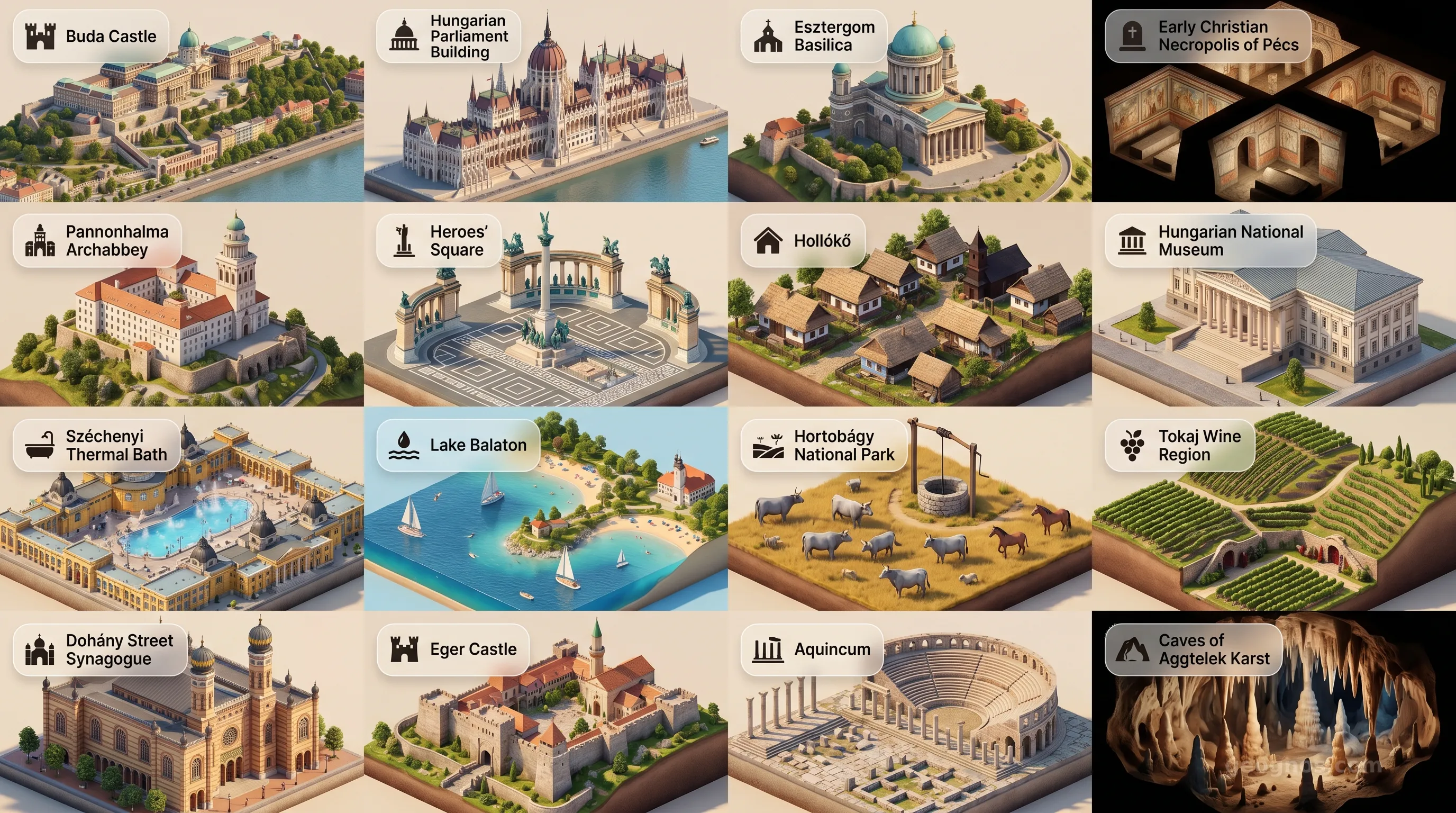
Perched above the Danube River, Buda Castle is the historical castle and palace complex of the Hungarian kings in Budapest. First completed in 1265, the massive Baroque palace occupying most of the site today was built between 1749 and 1769. It is vital for students of European history to understand Hungary's turbulent past, as the castle has been destroyed and rebuilt through numerous sieges, including World War II. Today, it houses the Hungarian National Gallery and the Budapest History Museum. The best time to visit is during the mild spring or autumn. Tourist tip: Take the historic Castle Hill Funicular from the Chain Bridge to the top for spectacular panoramic views of Pest.
Iconic Neo-Gothic Legislative Seat
The Hungarian Parliament Building is a magnificent example of Neo-Gothic architecture and the enduring symbol of Budapest. Designed by Imre Steindl and completed in 1904, it is the largest building in Hungary. Historically, it reflects the country's economic and cultural boom around the 1896 millennium. For students of political science and architecture, its intricate facade and opulent interior—housing the Holy Crown of Hungary—are essential studies. It is breathtaking year-round, though winter evenings offer magical lighting against the snow. Tourist tip: Book guided tour tickets online well in advance, as same-day entry is rarely available.
Mother Church of Hungary
Esztergom Basilica is the seat of the Catholic Church in Hungary and the largest church in the country. Located in the birthplace of Saint Stephen, the first King of Hungary, it holds immense religious and national significance. The current Classicist basilica was built in the 19th century, but the site has been a religious center since the 11th century. Students of theology and art history will marvel at its colossal altarpiece, the largest painting in the world created on a single piece of canvas. The best season to visit is summer, when you can fully enjoy the scenic Danube Bend. Tourist tip: Climb the dark, narrow stairs to the cupola for an unparalleled view extending into neighboring Slovakia.
Ancient Roman Burial Chambers
Located in the city of Pécs (the ancient Roman city of Sopianae), this 4th-century necropolis is one of the most significant early Christian provincial cemeteries in Europe. It features decorated burial chambers with remarkable biblical frescoes that provide invaluable insights into late Roman architecture and early Christian art. For archaeologists and historians, it is an unparalleled study site showing the transition from paganism to Christianity. Autumn is an excellent time to visit, pairing the ruins with the surrounding vibrant cultural festivals in Pécs. Tourist tip: Do not miss the Cella Septichora visitor center, which beautifully integrates modern walkways over the ancient underground ruins.
Millennium-Old Benedictine Monastery
Founded in 996, the Pannonhalma Archabbey is one of the oldest historical monuments in Hungary. It has been a continuous center of Benedictine monastic life and education for over a thousand years. The complex showcases a fascinating blend of Romanesque, Gothic, and Baroque architectural styles. The abbey's monumental library holds incredibly rare manuscripts, including the oldest surviving document containing Hungarian words (from 1055). It is perfect for a late summer visit. Tourist tip: Explore the extensive arboretum and lavender fields, and be sure to taste the wine produced by the monks in the abbey's modern winery.
Monument to the Magyars
Heroes' Square (Hősök tere) is Budapest's largest and most symbolic square, built in 1896 to commemorate the thousandth anniversary of the Hungarian conquest of the Carpathian Basin. The iconic Millennium Monument features the Seven Chieftains of the Magyars and other important Hungarian national leaders, overseen by the Archangel Gabriel. It is a vital open-air textbook for students of Hungarian history and national identity. Spring brings beautiful weather for strolling the adjacent City Park. Tourist tip: Visit at twilight to see the statues dramatically illuminated against the night sky, and combine your trip with a visit to the nearby Museum of Fine Arts.
Living Traditional Palóc Village
Hollókő is an outstanding example of a deliberately preserved traditional settlement. This charming village has maintained its 17th-century rural architecture and the unique cultural heritage of the Palóc people, an ethnic subgroup of Hungarians. Rather than an open-air museum, it is a living community. Ethnography and sociology students will find it a fascinating study of traditional agricultural life in the 20th century. The absolute best time to visit is during the Easter festival, which bursts with folk costumes and traditional water-pouring customs. Tourist tip: Walk up to the ruins of the 13th-century Hollókő Castle for a beautiful view of the Cserhát Hills.
Repository of National History
The Hungarian National Museum in Budapest is the primary institution for discovering the history, art, and archaeology of Hungary. Housed in a striking Neoclassical building constructed in 1847, the museum itself played a pivotal role in the 1848 Hungarian Revolution when poet Sándor Petőfi purportedly read his 'National Song' from its steps. The collections range from prehistoric artifacts to contemporary history, making it indispensable for history students. The museum is a great year-round indoor destination. Tourist tip: Look specifically for the Hungarian Coronation Mantle, a stunning piece of 11th-century silk embroidery.
Europe's Largest Medicinal Bath
Located in Budapest's City Park, the Széchenyi Thermal Bath is a sprawling complex of 18 pools fed by natural hot springs. Built in 1913 in a vibrant Neo-Baroque style, it reflects Hungary's deep-rooted spa culture, which dates back to the Roman and Ottoman eras. Beyond relaxation, it is a cultural study of Hungarian social life, where locals famously play chess on floating boards. Winter is arguably the most magical season to visit, sitting in steaming outdoor pools while snow falls. Tourist tip: Bring your own towel and flip-flops to save on rental fees, and arrive early morning to beat the massive crowds.
The Hungarian Sea
Lake Balaton is the largest freshwater lake in Central Europe and serves as the ultimate summer playground for Hungarians. Historically, the lake region was heavily fortified with castles defending against the Ottomans, and later became an elegant resort area for 19th-century aristocrats. It is ecologically significant and surrounded by a diverse landscape of volcanic hills and vineyards. Summer is peak season for swimming and sailing, but early autumn is perfect for cycling the lake's perimeter and wine tasting. Tourist tip: Visit the Tihany Peninsula to see the stunning Benedictine Abbey and enjoy the famous echo of Tihany.
The Great Hungarian Plain
Hortobágy is Europe's largest continuous natural grassland and the cultural heartland of the Hungarian Puszta. It has been shaped by millennia of pastoral societies and is home to traditional Hungarian grey cattle, Racka sheep, and the famous 'csikós' (horse herdsmen). For biology and environmental students, the park is a crucial sanctuary for migratory birds. Spring and autumn offer the best bird-watching opportunities and milder weather for outdoor exploration. Tourist tip: Book a horse-drawn carriage tour to get deep into the plains and witness the awe-inspiring horsemen shows.
Birthplace of the Wine of Kings
The Tokaj region in northeastern Hungary is world-renowned for its Aszú, a sweet botrytized wine favored by European royalty for centuries (dubbed 'Wine of Kings, King of Wines' by Louis XIV). The landscape consists of ancient vineyards, historic villages, and labyrinthine underground cellars carved into volcanic tuff. It is a fantastic destination for viticulture and culinary students to study unique terroir and centuries-old winemaking traditions. Autumn, during the harvest season, is vibrant and highly recommended. Tourist tip: Rent a bicycle to travel between the small villages, and always pair your wine tastings with local artisanal cheeses.
The Great Synagogue
The Dohány Street Synagogue in Budapest is the largest synagogue in Europe and a stunning example of Moorish Revival architecture, built in 1859. It is the spiritual and historical center of Hungary's Jewish community. The complex includes the Hungarian Jewish Museum, the Holocaust Memorial Room, and the Raoul Wallenberg Memorial Park with the striking weeping willow memorial. It provides a profound historical study of Jewish life and tragedy in Central Europe. Accessible year-round, it offers a deeply moving experience. Tourist tip: Modest dress is strictly required; men are required to cover their heads (kippahs are provided at the entrance).
Symbol of Hungarian Heroism
Eger Castle is legendary in Hungarian history for the 1552 Siege of Eger, where a small garrison led by István Dobó successfully defended against a massive Ottoman army. The victory is immortalized in the famous novel 'Eclipse of the Crescent Moon'. Today, the castle features excellent museums covering the siege, medieval armories, and regional history, making it highly engaging for history students. Summer offers lively historical reenactments and medieval festivals. Tourist tip: After exploring the extensive casemates beneath the castle, head to the nearby Valley of the Beautiful Women to taste the legendary 'Bull's Blood' (Egri Bikavér) red wine.
Ancient Roman City Ruins
Located in the northern part of Budapest (Óbuda), Aquincum was once a major city and military camp at the borders of the Roman Empire. Serving as the capital of the province of Pannonia Inferior, it provides a comprehensive look at Roman urban life, featuring ruins of amphitheaters, thermal baths, and elaborate floor mosaics. It is a goldmine for students of classical antiquity. Late spring is pleasant for walking the expansive outdoor archaeological park. Tourist tip: Download or rent the museum's audio guide, which does an excellent job of bringing the low-lying stone foundations to life with vivid historical context.
Vast Underground Labyrinth
Shared with Slovakia, the Aggtelek Karst features a remarkably diverse system of over 700 caves. The crown jewel is the Baradla Cave, stretching for 26 kilometers and filled with gigantic, otherworldly stalactite and stalagmite formations. For geology and geography students, it is an unparalleled showcase of karst development and subterranean ecosystems. The caves maintain a steady 10°C (50°F) temperature, making it a perfectly cool retreat during the sweltering summer months. Tourist tip: Wear sturdy, slip-resistant shoes and bring a warm sweater, even if it is scorching hot above ground.