Croatia
Top Sights & Landmarks
Roman Emperor's Retirement Fortress
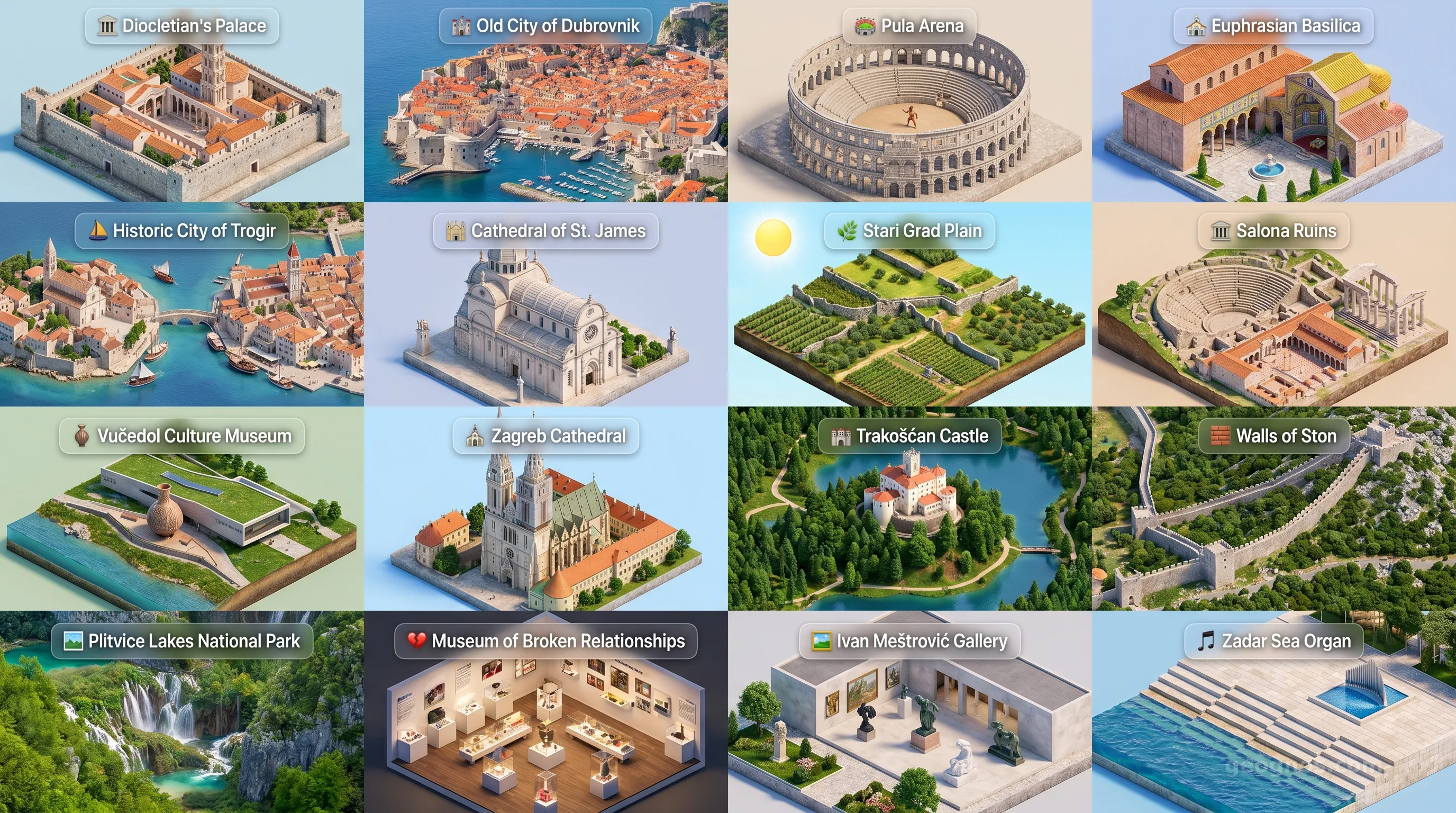
Constructed at the turn of the 4th century AD for the Roman Emperor Diocletian, this massive complex forms the very heart of modern-day Split. Students of history and architecture will be fascinated by how medieval, Renaissance, and modern buildings were seamlessly integrated into the ancient Roman walls. It is highly significant as one of the most complete architectural and cultural features of the Roman Empire on the Adriatic coast. The best time to visit is during the shoulder seasons of May or September to avoid the extreme summer heat and overwhelming crowds. Tourist tip: Explore the subterranean cellars (Podrumi) to see the original structural layout of the palace above.
The Pearl of the Adriatic
A stunningly preserved walled city that served as the capital of the prosperous maritime Republic of Ragusa. Its historical significance is immense, having been a sophisticated state that rivaled Venice in Mediterranean trade, diplomacy, and culture. It offers a living classroom for studying late-medieval urban planning, diplomacy, and defensive architecture. To truly appreciate its beauty without the intense summer cruise ship crowds, visit in October or April. Tourist tip: Walk the iconic two-kilometer-long city walls first thing in the morning as soon as they open to capture the best lighting and escape the midday heat.
Magnificent Roman Amphitheater
Constructed between 27 BC and 68 AD, the Pula Arena is among the six largest surviving Roman arenas in the world and the only one to have all four side towers completely preserved. Historically, it is a testament to the importance of the Istrian peninsula during the Roman Empire. Architecture and history students can examine the advanced Roman engineering, including the underground passages once used by gladiators. Summer is an incredible time to visit because the arena transforms into an open-air stage for film festivals and concerts, though late spring offers quieter historical study.
Early Byzantine Masterpiece
Located in the coastal town of Poreč, this 6th-century episcopal complex is an outstanding, intact example of early Byzantine architecture in the Mediterranean region. It is crucial for art history students studying the transition from classical to early medieval religious art, notably featuring breathtaking, glittering gold mosaics in its apse that rival those of Ravenna. The complex includes a church, memorial chapel, atrium, and an episcopal palace. Early autumn or late spring are the best seasons to visit. Tourist tip: Climb the 16th-century bell tower for a sweeping panoramic view of Poreč and the Adriatic Sea.
Romanesque-Gothic Island Town
Trogir boasts an exceptionally well-preserved urban fabric that has been continuously evolving since it was founded by Greek colonists in the 3rd century BC. Set on a small island connected by bridges, it features heavily concentrated Romanesque and Renaissance architecture, including the intricate portal of the Cathedral of St. Lawrence, carved by the master Radovan. It is an essential destination for studying medieval stonemasonry and Venetian urban influence. Visit in May or June for pleasant strolls. Tourist tip: Get lost in the labyrinthine cobblestone alleys; the island is small enough that you will never truly lose your way.
Renaissance Stone Masterwork
Situated in Šibenik, this 15th- and 16th-century basilica is a marvel of engineering, built entirely from stone without the use of mortar or wooden supports. Designed by master architects including Juraj Dalmatinac, it represents a unique fusion of Gothic and Renaissance styles. The cathedral is famous for its frieze of 71 sculptured faces of ordinary citizens from the era, providing invaluable socio-cultural insight. The best time to visit is during the quiet months of April or September. Tourist tip: View the cathedral from the steps leading up to St. Michael's Fortress to appreciate its magnificent dome set against the sea.
Ancient Greek Agricultural Landscape
Set on the island of Hvar, this cultural landscape has remained practically intact since Ionian Greeks from Paros colonized it in the 4th century BC. The original agricultural layout, characterized by geometric dry-stone wall parcels used for cultivating olives and grapes, is still in use today. For students of antiquity and agriculture, it is a rare, living 2,400-year-old grid system. Late summer to autumn is spectacular, aligning with the grape and olive harvests. Tourist tip: Rent a bicycle to ride through the ancient fields, sampling local wines and olive oils from the descendant vines and groves.
Capital of Roman Dalmatia
Located in the modern town of Solin, just outside Split, Salona was once a thriving metropolis and the capital of the Roman province of Dalmatia, housing over 60,000 inhabitants. Today, it is an expansive archaeological park featuring the ruins of an amphitheater, early Christian basilicas, Roman baths, and a sprawling necropolis. It provides phenomenal insights into the expansion and eventual fall of Roman power in the Balkans. Visit in spring to enjoy the wildflowers blooming among the ruins. Tourist tip: The site is vast and relatively unshaded, so bring plenty of water, a hat, and comfortable walking shoes.
Prehistoric Copper Age Settlement
Located near the eastern city of Vukovar along the Danube river, this highly modern museum sits on one of the most significant Eneolithic (Copper Age) archaeological sites in Europe. The Vučedol culture (3000-2500 BC) was highly advanced, possessing the oldest Indo-European calendar and practicing advanced metallurgy. It is a must-visit for students of prehistory and anthropology. The indoor nature of the museum makes it a great year-round destination. Tourist tip: Take time to study the famous 'Vučedol Dove' artifact replica, a symbol of peace and cultural pride for the region.
Twin-Spired Gothic Monument
The tallest building in Croatia, this Roman Catholic cathedral is a monumental sacral building in the Gothic style southeast of the Alps. Originally built in the 13th century, it was heavily reconstructed by architect Hermann Bollé after the devastating 1880 earthquake. It holds immense national importance, housing the remains of significant Croatian figures. History and architecture students can observe the ongoing structural retrofitting and the blending of historical periods. Visit year-round, particularly in December during Zagreb's famous Advent. Tourist tip: Check local updates prior to visiting, as the interior may have restricted access due to ongoing restorations from the 2020 earthquake.
Romanticist Neo-Gothic Fortress
Perched dramatically on a hill above a serene lake in northern Croatia, Trakošćan was built in the 13th century as a modest observation fortress but was transformed in the mid-19th century into a romantic Neo-Gothic residential manor by the Drašković noble family. The castle's museum provides an immersive look into the lifestyle, weaponry, and art of Croatian nobility over centuries. Autumn is arguably the best time to visit when the surrounding forest canopy erupts in fiery colors. Tourist tip: Allot an extra hour to walk the peaceful 5-kilometer path circling the lake beneath the castle.
The European Wall of China
Built in the 14th century by the Republic of Ragusa, this 5.5-kilometer-long defensive wall connects the towns of Ston and Mali Ston. It was constructed primarily to protect the highly lucrative salt pans, which generated massive wealth for the republic. It remains one of the longest preserved fortification systems in the world. For military history students, it is an unparalleled example of medieval defense strategy. Spring and autumn are the best times to tackle the strenuous climb. Tourist tip: After hiking the walls, reward yourself with fresh oysters in Mali Ston, considered among the best in the world.
Terraced Lakes and Waterfalls
Croatia's most famous national park and a UNESCO World Heritage site, renowned for its chain of 16 terraced lakes joined by spectacular waterfalls that extend into a limestone canyon. The geological phenomena of travertine (tufa) barriers constantly growing and reshaping the water flow make it a prime location for studying hydrology, botany, and geology. While summer is peak season, late spring (May) or early autumn (September) offer rushing waters with fewer crowds. Winter transforms the park into a frozen wonderland. Tourist tip: Buy your entry tickets well in advance online, as daily visitor caps are strictly enforced.
Collection of Emotional Artifacts
Located in Zagreb's Upper Town, this deeply moving, globally acclaimed contemporary museum exhibits personal objects left over from former lovers, accompanied by brief stories. It offers profound psychological and sociological insights into human relationships, grief, and emotional catharsis across different cultures. It is an outstanding study in modern curatorial practices and human anthropology. Being indoors, it is a perfect year-round destination. Tourist tip: Bring tissues, as the stories range from hilarious to utterly heartbreaking; plan for a lighthearted coffee in the museum's adjacent café afterward.
Masterpieces of a Sculptural Genius
Housed in a beautiful seaside villa in Split that the artist built for his family, this art museum is dedicated to the work of Ivan Meštrović, Croatia's greatest 20th-century sculptor. The gallery contains his masterpieces in bronze, marble, and wood, offering an deep dive into modern monumentalism and national artistic identity. Art students will appreciate the evolution of his style from Secessionist to monumental classicism. The gardens offer stunning views of the Adriatic, making sunset visits particularly special. Tourist tip: Your ticket also grants access to the nearby Kaštelet-Crikvine, a chapel housing Meštrović's extraordinary wooden reliefs of the life of Christ.
Musical Architectural Sound Art
Designed by architect Nikola Bašić, the Sea Organ (Morske orgulje) is an experimental architectural sound art object located on the coast of Zadar. Underneath marble steps leading into the Adriatic Sea, a system of polyethylene tubes and a resonating cavity translates the rhythm of the waves into hauntingly beautiful, randomized musical chords. It is a fantastic case study for students of acoustic engineering and urban landscape design. The best time to visit is at sunset. Tourist tip: Stick around just after the sun dips below the horizon to see the adjacent 'Greeting to the Sun' installation light up the promenade.