Montenegro
Top Sights & Landmarks
The Venetian Jewel of the Adriatic
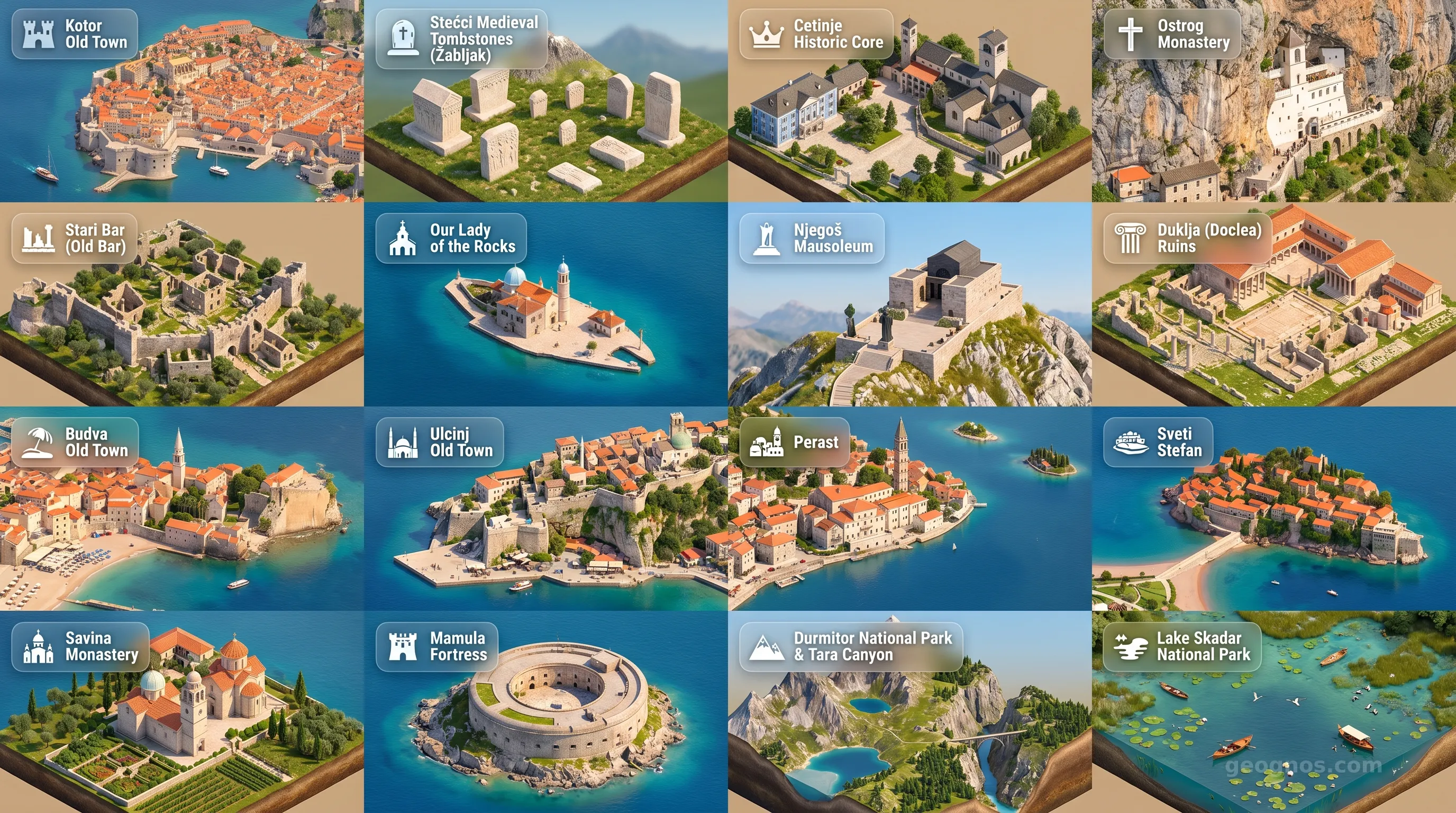
Kotor is an unparalleled destination for studying Venetian-era Mediterranean architecture and medieval urban planning. Nestled in a dramatic ria (submerged river canyon), this site is famous for its fortified walls that snake up the steep St. John's Mountain. Its historical significance lies in its centuries as a vital maritime trade hub under Venetian rule, evident in its labyrinth of cobblestone streets, grand patrician palaces, and the 12th-century St. Tryphon Cathedral. The best time to visit is during the shoulder seasons of May or September to avoid intense summer crowds and heat. Tourist tip: Arrive early in the morning to hike the 1,350 ancient steps to the Castle of San Giovanni for unobstructed, panoramic views over the Bay of Kotor before the cruise ship crowds arrive.
Enigmatic Medieval Graveyards
The Stećci are monumental medieval tombstones scattered across the Balkans, and Montenegro hosts incredibly preserved sites, notably Grčko Groblje near Žabljak. Ideal for history and anthropology students, these monolithic stones feature intricate carvings of pagan and Christian symbols, hunting scenes, and archaic epigraphs dating from the 12th to the 16th century. They offer a rare window into the intertwined religious and cultural history of the medieval Balkans. The best time to visit is between June and September, when the mountain snow has melted. Tourist tip: Combine this historical excursion with a visit to the nearby Riblje Lake to enjoy the striking contrast of ancient archaeological mysteries set against dramatic alpine scenery.
The Old Royal Capital
Cetinje is the historical and cultural heart of Montenegro. Once the royal capital, it is an essential site for studying the country's turbulent struggle for independence against the Ottoman Empire. The town is dotted with former European embassies featuring distinctive architectural styles, the Cetinje Monastery (holding relics like the right hand of John the Baptist), and the National Museum of Montenegro. It serves as a living museum of 19th-century state-building. Spring and early autumn are the best seasons to visit for mild weather. Tourist tip: Purchase a combined museum ticket to gain access to King Nikola’s Palace, the Biljarda (former residence of Prince-Bishop Njegoš), and the Art Museum, all within walking distance of each other.
The Miracle in the Cliff
Carved into a nearly vertical mountain cliff, the 17th-century Ostrog Monastery is the most important spiritual and pilgrimage site in Montenegro, drawing Orthodox Christians, Catholics, and Muslims alike. Founded by Vasilije, the Metropolitan Bishop of Herzegovina, the site is an architectural marvel that prompts awe and academic interest in religious coexistence and high-altitude ecclesiastical engineering. The monastery houses stunning frescoes painted directly onto the cave walls. The best time to visit is late spring or early autumn, avoiding the massive pilgrimage crowds of summer. Tourist tip: Modest dress is strictly required. For the full traditional experience, consider walking barefoot up the final path from the Lower to the Upper Monastery, as many pilgrims do.
The Pompeii of Montenegro
Unlike the coastal town of modern Bar, Stari Bar is an ancient settlement situated in the foothills of Mount Rumija. Abandoned after a devastating earthquake in 1979, it is now an expansive open-air archaeological site. It provides scholars and visitors with a tangible timeline of Byzantine, Venetian, and Ottoman architectural influences spanning over a millennium. Key structures include a 14th-century fortress, an Ottoman bathhouse, and ancient aqueducts. The site is best visited in spring when the ruins are draped in vibrant wildflowers. Tourist tip: Wear sturdy shoes as the ancient cobblestones can be slippery. Don't miss the Stara Maslina nearby, an olive tree reputed to be over 2,000 years old.
The Man-Made Island Sanctuary
Gospa od Škrpjela (Our Lady of the Rocks) is a breathtaking artificial island situated off the coast of Perast in the Bay of Kotor. According to legend, it was built over centuries by local seamen who dropped rocks into the sea after finding an icon of the Madonna and Child on a sea rock in 1452. The Catholic church on the island boasts 68 magnificent paintings by Tripo Kokolja, making it a masterclass in Baroque art and maritime heritage. It is a brilliant study of local folklore morphing into monumental architecture. Summer offers the easiest boat access, though spring is less crowded. Tourist tip: Take a quick boat taxi from Perast and make sure to visit the tiny museum attached to the church, which houses hundreds of silver votive tablets donated by grateful sailors.
The Resting Place of a Poet Prince
Perched at the spectacular peak of Mount Lovćen, this monumental mausoleum is dedicated to Petar II Petrović-Njegoš, Montenegro's greatest prince-bishop, philosopher, and poet. Designed by renowned sculptor Ivan Meštrović, the structure is an imposing marvel of granite and marble featuring a stunning 28-ton statue of Njegoš under a ceiling covered in 200,000 gold tiles. It is a symbol of Montenegrin national identity and a must-visit for students of Slavic literature and history. Summer is the optimal time to visit, as the mountain roads can be closed due to snow in winter. Tourist tip: Be prepared to climb 461 steps to reach the mausoleum. On a clear day, the circular viewing platform behind the monument offers a 360-degree view encompassing Montenegro, Albania, Croatia, and sometimes even the coast of Italy.
The Roman Predecessor to Podgorica
Located just a few kilometers from the modern capital of Podgorica, the ruins of Duklja (Doclea) offer a fascinating glimpse into Roman urbanization in the Balkans. Founded in the 1st century AD, Doclea became the capital of the Roman province of Praevalitana. Students of antiquity can explore the remnants of the forum, basilicas, thermae (baths), and ancient necropolises. The site highlights the region's importance in the Roman trade network before its destruction by earthquakes and barbarian invasions. Spring and autumn are the best times to wander the ruins comfortably. Tourist tip: Since the site is mostly unshaded and lacks extensive tourist facilities, bring water, a hat, and a good guidebook or hire a local guide to fully interpret the scattered stone foundations.
The Ancient Illyrian Settlement
Budva Old Town (Stari Grad) is one of the oldest urban centers on the Adriatic coast, with historical records dating back over 2,500 years. Originally an Illyrian settlement, it later absorbed Greek, Roman, and Venetian influences. Encircled by medieval stone walls, its narrow streets host numerous historic churches, including the 7th-century Church of St. John. The citadel offers a fantastic vantage point and houses a maritime museum. It is an excellent location to study the layering of Mediterranean civilizations. September is ideal, offering warm seas and fewer tourists than the peak summer months. Tourist tip: Explore the ancient Roman necropolis located just outside the Old Town walls, and enjoy a seaside coffee at the Richard's Head beach adjacent to the medieval fortifications.
The Pirate Stronghold of the Adriatic
Perched on a dramatic cliff overlooking the Adriatic Sea, Ulcinj's Old Town is steeped in a multi-layered history of Illyrians, Romans, Byzantines, Venetians, and Ottomans. Uniquely, in the 16th century, it became a notorious stronghold for pirates, and legend has it that the famous author Miguel de Cervantes was held captive here, inspiring characters in 'Don Quixote'. Its unique blend of Eastern and Western architecture, including the Slave Square (Trg Robova), makes it a rich subject for historical study. Late spring and early autumn provide excellent weather for exploration. Tourist tip: Visit the local museum complex within the citadel to see archaeological artifacts from the Bronze Age to the Ottoman period, and stay for sunset when the stone walls glow against the sea.
The City of Captains and Palaces
Perast is a remarkably preserved Baroque town on the Bay of Kotor, serving as a time capsule of the region's golden age of seafaring. During the 17th and 18th centuries, it boasted an impressive fleet and produced some of the Adriatic's most skilled naval captains. Today, students of architecture and history can marvel at its 16 ruined or preserved palaces and 19 Catholic churches, built primarily during Venetian rule. May and June are ideal for visiting, capturing the town in bloom without the heavy summer traffic. Tourist tip: Climb the 55-meter-high bell tower of the Church of St. Nicholas for a spectacular view of the town’s rooftops and the straight of Verige, the narrowest point of the Boka Bay.
The Iconic Fortified Islet
Sveti Stefan is arguably the most photographed site in Montenegro. Originally a 15th-century fortified fishing village built to defend the Paštrovići tribe against Ottoman and pirate attacks, the islet is connected to the mainland by a narrow tombolo. Although it is now a luxury resort, its exterior remains perfectly preserved, showcasing authentic stone houses with red-tiled roofs. It offers a prime example of vernacular coastal architecture adapted for defense. Summer is the most vibrant time to visit the surrounding areas. Tourist tip: While access to the island itself is restricted to resort guests and paid tours, the viewpoint from the mainland coastal road (or a walk through the adjacent Miločer Park) provides the best photo opportunities.
The Boka Bay's Baroque Masterpiece
Nestled amidst lush Mediterranean vegetation in Herceg Novi, the Savina Monastery complex comprises three churches, the oldest dating back to the 11th century. The grandest is the Church of the Dormition, an exquisite example of Serbian Baroque architecture featuring a magnificent iconostasis and treasures including a crystal cross belonging to St. Sava. It is highly significant for the study of Orthodox monasticism and the intersection of Byzantine and Baroque artistic styles in the Adriatic region. Spring is particularly beautiful as the surrounding gardens burst into color. Tourist tip: Enjoy the serene, shaded courtyard and sample the monastery's own wine, produced from the small vineyard directly overlooking the entrance to the Bay of Kotor.
The Circular Island Fortress
Occupying 80% of the small, rocky island of Lastavica at the entrance to the Bay of Kotor, Mamula Fortress is a striking 19th-century military installation built by Austro-Hungarian general Lazarus von Mamula. It is historically significant not only as a feat of defensive naval architecture but also for its dark history during World War II, when it was used as a concentration camp by fascist forces. Today, it has been controversially transformed into a high-end resort, yet its imposing circular geometry remains a subject of study for military historians. Best seen during the summer via boat tours. Tourist tip: If you cannot access the interior due to hotel operations, a boat tour passing closely around the island still offers an incredible appreciation of its massive defensive stonework.
The Tear of Europe
Durmitor National Park is a majestic massif boasting 48 peaks over 2,000 meters and 18 glacial lakes known as 'mountain eyes'. Bordering it is the Tara River Canyon, the deepest gorge in Europe (reaching depths of 1,300 meters). Protected as a UNESCO World Heritage site, it is a paradise for geologists, biologists, and outdoor enthusiasts studying glacial landscapes and endemic alpine biodiversity. It also holds historical significance related to partisan movements during WWII. Summer is perfect for hiking and rafting, while winter transforms the area into a premier ski destination. Tourist tip: Do not miss a walk around the Black Lake (Crno Jezero), and thrill-seekers should book a white-water rafting trip on the Tara River to experience the canyon's scale from the bottom up.
The Balkan's Largest Lake
Straddling the border between Montenegro and Albania, Lake Skadar is the largest lake in the Balkan Peninsula and one of Europe’s most important bird reserves, famously home to the rare Dalmatian pelican. Historically, the lake is dotted with tiny islands holding medieval Orthodox monasteries (such as Kom and Starčevo) and remnants of Ottoman fortresses. It provides a unique setting for studying wetland ecosystems intertwined with medieval spiritual retreats. Spring and autumn are the best seasons for bird watching and comfortable boat cruises. Tourist tip: Rent a traditional 'čun' (wooden boat) from the village of Virpazar to navigate the lily-pad-covered waters, and sample the local Crmnica wine, Vranac, in the surrounding lakeside villages.