Albania
Top Sights & Landmarks
A Microcosm of Mediterranean History
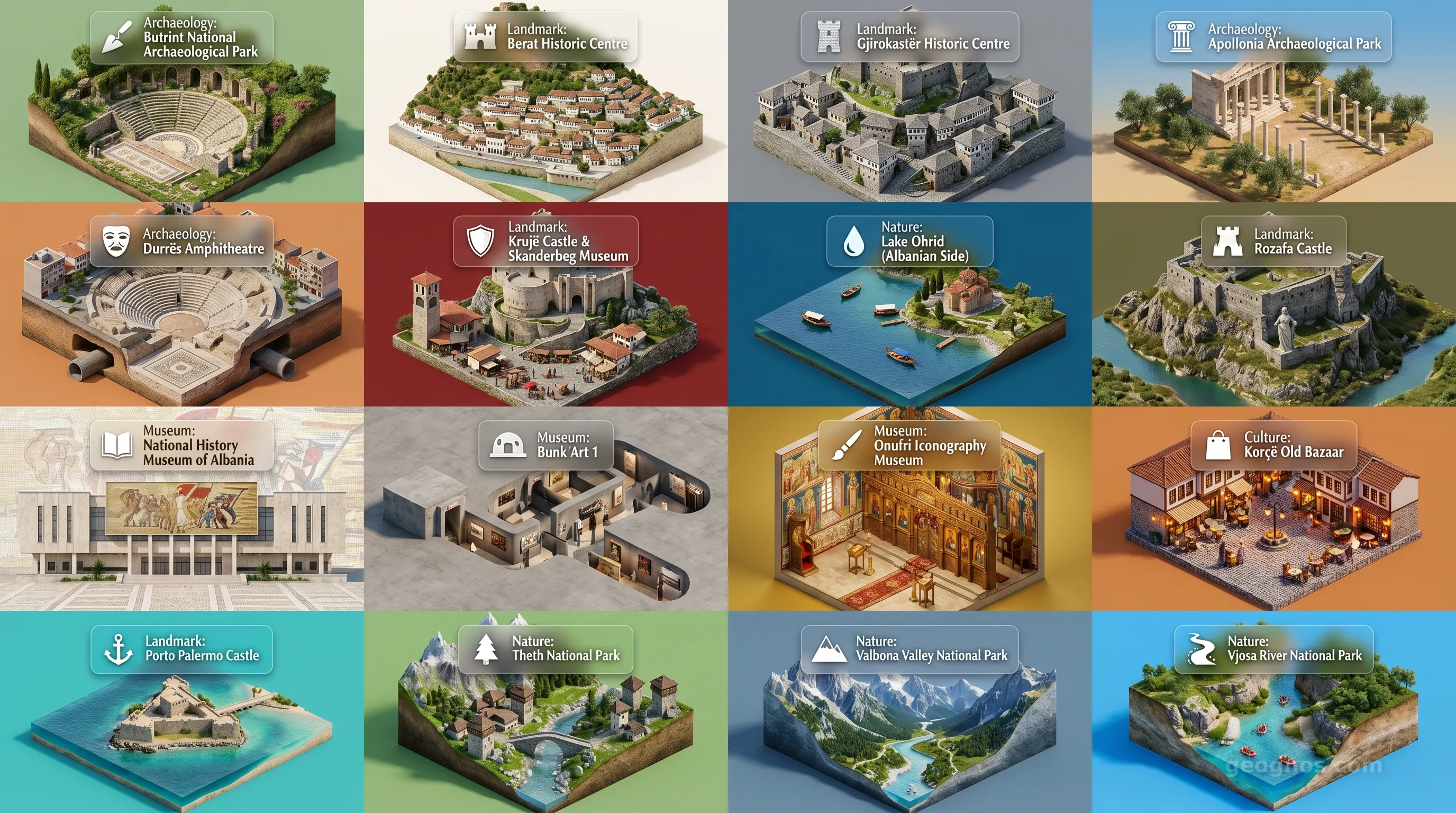
Butrint is Albania's most significant archaeological site, offering a fascinating timeline that spans Greek, Roman, Byzantine, and Venetian periods. For history and archaeology students, it is a living laboratory, displaying well-preserved ruins like a Roman theater, early Christian baptistery, and ancient city walls set within a lush national park. The site's historical significance lies in its strategic maritime location, which made it a coveted settlement for centuries. The best season to visit is Spring or Autumn to avoid the intense summer heat and dense crowds. Tourist Tip: Dedicate at least three hours to explore the ruins and the surrounding wetlands, which are also rich in endemic biodiversity.
The Town of a Thousand Windows
Renowned for its striking Ottoman-era white houses cascading down a steep hill, Berat represents a rare example of a well-preserved Ottoman town displaying harmonious coexistence of various religious and cultural communities. For architectural and sociological studies, the layout of the Mangalem and Gorica neighborhoods provides excellent insights into 18th and 19th-century urban planning. The Kala (citadel) is uniquely still inhabited today. The best time to visit is May or September. Tourist Tip: Walk up the steep cobblestone paths to the castle just before sunset for breathtaking golden-hour views of the Osum River valley.
The Stone City of the Balkans
Gjirokastër is a phenomenal showcase of traditional Ottoman tower houses (kullë) built entirely of stone, including their characteristic slate roofs. Culturally significant as the birthplace of former dictator Enver Hoxha and internationally acclaimed author Ismail Kadare, the city is a prime destination for students of Balkan history and literature. The formidable Gjirokastër Castle dominates the skyline and houses a fascinating weapons museum. The best season to visit is late Spring to early Autumn. Tourist Tip: Make sure to visit the Skenduli House for an authentic guided tour by a descendant of the original wealthy Ottoman-era owners.
The Ancient City Where Augustus Studied
Founded in 588 BC by Greek colonists from Corfu and Corinth, Apollonia grew into a massive economic and cultural hub in the Roman Empire. It holds immense historical importance as the place where the young Octavian (future Emperor Augustus) was studying when he learned of Julius Caesar's assassination. Students of classical antiquity will marvel at the Bouleuterion (monument of Agonothetes) and the Odeon. Spring is the ideal season to visit when the surrounding fields are vibrant and green. Tourist Tip: Don't miss the adjacent Archaeological Museum housed inside a beautifully preserved 13th-century Byzantine monastery.
The Largest Amphitheatre in the Balkans
Built in the 2nd century AD during the reign of Emperor Trajan, this colossal Roman amphitheatre once held up to 20,000 spectators. It is of profound importance for studying Roman engineering and early Christian history, featuring a rare early Christian chapel with stunning wall mosaics built directly into the amphitheatre's galleries centuries later. The site reflects the complex, multi-layered history of Durrës (ancient Dyrrachium). Best visited in Spring or Autumn. Tourist Tip: After exploring the subterranean tunnels, walk down to the nearby Venetian Tower and the vibrant seaside promenade.
The Stronghold of Albania's National Hero
Krujë Castle was the epicenter of the Albanian resistance against the Ottoman Empire in the 15th century, successfully defended by the national hero, George Castriot Skanderbeg, in three major sieges. For students of European history, Krujë is a symbol of the Christian buffer against Ottoman expansion. Inside the fortress walls lies the Skanderbeg Museum, designed in the 1980s by the dictator's daughter, offering an epic (if stylized) narrative of the era. Visit year-round, though early Autumn is highly pleasant. Tourist Tip: Stroll through the traditional Old Bazaar on your way up to the castle to purchase authentic handmade carpets, silver jewelry, and antiques.
Europe's Oldest Lake
Shared with North Macedonia, Lake Ohrid is one of the oldest and deepest lakes in Europe, dating back over three million years. It is an exceptional site for biology and geology students due to its highly unique ecosystem, containing hundreds of endemic species, such as the rare Koran trout. The town of Pogradec offers a relaxed atmosphere steeped in Albanian literature and art. Summer is the best season for swimming and lakeside activities. Tourist Tip: Dine at a lakeside restaurant in the village of Lin or Drilon and order the traditional Koran fish baked in a pan.
The Fortress of Immurement
Towering over the northern city of Shkodër, Rozafa Castle boasts Illyrian origins with later Venetian and Ottoman modifications. It is steeped in a haunting Balkan folklore legend about a woman named Rozafa who was immured (walled alive) into the castle foundations to ensure its walls would not collapse. History students can trace centuries of military strategy through its overlapping architectural styles. The panoramic views of the meeting point of the Drin, Kir, and Buna rivers are unparalleled. Visit in Spring or Autumn. Tourist Tip: Wear sturdy shoes as the ancient cobblestone paths inside the fortress can be quite slippery.
A Journey Through the Albanian Identity
Located in Tirana's Skanderbeg Square, this museum is Albania's largest, instantly recognizable by the massive socialist-realist mosaic on its facade titled 'The Albanians.' It is an essential starting point for anyone studying the country, housing pavilions that cover Antiquity, the Middle Ages, the National Renaissance, and the harrowing communist regime of Enver Hoxha. It contextualizes the complex evolution of the Albanian state. Can be visited year-round. Tourist Tip: Do not skip the Pavilion of Communist Terror on the upper floor, which provides a sobering look at life under the dictatorship.
The Cold War Subterranean Secret
Built covertly in the 1970s for Albania's communist political elite to survive a nuclear fallout, this massive five-story underground bunker has been transformed into a cutting-edge history and contemporary art museum. For students of political science and modern history, it provides a chilling, immersive experience of Albania's extreme isolationist policies during the Cold War. The exhibits decode the paranoia of Enver Hoxha's regime. Excellent for visiting year-round. Tourist Tip: Bring a light jacket, as the thick concrete and underground location make the bunker remarkably chilly even in the height of summer.
Byzantine Art in a Castle Church
Located within the Dormition of St. Mary Cathedral inside the Berat Castle, this museum celebrates the works of Onufri, the 16th-century Albanian master painter. Onufri is renowned for breaking Byzantine artistic conventions by infusing his subjects with realism and utilizing a brilliant, highly secretive 'Onufri Red' pigment. Art history students will be captivated by the vividly painted icons and the intricately carved wooden iconostasis. Best visited in Spring or Autumn. Tourist Tip: Photography without flash is usually prohibited or heavily restricted; take the time to simply observe the emotional depth of the saints' faces.
The Cultural Capital's Cobbled Heart
Korçë is often dubbed the 'City of Serenades' and the cradle of Albanian culture, notably home to the first Albanian-language school. Its recently renovated Old Bazaar dates back to the Ottoman period and serves as a masterclass in revitalizing urban historic spaces without losing their soul. Sociology and urban studies enthusiasts will find the blend of Byzantine, Ottoman, and Western architectural influences fascinating. Winter is magical here, often blanketed in snow, while Summer offers lively street music. Tourist Tip: Pair your stroll with a slice of local Lakror pie and a glass of Korça beer.
The Ali Pasha Fortress on the Riviera
Situated on a spectacular small peninsula along the Albanian Riviera, this uniquely triangular castle with round towers was historically attributed to the powerful 19th-century ruler Ali Pasha of Ioannina. Modern studies, however, suggest earlier Venetian origins. It stands as an important study site for military architecture in the Mediterranean. The dark, echoing corridors and the commander's quarters are remarkably well-preserved. Summer and early Autumn are the best times to visit. Tourist Tip: After exploring the dark, cool tunnels of the fortress, take a swim in the crystal-clear, secluded cove right next to the land bridge.
The Heart of the Accursed Mountains
Nestled in the dramatic Albanian Alps, Theth remains a bastion of ancient highland traditions, most notably the 'Kanun' of Lekë Dukagjini, a medieval code of law. Anthropology students will find the 'Lock-in Tower' (Kulla e Ngujimit)—historically used to protect men involved in blood feuds—to be of immense interest. The dramatic limestone peaks and lush valleys are jaw-dropping. Summer is the only reliable time to visit, as heavy snow blocks the pass in winter. Tourist Tip: Embark on the moderate hike to the Blue Eye of Theth (Syri i Kaltër i Thethit) and the Grunas Waterfall for incredible nature photography.
The Jewel of the Albanian Alps
Valbona Valley is characterized by towering, jagged peaks, deep karst topography, and the emerald Valbona River. It offers environmental scientists and geography students a pristine look at alpine ecosystems largely untouched by mass industrialization. The culture here is deeply rooted in mountain hospitality. The best season is late June through September. Tourist Tip: The epic 15-kilometer hike from Valbona to Theth over the mountain pass is a must-do for fit travelers, offering some of the most remote and spectacular views in Europe.
Europe's Last Wild River
Recently declared the first Wild River National Park in Europe, the Vjosa flows freely from the Pindus Mountains in Greece all the way to the Adriatic Sea without artificial barriers. For students of ecology, hydrology, and environmental science, it is an unparalleled living ecosystem showing what European rivers looked like before widespread damming. The braided river channels create ever-shifting, unique landscapes. Spring and early Summer are best. Tourist Tip: Book a white-water rafting excursion near the town of Përmet for a thrilling way to experience the river's dynamic flow.