Greece
Top Sights & Landmarks
The Cradle of Western Civilization
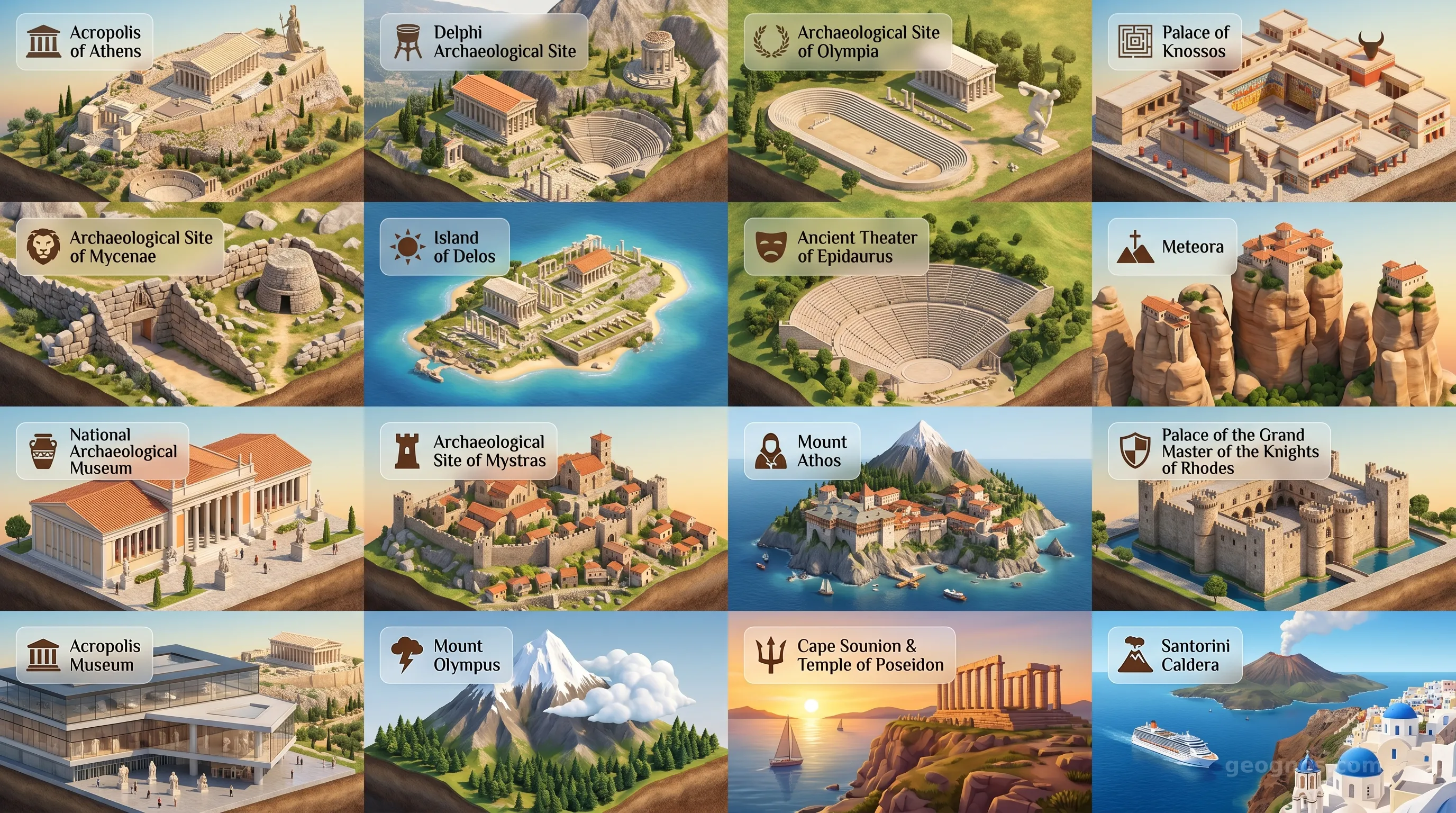
Dominating the Athenian skyline, the Acropolis is the quintessential symbol of ancient Greek civilization and the birthplace of democracy. The site features the iconic Parthenon, dedicated to the goddess Athena, showcasing unparalleled 5th-century BC Doric architecture under Pericles. For students of history, art, and architecture, it offers a masterclass in optical refinements and classical aesthetics. The historical significance is monumental, as this limestone hill has served as a citadel, sanctuary, and enduring emblem of Western cultural heritage. The best seasons to visit are Spring (April to June) and Autumn (September to October) when the weather is mild. Tourist tip: Arrive precisely at 8:00 AM or late in the afternoon to avoid peak crowds, cruise ship tour groups, and the intense midday Mediterranean sun.
The Ancient Navel of the World
Nestled on the southwestern slopes of Mount Parnassus, Delphi was revered throughout the ancient Greek world as the omphalos (the center of the universe) and the seat of the Pythian Oracle. Pilgrims and kings journeyed here to consult the priestess of Apollo before making major state or personal decisions, making it a critical study site for ancient geopolitics and religious practices. The ruins include the Temple of Apollo, the ancient theater, and the stadium. Spring is the absolute best time to visit, as the mountain slopes erupt in vibrant wildflowers and the weather is conducive to walking the steep paths. Tourist tip: Do not skip the adjacent Delphi Archaeological Museum to witness the Charioteer of Delphi, one of the finest surviving ancient bronze statues.
Birthplace of the Olympic Games
Located in the Peloponnese region, Olympia is universally celebrated as the birthplace of the Olympic Games, first held in 776 BC. This sanctuary was dedicated to Zeus and historically housed a colossal chryselephantine statue of the god, one of the Seven Wonders of the Ancient World. For students of sports history, sociology, and classical antiquity, Olympia provides a profound look into the Panhellenic ideals of truce, physical excellence, and religious devotion. The site is characterized by the ancient stadium, the Temple of Hera, and the remnants of the palaestra. Autumn provides cool, comfortable weather for exploring the vast, tree-lined ruins. Tourist tip: Line up at the ancient stadium's starting line for a memorable photo, and take time to explore the on-site museum holding the famous Hermes of Praxiteles.
The Legendary Labyrinth of King Minos
Just outside Heraklion in Crete lies Knossos, the ceremonial and political center of the Minoan civilization, often cited as Europe's oldest city. Uncovered and partially (and controversially) restored by Sir Arthur Evans in the early 20th century, the complex sprawling palace is deeply entangled with the myths of King Minos, the Minotaur, and the Labyrinth. It offers immense educational value regarding Bronze Age architecture, advanced ancient plumbing systems, and vibrant fresco art like the 'Bull-Leaping' mural. The best seasons for a visit are late Spring or early Autumn, as summer in Crete is extraordinarily hot. Tourist tip: Hire a licensed guide at the entrance to fully grasp the complex layout, and buy a combined ticket that includes the Heraklion Archaeological Museum.
Fortress of Agamemnon
The fortified citadel of Mycenae was the center of the Mycenaean civilization, which dominated mainland Greece from 1600 to 1100 BC. Inextricably linked with the Homeric epics, it was supposedly the kingdom of Agamemnon, the leader of the Greeks during the Trojan War. Visitors and scholars alike are drawn to its colossal Cyclopean walls, the monumental Lion Gate, and the awe-inspiring Tholos (beehive) tombs, most notably the Treasury of Atreus. The site offers crucial insights into Late Bronze Age military architecture and palatial economies. Visit during the cooler months of Spring or Fall, as the site offers very little shade. Tourist tip: Bring sturdy walking shoes to navigate the uneven terrain and a flashlight to peek inside the darker ancient cisterns.
The Mythological Birthplace of Apollo
An uninhabited island near Mykonos, Delos is one of the most important mythological, historical, and archaeological sites in Greece. According to myth, it was the birthplace of Apollo and Artemis. Historically, it evolved from a sacred sanctuary into a booming cosmopolitan trading port during the Hellenistic and Roman periods. Today, it stands as a remarkably well-preserved ghost town, featuring the iconic Terrace of the Lions, ancient mosaics, and ruined temples. It is a vital study location for ancient maritime trade, urban planning, and Hellenistic domestic architecture. The island is accessible from Spring to Autumn. Tourist tip: There is no accommodation on Delos, so visits are restricted to day trips via boat from Mykonos. Bring a hat, sunscreen, and plenty of water, as the island is incredibly exposed.
Masterpiece of Classical Acoustics
Constructed in the 4th century BC by Polykleitos the Younger, the Theater of Epidaurus is widely regarded as the best-preserved ancient theater in Greece, famous for its flawless acoustics. A coin dropped in the orchestra can be heard clearly from the highest tier, 55 rows up. The theater was part of the sanctuary of Asclepius, the god of medicine, making this site an ancient holistic healing center. Students of architecture, physics, and classical drama find this site incredibly rewarding. To experience it fully, visit during the summer months when the Athens Epidaurus Festival hosts live performances of ancient Greek dramas. Tourist tip: Test the acoustics yourself by clapping or tearing a piece of paper in the center of the stage, but do so respectfully.
Monasteries Suspended in the Sky
Meteora is a breathtaking geological marvel and a profound center of Eastern Orthodox spirituality. Massive, sheer sandstone pillars rise dramatically from the plains of Thessaly, crowned by Byzantine monasteries dating back to the 14th century. Originally built as isolated refuges by monks fleeing Ottoman persecution, these structures represent a triumph of human engineering over forbidding nature. It is an extraordinary site for studying geology, Byzantine art, and monastic history. Spring and Autumn offer dramatic mists and lush surroundings, perfect for photography and hiking the ancient trails between the pillars. Tourist tip: Strict dress codes apply; women must wear long skirts (not trousers) and men must wear long pants to enter the monasteries. Wraps are usually available at the entrance.
The Treasury of Greek Antiquity
Located in Athens, this is the largest archaeological museum in Greece and one of the most important museums in the world devoted to ancient Greek art. Its collections provide a comprehensive panorama of Greek civilization from the beginnings of prehistory to late antiquity. Essential studies include the golden Mask of Agamemnon, the stunning frescoes of Thera (Santorini), the majestic bronze statue of Poseidon/Zeus of Artemision, and the enigmatic Antikythera mechanism—the world's oldest analog computer. This museum is a must-visit for anyone wishing to contextualize the ruins seen elsewhere in the country. It is excellent year-round. Tourist tip: Allocate at least three to four hours to fully appreciate the vast collection, and consider visiting in the late afternoon for a quieter experience.
The Wonder of the Morea
Clinging to the steep slopes of Mount Taygetos near Sparta, the ruined medieval city of Mystras was the cultural and political capital of the Byzantine Peloponnese (the Despotate of the Morea) in the 14th and 15th centuries. It is a stunning ghost town of palaces, fortresses, and beautifully preserved churches featuring some of the finest late-Byzantine frescoes in existence. Mystras was also a major center of learning, attracting scholars and artists before falling to the Ottomans. It is heavily studied for Byzantine architecture and late medieval history. Visit in Spring when the hillside is lush and the temperature allows for the strenuous upward hike. Tourist tip: Enter through the Upper Gate, explore the fortress and upper town, and walk downhill to the Lower Gate. Ensure a driver or taxi can pick you up at the bottom.
The Holy Mountain and Monastic Republic
Occupying the easternmost peninsula of Halkidiki, Mount Athos is an autonomous monastic state that has operated continuously for over a thousand years. Home to 20 Eastern Orthodox monasteries and roughly 2,000 monks, the area preserves incredibly rare medieval manuscripts, holy relics, and Byzantine frescoes. It is a vital center for theological study, Byzantine history, and historical preservation. Because of its spiritual nature and strict 'Avaton' rule, access is tightly controlled; only adult males who have secured a specific permit (Diamonitirion) well in advance are allowed to enter. For those permitted, Spring and Autumn offer the best weather for walking between monasteries. Tourist tip: Women cannot visit Mount Athos, but both men and women can experience the peninsula's stunning coastal architecture by taking a scenic boat cruise along its shores.
Medieval Stronghold of the Hospitallers
Situated within the UNESCO-listed Medieval City of Rhodes, this formidable palace was built by the Knights Hospitaller of St. John in the 14th century. Serving as a fortress, the headquarters of the order, and later as a holiday home for Mussolini during the Italian occupation, it is a magnificent example of Gothic architecture—a rarity in Greece. Students of medieval history, the Crusades, and architectural reconstruction will find the layered history of the structure fascinating. Inside, exquisite Hellenistic and Roman floor mosaics from the neighboring island of Kos are displayed. Visit between April and October. Tourist tip: Take a walk along the impressive Street of the Knights before entering the palace, and walk the medieval moat surrounding the old town for a full appreciation of its fortifications.
A Modern Masterpiece Framing Ancient Wonders
Designed by architect Bernard Tschumi, the Acropolis Museum in Athens is a cutting-edge facility built specifically to house the artifacts discovered on the Acropolis rock and its surrounding slopes. The museum features stunning glass floors that reveal the active archaeological excavation of an ancient Athenian neighborhood beneath visitors' feet. The top-floor Parthenon Gallery matches the exact dimensions and orientation of the Parthenon itself, displaying the surviving pediment sculptures and friezes while leaving spaces for the missing marbles currently held in London. It is unparalleled for contextualizing the classical era. Visit year-round. Tourist tip: Enjoy a coffee or lunch at the museum's second-floor balcony restaurant, which offers breathtaking, unobstructed views of the Acropolis.
The Mythic Home of the Gods
Mount Olympus is the highest mountain in Greece, with its Mytikas peak soaring to 2,917 meters. In ancient Greek religion, its cloud-covered summits were believed to be the home of the Twelve Olympian gods. Today, it is Greece's first National Park and a UNESCO Biosphere Reserve, boasting exceptional biodiversity, rare flora, and dramatic gorges. It offers immense value for students of classical mythology, environmental science, and ecology. The best time to visit for hiking and mountaineering is from June to September when the higher trails are free of snow. Tourist tip: You do not need to be an expert mountaineer to enjoy Olympus; the trail through the Enipeas Gorge starting from Litochoro offers stunning waterfalls, dense forests, and accessible day hiking.
The Guardian of the Aegean Sea
Perched on a craggy cliff 60 meters above the Aegean Sea at the southernmost tip of the Attica peninsula, the Temple of Poseidon dates back to 444 BC. Built during the Golden Age of Athens, it functioned as a maritime sanctuary and a navigational landmark for ancient sailors returning home. The site is famously inscribed with the graffiti of English Romantic poet Lord Byron. It offers a romantic and highly scenic look into how ancient Greeks integrated religious architecture with dramatic natural landscapes. The sunsets here are legendary, making late afternoon the most popular time to visit. Tourist tip: Time your visit to arrive about an hour before sunset. After exploring the ruins, dine at a nearby seaside taverna for spectacular views of the illuminated temple.
A Volcanic Masterpiece
The Santorini Caldera is a vast, mostly submerged volcanic crater formed during the devastating Minoan eruption around 1600 BC, one of the largest volcanic events in recorded history. This eruption destroyed the local settlement of Akrotiri (the 'Minoan Pompeii') and possibly birthed the legend of Atlantis. Today, the caldera's towering multi-colored cliffs are capped by picturesque white-washed villages like Oia and Fira. It is a premier site for studying volcanology, geology, and Bronze Age history. The best times to visit are late Spring (May) or early Autumn (September) to avoid massive summer crowds. Tourist tip: Book a sunset catamaran cruise that sails into the caldera to swim in the volcanic hot springs and witness the island's sheer scale from the water.