North Macedonia
Top Sights & Landmarks
The Jerusalem of the Balkans
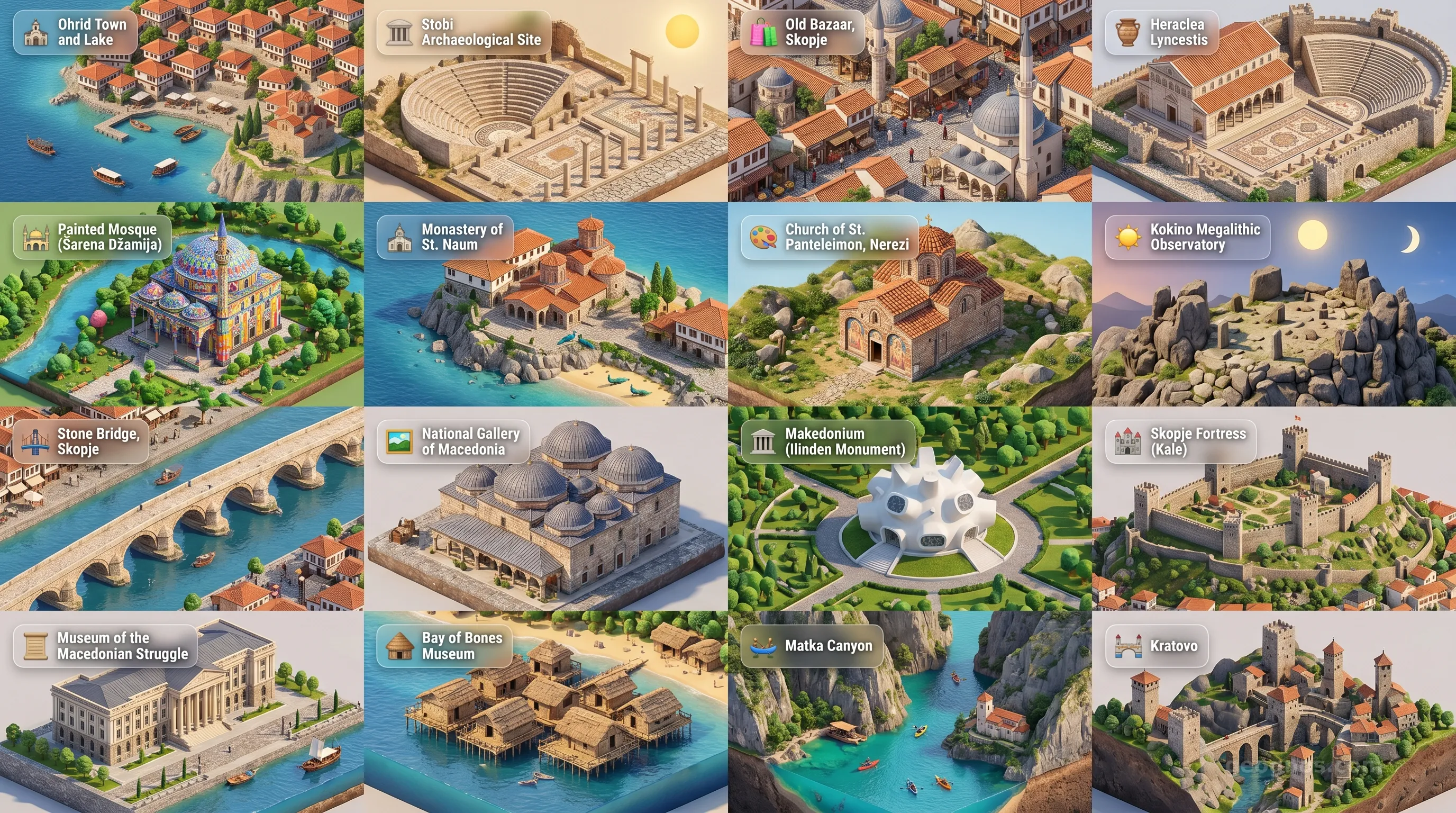
One of the oldest human settlements in Europe, Ohrid is a dual UNESCO World Heritage site recognized for both its immense cultural history and unique natural biodiversity. Known as the cradle of Slavic literacy where St. Clement founded the first Slavic university, the town boasts ancient churches (once 365, one for every day of the year), Roman amphitheatres, and medieval fortresses. The best time to visit is summer (June-August) to enjoy swimming in the pristine tectonic lake. Tourist tip: Walk up the cobblestone streets to the Church of St. John at Kaneo for an unforgettable sunset view over the water.
Ancient City at the Crossroads
Stobi was the largest city in the northern part of the Roman province of Macedonia and later a vital early Byzantine settlement. Located on the ancient Via Axia trade route, it is highly significant for historical studies, showcasing beautifully preserved peacock floor mosaics, early Christian basilicas, and an ancient Roman amphitheater. Spring and autumn are the most pleasant times to explore the ruins without the intense summer heat. Tourist tip: Hire an on-site local guide to fully contextualize the complex layers of urban development spanning from the Hellenistic period to the 6th century.
Ottoman Heart of the Capital
As one of the oldest and largest marketplaces in the Balkans, the Old Bazaar has been Skopje's center for trade and culture since the 12th century. It is an open-air museum of Ottoman architecture, featuring caravanserais, intricate mosques, and traditional artisan workshops. It offers profound insights into the region's multi-ethnic history. It is a fantastic year-round destination. Tourist tip: Let yourself get lost in the winding alleyways, and be sure to stop at a traditional kafana for authentic locally-made cevapi followed by a rich Turkish tea.
Philip II's Ancient Stronghold
Founded by Philip II of Macedon (father of Alexander the Great) in the 4th century BC, Heraclea Lyncestis later evolved into an important Roman and Early Christian center. Students of history and art flock here to study the breathtakingly detailed floor mosaics in the Great Basilica, depicting intricate regional flora and fauna. Late spring to early autumn offers the best weather for viewing the outdoor mosaics. Tourist tip: Combine your visit with a trip to the nearby city of Bitola to stroll down its famous Shirok Sokak street.
Tetovo's Masterpiece of Ottoman Art
Unlike traditional ceramic-tiled mosques, this 15th-century wonder in Tetovo features vibrant exterior and interior panels painted with vivid floral and geometric motifs. Uniquely, it was financed by two local women rather than a sultan, which is a rarity in Ottoman architectural history. It provides an exceptional case study in Islamic art. Best visited year-round. Tourist tip: Dress modestly and check local prayer times before entering to respectfully admire the exquisite baroque-Ottoman art inside.
Lakeside Spiritual Haven
Established in 905 AD by St. Naum, a prominent medieval scholar and disciple of Saints Cyril and Methodius. This monastery is a beacon of Eastern Orthodox history and a major pilgrimage site, renowned for its majestic frescoes and the belief that you can still hear the saint's heartbeat if you press your ear to his tomb. Late summer is idyllic for a visit. Tourist tip: After visiting the church, take a peaceful rowboat ride at the nearby bubbling springs of the Black Drim river, accompanied by the resident peacocks.
Byzantine Art Pioneer
Perched on Mount Vodno above Skopje, this 12th-century Byzantine church is world-renowned for its emotional 'Lamentation of Christ' fresco. The raw human emotion depicted in the art predates and prefigures the realism of the Italian Renaissance, making it a critical study site for art historians. It is best visited in spring or autumn. Tourist tip: The tranquil courtyard offers incredible panoramic views over the city of Skopje, making it a perfect spot for photography and quiet reflection.
Bronze Age Star Tracker
Recognized by NASA as one of the world's oldest ancient observatories, this megalithic site dates back almost 4,000 years. Carved into volcanic rock, its markers were used by Bronze Age inhabitants to track the cycles of the sun and moon. It is an exceptional destination for archaeoastronomy enthusiasts. Summer, particularly during the solstice, is the absolute best time to visit. Tourist tip: Wear sturdy hiking shoes; the ascent up the rugged volcanic rocks can be steep, but the panoramic views are deeply rewarding.
The Symbol of Skopje
Constructed in the 15th century under the patronage of Sultan Mehmed the Conqueror, this iconic solid stone bridge physically and symbolically connects the modern, European-style city center with the historic Ottoman Old Bazaar. It has survived centuries of earthquakes and conflicts, standing as a testament to medieval engineering. Can be visited in any season. Tourist tip: The bridge is exceptionally photogenic at dusk when the lights of the Vardar River illuminate its arches.
Art in a 15th-Century Bathhouse
Housed within the stunning multi-domed Daut Pasha Hamam—once one of the largest public baths in the Ottoman Empire—this gallery holds an incredible collection of Macedonian contemporary art, as well as historic icons spanning centuries. It is a brilliant example of adaptive reuse of historic buildings. Perfect for a year-round indoor visit. Tourist tip: Take a moment to notice the spectacular acoustics and the star-shaped skylights piercing the roof domes while exploring the exhibitions.
Retro-Futuristic Memorial
Located in the highest town in the Balkans, Kruševo, the Makedonium is a surreal, retro-futuristic structure resembling a mace or a heart valve. It honors the fighters of the 1903 Ilinden Uprising against the Ottoman Empire and WWII partisans. It is an absolute marvel of Yugoslav-era brutalist/spomenik architecture. Best visited in summer or during the winter ski season. Tourist tip: Step inside the monument to witness the stunning, intricate stained glass and the resting place of revolutionary Nikola Karev.
Ancient Watch over the Vardar
Looming high over Skopje, Kale Fortress features defensive walls originally built using yellow limestone and travertine during the 6th century AD under Byzantine Emperor Justinian I. It has served various empires, making it vital for understanding the strategic military history of the region. Spring and autumn are best for exploring the open grounds. Tourist tip: Visit in the late afternoon; walking along the restored ramparts offers the best panoramic sunset views over the capital city.
Chronicle of Statehood
Situated on the banks of the Vardar River in Skopje, this sprawling museum offers an immersive and deeply detailed look into North Macedonia's centuries-long fight for statehood and independence. Through an array of historical artifacts, original documents, and highly detailed wax figures, it brings the complex Balkan history to life. Ideal for rainy days year-round. Tourist tip: Opt for the guided tour, as the context provided by local historians is crucial for untangling the intricate regional politics of the 19th and 20th centuries.
Floating Prehistoric Village
A remarkable archaeological reconstruction of a prehistoric pile-dwelling settlement that floated on the waters of Lake Ohrid between 1200 and 700 BC. The museum gets its name from the numerous animal bones discovered during underwater excavations. It offers a unique glimpse into Iron and Bronze Age daily life. The best time to visit is from May to September. Tourist tip: The water surrounding the museum is astonishingly clear—bring a camera with a polarizing filter to photograph the underwater foundational piles.
Gorge of Monasteries and Caves
Just outside Skopje lies Matka, a breathtakingly steep canyon cut by the emerald waters of the Treska River. It is highly valued for both its rich biodiversity, holding many endemic species of butterflies, and its medieval cliffside monasteries. It is also home to Vrelo Cave, potentially one of the deepest underwater caves globally. Spring and summer offer lush greenery and cool shade. Tourist tip: Rent a kayak or hire a small boat tour to reach Vrelo Cave and fully experience the canyon's towering majesty from the water.
The Town of Bridges and Towers
Kratovo is a highly unique medieval town situated entirely within the crater of an extinct volcano. Historically known as a wealthy mining town under the Roman and Ottoman empires, its winding streets are famous for their ancient stone bridges and defensive watchtowers. Ideal for urban studies and history buffs. Spring and autumn provide beautiful foliage against the dark stone. Tourist tip: Sit down in a local kafana to taste the regional slow-cooked specialty, 'pastrmajlija' (an oval-shaped baked dough pie with cured meat).