Cyprus
Top Sights & Landmarks
Ancient Mosaics and Ruins
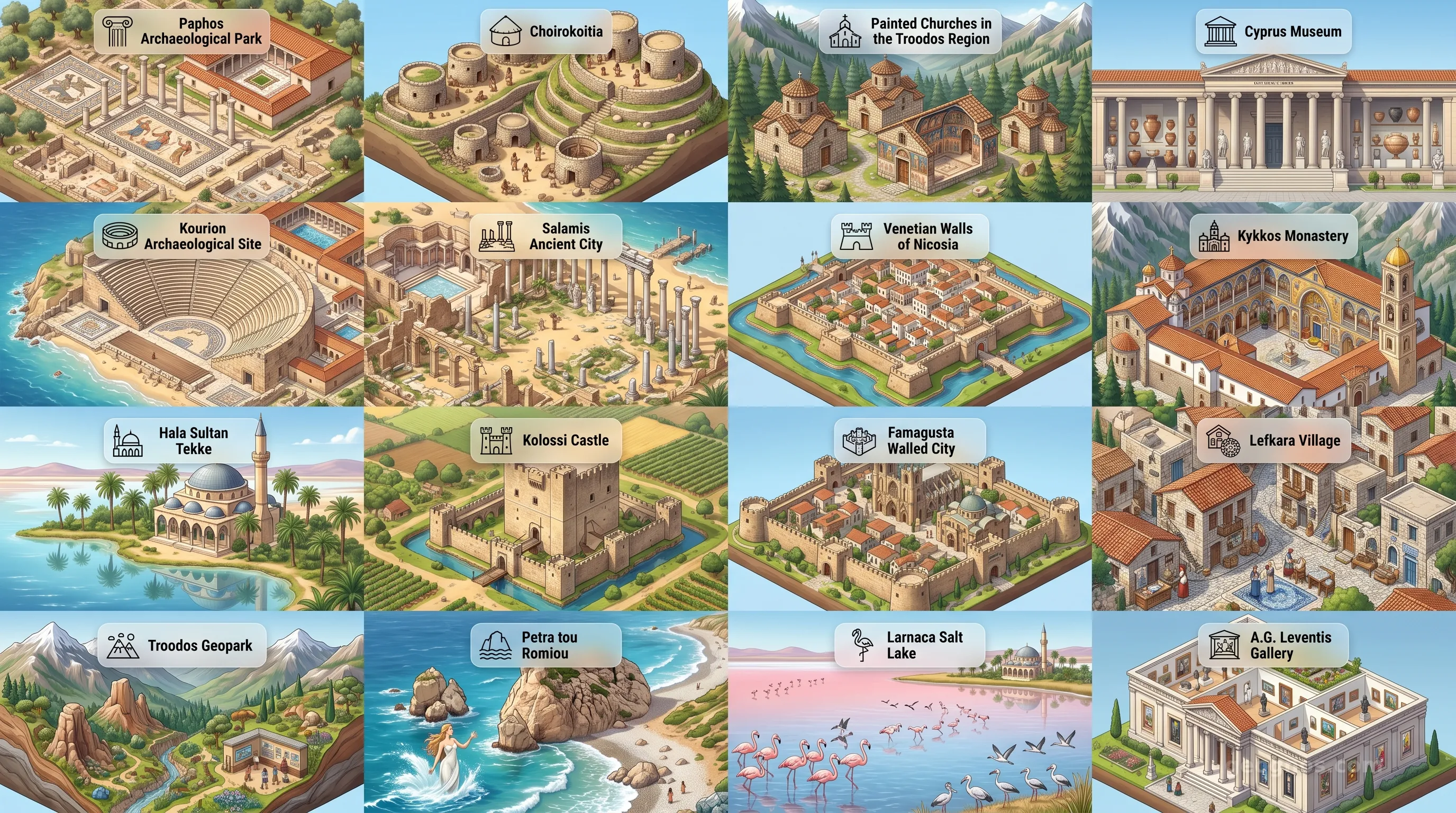
A treasure trove for history and art students, this vast park is home to some of the world's most pristine and intricate Roman floor mosaics, depicting vibrant scenes from Greek mythology. Historically significant as the capital of Cyprus during the Greco-Roman period, it offers a profound look into ancient elite life. The best season to visit is spring (March to May) when the sprawling ruins are carpeted in wildflowers. Tourist tip: Allocate at least three hours to explore fully, and wear comfortable walking shoes as the terrain is extensive and uneven.
Neolithic Settlement
As one of the most important prehistoric sites in the eastern Mediterranean, Choirokoitia provides an unparalleled window into human evolution and early communal living dating back to the 7th millennium BC. Students of archaeology will marvel at the remarkably preserved cylindrical stone dwellings. Visiting during autumn or spring ensures a pleasant exploration of the hillside ruins. Tourist tip: Don't miss the reconstructed huts near the entrance, which provide excellent context for what the settlement looked like thousands of years ago.
Byzantine Frescoes
A remarkable network of ten beautifully preserved Byzantine churches hidden within the Troodos Mountains. Their unassuming, barn-like stone exteriors conceal incredibly vivid and religiously significant frescoes spanning the 11th to 16th centuries. For art historians, these murals represent a crucial transition in Eastern Orthodox iconography. Summer is ideal for visiting, as the mountain elevation offers a cool retreat from coastal heat. Tourist tip: Photography is strictly prohibited inside; respect the dress code by covering shoulders and knees.
National Archaeological Museum
Located in Nicosia, this is the oldest and most comprehensive archaeological museum on the island, safeguarding Cyprus's deepest historical secrets. It houses artifacts from the Neolithic age through the Early Byzantine period, including the famous terracotta army from Ayia Irini. It is an essential study stop for anyone wanting to grasp the island's complex layered history before visiting the physical sites. Open year-round. Tourist tip: Read up on the island's copper trade beforehand to fully appreciate the Bronze Age exhibits.
Majestic Greco-Roman City
Perched dramatically on a coastal cliff, this spectacular ancient city-kingdom boasts a magnificent restored amphitheater, intricate public baths, and stunning mosaics in the House of Eustolios. It demonstrates the intersection of Hellenistic, Roman, and Early Christian cultures. The site is a visual feast for both casual tourists and architectural students. Spring and late autumn offer the best lighting for photography and cooler temperatures. Tourist tip: Check local schedules, as the amphitheater frequently hosts open-air theatrical and musical performances in the summer.
Ancient Royal Capital
Once the grandest and wealthiest city-kingdom in ancient Cyprus, Salamis features a sprawling complex of ruins, including a massive gymnasium with headless marble statues, a vast amphitheater, and complex Roman baths. It serves as a monumental study of the island's Hellenistic and Roman prosperity. Best visited in the mild months of April or October. Tourist tip: Located in Northern Cyprus, ensure you have your passport ready for the Green Line crossing, and bring plenty of water as shade is limited.
Renaissance Fortifications
Encircling the old city of Nicosia in a perfect star-shaped configuration with eleven bastions, these walls are a masterclass in 16th-century Renaissance military architecture. Built by the Venetians to defend against the Ottomans, they now serve as a cultural boundary dividing the modern city from the historic core. Ideal to visit year-round. Tourist tip: Walk along the moat, which has been transformed into parks, art spaces, and sports fields, and enter through the iconic Famagusta Gate.
Wealthy Orthodox Monastery
The most lavish and historically influential Orthodox monastery in Cyprus, situated at an altitude of 1,318 meters. Founded in the 11th century, it is famed for housing an icon of the Virgin Mary supposedly painted by the Apostle Luke. The architecture, modern mosaics, and the museum's ecclesiastic treasures offer deep insights into Greek Orthodox heritage. Summer provides an escape from coastal heat, but winter visits surrounded by snow are magical. Tourist tip: The drive up is incredibly winding; hire a local driver if you are not comfortable navigating mountain switchbacks.
Venerated Islamic Shrine
Nestled on the serene shores of the Larnaca Salt Lake, this historic mosque is one of the most revered sites in Islam, built over the tomb of Umm Haram, the aunt of the Prophet Muhammad. It is a stunning example of Ottoman architecture and a symbol of the island's religious diversity. It is best visited during the winter months when the adjacent lake is full of water and migratory flamingos. Tourist tip: Dress modestly, and enjoy the tranquil gardens surrounding the complex.
Crusader Stronghold
A prime example of medieval military architecture, this 15th-century stronghold was once a major command center for the Knights Templar and later the Knights of St. John. Historically significant for its role in the Crusades and as the birthplace of 'Commandaria', the world's oldest named wine still in production. The site is a must-study for medieval historians. Spring and autumn are the best seasons to visit. Tourist tip: Climb the narrow spiral staircase to the roof for commanding views of the surrounding citrus groves.
Medieval Gothic Fortress
A living museum of Gothic architecture enclosed by massive Venetian fortifications. The city features the spectacular Lala Mustafa Pasha Mosque (originally the Gothic Cathedral of St. Nicholas) and Othello Castle, famously linked to Shakespeare's play. It offers an unparalleled study of the architectural shifts between Crusader, Venetian, and Ottoman rule. Spring is ideal for exploring. Tourist tip: Passport required to cross into Northern Cyprus; hire a local guide to fully appreciate the complex history of the ruined churches scattered throughout the old town.
Home of Cypriot Lace
A picturesque mountain village renowned worldwide for its traditional silversmithing and 'Lefkaritika' lace, which is recognized as UNESCO Intangible Cultural Heritage. Legend has it that Leonardo da Vinci visited in 1481 and purchased lace for the altar of the Milan Cathedral. The stone-paved alleys and traditional architecture make it an aesthetic delight. It is wonderful to visit in the cooler autumn months. Tourist tip: Watch the local women crafting lace in the streets and verify the authenticity certificate before purchasing expensive pieces.
Ophiolite Geological Wonder
Covering much of the Troodos mountain range, this geopark is a mecca for geology students worldwide. It reveals a fully intact section of oceanic crust (the Troodos Ophiolite) that was thrust upward by tectonic plates millions of years ago, allowing scientists to study the ocean floor without diving. Stunning natural trails offer recreation alongside education. Spring and early autumn are best for hiking. Tourist tip: Start at the Troodos Geopark Visitor Centre in an old asbestos mine to get a foundational understanding of the rock formations.
Aphrodite's Mythological Birthplace
A striking geological formation of massive sea stacks jutting out of the Mediterranean. According to ancient myth, this is where Aphrodite, the Greek goddess of love and beauty, emerged from the sea foam. The striking contrast of the white limestone against the azure waters makes it highly popular for photography. Best visited at sunset year-round. Tourist tip: Swimming here can be dangerous due to strong undercurrents; instead, enjoy the pebble beach and the breathtaking views from the viewing pavilion.
Flamingo Winter Habitat
A complex network of four salt lakes that undergo a dramatic seasonal transformation. During the scorching summer, it evaporates into a stark, cracked crust of white salt. In the winter, it fills with water and becomes a crucial wetland habitat for thousands of migrating Greater Flamingos. It is an excellent site for environmental studies and birdwatching. Winter (December to February) is the absolute best time to visit. Tourist tip: Bring a pair of binoculars and use the designated walking trails to avoid disturbing the wildlife.
European & Cypriot Fine Art
A premier cultural institution in Nicosia housing an impressive collection of European, Greek, and Cypriot fine art spanning four centuries. The gallery highlights the cultural dialogue between Cyprus and the broader European continent, making it an excellent resource for art history students. Fully air-conditioned, it's a perfect midday escape during the hot summer months. Tourist tip: Download the gallery's free audio guide app for deep dives into the historical context of the exhibited masterpieces.