Libya
Top Sights & Landmarks
The Jewel of Roman Africa
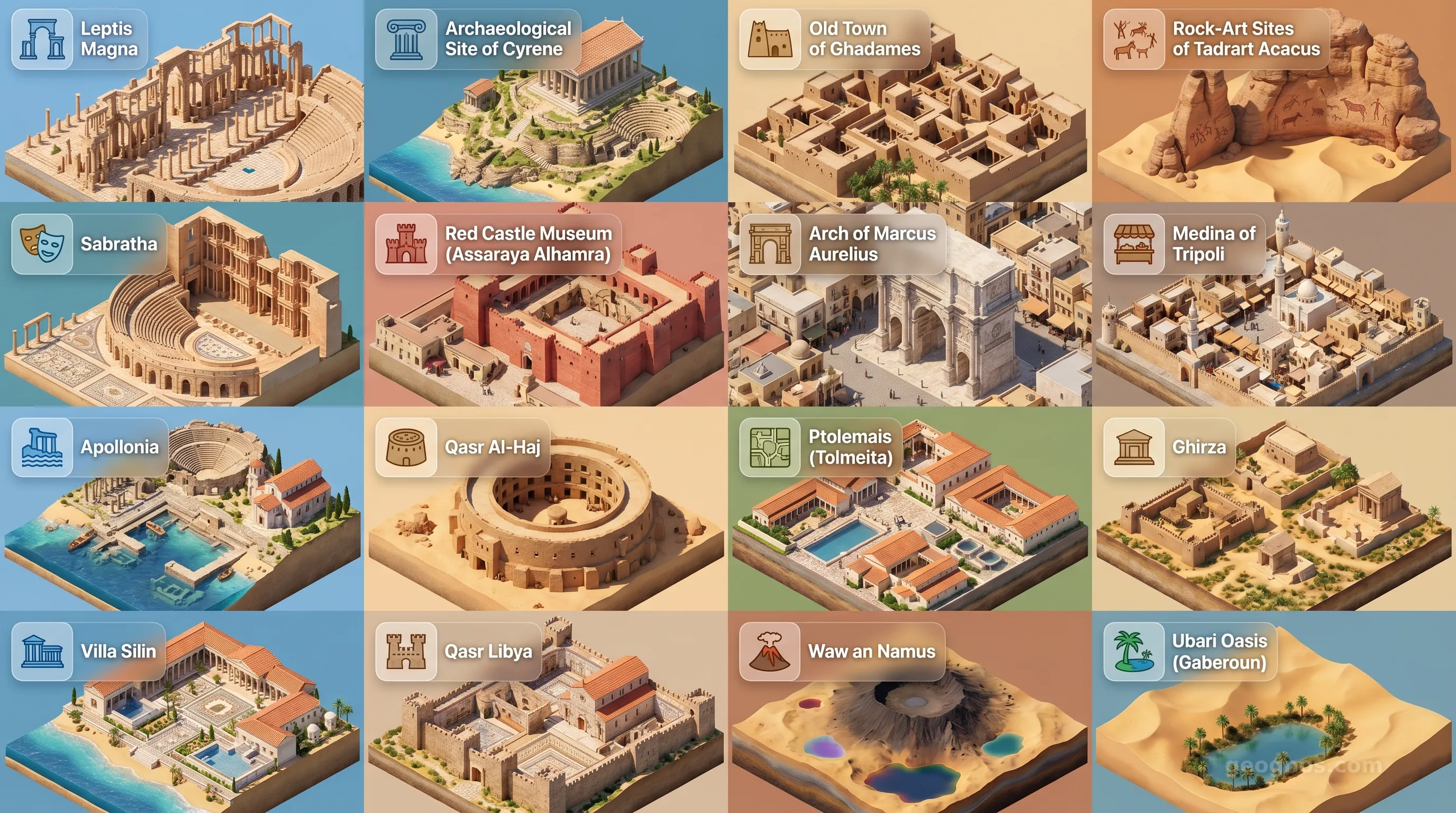
Widely considered one of the most spectacular and unspoiled Roman ruins in the Mediterranean, Leptis Magna was greatly expanded by its native son, Emperor Septimius Severus. Students of classical architecture will marvel at the Severan Arch, the vast basilica, and the remarkably preserved amphitheater. Historically, it represents the zenith of Roman urban planning and imperial power in North Africa. The best time to visit is during the mild spring or autumn months. Tourist tip: Hire a local guide to fully appreciate the site's vast scale, and bring plenty of water as shade is scarce.
The Athens of Africa
Founded by the Greeks in 631 BCE, Cyrene was one of the principal cities of the Hellenic world, later transitioning into a vital Roman center. The site is a treasure trove for historians, featuring the colossal Temple of Zeus, the Sanctuary of Apollo, and a sweeping Greek theater that overlooks the Mediterranean. It offers profound insights into ancient philosophy, medicine, and syncretic Greco-Libyan culture. Spring is the ideal season to visit when the surrounding Green Mountain area is in full bloom. Tourist tip: Don't miss the nearby ancient necropolis, which is one of the largest in the ancient world.
The Pearl of the Desert
An outstanding example of a traditional Saharan settlement, Ghadames is a marvel of desert architecture. Its interconnected, whitewashed mud-brick houses create a labyrinthine network of shaded alleys, engineered perfectly to withstand extreme desert temperatures. For centuries, it was a pivotal hub for trans-Saharan trade routes. Students of sustainable architecture and urban planning will find its climate-adaptive design fascinating. Winter is the best time to visit to avoid the intense summer heat. Tourist tip: Explore the rooftops, which were traditionally reserved for women to move freely between households.
Prehistoric Desert Canvas
Bordering Algeria, the Tadrart Acacus mountain range contains thousands of cave paintings and carvings dating from 12,000 BCE to 100 CE. These striking images chronicle the evolution of the Sahara from a lush savanna teeming with giraffes and elephants to an arid desert, offering an unparalleled visual history of ancient climate change and human adaptation. The surreal landscape of rock arches and towering dunes is a photographer's dream. Travel here between October and March. Tourist tip: Access requires a 4x4 vehicle and a knowledgeable local Tuareg guide.
Coastal Roman Splendor
Originally a Phoenician trading post, Sabratha grew into a thriving Roman city known for its magnificent three-story theater, which remains one of the finest surviving examples of Roman theatrical architecture. The site also features beautifully preserved mosaics and temples set against the striking backdrop of the Mediterranean Sea. It is an essential study site for ancient maritime trade networks. Spring and autumn provide ideal weather for exploring. Tourist tip: Visit the on-site museum to see the stunning Byzantine mosaics excavated from the city's basilicas.
Tripoli's Historical Fortress
Dominating Tripoli's waterfront, the Red Castle is Libya's premier museum, housed in an imposing fortress whose foundations date back to the Phoenician era. The museum’s extensive collections span from prehistoric artifacts to Greek, Roman, and Islamic treasures, making it a crucial starting point for understanding Libya's layered history. It provides an excellent educational overview for both students and curious travelers. The museum is a year-round destination. Tourist tip: Dedicate at least a half-day to explore its multiple floors, and look out for the intricate classical mosaics.
Tripoli's Roman Gateway
Constructed in 165 CE, this triumphal arch is the most prominent surviving Roman monument in Tripoli (ancient Oea). Made entirely of marble, it features intricate reliefs of Apollo and Minerva, symbolizing the city's wealth and Roman cultural integration. It stands as a testament to classical imperial propaganda and urban design. Being in the capital, it is easily accessible year-round. Tourist tip: Visit in the late afternoon when the golden hour light accentuates the deep carvings, and then step into the adjacent old Medina.
The Walled Old City
The Medina is the historic heart of Tripoli, enclosed by old walls and brimming with Ottoman-era houses, bustling souks, traditional khans, and historic consulates. It is a living museum of Islamic and Mediterranean architecture, vital for students of cultural geography and urban history. The vibrant atmosphere offers a sensory journey through centuries of trade. It is best explored year-round. Tourist tip: Get lost in the copper and silk markets, but always be prepared to politely haggle. Respect local customs by dressing modestly.
The Sunken Greek Port
Serving as the port for the ancient city of Cyrene, Apollonia boasts spectacular ruins that span Greek, Roman, and Byzantine periods. Because of tectonic shifts, a significant portion of the ancient harbor is now submerged underwater, making it a fascinating destination for marine archaeologists and history enthusiasts. Ashore, you can explore the remains of palaces and Byzantine churches. Late spring or early autumn is the best time to visit. Tourist tip: If permitted, snorkeling over the submerged harbor walls provides a truly unique historical perspective.
Ancient Berber Granary
Built around the 12th century, Qasr Al-Haj is a magnificent, circular fortified granary designed by indigenous Berbers to store their harvests. Its massive, windowless exterior walls give way to a stunning interior courtyard surrounded by multi-story storage cells. This architectural marvel offers profound insights into ancient communal living, food security, and indigenous Saharan engineering. Winter and early spring are the best times to visit. Tourist tip: Stand in the exact center of the courtyard to experience the remarkable acoustics and scale of the structure.
The Hellenistic Capital
Ptolemais was one of the five cities of the Libyan Pentapolis and eventually became the regional capital. It features vast, uncrowded ruins including a grand Hellenistic palace, a massive underground cistern (the 'Square of Cisterns'), and early Christian basilicas. The site represents a unique blend of Greek foundations overlaid with late Roman and Byzantine developments. Visit during the spring for pleasant weather. Tourist tip: The onsite museum is small but holds incredible statuary; ask the caretaker to unlock it if it appears closed.
Romano-Libyan Fortified Settlement
Deep in the pre-desert, Ghirza is renowned for its unique fusion of Roman and indigenous Libyan culture. It is famous for its elaborate monumental tombs decorated with intricate reliefs depicting daily agricultural life, hunting scenes, and local chieftains rather than classical Roman gods. It is a critical site for studying the peripheral reaches of the Roman Empire and indigenous assimilation. The cooler winter months are necessary for a visit due to its arid location. Tourist tip: Many original reliefs were moved to the Red Castle Museum, so visit both to get the full picture.
Luxurious Seaside Roman Villa
Discovered in the 1970s, Villa Silin is an exquisitely preserved Roman patrician villa situated right on the Mediterranean coast near Leptis Magna. It is celebrated for its stunningly vibrant floor mosaics depicting scenes of gladiator combat, chariot races, and mythological figures. The site offers an intimate look at the luxurious domestic life of Roman elites in North Africa. Spring is ideal, with gentle sea breezes. Tourist tip: Access can sometimes be restricted for preservation; check locally in advance to ensure the site is open to visitors.
Byzantine Mosaic Treasure
Originally an ancient Greek settlement that flourished under Byzantine rule, Qasr Libya is most famous for its museum housing 50 extraordinary 6th-century Byzantine mosaics. Originally part of a local church, these panels depict a mix of Christian symbolism, daily life, local wildlife, and notably, a representation of the Pharos lighthouse of Alexandria. It is a must-visit for art historians and theology students. Spring provides excellent conditions for travel in the Green Mountain region. Tourist tip: The mosaics are displayed on the walls of the museum, allowing for excellent close-up photography.
The Oasis of Mosquitoes
Located deep in the Sahara, Waw an Namus is an extinct volcanic caldera characterized by an immense field of dark basaltic ash that contrasts sharply with the surrounding yellow desert. Inside the crater are three striking, multicolored salt lakes fringed with lush palm vegetation. It is a spectacular anomaly of nature, fascinating for geologists and adventurous travelers alike. Winter is the only safe time to undertake the grueling journey. Tourist tip: 'Namus' means mosquitoes, which are rampant near the lakes; bring strong repellent and a mosquito net.
Saharan Lakes of the Sand Sea
Nestled amid the towering dunes of the Idehan Ubari sand sea, the Ubari lakes—most notably Gaberoun—are remnants of an ancient mega-lake. Their highly saline waters support unique crustacean life, and they are surrounded by striking date palms. The geographical contrast of water amidst endless sand makes it a surreal study in hydrology and desertification. November to February is the optimal time for a desert expedition. Tourist tip: The salt content makes the water extremely buoyant, similar to the Dead Sea, allowing for a unique swimming experience.