Tunisia
Top Sights & Landmarks
The Fallen Rival of Rome
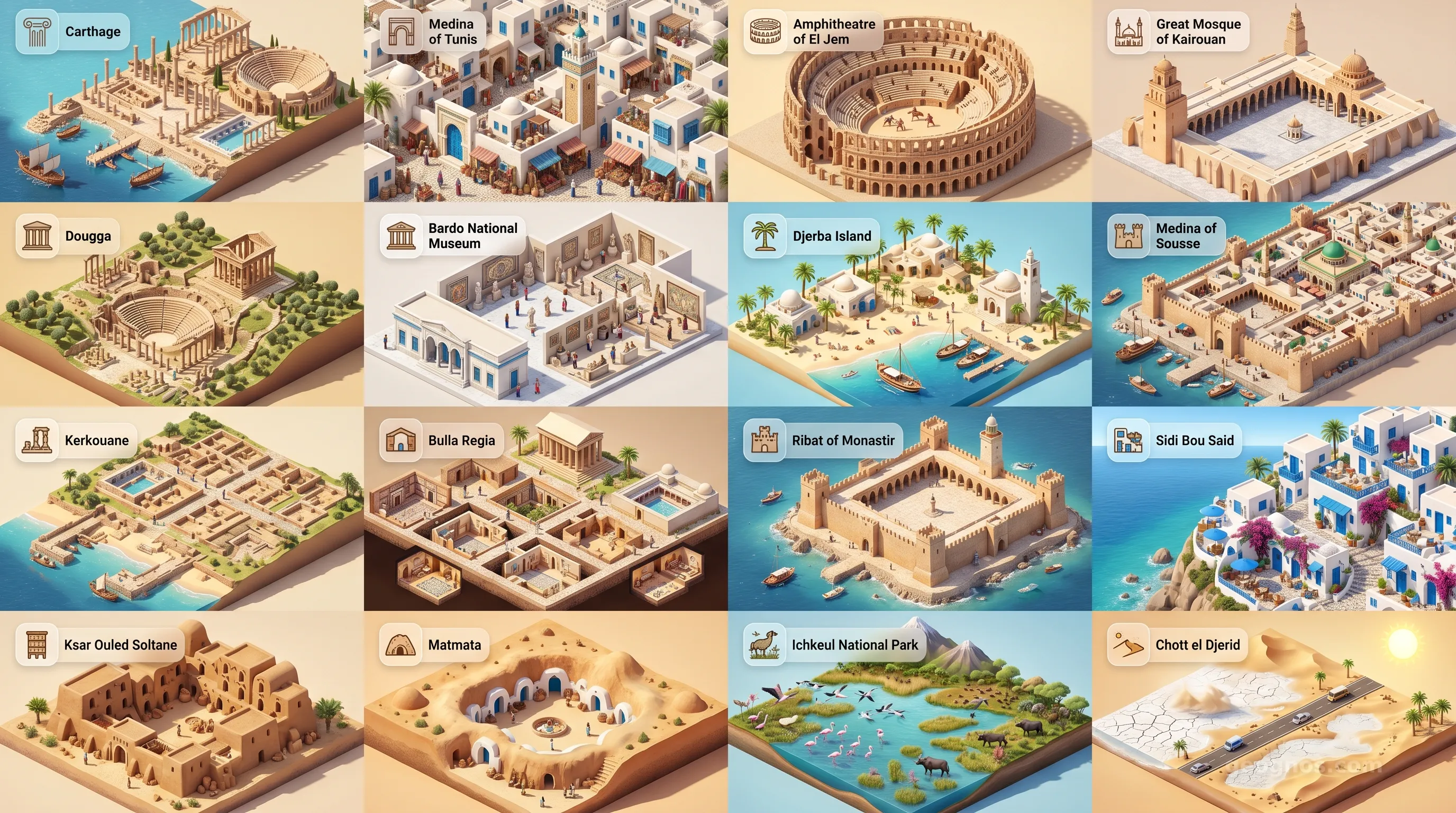
Once the heart of a maritime empire that dominated the Mediterranean, Carthage is essential for students of classical history. Founded by Phoenicians, it was the home of Hannibal before being famously destroyed and rebuilt by Rome. Visitors can study the Antonine Baths, the Tophet, and Punic ports. The best season to visit is Spring or Autumn to avoid intense heat. Tourist Tip: The ruins are widely scattered across a modern wealthy suburb; hiring a local guide or renting a bicycle is highly recommended to fully grasp the site's immense scale.
The Heart of Islamic Urban Planning
The Medina of Tunis is one of the best-preserved Islamic cities in the world. Containing over 700 monuments, including palaces, mosques, mausoleums, and fountains dating back to the Almohad and Hafsid periods, it offers profound insights into 8th-century urban design. Historically, it was a pivotal center of wealth and Islamic scholarship. The best time to visit is during the mild Spring months. Tourist Tip: Allow yourself to get lost in the labyrinthine souks, but use the towering minaret of the central Ez-Zitouna Mosque as your navigational anchor.
The Great Colosseum of Africa
This towering 3rd-century monument is the largest colosseum in North Africa and one of the most remarkable Roman ruins in the world, originally seating 35,000 spectators. It stands as a testament to the grandeur and engineering prowess of Imperial Rome. It is a fantastic case study in Roman architecture and social entertainment. Winter to Spring is the best time to visit for comfortable exploration. Tourist Tip: Walk through the intact underground passageways where gladiators and wild beasts were once held, and climb to the upper tiers for sunset photography.
The Holiest City of the Maghreb
Founded in 670 AD, Kairouan is considered the fourth holiest city in Islam. The Great Mosque is a masterpiece of Islamic architecture, featuring a massive courtyard, a stunning hypostyle prayer hall, and the oldest surviving minaret in the world. It is a must-study for Islamic art and architectural history. Winter and Spring offer the most pleasant weather for a visit. Tourist Tip: Dress modestly as it is a highly revered religious site. Afterward, explore the local medina to taste 'Makroudh', Kairouan's famous date-filled pastry.
Africa's Best-Preserved Roman Town
Perched on a hill surrounded by olive groves, Dougga represents the quintessential Roman-African town. Its remarkably intact Capitolium, theater, and mausoleums provide an unparalleled glimpse into the daily life of a Roman settlement adapted to local Numidian terrain. It is highly valued for archaeological studies. Spring is arguably the best time to visit when the surrounding landscape is carpeted in vibrant wildflowers. Tourist Tip: Wear sturdy walking shoes; the site is extensive and requires walking over uneven ancient stone paths.
The World's Greatest Mosaic Collection
Housed in a stunning 15th-century Hafsid palace, the Bardo Museum contains the most extensive collection of Roman mosaics in the world. These vibrant artworks tell vivid stories of ancient daily life, mythology, and agriculture in North Africa. It is an absolute treasure trove for art historians and classicists. The museum is a great year-round destination, perfect for escaping the summer heat or winter rain. Tourist Tip: Look up! The intricately carved wooden ceilings of the palace rooms are just as spectacular as the mosaics on the floors and walls.
The Island of Coexistence
Recently added to the UNESCO list, Djerba is celebrated for its unique settlement pattern and extraordinary cultural mosaic, blending Berber, Arab, and ancient Jewish communities. The El Ghriba Synagogue is one of the oldest in the world. It is a living sociological study of religious harmony and island adaptation. Summer and early Autumn are perfect for combining cultural tours with beach relaxation. Tourist Tip: Visit the village of Erriadh to see 'Djerbahood', an open-air museum where global artists have painted stunning murals on traditional white walls.
The Coastal Fortress City
The Sousse Medina is an outstanding example of early Islamic coastal defense architecture. Unlike other medinas, it features a towering Ribat (fortress) and a Great Mosque designed to look like a military stronghold to protect against Byzantine naval attacks. It is crucial for understanding medieval Mediterranean military history. Spring to Summer is the ideal time to visit. Tourist Tip: Climb the watchtower of the Ribat for panoramic views of the medina's rooftops and the sparkling Mediterranean Sea.
The Untouched Punic City
Kerkouane is incredibly unique because it is the only Carthaginian (Punic) city that was never rebuilt by the Romans after its destruction during the First Punic War. This makes it the sole surviving example of pure Punic town planning and domestic architecture. It is a vital site for classical archaeologists. Spring is the best season to enjoy the coastal breeze and blooming flora. Tourist Tip: Note the distinct pink mortar used in the surprisingly modern ancient bathtubs found in nearly every ruined house.
The Subterranean Roman Villas
Bulla Regia offers a fascinating architectural anomaly: complete subterranean Roman villas. To escape the fierce summer heat, wealthy citizens built their homes underground, which coincidentally preserved their exquisite floor mosaics in situ. It is a brilliant study in ancient climate adaptation. The site is best visited from Spring to Autumn. Tourist Tip: The underground rooms are delightfully cool even on the hottest days, making this an excellent midday stop for tourists exploring the northwest.
The Majestic Islamic Fortress
Founded in 796 AD, the Ribat of Monastir is the most prominent and well-preserved Islamic defensive structure in the Maghreb. It served as both a military fort and a spiritual retreat for soldier-monks. Its striking aesthetics have made it a popular filming location, famously featured in Monty Python's 'Life of Brian'. It is an excellent destination for military history enthusiasts. Best visited during Spring or Summer. Tourist Tip: Explore the small Islamic art museum housed within the former prayer hall of the fortress.
The Blue and White Village
Perched on a cliff overlooking the Gulf of Tunis, Sidi Bou Said is famously adorned in striking blue and white. Its history is tied to Andalusian refugees who brought their Moorish architectural styles to Tunisia. It became an enclave for artists and writers in the 20th century, perfect for cultural tourism and art students. Spring and Autumn provide glorious light and fewer crowds. Tourist Tip: Grab a seat at the iconic Café des Nattes or Café des Délices to enjoy traditional mint tea with pine nuts while watching the sunset.
The Towering Berber Granary
This is one of the most impressive examples of a 'ksar', a traditional fortified Berber granary. Featuring multi-story, vaulted mud-brick structures known as 'ghorfas', it demonstrates indigenous architectural ingenuity designed to keep grain cool and safe. It gained global fame as the backdrop for the slave quarters of Mos Espa in Star Wars: Episode I. Winter to Spring is best to avoid severe desert heat. Tourist Tip: The late afternoon sun casts striking shadows across the curved architecture, creating exceptional photography opportunities.
The Troglodyte Underground World
Matmata is famous for its unique troglodyte dwellings, where homes are created by digging a large artificial crater in the earth and tunneling caves into the walls. This ancient Berber method of escaping the extreme Saharan climate is a marvel of human geography and adaptation. It is also famous as Luke Skywalker's childhood home in Star Wars. Winter and Spring are the best seasons. Tourist Tip: Consider staying overnight in one of the converted underground hotels to truly experience the silence and natural insulation of these structures.
The Great Avian Sanctuary
As the last remaining lake in a chain that once extended across North Africa, Ichkeul is a crucial stopover point for hundreds of thousands of migrating birds, including ducks, geese, storks, and pink flamingos. It is an indispensable site for ecological study and ornithology. Winter is absolutely the best season to visit, as this is when the migratory flocks descend upon the lake. Tourist Tip: Bring a good pair of binoculars and visit the eco-museum on the hill before taking the trails down to the wetlands.
The Great Saharan Salt Lake
Chott el Djerid is a massive endorheic salt lake in the Sahara. During the summer, it dries completely into a shimmering crust of white, pink, and green salt crystals that generate mesmerizing mirages. In the winter, it turns into a shallow inland sea. It is a spectacular site for geology students and nature lovers. Late Autumn to Spring is ideal for crossing. Tourist Tip: Stick to the raised causeway road that crosses the lake; driving off-road is highly dangerous as vehicles easily sink into the hidden mud beneath the salt crust.