Algeria
Top Sights & Landmarks
Prehistoric Saharan Rock Art Plateau
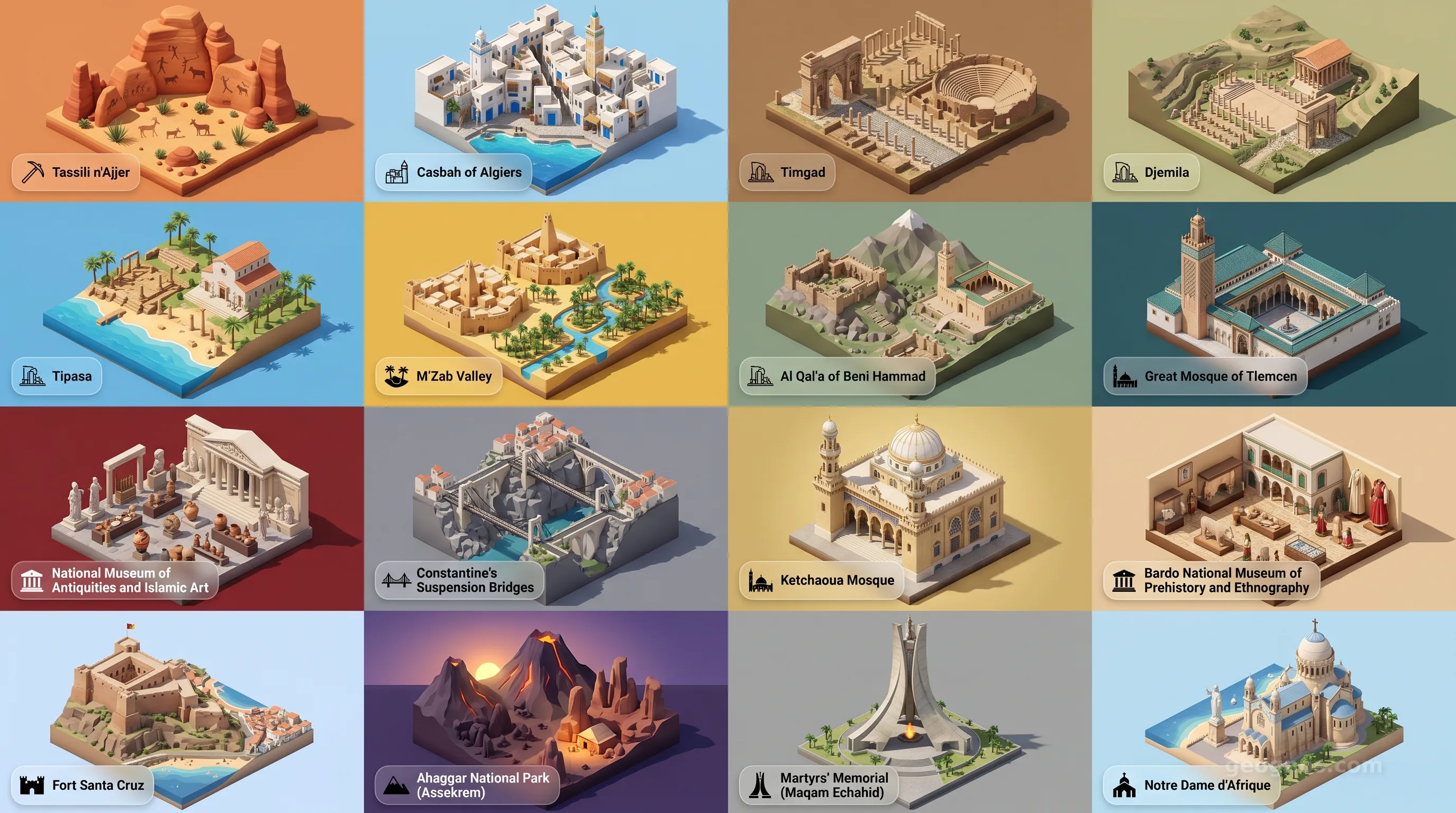
Tassili n'Ajjer is a vast plateau in the Sahara Desert, offering an unparalleled window into prehistoric human evolution. It is incredibly significant for housing over 15,000 prehistoric cave paintings and engravings dating back to 10,000 BC, documenting climate change, animal migrations, and human life on the edge of the Sahara. For students of anthropology and geology, it is an open-air laboratory. The sandstone formations, eroded into 'forests of rock', look entirely otherworldly. The best season to visit is between October and March to avoid lethal summer heat. Tourist tip: Access requires a hired local Tuareg guide and a 4x4 vehicle, usually organized from the oasis town of Djanet.
The Historic Heart of Algiers
The Casbah of Algiers is a magnificent, steep walled citadel that encompasses the traditional pre-colonial core of the capital. Historically, it reflects a blend of Arab-Berber and Ottoman architecture and was the central stage for the famous Battle of Algiers during the country's war of independence. Architecture students will marvel at the ingenious urban planning, ancient mosques, and Ottoman-style palaces navigating the steep coastal terrain. Spring and autumn offer the most pleasant weather for exploring the myriad of winding, stepped alleys. Tourist tip: Given its labyrinthine nature, hiring a local guide is highly recommended to discover hidden palaces and avoid getting lost.
The Pompeii of Africa
Timgad is one of the most perfectly preserved examples of a Roman grid city, established by Emperor Trajan in 100 AD. Its historical significance lies in its incredible demonstration of Roman urban planning in a North African context, originally built as a military colony. History and archaeology enthusiasts will be fascinated by the monumental Arch of Trajan, the thermal baths, and the extensive library ruins. The ideal time to visit is during spring (April to June) when the surrounding Aurès mountains are green and temperatures are mild. Tourist tip: Plan for at least half a day to walk the expansive decumanus and cardo; wear sturdy walking shoes.
Roman Ruins in the Mountains
Set in a beautiful, mountainous landscape, Djemila (formerly Cuicul) features some of the finest Roman ruins in North Africa. Unlike Timgad's strict grid, Djemila's layout was uniquely adapted to fit its rugged, mountainous terrain, offering profound insights into Roman architectural adaptability. It features incredible basilicas, temples, and a well-preserved theater. The adjacent museum houses spectacular, intact mosaic floors. The best season to visit is late spring or early autumn, taking advantage of the cool mountain breeze. Tourist tip: Do not miss the on-site museum, as it holds some of the most vibrant Roman mosaics discovered on the continent.
Ancient Coastal Crossroad
Overlooking the Mediterranean Sea, Tipasa uniquely combines Phoenician, Roman, Paleochristian, and Byzantine ruins alongside indigenous monuments. This site highlights the intense cultural cross-pollination of the ancient Mediterranean world. Students of history will appreciate the timeline of conquest and settlement laid bare against a stunning coastal backdrop, a setting famously eulogized by writer Albert Camus. Spring and early autumn are perfect for exploring. Tourist tip: After exploring the ruins, enjoy a fresh seafood meal at the nearby harbor, and visit the Royal Mausoleum of Mauretania located just a few kilometers away.
10th-Century Desert Urbanism
Located in the Sahara, the M'Zab Valley comprises five fortified walled towns (ksour) established by the Ibadi Muslims in the 10th century. Its historical importance is tied to its highly functional, egalitarian, and minimalist architecture, which deeply influenced modern architects like Le Corbusier. The valley is a living museum of sustainable desert living and communal organization. Winter (November to February) is the best time to visit to avoid the extreme Saharan temperatures. Tourist tip: Modest dress is strictly enforced in these deeply traditional communities, and smoking or taking photos of locals without permission is prohibited.
First Capital of the Hammadid Empire
Situated in the Hodna mountains, these ruins are the remains of the first capital of the Hammadid emirs, founded in 1007. It is of immense cultural importance as it provides a rare, authentic picture of a fortified Islamic city and features one of the largest ancient mosques in Algeria. Architecture students can study the early influences of Maghreb Islamic design here. The mountainous climate makes spring the most pleasant time to visit. Tourist tip: It is quite remote and requires a hike to explore fully; bring plenty of water and arrange for private transport from the nearest city of M'Sila.
Masterpiece of Almoravid Architecture
Built in 1136, the Great Mosque of Tlemcen is one of the most important and best-preserved examples of the Almoravid dynasty's architecture in the world. It is highly significant for Islamic art historians due to its intricate mihrab, stunning ribbed dome, and elaborate stucco work, which heavily influenced Andalusian and Moroccan styles. Tlemcen's moderate altitude makes it a pleasant visit year-round, though spring highlights the city's lush surroundings. Tourist tip: Tlemcen is known as the 'Pearl of the Maghreb'; combine your visit to the mosque with a trip to the nearby El Ourit Waterfalls and the Mansourah ruins.
Algeria's Oldest Museum
Located in Algiers, this is the oldest museum in Algeria and the custodian of the nation's immense historical timeline. It houses an exceptional collection of artifacts from the Punic, Roman, Byzantine, and Islamic periods. It is indispensable for students wishing to understand the complex layers of Algerian history, displaying everything from Roman mosaics and bronzes to intricately carved Islamic woodwork and ceramics. Accessible year-round. Tourist tip: The museum is split into two sections (Antiquities and Islamic Art); ensure you allocate at least three hours to do justice to both.
The City of Bridges
Constantine is dramatically perched on a plateau surrounded by a deep ravine carved by the Rhumel River. The city has over 2,000 years of history, originally serving as the capital of the ancient Numidian kingdom. It is globally famous for its spectacular suspension bridges, notably the Sidi M'Cid Bridge, connecting the rocky outcrops. Engineering and urban geography students will be enthralled by how the city adapts to its vertigo-inducing geography. Spring and autumn are the best seasons to visit. Tourist tip: Take the cable car (téléphérique) across the gorge for breathtaking, panoramic views of the bridges and the ravine below.
Symbol of Historical Transformation
Located at the foot of the Casbah in Algiers, the Ketchaoua Mosque is a striking architectural blend of Moorish and Byzantine styles. Originally built in 1612 during the Ottoman era, it was controversially converted into the Cathedral of St. Philippe during French colonial rule before reverting to a mosque upon independence in 1962. It stands as a profound physical representation of Algeria's turbulent history of colonization and reclamation. Visit anytime of the year. Tourist tip: Admire the monumental flight of stairs and the ornate portico, but remember to dress modestly if you plan to enter the prayer halls.
Moorish Palace turned Prehistoric Museum
Housed in a spectacular 18th-century Moorish villa in Algiers, the Bardo Museum is as famous for its stunning architecture as it is for its collections. It holds vital prehistoric artifacts, including those of the ancient hominid 'Ain Hanech', showcasing early human presence in North Africa. The ethnographic section beautifully details the diverse cultures of Algeria, including the Tuareg and Kabyle peoples. It is a fantastic year-round destination. Tourist tip: Enjoy the beautifully tiled courtyard and the serene gardens of the palace, which provide a quiet escape from the bustling city.
Spanish Stronghold Overlooking Oran
Perched 400 meters above the Mediterranean on Mount Murdjadjo, Fort Santa Cruz was built by the Spanish between 1577 and 1604. It offers a tangible history of the Spanish-Ottoman struggle for control of the Mediterranean coast. Below the fort is the picturesque Chapel of Santa Cruz, adding a layer of French colonial religious history. The site offers incredible panoramic views of the city of Oran and the bay. Best visited in spring or early autumn. Tourist tip: The hike up the mountain is rewarding but strenuous; alternatively, you can take a newly installed cable car straight to the summit.
Volcanic Peaks of the Tuareg
Located in the deep south of Algeria, the Ahaggar (Hoggar) Mountains feature surreal, jagged volcanic plugs that rise dramatically from the desert floor. The region is the cultural heartland of the Tuareg people and holds deep geological significance. It is also famous for the hermitage of Charles de Foucauld on the Assekrem plateau, offering what is often described as the most beautiful sunrise in the world. Winter (December to February) is the only safe time to visit. Tourist tip: Dress warmly for the early morning ascent to Assekrem, as high-altitude desert temperatures drop below freezing at night.
Monument to Algerian Independence
Towering over Algiers, the Maqam Echahid is an iconic concrete monument commemorating the Algerian War of Independence. Its design features three stylized palm leaves sheltering the 'Eternal Flame'. Beneath it lies the Museum of the El Moudjahid, crucial for students of modern post-colonial history to understand Algeria's bloody but successful struggle for liberation from France. Easily accessible year-round. Tourist tip: The esplanade offers a fantastic view over the Bay of Algiers. Visit in the late afternoon to see the monument brilliantly illuminated at dusk.
The Basilica of Algiers
A stunning Catholic basilica inaugurated in 1872, Notre Dame d'Afrique was built in a beautiful Neo-Byzantine style and stands on a cliff overlooking the Bay of Algiers. It is a vital symbol of religious tolerance; its apse bears the inscription: 'Our Lady of Africa, pray for us and for the Muslims.' It offers profound insights into the complex socio-religious fabric of French colonial Algeria. Enjoyable in any season. Tourist tip: Take the cable car from Bologhine to reach the basilica effortlessly, and stay for the sunset over the Mediterranean.