Mauritania
Top Sights & Landmarks
Ancient Library City of the Sahara
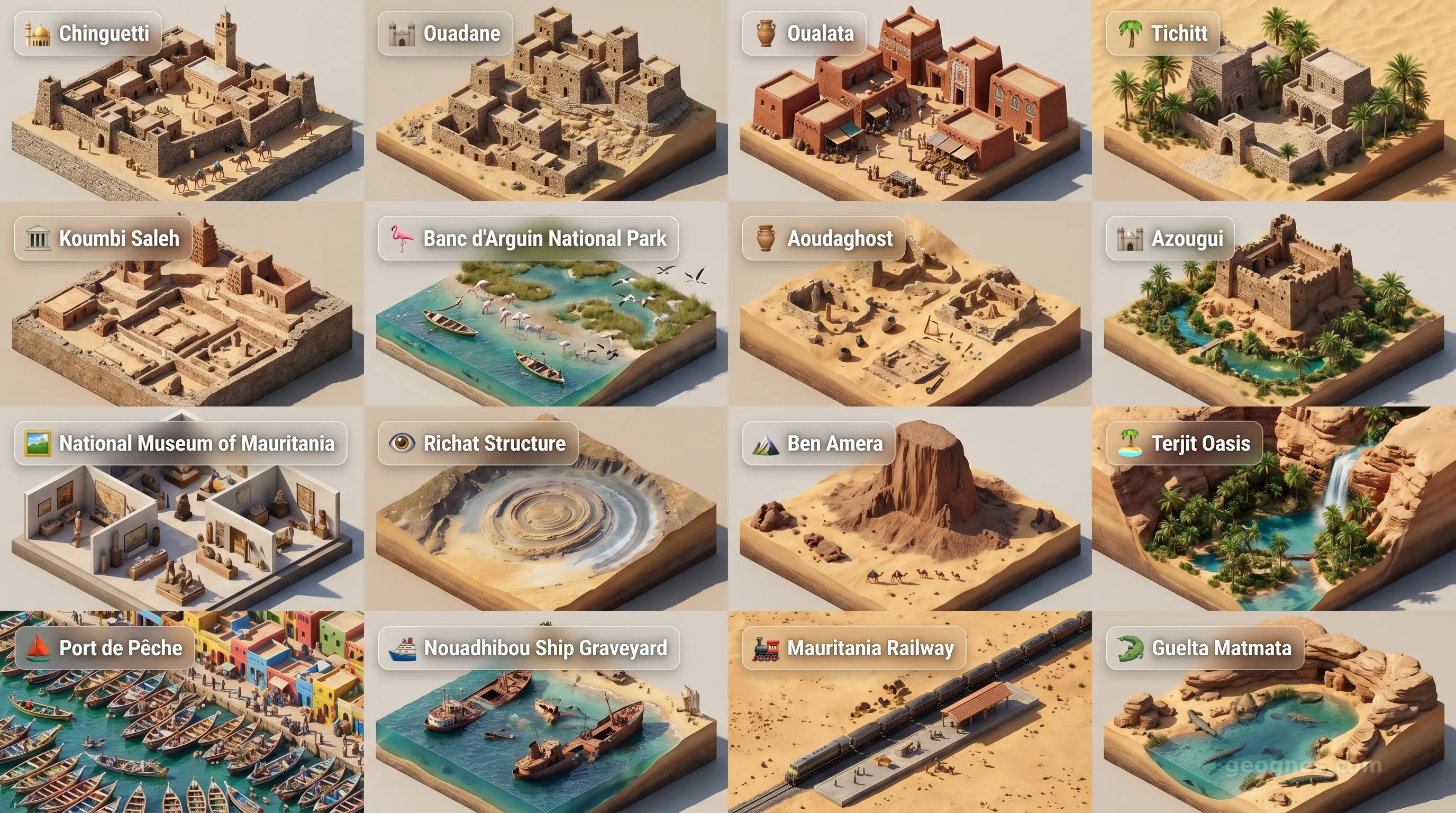
Once a thriving metropolis and the center of several trans-Saharan trade routes in the 13th century, Chinguetti is renowned for its ancient dry-stone architecture and priceless desert libraries. Students of Islamic history will be mesmerized by the thousands of preserved manuscripts detailing science, astronomy, and law. Tourists can wander the labyrinthine alleyways of this ancient Ksour and admire the iconic Friday Mosque with its unmortared stone minaret. The best time to visit is between November and February to avoid the blistering Saharan heat. Tip: Engage a local guardian to show you the private family libraries, as these are the true treasures of the city.
Ruined Caravan City on a Cliff
Perched dramatically on the edge of the Adrar Plateau, Ouadane was founded in 1147 by Berber tribes and became a crucial staging post for the trans-Saharan gold and salt trades. The sprawling, multi-tiered ruins of the old town cascade down the cliffside, offering an unparalleled glimpse into medieval Saharan urban planning. It is a spectacular site for archaeological study, reflecting the rise and fall of desert commerce. Visit during the cooler winter months (December to February). Tip: Climb to the highest point of the ruins at sunset for a breathtaking panoramic view of the vast desert below.
The Painted Pearl of the Desert
Located in the remote southeast, Oualata is visually distinct from Mauritania's other ancient ksour due to its highly decorative architecture. The town is famous for its intricate, reddish-brown and white geometric murals that adorn the interior courtyards and exterior doors of the traditional houses—a craft traditionally passed down among women. Historically, it was a major scholarly and religious center in the 13th and 14th centuries. Studying Oualata offers insights into the cultural fusion of Berber, Arab, and sub-Saharan African traditions. Travel here between November and March. Tip: Hire a local guide to explain the symbolism behind the unique arabesque wall paintings.
The Green Stone Settlement
Tichitt is the most isolated of Mauritania's ancient caravan cities, situated at the base of the Tagant Plateau. Founded around 1150, the town is architecturally unique, built almost entirely from locally quarried greenish-grey stone. The impressive 16th-century mosque and the surviving vernacular houses provide invaluable context for students researching the adaptation of human settlements in hyper-arid environments. The best season to visit is mid-winter. Tip: Because of its remote location, accessing Tichitt requires a sturdy 4x4 and an experienced driver, but the journey through shifting dunes is half the adventure.
Capital of the Ancient Ghana Empire
Koumbi Saleh is one of the most historically significant archaeological sites in West Africa, widely believed to be the capital of the medieval Ghana Empire. At its peak in the 11th century, it was a massive, wealthy metropolis dominating the gold and salt trade before falling to the Almoravids. For history and archaeology students, the excavated foundations of mosques, houses, and royal quarters reveal the immense scale of sub-Saharan political power before European contact. Visit between November and February. Tip: Interpretive signage is minimal, so visiting with an expert guide familiar with medieval West African history is highly recommended.
Coastal Haven for Millions of Birds
Where the Sahara Desert meets the Atlantic Ocean, the Banc d'Arguin is a vast expanse of sand dunes, coastal swamps, and shallow coastal waters. It is one of the most important wintering zones for migratory birds in the world, hosting over two million broad-billed sandpipers, flamingos, and pelicans annually. It is also home to the Imraguen people, who historically fished in symbiotic partnership with dolphins. It is a premier destination for ornithologists and environmental science students. The best birdwatching season is from November to January. Tip: Explore the shallow waters on a traditional lateen-rigged wooden sailboat (lotte) organized by local Imraguen fishermen.
Ancient Trans-Saharan Trade Hub
Nestled in the Hodh El Gharbi region, Aoudaghost was a wealthy Berber town and a critical southern terminus for trans-Saharan trade between the 9th and 11th centuries. Excavations have uncovered glass, pottery, and architectural remains that point to a highly cosmopolitan society influenced by North Africa, the Middle East, and the Sahel. It is a fascinating field study location for those investigating ancient global trade networks. The best time to visit is during the dry, cooler winter. Tip: Due to the rugged terrain and remote location, combine this visit with a wider tour of the Tagant region using a well-equipped expedition vehicle.
Cradle of the Almoravid Dynasty
Azougui, located near the modern town of Atar in the Adrar oasis region, holds profound historical weight as the 11th-century citadel and capital of the Almoravid dynasty. The Almoravids eventually expanded their empire from the Senegal River to the Iberian Peninsula (Spain). Today, students and tourists can explore the atmospheric ruins of the fortress and the tomb of the venerated chronicler Imam al-Hadrami. Surrounded by thousands of date palms, the area is serene and historically charged. Visit from November to March. Tip: Make sure to respectfully explore the adjacent palm grove, which perfectly illustrates traditional oasis agriculture.
Guardian of Mauritanian Heritage
Situated in the capital city of Nouakchott, the National Museum of Mauritania is the premier institution for understanding the country's diverse cultural and historical tapestry. It houses extensive archaeological collections from Koumbi Saleh and Aoudaghost, alongside ethnographic exhibits detailing the nomadic lifestyle, traditional Moorish clothing, and indigenous crafts. It is an essential first stop for students and tourists wanting a curated overview of Mauritania's past and present. It can be visited year-round. Tip: Look out for the collection of ancient arrowheads and the intricate leatherwork saddles used by desert nomads.
The Eye of the Sahara
The Richat Structure is a spectacular 40-kilometer-wide circular geological formation that looks like a gigantic bullseye from space. Originally thought to be a meteorite impact crater, geologists now understand it to be a deeply eroded, symmetrical geological dome. It is an absolute must-visit for geology students and adventure tourists seeking extraterrestrial-looking landscapes. The sheer scale is best appreciated from above or via satellite imagery, though off-roading through its concentric rings is an unforgettable ground experience. Best visited between December and February. Tip: Consider a hot air balloon or scenic flight charter if your budget allows, to truly comprehend its massive scale.
Africa's Largest Monolith
Rising dramatically 633 meters out of the flat, endless Sahara, Ben Amera is the second-largest monolith in the world (after Uluru in Australia). This towering mass of dark black granite is steeped in local folklore and provides an imposing, stark contrast to the surrounding golden dunes. In 1999, international artists gathered nearby to carve incredible sculptures into scattered boulders, adding a layer of contemporary art to the ancient geology. It is a phenomenal site for geography students and intrepid photographers. Visit during the winter months. Tip: Camp overnight at the base of the monolith to witness the spectacular interplay of shadows and starlight.
A Lush Paradise in the Desert
Tucked away in a deep gorge of the Adrar plateau, Terjit Oasis is a literal desert paradise. A natural thermal spring flows from the rocky cliffs, nourishing a dense canopy of date palms and creating cool, shaded pools perfect for swimming. Historically used as a resting place for ancient camel caravans, it continues to offer respite to modern travelers. It provides a striking biological contrast to the arid surroundings, ideal for studying desert micro-ecosystems. The oasis is pleasant from October to April. Tip: Enjoy a traditional mint tea ceremony in one of the khaimas (traditional tents) set up near the thermal springs.
Nouakchott's Vibrant Fish Market
Every afternoon on the beaches of Nouakchott, hundreds of brightly painted wooden pirogues crash through the Atlantic surf to deliver the daily catch. The Port de Pêche is a chaotic, colorful, and culturally immersive spectacle of West African coastal life. Teams of fishermen chant as they haul heavy nets, while vendors negotiate fiercely over fresh octopus and snapper. For sociology and anthropology students, it offers a raw look at Mauritania's vital fishing economy. Visit year-round, but late afternoon (around 4 PM to 6 PM) is the best time for action. Tip: Wear waterproof footwear and be prepared for strong odors; ask permission before taking close-up portraits.
The Rusting Fleet of Nouadhibou
The coastline around Nouadhibou was once known as the largest ship graveyard in the world, with over 300 rusting commercial vessels abandoned in its shallow waters. While recent salvage operations have cleared many, dozens of skeletal iron hulks still remain, jutting out of the Atlantic waves. The site is a hauntingly beautiful testament to maritime history, economic shifts, and environmental impact—a fascinating case study for students of maritime law and modern ecology. Visit year-round. Tip: The best viewpoints are near the commercial port; hire a local boatman to safely navigate closer to the wrecks for photography.
The Longest Train in the World
The Train des Mines transports iron ore across 700 kilometers of unforgiving Sahara Desert from the mines of Zouérat to the port of Nouadhibou. Measuring up to 3 kilometers in length, it is one of the longest and heaviest trains on Earth. Adventurous travelers can ride for free atop the open iron ore wagons, experiencing the Sahara in the most raw, visceral way imaginable. For engineering and logistics students, the railway is a marvel of industrial infrastructure in extreme conditions. The journey is best attempted between November and February. Tip: Pack a ski mask, heavy blankets, and goggles; the dust, iron ore powder, and night temperatures are intense.
Hidden Canyon of the Desert Crocodiles
Hidden deep in the Tagant region, Guelta Matmata is a stunning gorge holding a permanent body of water (guelta). It is incredibly significant biologically because it is one of the last remaining refuges for the West African crocodile in the Sahara—a relic population from thousands of years ago when the desert was green. Biology and ecology students will find this isolated ecosystem fascinating. The landscape features dramatic rock walls and rich birdlife. Best visited from November to March. Tip: Silence and patience are key; approach the water's edge quietly early in the morning to spot the elusive crocodiles basking on the rocks.