🇸🇳

Senegal

Africa • Countries •
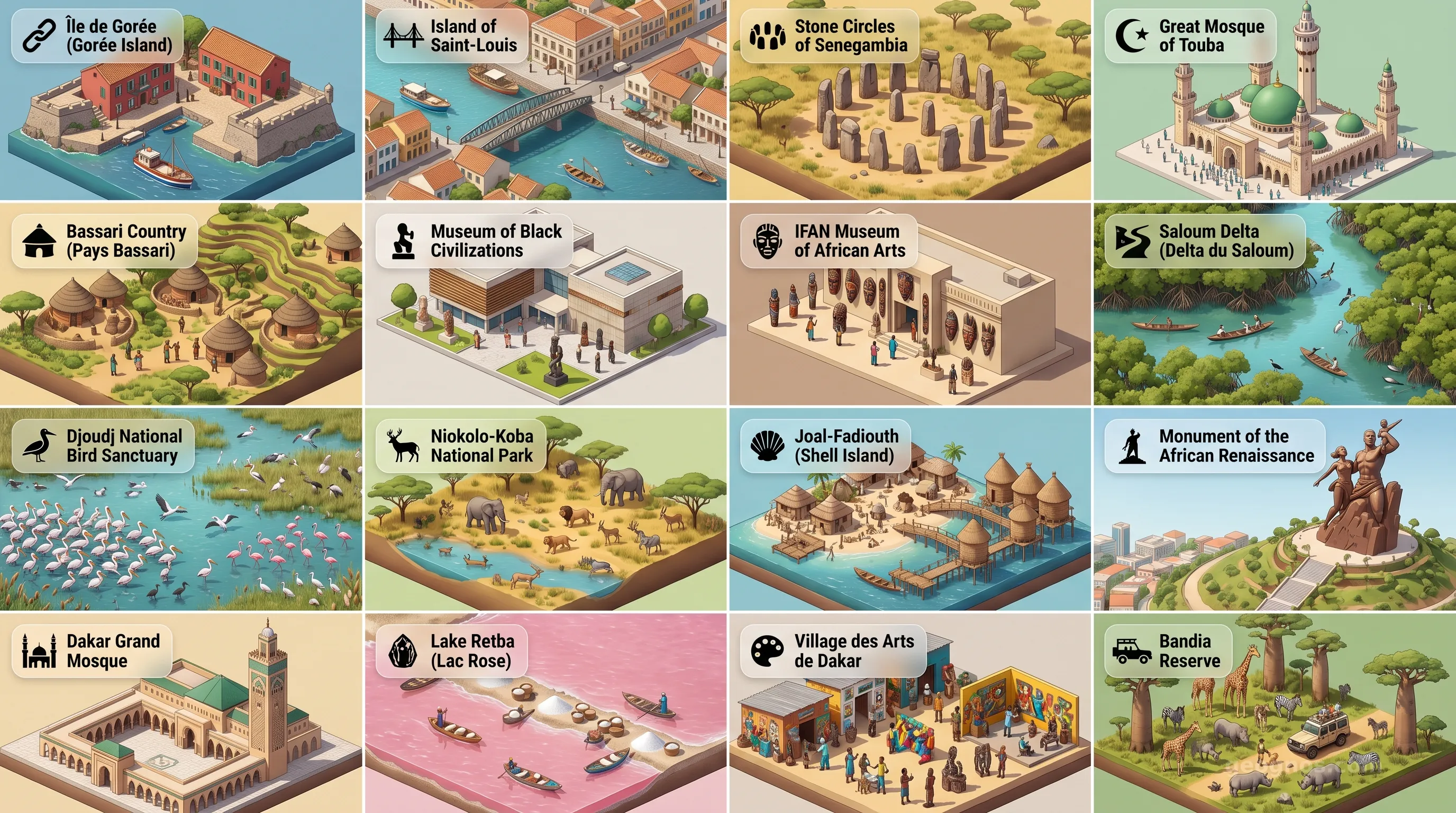
Senegal - Panoramic Places of Interest Atlas including Île de Gorée (Gorée Island), Island of Saint-Louis, Stone Circles of Senegambia, Great Mosque of Touba, Bassari Country (Pays Bassari), Museum of Black Civilizations, IFAN Museum of African Arts, Saloum Delta (Delta du Saloum), Djoudj National Bird Sanctuary, Niokolo-Koba National Park, Joal-Fadiouth (Shell Island), Monument of the African Renaissance, Dakar Grand Mosque, Lake Retba (Lac Rose), Village des Arts de Dakar, Bandia Reserve

Top Sights & Landmarks

01

Île de Gorée (Gorée Island)

Symbol of the Transatlantic Slave Trade

02

Island of Saint-Louis

Senegal's Former Colonial Capital

03

Stone Circles of Senegambia

Ancient Megalithic Wonders

04

Great Mosque of Touba

Epicenter of the Mouride Brotherhood

05

Bassari Country (Pays Bassari)

Terraced Landscapes and Ancient Traditions

06

Museum of Black Civilizations

A Pan-African Cultural Repository

07

IFAN Museum of African Arts

Oldest Art Museum in West Africa

08

Saloum Delta (Delta du Saloum)

Mangroves and Ancient Shell Mounds

09

Djoudj National Bird Sanctuary

A Vital Wetland for Migratory Birds

10

Niokolo-Koba National Park

Vast Savanna and Guinean Forest Biosphere

11

Joal-Fadiouth (Shell Island)

The Island Made of Clam Shells

12

Monument of the African Renaissance

Colossal Bronze Tribute to Africa

13

Dakar Grand Mosque

Post-Independence Islamic Splendor

14

Lake Retba (Lac Rose)

Senegal's Famous Pink Lake

15

Village des Arts de Dakar

The Pulse of Contemporary Senegalese Art

16

Bandia Reserve

Accessible West African Safari

Background

Senegal is one of the few countries in the world with evidence of continuous human life from the Paleolithic period to present. Between the 14th and 16th centuries, the Jolof Empire ruled most of Senegal. Starting in the 15th century, Portugal, the Netherlands, France, and Great Britain traded along the Senegalese coast. Senegal’s location on the western tip of Africa made it a favorable base for the European slave trade. European powers used the Senegalese island of Goree as a base to purchase slaves from the warring chiefdoms on the mainland, and at the height of the slave trade in Senegal, over one-third of the Senegalese population was enslaved. In 1815, France abolished slavery and began expanding inland. During the second half of the 19th century, France took possession of Senegal as a French colony. In 1959, the French colonies of Senegal and French Sudan were merged and granted independence in 1960 as the Mali Federation. The union broke up after only a few months. In 1982, Senegal joined with The Gambia to form the nominal confederation of Senegambia. The envisaged integration of the two countries was never implemented, and the union dissolved in 1989. Since the 1980s, the Movement of Democratic Forces in the Casamance -- a separatist movement based in southern Senegal -- has led a low-level insurgency. Several attempts at reaching a comprehensive peace agreement have failed. Since 2012, despite sporadic incidents of violence, an unofficial cease-fire has remained largely in effect. Senegal is one of the most stable democracies in Africa and has a long history of participating in international peacekeeping and regional mediation. The Socialist Party of Senegal ruled for 40 years until Abdoulaye WADE was elected president in 2000 and re-elected in 2007. WADE amended Senegal's constitution over a dozen times to increase executive power and weaken the opposition. In 2012, WADE’s decision to run for a third presidential term sparked public backlash that led to his loss to current President Macky SALL. A 2016 constitutional referendum limited future presidents to two consecutive five-year terms. President Bassirou Diomaye FAYE took office in April 2024.

Location

Latitude
14° N
Longitude
-14° E
N S W E
World Map Location
Geographic Location

Western Africa, bordering the North Atlantic Ocean, between Guinea-Bissau and Mauritania

Map Reference
Africa

Area

Total Area
196,722 sq km
Land (98%)
Land: 192,530 sq km
Water: 4,192 sq km

Elevation

Highest Point
unnamed elevation 2.8 km southeast of Nepen Diaka
unnamed elevation 2.8 km southeast of Nepen Diaka 648 m
Lowest Point
Atlantic Ocean
Atlantic Ocean 0 m
Mean Elevation
69 m

Detailed Geography Information

Coastline

531 km

Geography - note

westernmost country on the African continent; The Gambia is almost an enclave within Senegal

Irrigated land

1,200 sq km (2012)

Land boundaries

Total boundary: 2,684 km
The Gambia 749 km
Guinea 363 km
Mali 489 km
Mauritania 742 km

Major aquifers

Senegalo-Mauritanian Basin

Major rivers (by length in km)

Senegal (shared with Guinea [s], Mali, and Mauritania [m] ) - 1,641 km; Gambie (Gambia) (shared with Guinea [s] and The Gambia [m]) - 1,094 km note: [s] after country name indicates river source; [m] after country name indicates river mouth

Major watersheds (area sq km)

Atlantic Ocean drainage: Senegal (456,397 sq km)

Maritime claims

territorial sea: 12 nm contiguous zone: 24 nm exclusive economic zone: 200 nm continental shelf: 200 nm or to the edge of the continental margin

Natural hazards

lowlands seasonally flooded; periodic droughts

Natural resources

fishphosphatesiron ore

Terrain

generally low, rolling, plains rising to foothills in southeast

Population & Growth

+2.40% Growth
19,311,233
Total inhabitants (2025 est.)
Male: 49.3% (9,516,356) Female: 50.7% (9,794,877)

Age Distribution

0-14 years
40.7%
~7,859,672
15-64 years
55.9%
~10,794,979
65 years
3.4%
~656,582
Note: 2024 est.

Demographic Longevity

Median Age
19.4 years
Male
18.4 yrs
Female
20 yrs
Life Expectancy
70.6 years
Male
68.8 yrs
Female
72.4 yrs

Vital Dynamics

Birth Rate
29.54
births per 1,000 people
Death Rate
4.85
deaths per 1,000 people
Net Migration
-0.66
migrants per 1,000 people
Fertility Rate
3.96
children born per woman

Detailed People & Society Information

Alcohol consumption per capita

0.25 liters of pure alcohol (2019 est.)

Children under the age of 5 years underweight

16.2% (2023 est.)

Currently married women (ages 15-49)

65.5% (2023 est.)

Dependency ratios

total dependency ratio: 77.4 (2025 est.) youth dependency ratio: 71.2 (2025 est.) elderly dependency ratio: 6.2 (2025 est.) potential support ratio: 16.1 (2025 est.)

Education expenditure

6.2%

6.2% of GDP (2023 est.) 20.9% national budget (2025 est.)

Ethnic groups

Wolof
39.7%
Pulaar
27.5%
Sereer
16%
Mandinka
4.9%
Jola
4.2%
Soninke
2.4%
other
5.4%

Gross reproduction rate

1.93 (2025 est.)

Health expenditure

4.4%

4.4% of GDP (2021) 3.4% of national budget (2022 est.)

Hospital bed density

0.7 beds/1,000 population (2019 est.)

Infant mortality rate

total: 30.4 deaths/1,000 live births (2025 est.) male: 34.4 deaths/1,000 live births female: 27.6 deaths/1,000 live births

Languages

Literacy

total population: 50.4% (2023 est.) male: 61.5% (2023 est.) female: 41.5% (2023 est.)

Major urban areas - population

3.340 million DAKAR (capital) (2023)

Maternal mortality ratio

237 deaths/100,000 live births (2023 est.)

Mother's mean age at first birth

21.9 years (2019 est.) note: data represents median age at first birth among women 25-49

Nationality

noun: Senegalese (singular and plural) adjective: Senegalese

Obesity - adult prevalence rate

8.8% (2016)

Physician density

0.11 physicians/1,000 population (2023)

Population distribution

the population is concentrated in the west, with Dakar anchoring a well-defined core area; approximately 70% of the population is rural, as shown in this population distribution map

Refugees and internally displaced persons

Total Displaced & Vulnerable Persons
18,986 individuals
Refugees
68.8%
13,064
13,064 (2024 est.)
Internally Displaced Persons (IDPs)
31.2%
5,922
5,922 (2024 est.)

Religions

Muslim
97.2%
Christian
2.7%

School life expectancy (primary to tertiary education)

total: 9 years (2023 est.) male: 8 years (2023 est.) female: 10 years (2023 est.)

Sex ratio

at birth: 1.05 male(s)/female 0-14 years: 1.04 male(s)/female 15-64 years: 0.94 male(s)/female 65 years and over: 0.76 male(s)/female total population: 0.97 male(s)/female (2024 est.)

Tobacco use

total: 5.4% (2025 est.) male: 10.5% (2025 est.) female: 0.5% (2025 est.)

Climate & Issues

Climate Profile

tropical; hot, humid; rainy season (May to November) has strong southeast winds; dry season (December to April) dominated by hot, dry, harmattan wind

Key Environmental Issues
deforestation overgrazing soil erosion desertification droughts seasonal flooding overfishing weak environmental laws poaching

Land Cover

Coverage Distribution
Agri (49%)
Forest (45%)
Arable: 19.9%
Crops: 0.4%
Pasture: 29.1%
Forest: 45.1%

Air & Carbon Emissions

Annual CO2 Output 2023 est.
10.373 million
Coal (89%) Oil (0%) Gas (11%)
PM2.5 Exposure 42.2 µg/m³
0 5 (WHO Limit) 15 25 35+
Methane Emissions
energy: 37 kt (2022-2024 est.)

Water Resources & Use

Renewable Water Resources 38.97 billion cubic meters (2022 est.)
Annual Water Withdrawal
municipal: 261 million cubic meters (2022 est.)
Municipal (9%) Ind (0%) Agri (91%)

Detailed Environmental Information

International environmental agreements

BiodiversityClimate ChangeClimate Change-Kyoto ProtocolClimate Change-Paris AgreementComprehensive Nuclear Test BanDesertificationEndangered SpeciesHazardous WastesLaw of the SeaMarine Life ConservationNuclear Test BanOzone Layer ProtectionShip PollutionWetlandsWhaling

Urbanization

urban population: 49.6% of total population (2023) rate of urbanization: 3.59% annual rate of change (2020-25 est.)

Waste and recycling

municipal solid waste generated annually: 2.454 million tons (2024 est.) percent of municipal solid waste recycled: 11.9% (2022 est.)

Capital & State Profile

Capital City
Dakar
14.7333° N, -17.6333° E
Timezone UTC 0
Government Type
presidential republic
Independence 1960-04-04
National Holiday 04-04

Executive Branch

Chief of State
President Bassirou Diomaye FAYE (since 2 April 2024)
Head of Government
Prime Minister Ousmane SONKO (since 2 April 2024)
Last Election 24 March 2024
Next Election March 2029
Cabinet Council of Ministers appointed by the president

Legislative Branch

unicameral
Legislature Name National Assembly (Assemblée nationale)
Seats & Term
165 (all directly elected) seats / 5 years
Women in Chamber
41.2% Representation
Electoral System mixed system
Parties Composition
Pastef Party 130Coalition Takku Wallu Sénégal 16Other 19

National Identity & Symbols

National Flag Description

three equal vertical bands of green (left side), yellow, and red, with a small five-pointed green star centered on the yellow band; green stands for Islam, progress, and hope, yellow for natural wealth and progress, and red for sacrifice and determination; the star represents unity and hope

Symbolic Meaning history: uses the colors of the Pan-African movement
National Symbol lion
National Colors green, yellow, red
National Anthem Pincez tous vos koras, frappez les balafons (Pluck Your Koras, Strike the Balafons)

Detailed Government Information

Administrative divisions

14 regions (régions, singular - région); Dakar, Diourbel, Fatick, Kaffrine, Kaolack, Kéedougou, Kolda, Louga, Matam, Saint-Louis, Sedhiou, Tambacounda, Thies, Ziguinchor

Citizenship

citizenship by birth: no citizenship by descent only: at least one parent must be a citizen of Senegal dual citizenship recognized: no, but Senegalese citizens do not automatically lose their citizenship if they acquire citizenship in another state residency requirement for naturalization: 5 years

Constitution

history: previous 1959 (pre-independence), 1963; latest adopted by referendum 7 January 2001, promulgated 22 January 2001 amendment process: proposed by the president of the republic or by the National Assembly; passage requires Assembly approval and approval in a referendum; the president can bypass a referendum and submit an amendment directly to the Assembly, which requires at least three-fifths majority vote; the republican form of government is not amendable

Country name

conventional long form: Republic of Senegal conventional short form: Senegal local long form: République du Sénégal local short form: Sénégal former: Senegambia (along with The Gambia), Mali Federation etymology: named for the Senegal River that forms the northern border of the country; the river's name may derive from "Azenegue," the Portuguese name for the Berber Zenaga people who lived north of the river, or it could come from a local word meaning "navigable"

International law organization participation

accepts compulsory ICJ jurisdiction with reservations; accepts ICCt jurisdiction

International organization participation

Judicial branch

highest court(s): Supreme Court or Cour Suprême (consists of the court president and 12 judges and organized into civil and commercial, criminal, administrative, and social chambers); Constitutional Council or Conseil Constitutionnel (consists of 7 members, including the court president, vice president, and 5 judges) judge selection and term of office: Supreme Court judges appointed by the president of the republic upon recommendation of the Superior Council of the Magistrates, a body chaired by the president and minister of justice; judge tenure varies, with mandatory retirement either at 65 or 68 years; Constitutional Council members are appointed, 5 by the president and 2 by the National Assembly speaker; judges serve 6-year terms, with renewal of 2 members every 2 years subordinate courts: High Court of Justice (for crimes of high treason by the president); Courts of Appeal; Court of Auditors; assize courts; regional and district courts; Labor Court

Legal system

civil law system based on French law; Constitutional Council reviews legislative acts

National heritage

total World Heritage Sites: 7 (5 cultural, 2 natural) selected World Heritage Site locales: Island of Gorée (c); Niokolo-Koba National Park (n); Djoudj National Bird Sanctuary (n); Island of Saint-Louis (c); Stone Circles of Senegambia (c); Saloum Delta (c); Bassari Country: Bassari, Fula, and Bedik Cultural Landscapes (c)

Political parties

Alliance for Citizenship and Work or ACT Alliance for the Republic-Yakaar or APR Alliance of Forces of Progress or AFP AND (National Alliance for Democracy) And-Jef/African Party for Democracy and Socialism or AJ/PADS ARC (Alternative for the next generation of citizens) Awalé Benno Bokk Yakaar or BBY (United in Hope); coalition includes AFP, APR, BGC, LD-MPT, PIT, PS, and UNP Bokk Gis Gis coalition Citizen Movement for National Reform or MCRN-Bes Du Nakk Coalition Mimi 2024 Dare the Future movement Democratic League-Labor Party Movement or LD-MPT Democratic Renaissance Congress Front for Socialism and Democracy/Benno Jubel or FSD/BJ Gainde Centrist Bloc or BCG General Alliance for the Interests of the Republic or AGIR Grand Party or GP Gueum sa Bopp (Believe in yourself) Independence and Labor Party or PIT Jotna Coalition Liberate the People (Yewwi Askan Wi) or YAW Madicke 2019 coalition National Union for the People or UNP Only Senegal Movement Party for Truth and Development or PVD Party of Unity and Rally or PUR Patriotic Convergence Kaddu Askan Wi or CP-Kaddu Askan Wi PRP (Republican party for Progress) Rewmi Party Save Senegal (Wallu Senegal Grand Coalition) or WS; coalition includes PDS, Jotna Coalition, Democratic Renaissance Congress Senegalese Democratic Party or PDS Socialist Party or PS Tekki Movement Réewum Ngor (Republic of Values) Servants (Les Serviteurs)

Suffrage

18 years of age; universal

Economic Overview

lower middle-income, services-driven West African economy; key mining, construction, agriculture, and fishing industries; tourism and exports hit hard by COVID-19; large informal economy; developing offshore oil and gas fields; systemic corruption

Size & Performance

Real GDP (PPP)
$83.183 billion
Latest available estimate (2024)
2023: $77.82 billion2022: $74.642 billion
Real GDP Growth
6.9% (2024 est.)
+6.9%
GDP Per Capita (PPP)
$4,500
2023: $4,3002022: $4,200

GDP Sector Breakdown

Agriculture: 15.5%Industry: 25.4%Services: 49.1%
Origin GDP %
Agriculture 15.5%
Industry 25.4%
Services 49.1%

Trade Balance

Trade Position
Trade Deficit
$7.92 billion
Total Exports
$7.001 billion (2023 est.)
Total Imports
$14.916 billion (2023 est.)
Exports (32%) Imports (68%)

Budget Balance

Budget Position
Budget Deficit
-$1.52 billion
Revenues
$7.749 billion (2023 est.)
Expenditures
$9.267 billion (2023 est.)
Revenues (46%) Expenditures (54%)

Export Profile

Top Export Partners

21.0%
12.0%
5.0%
4.0%
Note: 2023; top five export partners based on percentage share of exports

Major Export Commodities

goldrefined petroleumphosphoric acidfishcement

Import Profile

Top Import Partners

Note: 2023; top five import partners based on percentage share of imports

Major Import Commodities

refined petroleumcrude petroleumricegarmentswheat

Labor & Employment

Total Labor Force 5.763 million (2024 est.)
General Unemployment Rate 3%
Youth Unemployment (Ages 15-24) 4.1%

Income Inequality

Gini Coefficient (Family Income) 36.2
0 (Perfect Equality) Moderate Inequality 100 (Perfect Inequality)

Family Income / Consumption Share

Lowest 10%: 3% (2021 est.) Highest 10%: 28.8% (2021 est.)
Inequality Gap: Top 10% holds 9.6x the share of the bottom 10%.

Detailed Economic Data

Agricultural products

ricegroundnutswatermelonsmilletcassavasugarcanemaizesorghumonionsmilk

Current account balance

-$6.072 billion (2023 est.) -$5.542 billion (2022 est.) -$3.327 billion (2021 est.) note: balance of payments - net trade and primary/secondary income in current dollars

Debt - external

$14.985 billion (2023 est.) note: present value of external debt in current US dollars

Exchange rates

Communaute Financiere Africaine francs (XOF) per US dollar - Exchange rates: 606.345 (2024 est.) 606.57 (2023 est.) 623.76 (2022 est.) 554.531 (2021 est.) 575.586 (2020 est.)

GDP - composition, by end use

Industrial production growth rate

20% (2024 est.) note: annual % change in industrial value added based on constant local currency

Industries

agricultural and fish processingphosphate miningfertilizer productionpetroleum refiningzirconand gold miningconstruction materialsship construction and repair

Inflation rate (consumer prices)

0.8% (2024 est.) 5.9% (2023 est.) 9.7% (2022 est.) note: annual % change based on consumer prices

Remittances

10.6% of GDP (2023 est.) 10.5% of GDP (2022 est.) 11.3% of GDP (2021 est.) note: personal transfers and compensation between resident and non-resident individuals/households/entities

Taxes and other revenues

19.5% (of GDP) (2023 est.) note: central government tax revenue as a % of GDP

Grid Infrastructure

Electricity Access 67.9%
Urban: 96.6% Rural: 43.4%
Capacity 1.772 million kW (2023 est.)
Consumption 7.547 billion kWh (2023 est.)
Imports 486 million kWh (2023 est.)
Grid Losses: 983 million kWh (2023 est.)

Generation Mix

Percentage Share of Production
fossil fuels 78.3%
wind 9.1%
solar 7.4%
hydroelectricity 3.9%
biomass and waste 1.4%

Fossil Fuels Production

Petroleum
Production 9,000 bbl/day (2023 est.)
Consumption 65,000 bbl/day (2023 est.)
Natural Gas
Production 34.646 million cubic meters (2023 est.)
Consumption 34.604 million cubic meters (2023 est.)
Coal
Consumption 138,000 metric tons (2023 est.)
Exports 21 metric tons (2023 est.)
Imports 181,000 metric tons (2023 est.)

Intensity & Nuclear

Energy Consumption Per Capita 8.303 million Btu/person (2023 est.)
No nuclear energy infrastructure or reactor operations reported in this country dossier.

Digital Access

.sn
Internet Usage 61%

Active internet users as a percentage of the total population.

Fixed Broadband

Penetration Rate 2 / 100
Total Subscriptions 357,000 (2023 est.)

Mobile Cellular

Penetration Rate 124 / 100
Total Subscriptions 22.4 million (2023 est.)

Broadcast Media

over 25 private TV stations; state-run Radiodiffusion Télévision Sénégalaise (RTS) broadcasts from five cities; wide range of independent TV available via satellite; hundreds of radio stations; transmissions of several international broadcasters are accessible on FM in Dakar

Aviation

6V
Airports
20
As of 2025

Railways

Total Track Length
906 km
National Network Data from 2017

Ports & Harbors

Ports Count 6
Hover for breakdown & key ports As of 2024

Merchant Marine

Commercial Fleet
36 ships
Hover for vessel types breakdown As of 2023

Military Expenditures

GDP Allocation 1.6%
1.6% of GDP (2024 est.) 1.5% of GDP (2023 est.) 1.6% of GDP (2022 est.) 1.7% of GDP (2021 est.) 1.5% of GDP (2020 est.)

Active Duty Strengths

approximately 25,000 active Armed Forces personnel, including the Gendarmerie (2025)

Refers to active military personnel.

Service & Defense Details

Military and security forces

Senegalese Armed Forces (les Forces Armées Sénégalaises, FAS): Army (l’Armée de Terre, AT), Senegalese National Navy (Marine Séenéegalaise, MNS), Senegalese Air Force (l'Arméee de l'Air du Séenéegal, AAS), National Gendarmerie Ministry of Interior: National Police (2025) note: the National Police operates in major cities, while the Gendarmerie under the FAS primarily operates outside urban areas; both services have specialized anti-terrorism units, and the Gendarmerie has both Territorial and Mobile components

Military deployments

190 Central African Republic (MINUSCA; plus about 575 police); approximately 380 police Democratic Republic of the Congo (MONUSCO) (2025)

Military equipment inventories and acquisitions

the military has a mix of older, secondhand, and some more modern equipment from a variety of suppliers, including China, France, Russia, South Africa, Spain, Türkiye, and the US (2025)

Military - note

the Senegalese military is responsible for both territorial defense and internal security; it also assists the civilian government in such areas as preventive healthcare, infrastructure development, environmental protection, and disaster response; key areas of focus for the military include a low-level insurgency in the country's south, maritime security, and securing the border against smuggling and Sahel-based Islamist insurgent groups affiliated with al-Qa'ida and the Islamic State; the military participates in foreign peacekeeping deployments and multinational exercises; its closest security partner is France, which has long maintained a military presence in Senegal Senegalese security forces have been engaged in a low-level counterinsurgency campaign in the southern Casamance region against factions of the separatist Movement of Democratic Forces of the Casamance (MDFC) since 1982; the conflict is one of longest running low-level insurgencies in the World, having claimed more than 5,000 lives while leaving another 60,000 displaced; in recent years, nearly all of the MDFC factions have agreed to cease hostilities (2025)

Military service age and obligation

18-28 (up to 35 for specialized roles); 24-month service commitment (2025)

Space Agency

Senegalese Space Study Agency (Agence Sénégalaise d'Etudes Spatiales or ASES; launched in 2023 under the Ministry of Higher Education, Research, and Innovation) (2025)

Program Overview

small, nascent program focused on earth observation/remote sensing capabilities, largely for climate resilience, environmental management, research, and socio-economic development; conducts research in fields such as astronomy and planetary sciences; has cooperated with space agencies in China, France, Turkey, and the US, as well as the ESA (2025)

Program Milestones

2023 signed cooperation agreement with ESA to leverage space technology for socio-economic growth; established a space control center to provide infrastructure for satellite manufacturing and satellite services
2024 first Earth observation/remote sensing nanosatellite (GaindeSat-1A) built with French assistance and launched by US; signed agreement with Turkey on space infrastructure advancement; agreed to participate in China's lunar exploration/research station project
2025 signed US-led Artemis Accords for space and lunar exploration; signed agreement with France for capacity development in space infrastructure and Earth observation initiatives