Nigeria
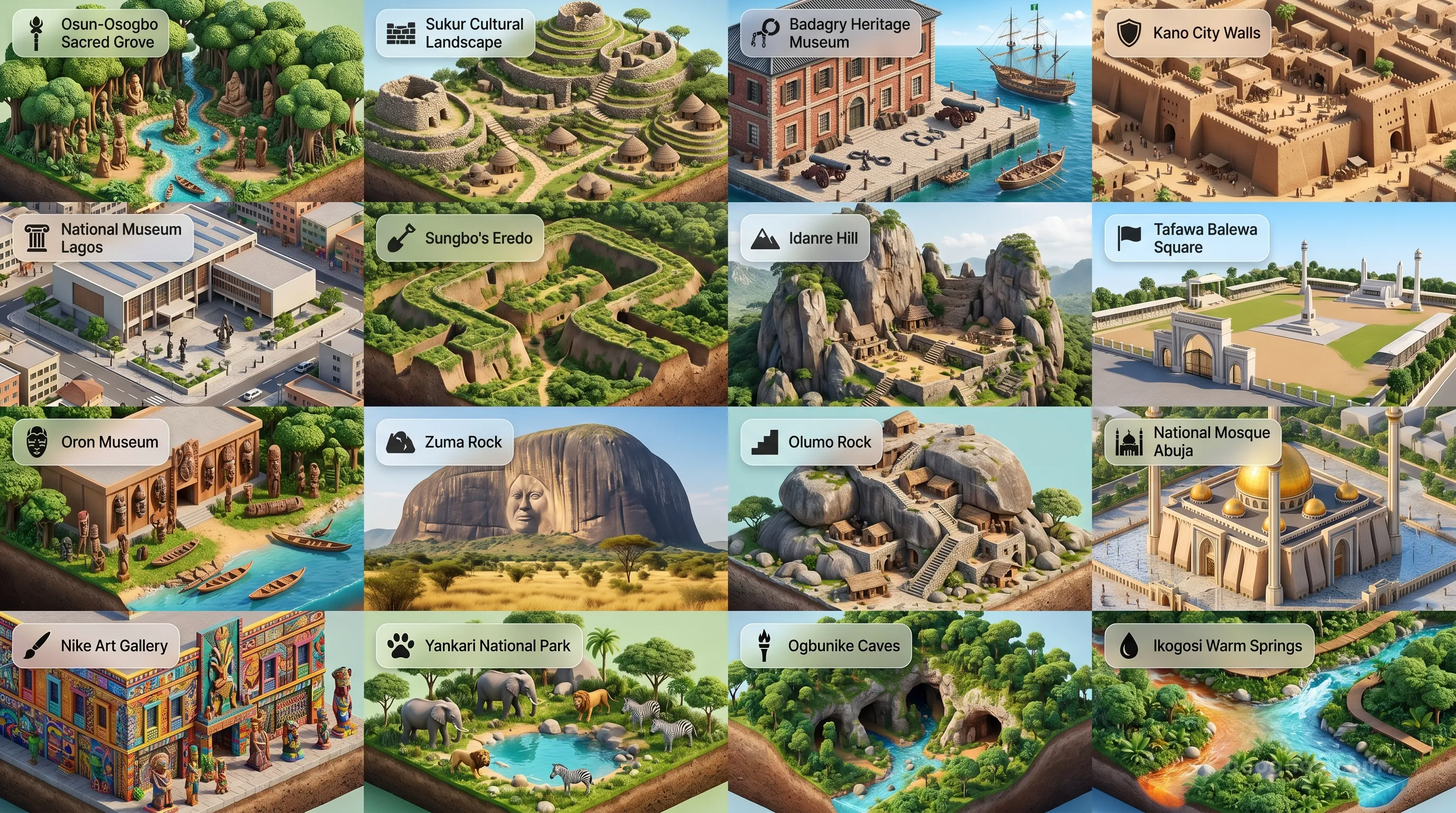
Top Sights & Landmarks
Ancient Yoruba Spiritual Sanctuary
Nestled along the banks of the Osun River, this sacred grove is a profound testament to ancient Yoruba cosmology and one of the last remaining remnants of primary high forest in southern Nigeria. Dedicated to Osun, the Yoruba goddess of fertility, it is a living sanctuary adorned with intricate shrines, sculptures, and artworks. Scholars and tourists visit to study its synthesis of nature and religion, augmented by the striking sculptural works of Susanne Wenger. It is best visited in August during the vibrant Osun-Osogbo festival. Tourist tip: Hire a local guide to fully grasp the rich mythology, and respect the strict 'no photography' rules in specific inner sanctums.
Hilltop Iron Age Settlement
Perched on a hill above the village of Sukur in the Mandara Mountains, this exceptional site features the Hidi's (Chief's) Palace, terraced fields, and the remains of a once-thriving iron industry. Its historical significance lies in its unbroken record of human settlement and spiritual culture spanning centuries. It provides invaluable insights for anthropologists and historians studying West African iron-age societies and traditional architectural techniques. The best time to visit is during the dry season (November to March). Tourist tip: Prepare for a steep hike to reach the hilltop palace, and carry enough water.
Chronicle of the Transatlantic Slave Trade
Housed in the former District Officer's office built in 1863, the Badagry Heritage Museum meticulously preserves the grim artifacts and heartbreaking narratives of the transatlantic slave trade. Badagry was a major slave port, and this museum is an essential educational site for understanding the horrific realities of human trafficking in West Africa. Historical artifacts like slave chains, trade documents, and branding irons are on display. Visit year-round to reflect on this critical piece of global history. Tourist tip: Combine your visit with the nearby Point of No Return and the First Storey Building in Nigeria for a comprehensive historical tour.
Remnants of a Medieval Hausa Kingdom
Built in the 11th century to protect the ancient city of Kano, these towering mud walls stand as an enduring symbol of medieval Hausa military architecture and Islamic urban planning. Once boasting a radius of 14 kilometers, the walls and their iconic gates (Kofars) were integral to the trans-Saharan trade network. Though weather and urbanization have eroded parts of it, historians and architects are drawn to the remaining structures to study pre-colonial defensive engineering. The dry season (December to February) is optimal for exploring. Tourist tip: Engage a local historian at the Gidan Makama Museum to map out a walking tour of the remaining majestic gates.
Custodian of Nigerian Antiquities
The National Museum in Lagos is Nigeria's premier institution for cultural preservation, housing an unparalleled collection of the nation's artifacts. Its crowning glory is the world-renowned Nok Terracottas, alongside the intricately carved ivory tusks from Benin and the bronze artifacts from Igbo-Ukwu and Ife. It is a mandatory stop for students of African art and history seeking to trace the artistic evolution of the continent prior to European contact. Accessible year-round, it offers a cool respite from the bustling city. Tourist tip: Do not miss the bullet-riddled car of the late General Murtala Mohammed, offering a glimpse into Nigeria's turbulent political past.
Massive Ancient Earthwork Monument
Sungbo's Eredo is a 160-kilometer-long system of defensive walls and ditches hidden within the rainforests of Ogun State. Constructed over a millennium ago, it is considered one of the largest single monuments in Africa, requiring more earth to be moved than the Great Pyramid of Giza. Legend ties it to Bilikisu Sungbo, whom locals claim was the biblical Queen of Sheba. It is a fascinating study site for landscape archaeologists and historians. The best season to visit is the dry season, as the jungle terrain can be muddy. Tourist tip: Wear sturdy boots and insect repellent, and ensure you have a knowledgeable local guide, as the ruins are heavily overgrown.
Ancient Settlement Among the Clouds
Rising 3,000 feet above sea level, Idanre Hill is a breathtaking geological wonder that served as a natural fortress for the Idanre people for over 800 years before they relocated to the valley. The hilltop retains the old king's palace, ancient shrines, and unreadable letters carved into the rock face. It is an extraordinary site for geologists and historians alike. The view from the top offers panoramic vistas of the surrounding green valleys. The best time to visit is during the dry season to ensure safe climbing. Tourist tip: Be prepared to climb exactly 682 steps to reach the top, taking breaks at the designated resting spots.
Heart of Nigeria's Independence
Tafawa Balewa Square (TBS) in Lagos is an expansive ceremonial ground that holds immense patriotic significance; it was here that Nigeria officially declared its independence from British rule on October 1, 1960. Flanked by imposing monuments, including the Remembrance Arcade for fallen soldiers and towering statues of white horses and red eagles, it is a key site for political historians. It remains a bustling center for modern events. It can be visited any time of the year. Tourist tip: Look out for the 26-story Independence House nearby, and visit during a major cultural festival or concert to see the square come alive.
Home to the Ancient Ekpu Carvings
Situated near the scenic Calabar River in Akwa Ibom, the Oron Museum is dedicated almost entirely to the art and culture of the Oron people. It is famous globally for housing hundreds of Ekpu (ancestral) carvings, which are among the oldest and finest surviving wooden sculptures in Africa. During the Nigerian Civil War, many of these artifacts were lost or damaged, making the remaining pieces critically important for art historians and anthropologists. Open all year, the museum also offers beautiful riverine views. Tourist tip: Take a moment to enjoy the serene outdoor bunker used during the Civil War, and catch a boat ride across the river to Calabar.
The Monolithic Gateway to Abuja
An iconic symbol of Nigeria, prominently featured on the 100 Naira note, Zuma Rock is a massive monolith rising majestically 725 meters above its surroundings. Historically, it was used as a defensive retreat by the Gwari people against invading tribes. Characterized by natural contours that resemble a human face, it is deeply embedded in local folklore and superstition. Geologists study its unique gabbro and norite rock composition. The best time to visit is during the rainy season (April to October) when heavy rains create temporary waterfalls on the rock's face. Tourist tip: Avoid climbing without professional gear and permission; the best photos are taken from the Abuja-Kaduna expressway.
Historic Fortress of the Egba People
Olumo Rock is not just a striking geological formation; it is the spiritual and historical heart of Abeokuta (which means 'Under the rock'). During the 19th-century inter-tribal wars, the Egba people used these massive granite rocks as a fortress and vantage point. The site features ancient shrines, hidden caves, and the preserved dwelling places of the priestesses. Today, an elevator and carved staircases make it accessible. Visit during the dry months for better visibility from the summit. Tourist tip: Opt for the stairs rather than the elevator to explore the small caves and hear the intriguing folktales from the resident guides.
Architectural Jewel of the Capital
Built in 1984, the Nigerian National Mosque is an architectural masterpiece renowned for its golden dome and four towering minarets that dominate the Abuja skyline. It represents the cultural and religious unity of Nigeria's Muslim population. The mosque is not only a place of worship but a site of architectural study due to its intricate Islamic geometric designs, sprawling library, and conference center. It is open to the public year-round. Tourist tip: Non-Muslim visitors are welcome outside of prayer times; ensure you dress modestly, and women must cover their heads before entering the complex.
Largest Collection of West African Art
Founded by the legendary Nigerian artist Chief Nike Davies-Okundaye, this towering five-story gallery in Lagos is arguably the largest of its kind in West Africa. It houses a staggering 8,000 diverse artworks, ranging from traditional Adire textiles to contemporary paintings and sculptures. It is an essential destination for art students, offering workshops in traditional Nigerian weaving and fabric dyeing. It is an excellent indoor attraction suitable for any season. Tourist tip: You may have the honor of being greeted by Mama Nike herself; don't hesitate to purchase authentic Adire fabrics directly from the source.
Premier Wildlife Reserve and Historic Caves
Yankari National Park is Nigeria's most famous wildlife sanctuary, providing refuge to elephants, baboons, and antelopes in their natural savanna habitat. Beyond ecology, the park holds historical importance with the Marshall Caves—ancient human settlements carved into sandstone—and the Dukkey Wells, an intricate historic water conservation system. Ideal for biology and history students alike, the best time for game viewing is late dry season (February to April) when animals congregate around water sources. Tourist tip: Bring a swimsuit for a rejuvenating dip in the Wikki Warm Springs, known for their crystal-clear, thermally heated waters.
Spiritual Subterranean Labyrinth
Located in a valley blanketed by tropical rainforest, the Ogbunike Caves are a complex network of subterranean caverns. Historically, the caves served as a refuge for locals during the Nigerian Civil War and have profound spiritual significance for the local Igbo people, who celebrate an annual festival in its honor. It is a fascinating geological site featuring underground rivers, bat colonies, and striking limestone formations. The dry season is preferable, as water levels inside the caves can rise dangerously during the rains. Tourist tip: Visitors must remove their shoes before entering the caves as a sign of respect for the site's spiritual sanctity.
Where Hot and Cold Waters Meet
Ikogosi Warm Springs is a unique geological phenomenon where a warm spring flows side by side with a cold spring, eventually meeting at a confluence without mixing temperatures immediately. The site is enveloped by rich, dense forest and is the subject of many local myths regarding two wives of a mythical hunter who turned into the opposing springs. Geologists visit to study the thermal properties of the rock formations that heat the water. It can be enjoyed year-round. Tourist tip: Take a walk along the wooden boardwalks through the forest, and swim in the temperature-regulated pool built near the springs.