Singapore
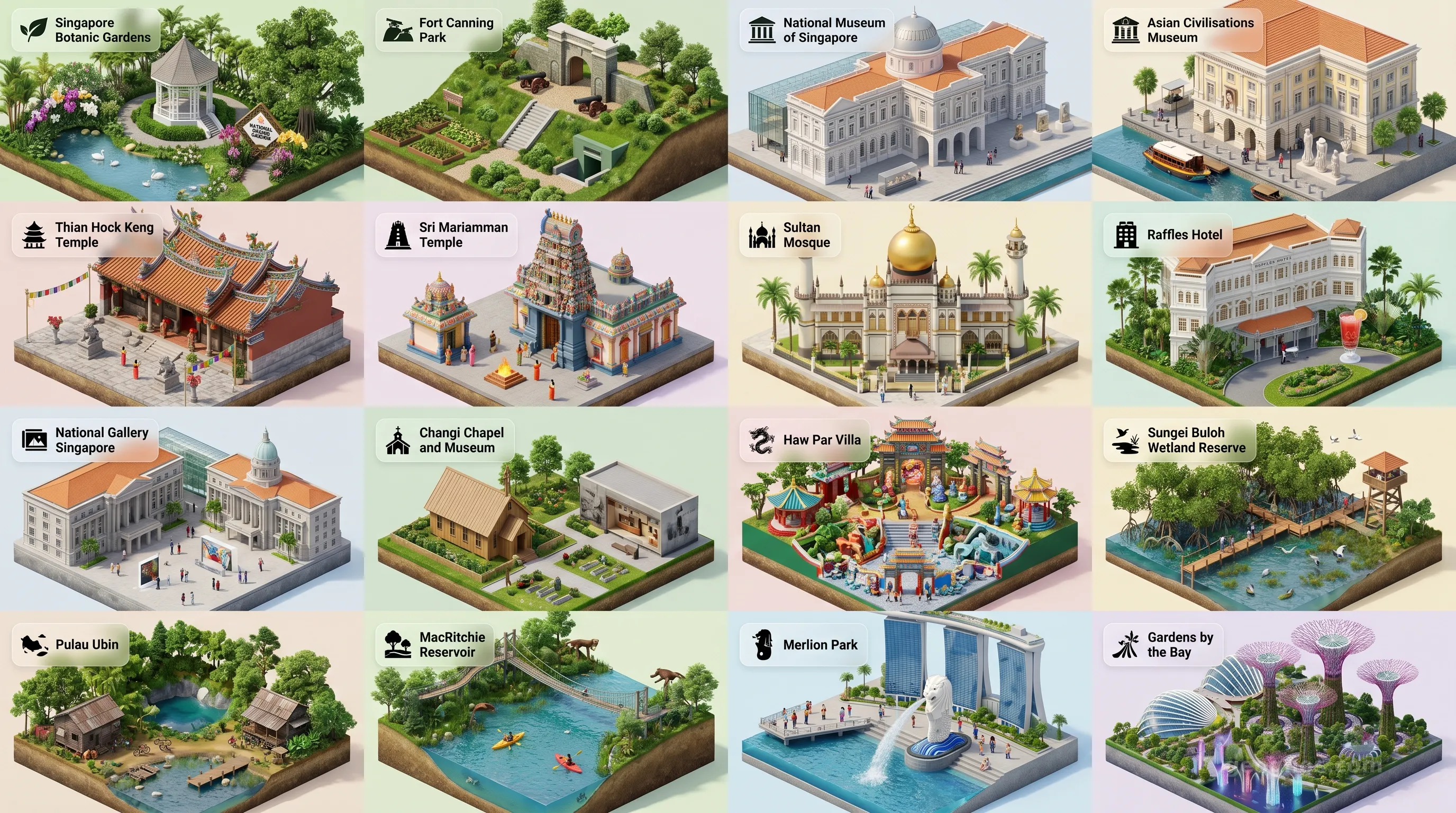
Top Sights & Landmarks
Singapore's Oldest Historic Garden
Inscribed as a UNESCO World Heritage site, this 160-year-old tropical garden played a pivotal role in the region's rubber trade boom. Students of botany and history will find the Heritage Museum and the National Orchid Garden deeply fascinating. It is a vital study of British colonial agricultural expansion. The best time to visit is early morning or late afternoon to escape the midday heat. Tourist tip: Bring mosquito repellent and enjoy a picnic near the Symphony Lake.
Ancient Royal Seat and WWII Bunker
Historically known as Bukit Larangan (Forbidden Hill), this archaeological site was the seat of 14th-century Malayan kings and later served as the British Army's headquarters during World War II. For students of history, the underground Battlebox bunker offers an immersive study into the 1942 fall of Singapore. Tourists will enjoy the lush spice gardens and the iconic Fort Canning Tree Tunnel. Best visited in the morning; wear comfortable walking shoes to navigate the hill's slopes.
The Nation's Oldest Museum
Established in 1887, this museum is the definitive repository of Singapore's history, transitioning from a 14th-century fishing village to a modern metropolis. The majestic neo-Palladian and Renaissance architecture makes it a stunning historic facade. It is a must-visit for students wanting a comprehensive timeline of Singaporean nation-building. It is an excellent indoor activity year-round. Tourist tip: Do not miss the immersive 'Story of the Forest' digital art installation in the Glass Rotunda.
Pan-Asian Cultural Heritage Repository
Located by the historic Singapore River in the Empress Place Building, this museum traces the diverse cultural roots of Singaporeans. It houses vast collections covering maritime trade, faith, and design across Asia. Scholars of anthropology and Asian history will find the Tang Shipwreck exhibit particularly invaluable. Perfect for year-round visits. Tourist tip: Join one of the free guided tours offered daily to fully grasp the historical context of the intricate artifacts.
Singapore's Oldest Chinese Temple
Built in 1839 by early Hokkien immigrants in gratitude to Mazu (Goddess of the Sea) for safe passage, this architectural marvel was constructed entirely without nails. It stands as a profound testament to the early Chinese diaspora. Architecture students can study traditional southern Chinese woodworking and porcelain roof crests here. It is fascinating year-round, but especially vibrant during the Lunar New Year. Tourist tip: Respect the quiet ambiance as it is an active place of worship.
Iconic and Oldest Hindu Temple
Dating back to 1827, this temple is a stunning example of Dravidian architecture, featuring a towering six-tiered gopuram (entrance tower) adorned with Hindu deities. Historically, it served as an asylum for new South Indian immigrants. It provides rich cultural insights for theology and history students. The best time to visit is during the Theemithi (fire-walking) festival in October or November. Tourist tip: Shoulders and knees must be covered, and shoes must be removed before entering.
Heart of the Kampong Glam District
Originally built in 1824 for Sultan Hussein Shah, the current magnificent structure with its massive golden domes was completed in 1932. It is a critical focal point for understanding Singapore's Malay and Arab heritage. Notice the black rim beneath the domes, made from glass bottles donated by poor Muslims so all could contribute. Visit year-round, but avoid Friday midday prayers if you wish to enter. Tourist tip: Explore the surrounding Arab Street for traditional textiles and Middle Eastern cuisine.
Pinnacle of Colonial Hospitality
Opened in 1887, Raffles Hotel is a pristine example of neoclassical colonial architecture and a symbol of Singapore's British colonial era. Literary legends like Somerset Maugham and Rudyard Kipling stayed here, making it intriguing for literature and history buffs. It is also the birthplace of the famous 'Singapore Sling' cocktail. It is great for a year-round visit. Tourist tip: Even if you are not a guest, you can wander the public courtyards or visit the Long Bar; smart casual attire is encouraged.
Southeast Asian Art in a Monumental Setting
Housed within two brilliantly restored national monuments—the former Supreme Court and City Hall—this gallery oversees the world's largest public collection of Singaporean and Southeast Asian modern art. Historically, City Hall was the site of the Japanese surrender in 1945 and Lee Kuan Yew's declaration of self-government. It offers immense value for both art and history students. Tourist tip: Visit the rooftop garden for a spectacular, unobstructed view of the Marina Bay skyline.
WWII Memorial and POW History
This deeply moving museum chronicles the dark days of the Japanese Occupation (1942-1945), focusing on the experiences of prisoners of war and civilian internees at Changi Prison. For students of 20th-century history, the preserved letters, drawings, and the recreated chapel provide a poignant study of human resilience. It is an indoor site suitable for any weather. Tourist tip: Opt for the audio guide to hear heartbreaking and inspiring personal accounts of the survivors.
Eclectic Park of Chinese Mythology
Built in 1937 by the Aw brothers (creators of Tiger Balm), this unique cultural park contains over 1,000 statues and dioramas depicting Chinese folklore, mythology, and Confucian tenets. The infamous '10 Courts of Hell' exhibit is a visceral educational tool originally meant to teach morality. It is a fascinating case study of early 20th-century cultural preservation. Best visited on a cloudy day as the park is entirely outdoors. Tourist tip: The imagery in the Hell exhibit can be graphic, so exercise discretion with young children.
Vital Mangrove and Migratory Bird Hub
Recognized as an ASEAN Heritage Park, this ecological jewel features extensive mangrove forests, mudflats, and ponds. It is a critical stopover for migratory birds traversing the East Asian-Australasian Flyway. Biology and ecology students will find the biodiversity here—including mudskippers, water monitors, and estuarine crocodiles—outstanding. The best time to visit is between September and March during the migratory bird season. Tourist tip: Bring a telephoto lens or binoculars and stay strictly on the boardwalks.
Singapore's Last Traditional Kampong
A short bumboat ride from Changi Point takes you back in time to the 1960s. Pulau Ubin preserves Singapore's last traditional 'kampong' (village) lifestyle amidst unspoiled granite quarries and dense forests. The Chek Jawa Wetlands on the island's eastern edge is a rich convergence of six distinct ecosystems, perfect for geographical studies. Best visited in the dry season. Tourist tip: Rent a bicycle at the jetty to explore the island, but be prepared for some rugged, unpaved trails.
Oldest Reservoir and Forest Reserve
Completed in 1868, MacRitchie is Singapore's oldest water supply system, now surrounded by a lush primary rainforest that serves as a green lung for the city. It represents a vital study in urban water management and tropical ecology. The highlight is the HSBC TreeTop Walk, a 250-meter aerial suspension bridge offering a bird's-eye view of the forest canopy. Visit early morning to spot long-tailed macaques and flying lemurs. Tourist tip: Do not feed the monkeys, and carry plenty of drinking water.
Home of the National Icon
Featuring the mythical Merlion—a creature with a lion's head and a fish's body—this park overlooks the scenic Marina Bay. The statue symbolizes Singapore's origins as a humble fishing village (Temasek) and its original name, Singapura (Lion City). While primarily a tourist hub, it is a crucial study in national branding and modern iconography. The best time to visit is at sunset or late evening. Tourist tip: Position yourself on the adjacent jetty for the best photo angle capturing both the Merlion and Marina Bay Sands.
Futuristic Botanical Marvel
This multi-award-winning horticultural destination exemplifies Singapore's vision of a 'City in a Garden'. Featuring the colossal Supertrees and two massive climate-controlled conservatories (Cloud Forest and Flower Dome), it is a masterclass in sustainable engineering and modern landscaping. Botany and urban planning students must visit. Evening is the best time to go to witness the Garden Rhapsody light and sound show. Tourist tip: Purchase conservatory tickets in advance, but the outdoor Supertree Grove is free to explore.