Canada
Top Sights & Landmarks
11th-Century Viking Settlement
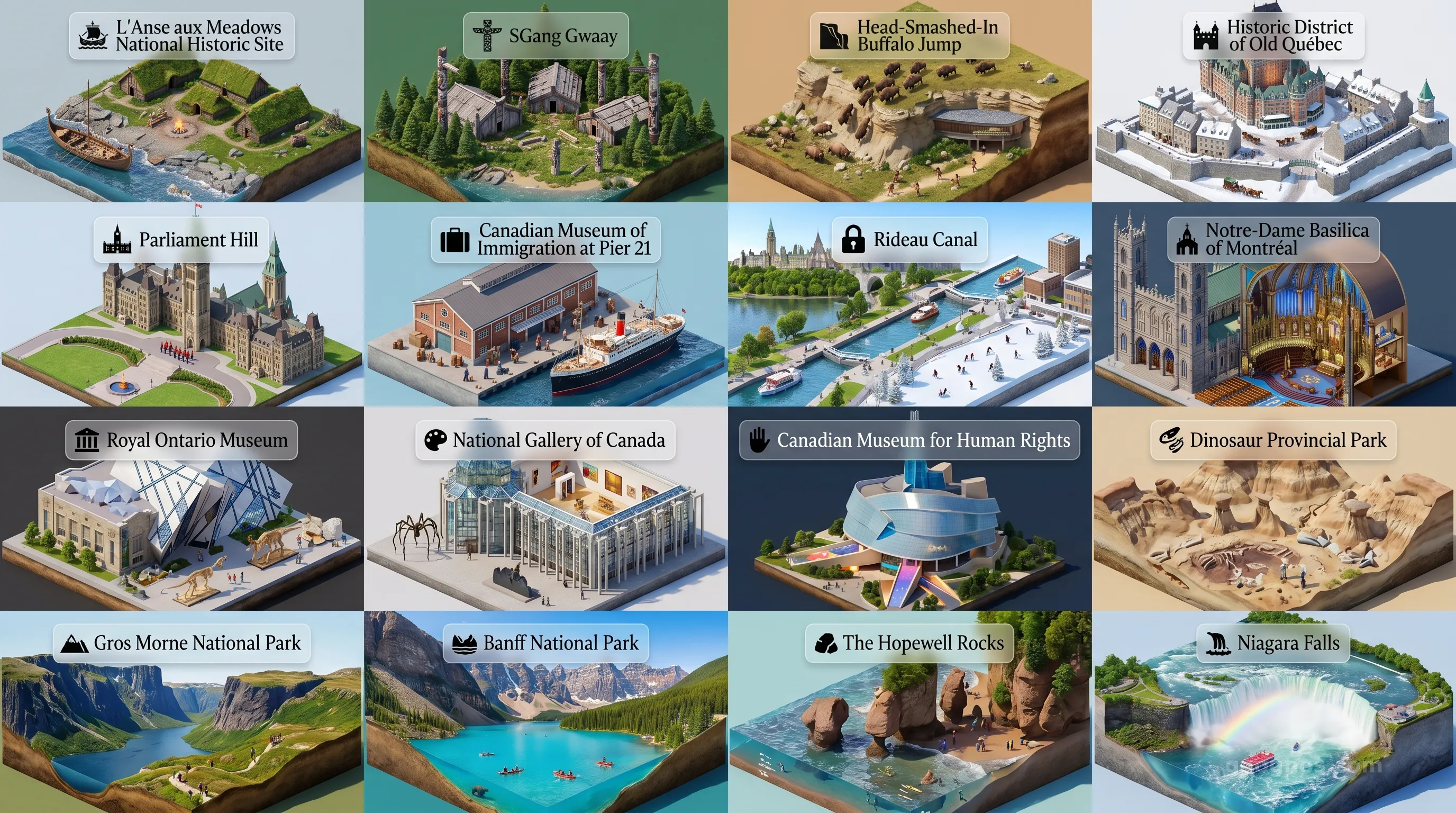
Discover the only authenticated Norse settlement in North America, dating back to the 11th century. This monumental archaeological site fundamentally altered our understanding of global exploration, proving Europeans reached the Americas nearly 500 years before Columbus. For students of history and archaeology, the meticulously reconstructed timber-and-sod buildings and ancient artifacts offer unparalleled insights into Viking life and early trans-oceanic contact. The best time to visit is from mid-June to early October when the weather is mildest and the site is fully operational. Tourist tip: Engage with the historical interpreters dressed in period attire for a truly immersive experience, and explore the dramatic coastal trails surrounding the site.
Ancient Haida Village
Located in the remote archipelago of Haida Gwaii, this ancient village is a profound testament to the art, culture, and deep historical roots of the Haida Nation. It features the remains of large cedar longhouses and a magnificent array of carved mortuary totem poles facing the ocean. As a place of immense spiritual and cultural importance, it offers students of anthropology and Indigenous studies a deeply moving look at a complex civilization that thrived for millennia before European contact. The best season to visit is summer, accessible only by boat or floatplane. Tourist tip: Access requires a guided tour, often led by Haida Watchmen who share invaluable oral histories and traditional knowledge.
6,000-Year-Old Hunting Ground
One of the world's oldest, largest, and best-preserved buffalo jumps, this site was used continuously by the Plains Indigenous peoples for over 6,000 years. The sophisticated hunting technique of driving buffalo over a cliff is a marvel of early communal organization and understanding of topography and animal behavior. The multi-level interpretive center is built directly into the cliffside, making it a masterclass in both history and modern architecture. Students will find the ecological and sociological history fascinating. Visit during the summer to witness traditional drumming and dancing exhibitions. Tourist tip: Walk the upper trail to stand at the exact precipice used by ancient hunters.
The Birthplace of French North America
Founded by Samuel de Champlain in 1608, Old Québec is the only North American city north of Mexico to have preserved its original ramparts. Its winding cobblestone streets, magnificent stone gates, and towering Château Frontenac make it an open-air museum of 17th- and 18th-century colonial history. It is an essential study site for those interested in the French and British colonial eras, the Seven Years' War, and early urban planning. It is magical to visit year-round, though the Winter Carnival in February offers a uniquely vibrant (if freezing) cultural experience. Tourist tip: Ride the funicular linking the Upper and Lower towns, and explore the Quartier Petit Champlain for authentic local artisan shops.
Seat of the Canadian Government
Perched on a limestone bluff overlooking the Ottawa River, Parliament Hill is the political and cultural heart of Canada. Its breathtaking Gothic Revival architecture, complete with gargoyles, pointed arches, and the towering Peace Tower, symbolizes the nation's democratic heritage stemming from Confederation in 1867. For students of political science and history, exploring the legislative chambers and the Centennial Flame provides a direct connection to Canada's ongoing evolution. Summer brings the Changing of the Guard ceremony, while December features spectacular illumination displays. Tourist tip: Free guided tours are available but must be booked well in advance online due to ongoing restoration works.
Gateway to Modern Canada
Often compared to Ellis Island in the US, Pier 21 in Halifax was the point of entry for over one million immigrants between 1928 and 1971. The museum offers deeply emotional and highly educational exhibits detailing the hardships, hopes, and contributions of those who built the modern Canadian mosaic. It is a critical study destination for sociology, history, and immigration policy. Visit during the summer or fall to combine the museum with a stroll along the vibrant Halifax waterfront. Tourist tip: Trace your own family roots at the Scotiabank Family History Centre located inside the museum, where expert archivists can help locate ship manifests.
19th-Century Engineering Marvel
Constructed in 1832 for strategic military purposes following the War of 1812, the Rideau Canal is the oldest continuously operated canal system in North America. Stretching 202 kilometers, it features remarkable hand-operated locks that remain virtually unchanged since their creation. It represents a monumental achievement in early 19th-century engineering. In summer, it is a bustling waterway for boaters and kayakers, while in winter, a large section in Ottawa freezes to become the world's largest naturally frozen ice-skating rink. Tourist tip: Grab a classic Canadian 'Beavertail' pastry to enjoy while skating the canal in January or February.
Gothic Revival Masterpiece
Built in 1829, this basilica is renowned for its dramatic, highly decorated interior featuring a deep blue ceiling studded with gold stars, intricately carved wood, and magnificent stained-glass windows depicting Montréal's religious history. It represents the deeply rooted Catholic history of Quebec and stands as a triumph of Gothic Revival architecture. Art and religious history students will be captivated by the artisanal craftsmanship. Open year-round, it is particularly stunning during the evening 'AURA' light show. Tourist tip: Book tickets for the AURA experience in advance; it masterfully uses laser projection mapping to highlight the basilica's stunning architectural details.
Canada's Largest Cultural Museum
The ROM is Canada's premier museum of art, world culture, and natural history. Its striking modern addition, the Michael Lee-Chin Crystal, sharply contrasts with its original 1914 neo-Romanesque heritage building. Students and researchers can delve into over six million items, including exceptional collections of dinosaur fossils, meteorites, and comprehensive galleries of Indigenous, East Asian, and African art. It is a fantastic year-round destination, perfect for a full-day immersive learning experience. Tourist tip: Check the museum's schedule for 'ROM After Dark', a special evening event for adults featuring food, drinks, and exclusive gallery access.
The Premier National Art Collection
Housed in a stunning glass-and-granite building designed by Moshe Safdie, the National Gallery holds the country's most comprehensive collection of Canadian art, including the Group of Seven, and arguably the world's most vital collection of Indigenous Canadian art. It serves as a vital institution for studying the cultural narratives, shifting identities, and artistic evolution of Canada. Accessible in all seasons, the light-filled galleries are breathtaking year-round. Tourist tip: Take a photo with 'Maman', the massive, iconic bronze spider sculpture by Louise Bourgeois located on the plaza right outside the entrance.
Global Hub for Human Rights Education
An architectural marvel located at the historic Forks in Winnipeg, this is the first national museum dedicated entirely to the evolution, celebration, and future of human rights. Its spiraling design takes visitors on a literal and metaphorical journey from darkness into light. Through interactive, highly engaging digital and physical exhibits, students explore vital topics like the Holocaust, Indigenous rights, and global human rights milestones. It is an emotionally powerful, year-round destination. Tourist tip: Ensure you climb to the Israel Asper Tower of Hope at the top of the museum for a breathtaking panoramic view of the city.
World's Richest Dinosaur Fossil Site
Set amid the stark, otherworldly badlands of Alberta, this park is a site of unparalleled importance for paleontology. Over 50 species of dinosaurs have been discovered here, fundamentally shaping global knowledge of the Late Cretaceous period. For science students and fossil enthusiasts, the sheer volume and quality of the remains found here are staggering. The best time to visit is late spring to early autumn, as winters are harsh. Tourist tip: Book a guided excavation or fossil safari in advance, as public access to the bone beds is strictly regulated to protect the site.
Plate Tectonics Revealed
Gros Morne offers a stunning juxtaposition of deep ocean fjords, towering cliffs, and the Tablelands—a rare place where the Earth's mantle has been thrust above sea level. This park provided crucial evidence for the theory of continental drift, making it a mandatory pilgrimage for geology and earth science students. Beyond its scientific value, its human history traces back thousands of years through Maritime Archaic cultures. Summer is ideal for hiking and boat tours. Tourist tip: Take the boat tour on Western Brook Pond, a massive landlocked fjord carved by glaciers, for spectacular, towering cliff views.
Canada's First National Park
Established in 1885 following the discovery of natural hot springs, Banff is intrinsically linked to the history of the Canadian Pacific Railway and the birth of Canada's tourism industry. Its emerald-green glacial lakes (like Lake Louise and Moraine Lake), jagged peaks, and abundant wildlife make it an iconic representation of the Canadian wilderness. Students of environmental science and history can study the balance between ecology and tourism. Summer offers spectacular hiking, while winter provides world-class skiing. Tourist tip: Arrive at major lakes before 7:00 AM or use the convenient Parks Canada shuttles to avoid notorious summer parking struggles.
The Highest Tides on Earth
Located on the Bay of Fundy, the Hopewell Rocks (or 'Flowerpot Rocks') are massive rock formations sculpted by the most extreme tidal forces in the world, shifting by up to 16 meters every day. The site is rich in the legends of the Indigenous Mi'kmaq people, who have lived in the region for millennia. It is a fantastic site to study oceanography, geology, and tidal energy. Visit between May and October. Tourist tip: Plan to stay for a full tidal cycle (about 6 hours). Walk on the ocean floor at low tide, then kayak around the exact same rock pillars at high tide.
Iconic Thunderous Waterfalls
While internationally famous for its raw, thundering natural beauty and immense hydroelectric power generation, Niagara Falls is also steeped in history, serving as a critical battleground during the War of 1812 and a key crossing point on the Underground Railroad for enslaved people escaping to freedom. It is an excellent destination for those studying geography, history, and sustainable energy. The falls are majestic year-round; winter transforms the mist into stunning ice formations. Tourist tip: Look beyond the tourist strip and walk the Niagara Glen Nature Centre trails to experience the breathtaking power of the lower river rapids.