Mexico
Top Sights & Landmarks
The City of the Gods
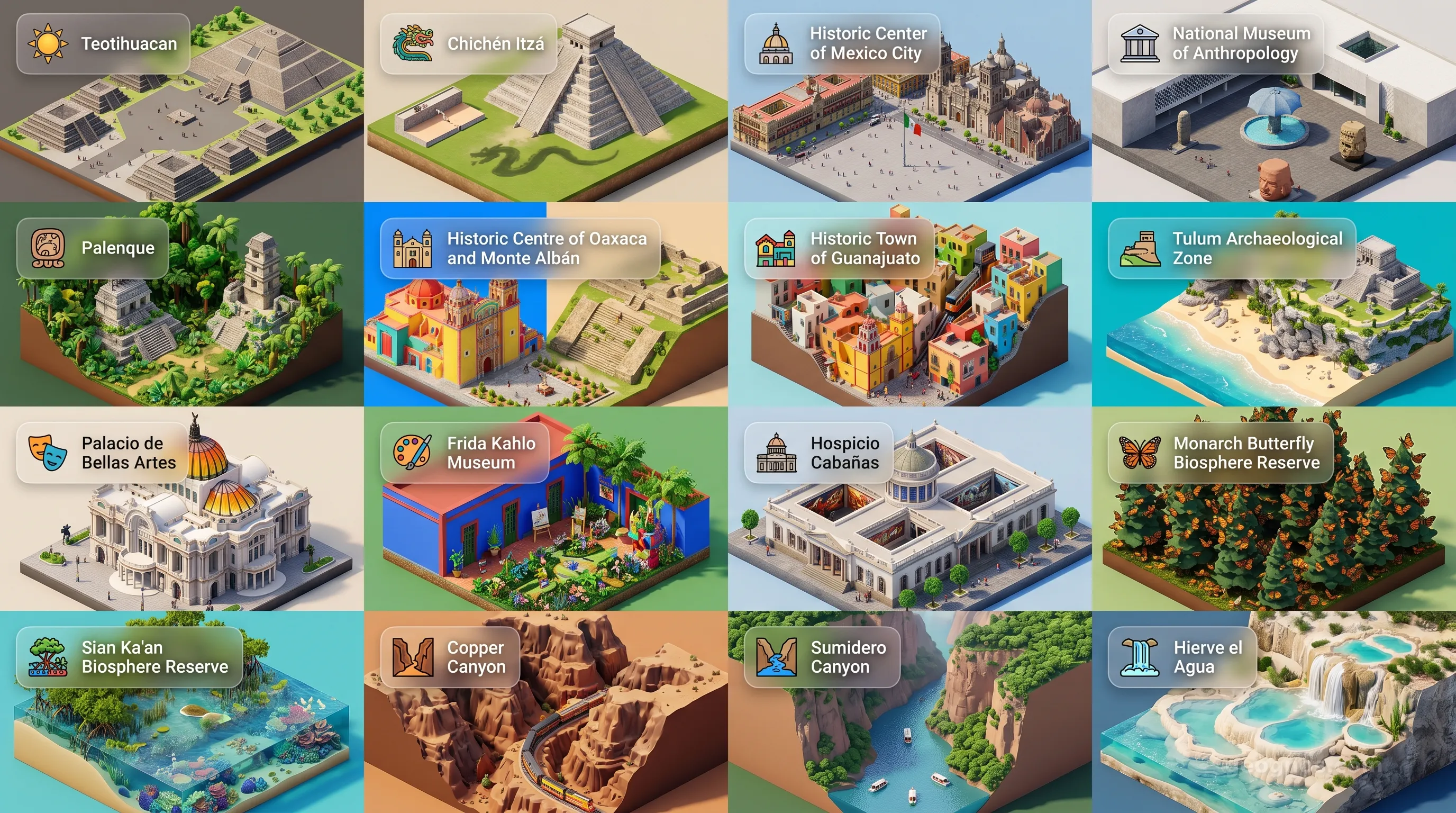
Once the largest city in the pre-Columbian Americas, Teotihuacan is a pinnacle of ancient urban planning. Students of history and architecture will be captivated by the towering Pyramid of the Sun and Pyramid of the Moon, linked by the majestic Avenue of the Dead. Its historical significance lies in its profound cultural, religious, and artistic influence that spread across Mesoamerica, predating the Aztecs who later named the ruins. The best season to visit is during the dry months from November to April to avoid afternoon downpours. Tourist tip: Arrive as soon as the gates open at 8:00 AM to beat both the intense midday heat and the large crowds from Mexico City.
Icon of the Maya Civilization
One of the New Seven Wonders of the World, Chichén Itzá was a massive focal point in the Northern Maya Lowlands from the Late Classic through the Terminal Classic periods. The site is an educational goldmine, particularly the Temple of Kukulcán (El Castillo), which demonstrates the Maya's extraordinary mastery of mathematics, astronomy, and acoustics. Visiting during the Spring or Autumn Equinox offers the chance to witness the famous 'serpent shadow' descending the pyramid's steps. The ideal time to visit is November to March. Tourist tip: Hire a local certified guide at the entrance to fully grasp the complex cosmology built into every stone structure.
The Aztec Capital Turned Colonial Core
Built directly over the ruins of the Aztec capital of Tenochtitlan, the Historic Center of Mexico City is a living textbook of cultural synthesis. The Templo Mayor archaeological site sits shoulder-to-shoulder with the massive Metropolitan Cathedral, showcasing the dramatic collision of indigenous and Spanish colonial worlds. Students of history can trace the evolution of the nation radiating from the central Zócalo. The climate is mild year-round, but spring (March to May) is particularly beautiful with blooming jacarandas. Tourist tip: Explore the surrounding pedestrian streets like Madero, and secure a rooftop reservation overlooking the Zócalo at sunset.
Keeper of Mesoamerican History
As Mexico's largest and most visited museum, this institution is non-negotiable for anyone studying human history or sociology. The museum houses unparalleled artifacts from Mexico's pre-Columbian heritage, including the legendary Aztec Calendar Stone and the jade death mask of Pakal the Great. Architecturally, the building is stunning, centered around a massive concrete umbrella that creates an artificial waterfall. It is perfect to visit year-round, regardless of the season. Tourist tip: The museum is massive; allocate at least a half-day and focus your energy on the Maya and Mexica (Aztec) halls if you are short on time.
Maya Masterpiece in the Jungle
Rising from the emerald jungles of Chiapas, Palenque may be smaller than Chichén Itzá, but it boasts some of the finest architecture, sculpture, and epigraphy of the Maya world. Historically, it reached its zenith under the rule of Pakal the Great in the 7th century. The intricate stucco reliefs and the deciphered hieroglyphic panels provide students with an unmatched record of Maya mythology and dynastic history. Visit during the drier winter months (December to February) to avoid extreme humidity. Tourist tip: Bring mosquito repellent and take the time to hike the trails behind the main ruins to discover unrestored temples consumed by the jungle.
Heart of Zapotec Culture
This dual-site designation encapsulates the deep, continuous history of the Oaxaca Valley. Monte Albán, perched on a flattened mountaintop, was the capital of the Zapotec civilization and features impressive plazas, tombs, and astronomical observatories. Below, the colonial city of Oaxaca boasts exquisite 16th-century architecture and serves as the epicenter of indigenous art and culinary traditions. It's a prime destination to study the resilience of native cultures. The best time to visit is around Día de los Muertos (late October/early November) for unparalleled cultural immersion. Tourist tip: Don't miss sampling complex local moles and mezcal in the city after a morning exploring the mountain ruins.
Silver City of Independence
Guanajuato's wealth, derived from its massive subterranean silver veins, financed some of the most stunning Baroque and Neoclassical architecture in the Americas. It is profoundly important historically as the cradle of Mexican Independence, where the first major battle occurred at the Alhóndiga de Granaditas. The winding, subterranean streets and colorful alleys make it a fascinating study for urban planners and architects. October is arguably the best time to visit due to the Festival Cervantino, a world-renowned arts festival. Tourist tip: Ditch the car—this city is built for walking. Take the funicular up to the Pípila monument for panoramic views.
The Coastal Maya Fortress
Tulum is singular among Maya sites due to its dramatic location atop 12-meter cliffs facing the Caribbean Sea. As one of the last cities built and inhabited by the Maya, it survived decades after the Spanish began occupying Mexico, acting as an important trading hub for obsidian and jade. For visitors and scholars, it illustrates the late post-classic Maya architectural style and coastal defense strategies. The dry season (December to April) provides the best weather. Tourist tip: Bring a swimsuit; there is a staircase leading directly from the ancient ruins down to a spectacular, pristine beach below.
Mexico's Crown Jewel of Fine Arts
Dominating the historic center of Mexico City, the Palacio de Bellas Artes is a spectacular synthesis of Art Nouveau exterior and Art Deco interior. Culturally, it is the highest house of culture in the country. Inside, art students will be captivated by monumental murals from Mexican masters like Diego Rivera, David Alfaro Siqueiros, and José Clemente Orozco. It represents the post-revolutionary push to establish a unified Mexican cultural identity. Valid to visit any time of the year. Tourist tip: Attend a performance of the Ballet Folklórico de México held here to see the spectacular Tiffany glass curtain depicting the Valley of Mexico's volcanoes.
La Casa Azul
Located in the bohemian neighborhood of Coyoacán, the Blue House was the birthplace, lifelong home, and death place of Mexico's most famous female artist, Frida Kahlo. The museum preserves her personal belongings, paints, and corsets, offering an intimate psychological portrait of the artist. It is an essential site for studying feminist art, Mexican identity, and 20th-century surrealism. Spring is lovely, bringing vibrant colors to the museum's courtyard gardens. Tourist tip: Tickets are strictly timed and frequently sell out weeks in advance; you must book online well before your trip.
A Monument to Humanity and Art
Located in Guadalajara, this massive 19th-century complex was originally built to care for orphans, the elderly, and the handicapped, making it a pivotal site for the study of architectural history related to social welfare. It is uniquely designed on a single level to accommodate the infirm. Its cultural apex, however, lies in its chapel, which features fifty-three breathtaking murals by José Clemente Orozco, including his masterpiece 'Man of Fire'. Visit between October and May for the best weather. Tourist tip: Lie down on the benches provided in the main chapel to view the domed ceiling murals comfortably without straining your neck.
The Great Orange Migration
Every winter, millions of monarch butterflies migrate from Canada and the US to the oyamel fir forests of central Mexico. This site is profoundly important for biologists and environmental students studying animal migration and conservation. Culturally, the indigenous Purépecha people associate the arriving butterflies with the returning souls of their ancestors for Día de los Muertos. The only time to witness this is from late November to March, with January and February being peak months. Tourist tip: Dress in layers, as the high-altitude forest is cold in the morning but warms up, prompting the butterflies to take flight in a spectacular golden cloud.
Where the Sky is Born
Translating to 'Origin of the Sky' in the Mayan language, Sian Ka'an is a vast protected area on the Caribbean coast encompassing tropical forests, mangroves, marshes, and a barrier reef. It contains over 20 ancient Maya archaeological sites. It's a living laboratory for environmental students studying biodiversity, featuring jaguars, manatees, and hundreds of bird species. The best season is the dry season from December to May. Tourist tip: Book an eco-tour that includes floating down the ancient Maya trading canals in the crystal-clear, slow-moving fresh water.
The Grand Canyons of Mexico
A group of six distinct massive canyons in the Sierra Madre Occidental, Copper Canyon is deeper and larger than the Grand Canyon in the US. It is the ancestral home of the Rarámuri (Tarahumara) people, renowned for their long-distance running abilities and resistance to Spanish conquest. Geologists and anthropologists alike will find this region endlessly fascinating. The transitional seasons of Spring and Autumn offer the most temperate climate for exploring. Tourist tip: The best way to experience the scale of the canyons is by riding the 'El Chepe' train, an engineering marvel that snakes through the mountains.
Chiapas' Towering Gorge
Carved by the Grijalva River, the Sumidero Canyon features vertical walls that reach up to 1,000 meters in height. The canyon holds such historical and cultural weight that its silhouette is featured on the coat of arms for the state of Chiapas. It is a striking example of geological faulting and river erosion over millions of years. November to May offers pleasant weather and avoids the heavy tropical rains. Tourist tip: Take a speed boat tour starting from the magical town of Chiapa de Corzo; keep an eye out for crocodiles, spider monkeys, and the 'Christmas Tree' waterfall formation.
The Petrified Waterfalls
Looking like a roaring waterfall frozen in time, Hierve el Agua is a set of natural rock formations created by mineral-laden springs dripping down the mountain over thousands of years. Besides its geological uniqueness, the site features a complex system of terraces and canals built by the Zapotecs around 2,500 years ago, making it an important site for studying ancient agriculture and hydro-engineering. The dry season (November-April) makes the roads safer to traverse. Tourist tip: Bring a swimsuit; you can bathe in the natural mineral infinity pools at the edge of the cliff overlooking the Oaxaca valley.