Sudan
Top Sights & Landmarks
Ancient Kushite Royal Necropolis
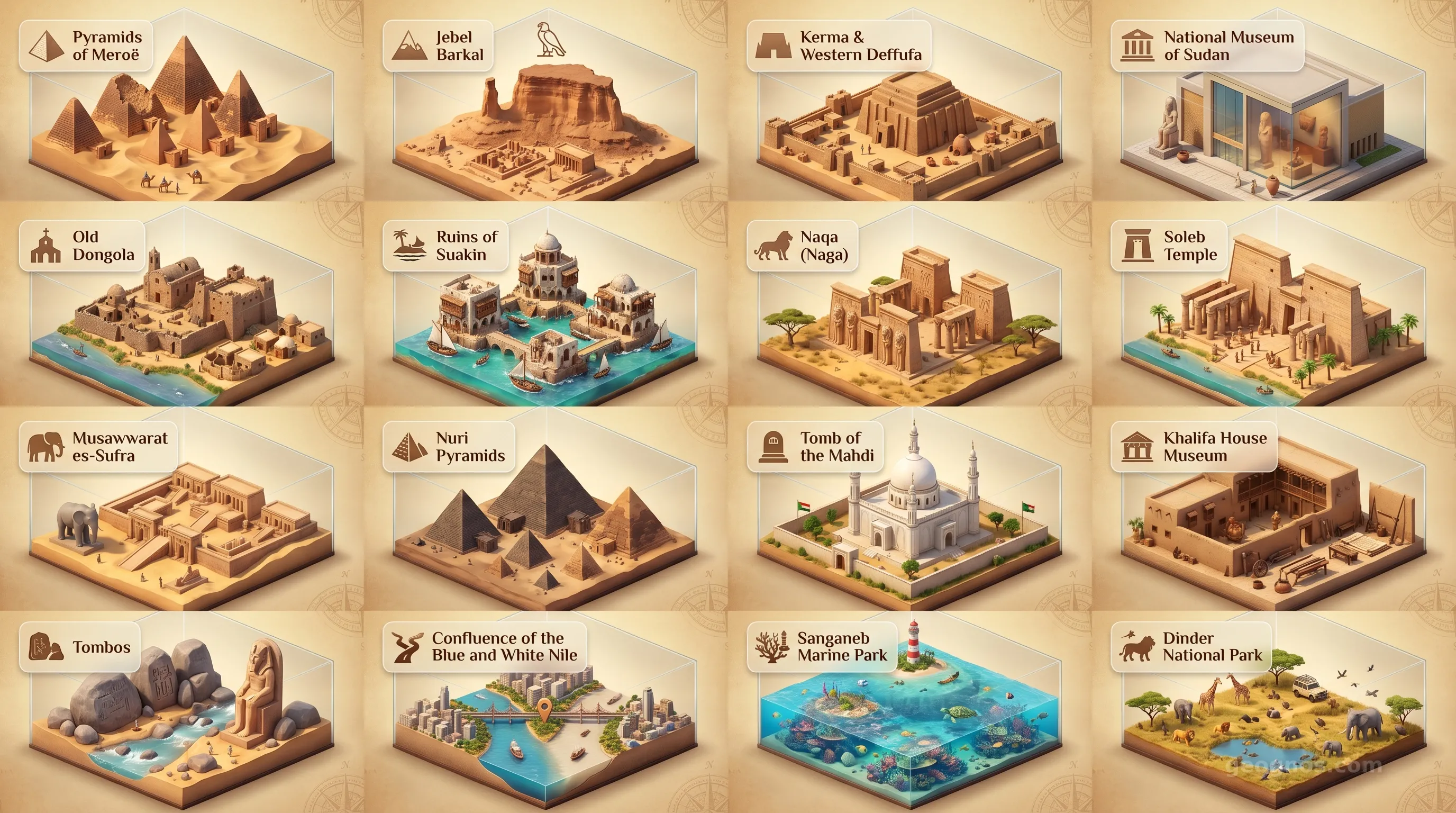
Serving as the southern capital of the ancient Kingdom of Kush, the Pyramids of Meroë form an awe-inspiring archaeological site featuring over 200 steeply angled Nubian pyramids. For students of archaeology and history, Meroë offers profound insights into an advanced African civilization that rivaled and even briefly ruled ancient Egypt (the 25th Dynasty). The site is historically vital for its royal tombs, Meroitic script, and evidence of extensive iron-smelting. The best time to visit is during the cooler months from October to March. Tourist tip: Arrive at dawn or dusk to witness the desert sun casting spectacular golden shadows across the red sandstone structures.
The Holy Mountain of Nubia
Rising dramatically from the Nubian Desert, Jebel Barkal is a small sandstone mountain that served as the primary religious heart of the Kingdom of Kush. It is surrounded by ruined temples, including the grand Temple of Amun, and a cluster of well-preserved pyramids. Academics revere it as the symbolic center of the Napatan state. The towering pinnacle of the mountain was believed to house the god Amun. Winter months (November to February) provide the best climate for exploration. Tourist tip: Climb the mountain late in the afternoon for a stunning panoramic sunset over the Nile and slide down the giant sand dune on the western face.
Africa's Oldest Mud-Brick Metropolis
Kerma is one of the oldest known continuous settlements in Africa, flourishing as the capital of the first Nubian kingdom long before the rise of Kush. Its centerpiece is the Western Deffufa, a massive, solid mud-brick temple that still stands over 18 meters tall. Studying Kerma provides critical context to indigenous, pre-Egyptian African urbanization, as its culture developed unique pottery and burial practices. October to March is the ideal season to visit. Tourist tip: Visit the excellent on-site museum founded by Swiss archaeologist Charles Bonnet to see incredibly well-preserved Kerma-culture artifacts.
Custodian of Sudan's Antiquity
Located in Khartoum, this is the most comprehensive museum in the country, housing artifacts spanning paleolithic times, Pharaonic Egypt, the Kingdom of Kush, and the Christian Makuria period. Crucially, its gardens contain entire ancient temples (like the temples of Buhen and Semna) that were moved stone-by-stone during the UNESCO campaign to save monuments from the flooding of Lake Nasser. It is a mandatory study stop for anyone researching the broader Nile Valley history. Open year-round, but mornings are best to avoid the midday heat. Tourist tip: Don't miss the stunning collection of Christian frescoes rescued from the cathedral of Faras.
Capital of Christian Makuria
Old Dongola sits on the eastern banks of the Nile and was the powerful capital of the Christian Kingdom of Makuria from the 7th to the 14th century, later transitioning into an Islamic hub. The site features the haunting ruins of Coptic churches, monasteries with fading frescoes, a royal throne hall, and a massive Islamic cemetery marked by striking domed qubbas (tombs). It represents a crucial chapter in African religious transformation. Visit between November and February. Tourist tip: The throne hall (later converted into a mosque) is one of the oldest surviving intact buildings in the region and is a must-see.
The Coral Ghost Town
Once the chief port for the Red Sea and an important departure point for African pilgrims heading to Mecca, Suakin was famously constructed entirely of coral blocks. Although mostly in ruins today, its crumbling, intricately carved historic facades stand as a testament to the blend of Ottoman, Arab, and local African architectural styles. It is a fantastic case study in Indian Ocean trade networks and imperial expansion. Best visited from October to April when the coastal weather is milder. Tourist tip: Walk the causeway from the mainland at sunset for deeply atmospheric photography of the coral ruins.
Hellenistic and Nubian Fusion
Located in the arid steppes south of Meroë, Naqa is a remarkably preserved ancient city featuring a stunning synthesis of Egyptian, Greek, Roman, and Nubian architectural styles. The Temple of Apedemak (the lion-headed god) features spectacular relief carvings of Meroitic royalty, while the nearby 'Roman Kiosk' looks like a piece of classical Mediterranean architecture transported to the desert. The site is a treasure trove for students of classical antiquity and cross-cultural exchange. November through February is optimal for visits. Tourist tip: The desert track to Naqa requires a 4x4 vehicle; ensure you travel with an experienced guide.
Pharaonic Grandeur in Nubia
Built in the 14th century BC by the Egyptian Pharaoh Amenhotep III, the Temple of Soleb is one of the most magnificent and best-preserved Egyptian temples in Sudan. Dedicated to Amun-Re and the deified pharaoh himself, its massive sandstone columns resemble the design of the Luxor Temple in Egypt. The site provides a critical lens into the era of Egyptian colonial domination over Nubia. It is best to visit during the winter months. Tourist tip: The temple is incredibly striking at sunrise, and nearby guesthouses offer a chance to experience local Nubian hospitality.
The Great Enclosure and Elephant Cult
Set within a dramatic basin of sandstone hills, Musawwarat es-Sufra is a sprawling, labyrinthine Meroitic temple complex unlike anything else in the Nile Valley. Known for its 'Great Enclosure,' the site is famous for its numerous intricate carvings of elephants, leading historians to theorize it was an elephant training center or a pilgrimage site for a specific cult. The lack of standard Egyptian layouts makes it a unique subject for architectural study. Visit during winter for comfortable temperatures. Tourist tip: Look closely at the walls to spot ancient graffiti left by Meroitic pilgrims thousands of years ago.
Tomb of the Black Pharaohs
Located across the Nile from Jebel Barkal, the necropolis of Nuri contains the pyramids of more than 70 Kushite kings and queens. Most notably, it is the resting place of King Taharqa, the most powerful of the 'Black Pharaohs' who ruled both Nubia and Egypt. His pyramid is the largest ever built in Sudan. The site provides deep historical insights into the royal funerary practices of the 25th Dynasty. Best visited between October and March. Tourist tip: The site is less frequented than Meroë, offering a quiet, deeply personal experience among the ruins.
Monument to the Mahdist Revolution
Located in Omdurman, this striking building with its gleaming silver dome contains the tomb of Muhammad Ahmad, the self-proclaimed Mahdi who led a successful 19th-century revolt against Turco-Egyptian and British rule. Though the original tomb was heavily damaged by British forces under Kitchener, it was later rebuilt by the Mahdi's son. It is a critical site for studying Sudan's modern history, anti-colonial resistance, and Islamic political movements. Accessible year-round. Tourist tip: Non-Muslims are generally not permitted inside the tomb itself, but the exterior architecture and the surrounding historic plaza are well worth the visit.
Relics of the Mahdist State
Situated directly across from the Mahdi's Tomb, this traditional two-story mud-brick building was the residence of Khalifa Abdallahi, the Mahdi's successor. Today, it functions as a museum holding a fascinating array of artifacts from the Mahdist period (1881-1899), including weapons, banners, and the first car in Sudan. It is an invaluable resource for students examining the administration of the Mahdist State and the Battle of Omdurman. Visit in the morning hours year-round. Tourist tip: Pair this visit with the Mahdi's Tomb and a trip to the bustling Omdurman souq nearby.
The Granite Quarries and Taharqa's Statue
Located near the Third Cataract of the Nile, Tombos was an important granite quarry in ancient times. The site is strewn with massive boulders bearing Egyptian hieroglyphic inscriptions, but its most famous feature is an enormous, unfinished granite statue of King Taharqa left abandoned in the sand. The site vividly illustrates ancient stone-working techniques and the logistical realities of monument building. Best visited in winter. Tourist tip: The contrast between the black granite boulders, the green palm groves, and the blue Nile makes Tombos one of the most picturesque spots in northern Sudan.
Where the Niles Meet
At a geographical focal point known as Al-Mogran in Khartoum, the sluggish, pale waters of the White Nile meet the fast-flowing, darker waters of the Blue Nile to form the main Nile River that flows northward to Egypt. This is a site of immense geographic and hydrological importance. It vividly demonstrates the differing ecological origins of the two rivers. Accessible year-round, but late summer (August-September) shows the most dramatic color contrast due to the Blue Nile's flood waters. Tourist tip: View the confluence from the White Nile Bridge or hire a local felucca (sailboat) for a close-up experience.
Red Sea Coral Atoll
Sanganeb is an entirely submerged coral reef atoll in the Red Sea, distinguished by a striking British-built lighthouse. It boasts some of the most pristine coral reefs in the world, teeming with sharks, dolphins, turtles, and hundreds of fish species. For marine biology students, it is an isolated, highly intact ecosystem perfect for studying Red Sea biodiversity. Best diving conditions are between September and November. Tourist tip: Climb the 268 steps of the Sanganeb lighthouse for a breathtaking, vertigo-inducing view of the vivid blue and turquoise reef system.
Sudan's Premier Biosphere Reserve
Established in 1935, Dinder National Park is one of the largest protected areas in Africa, positioned near the Ethiopian border. It serves as a vital ecotone between the Sahelian and Ethiopian highland ecosystems. The park is home to baboons, gazelles, ostriches, and a recovering population of lions and leopards. It is an excellent site for studying ecological conservation and migratory bird patterns. The park is only accessible during the dry season (December to May). Tourist tip: Access requires permits and a sturdy 4x4; joining an organized eco-safari from Khartoum is highly recommended.