Eritrea
Top Sights & Landmarks
Africa's Modernist Capital
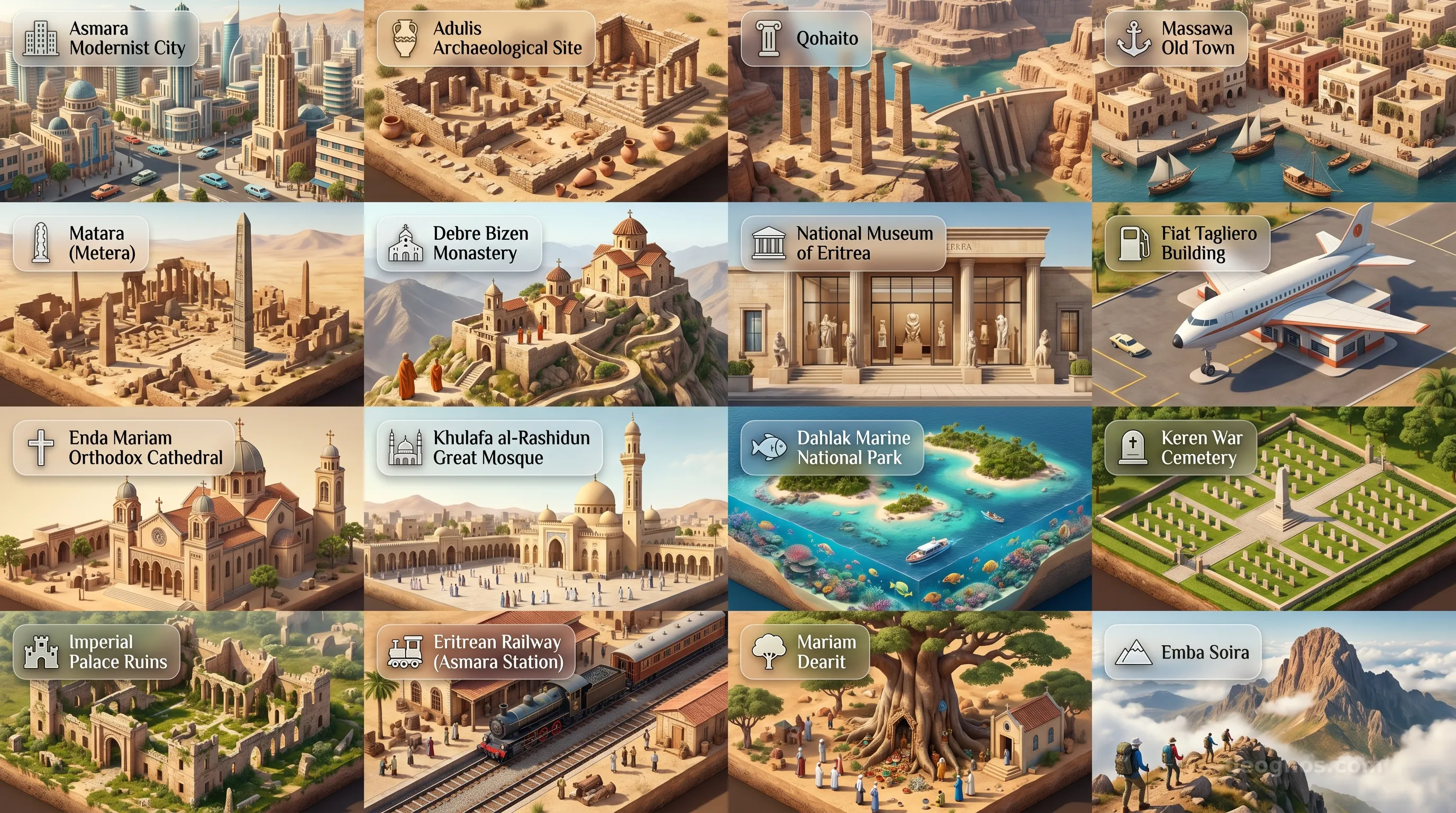
Asmara is an exceptionally well-preserved example of a colonial planned city, designated as a UNESCO World Heritage site. For students of architecture and urban planning, it offers an unparalleled living laboratory of early 20th-century modernist, rationalist, and art deco design seamlessly integrated with the local highland environment. Historically, the city reflects the ambition of Italian colonial expansion and the subsequent resilience of Eritrean culture. The best season to visit is between September and May when the highland climate is mild and pleasant. Tourist tip: Secure a walking map and explore the city on foot, taking time to enjoy a macchiato in one of the many vintage cafes.
Ancient Aksumite Port City
Adulis was once a thriving cosmopolitan port city on the Red Sea, serving as the maritime gateway for the Aksumite Empire. Students of archaeology and classical history will be fascinated by its trade connections stretching from the Mediterranean to India. The ongoing excavations reveal intricate stonework, early Christian basilicas, and ancient coins. The best time to visit is during the cooler months from November to February. Tourist tip: Visiting requires a travel permit from the Ministry of Tourism in Asmara; it is highly recommended to hire an official guide who can contextualize the unexcavated ruins.
Ruins on the Edge of a Canyon
Situated on a spectacular high plateau, Qohaito is a vast archaeological site believed to have been a major pre-Aksumite and Aksumite settlement. Beyond its historical significance—featuring the towering Temple of Mariam Wakiro and the ancient Safira Dam—the site is renowned for its breathtaking views over the Great Rift Valley. Researchers flock here to study the nearby prehistoric rock art in the Adi Alauti cave. Visit between September and February for clear skies. Tourist tip: Combine the historical tour with a hike to the edge of the canyon, but tread carefully as the drop-offs are sheer and unfenced.
The Pearl of the Red Sea
Massawa's Old Town is a stunning, albeit decaying, labyrinth of Ottoman and Italian architecture characterized by coral-block buildings, intricate wooden balconies, and covered walkways. Historically, it served as a vital trade hub for centuries and was heavily bombed during the Eritrean War of Independence, making it a poignant site for students of modern conflict and architectural conservation. Due to the extreme summer heat, the best time to visit is from December to March. Tourist tip: Explore the narrow alleyways of Batse Island in the early morning or late afternoon to capture the golden light reflecting off the historic coral facades.
Ancient City of Hawelti
Matara is a significant archaeological site that contains the ruins of an ancient Aksumite city. The most famous artifact found here is the mysterious Hawelti, an ancient obelisk bearing some of the oldest known Ge'ez script. For historians and linguists, Matara provides crucial evidence of pre-Christian traditions and the evolution of the Ethiopic alphabet. The region's climate is best enjoyed from September through February. Tourist tip: The site is expansive; enlist a knowledgeable local guide in the nearby town of Senafe to help locate the most significant subterranean tombs and palace foundations.
Highland Monastic Fortress
Perched dramatically on a jagged mountain peak, Debre Bizen is the most prominent Eritrean Orthodox Tewahedo monastery, founded in the 14th century. Historically, it was a center of religious resistance and manuscript preservation, housing invaluable medieval texts. The grueling hike offers researchers and pilgrims a profound glimpse into Eritrean spiritual life and highland ecology. The ideal visiting season is from September to May. Tourist tip: Access is strictly limited to men due to ancient monastic laws, and the steep two-hour trek requires a good level of physical fitness and plenty of drinking water.
Chronicle of a Nation
Located in Asmara, the National Museum of Eritrea serves as the central repository for the country's rich historical, archaeological, and cultural heritage. Students will find comprehensive exhibits covering paleontological discoveries from the Buya region, ancient Aksumite artifacts, and a sobering wing dedicated to the 30-year struggle for independence. The museum is indoors and can be visited year-round. Tourist tip: Operating hours can be idiosyncratic and photography is strictly regulated inside; always ask for permission before taking pictures of the exhibits.
Futurist Masterpiece in Asmara
Designed by Giuseppe Pettazzi in 1938, the Fiat Tagliero Building is an astonishing feat of Futurist architecture constructed in the shape of an airplane. Built initially as a functional service station, its massive 15-meter cantilevered wings are entirely unsupported by pillars, defying architectural norms of the era. Architecture students travel from around the world to study its bold structural engineering. It is beautiful year-round. Tourist tip: The building is best photographed during the golden hour just before sunset; view it from the street intersection for the most striking perspective.
Brick-and-Wood Religious Icon
Enda Mariam is an architectural triumph in Asmara, blending Italian rationalism with traditional Aksumite 'monkey-head' construction techniques (alternating layers of wood and brick). It has immense cultural importance as the focal point for the Eritrean Orthodox community. Scholars of religious architecture will find the fusion of indigenous building styles with colonial engineering utterly unique. Visit during January for the colorful Timkat (Epiphany) celebrations. Tourist tip: Dress modestly (shoulders and knees covered) and take off your shoes before entering the sacred areas of the cathedral complex.
Asmara's Modernist Mosque
Constructed in 1938, this mosque is a stunning example of Islamic architecture filtered through the lens of Italian rationalism, featuring intricate geometric tiling, dark stone columns, and an elegant minaret. It stands as a testament to Eritrea's deep history of religious coexistence. Sociology and architectural students can study the spatial dynamics of the sprawling plaza that integrates the mosque into the broader city grid. Year-round accessibility makes it a staple visit. Tourist tip: Visitors are welcome outside of prayer times; always seek permission before entering the interior courtyard.
Untouched Red Sea Archipelago
The Dahlak Archipelago comprises over 100 islands, boasting some of the most pristine and unexplored coral reef systems in the Red Sea. Historically, it was known to the Romans for its pearl diving. Today, marine biologists and environmental students study the incredible biodiversity here, including rare sea turtles and dugongs. The best season for diving and snorkeling is from October to April when the water visibility is highest. Tourist tip: Traveling to Dahlak requires a special permit and a chartered boat from Massawa, so organize your trip well in advance through an approved local agency.
Echoes of WWII in Africa
The Keren War Cemetery is the final resting place for British, Indian, and Allied troops who fell during the Battle of Keren in 1941, a decisive and bloody turning point in the East African Campaign of WWII. The impeccably maintained grounds provide a somber educational experience for students of military history. The surrounding mountains offer a stark visual of the challenging terrain soldiers faced. The best season to visit is the cooler period from September to February. Tourist tip: While in Keren, visit the lively Monday camel market for a vibrant contrast to the solemnity of the cemetery.
Scars of the Independence War
Located on Taulud Island in Massawa, this grand 19th-century palace was originally built by Werner Munzinger, later used by the Italian colonial governors, and finally served as Emperor Haile Selassie’s winter residence. It was heavily bombed during the 1990 battle for Massawa and stands today as a haunting, skeletal monument to the ravages of war. Urban explorers and history students will find the juxtaposition of grand architecture and destructive forces fascinating. Best visited between December and March. Tourist tip: Do not attempt to climb the unstable staircases; the structure is fragile, so observe and photograph from a safe distance.
Engineering Marvel of the Highlands
The Eritrean Railway is a masterpiece of colonial engineering, famously scaling the steep escarpment from the Red Sea coast to the 2,300-meter-high plateau of Asmara. The railway uses vintage 1930s Mallet steam locomotives. Engineering and history students are captivated by the sheer audacity of the tunnels, viaducts, and switchbacks. The cool, dry months (September to March) are best for train excursions. Tourist tip: The steam train only runs on weekends if there is enough demand (or if chartered by a group), so check availability with tourism offices beforehand.
The Shrine Inside a Baobab Tree
Located just outside Keren, Mariam Dearit is an extraordinary shrine to the Virgin Mary housed entirely within the hollowed trunk of a massive, ancient baobab tree. Historically significant as a symbol of fertility and protection, it represents a remarkable syncretism of orthodox faith and local animist reverence for nature. For cultural anthropology students, it offers a perfect case study of localized religious practices. May 29th is the annual pilgrimage day, drawing thousands. Tourist tip: It is a place of quiet reflection; women are advised to bring a scarf to cover their heads when entering the tree shrine.
Eritrea's Highest Peak
Standing at 3,018 meters, Emba Soira is the highest mountain in Eritrea, located in the southeastern part of the Debub region. The surrounding landscape consists of deep gorges and dramatic highland plateaus. Geology and environmental students can study the intense tectonic uplifting of the Great Rift Valley. The trek offers rugged, unspoiled nature, best tackled during the dry season from October to March. Tourist tip: Trekking requires a permit, a local guide, and high-clearance 4x4 transport to reach the trailhead near Senafe. Altitude sickness is a real possibility, so acclimatize in Asmara first.