🇩🇯

Djibouti

Africa • Countries •
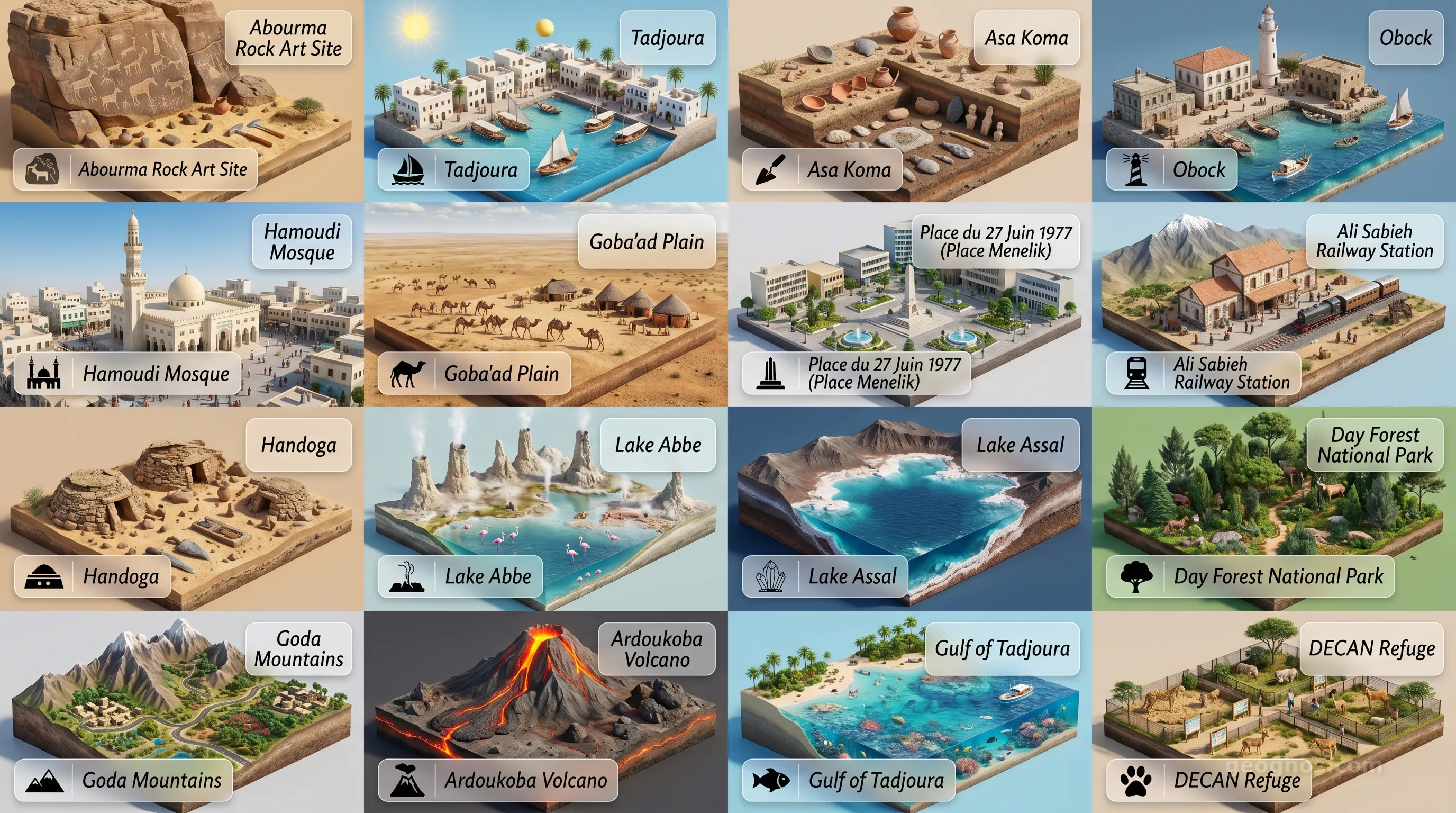
Djibouti - Panoramic Places of Interest Atlas including Abourma Rock Art Site, Tadjoura, Asa Koma, Obock, Hamoudi Mosque, Goba'ad Plain, Place du 27 Juin 1977 (Place Menelik), Ali Sabieh Railway Station, Handoga, Lake Abbe, Lake Assal, Day Forest National Park, Goda Mountains, Ardoukoba Volcano, Gulf of Tadjoura, DECAN Refuge

Top Sights & Landmarks

01

Abourma Rock Art Site

Neolithic Engravings in the Makou Massif

02

Tadjoura

The White City of Seven Mosques

03

Asa Koma

Prehistoric Settlement of the Red Hill

04

Obock

The First French Settlement

05

Hamoudi Mosque

Iconic Religious Center of Djibouti City

06

Goba'ad Plain

Cradle of Early Hominids

07

Place du 27 Juin 1977 (Place Menelik)

The Heart of the European Quarter

08

Ali Sabieh Railway Station

Relic of the Ethio-Djibouti Railway

09

Handoga

Ancient Nomadic Crossroads

10

Lake Abbe

The Chimneys of the Afar Triangle

11

Lake Assal

Lowest Point in Africa

12

Day Forest National Park

The Last Stand of the African Pencil Cedar

13

Goda Mountains

The Green Oasis of Djibouti

14

Ardoukoba Volcano

The Rift's Youngest Volcano

15

Gulf of Tadjoura

Marine Corridor of the Horn

16

DECAN Refuge

Horn of Africa Wildlife Sanctuary

Background

Present-day Djibouti was the site of the medieval Ifat and Adal Sultanates. In the late 19th century, the Afar sultans signed treaties with the French that allowed the latter to establish the colony of French Somaliland in 1862. The French signed additional treaties with the ethnic Somali in 1885. Tension between the ethnic Afar and Somali populations increased over time, as the ethnic Somalis perceived that the French unfairly favored the Afar and gave them disproportionate influence in local governance. In 1958, the French held a referendum that provided residents of French Somaliland the option to either continue their association with France or to join neighboring Somalia as it established its independence. Ethnic Somali protested the vote, because French colonial leaders did not recognize many Somali as residents, which gave the Afar outsized influence in the decision to uphold ties with France. After a second referendum in 1967, the French changed the territory’s name to the French Territory of the Afars and the Issas, in part to underscore their relationship with the ethnic Afar and downplay the significance of the ethnic Somalis. A final referendum in 1977 established Djibouti as an independent nation and granted ethnic Somalis Djiboutian nationality, formally resetting the balance of power between the majority ethnic Somalis and minority ethnic Afar residents. Upon independence, the country was named after its capital city of Djibouti. Hassan Gouled APTIDON, an ethnic Somali leader, installed an authoritarian one-party state and served as president until 1999. Unrest between the Afar minority and Somali majority culminated in a civil war during the 1990s that ended in 2001 with a peace accord between Afar rebels and the Somali Issa-dominated government. In 1999, Djibouti's first multiparty presidential election resulted in the election of Ismail Omar GUELLEH as president; he was reelected to a second term in 2005 and extended his tenure in office via a constitutional amendment, which allowed him to serve his third and fourth terms, and to begin a fifth term in 2021. Djibouti occupies a strategic geographic location at the intersection of the Red Sea and the Gulf of Aden. Its ports handle 95% of Ethiopia’s trade. Djibouti’s ports also service transshipments between Europe, the Middle East, and Asia. The government has longstanding ties to France, which maintains a military presence in the country, as do the US, Japan, Italy, Germany, Spain, and China.

Location

Latitude
11.5° N
Longitude
43° E
N S W E
World Map Location
Geographic Location

Eastern Africa, bordering the Gulf of Aden and the Red Sea, between Eritrea and Somalia

Map Reference
Africa

Area

Total Area
23,200 sq km
Land (100%)
Land: 23,180 sq km
Water: 20 sq km

Elevation

Highest Point
Moussa Ali
Moussa Ali 2,021 m
Lowest Point
Lac Assal
Lac Assal -155 m
Mean Elevation
430 m

Detailed Geography Information

Coastline

314 km

Geography - note

strategic location near world's busiest shipping lanes and close to Arabian oilfields; Lac Assal (Lake Assal) is the lowest point in Africa and the saltiest lake in the world

Irrigated land

10 sq km (2012)

Land boundaries

Total boundary: 528 km
Eritrea 125 km
Ethiopia 342 km
Somalia 61 km

Major lakes (area sq km)

salt water lake(s): Abhe Bad/Abhe Bid Hayk (shared with Ethiopia) - 780 sq km

Maritime claims

territorial sea: 12 nm contiguous zone: 24 nm exclusive economic zone: 200 nm

Natural hazards

earthquakes; droughts; occasional cyclonic disturbances from the Indian Ocean bring heavy rains and flash floods volcanism: experiences limited volcanic activity; Ardoukoba (298 m) last erupted in 1978; Manda-Inakir, located along the Ethiopian border, is also historically active

Natural resources

potential geothermal powergoldclaygranitelimestonemarblesaltdiatomitegypsumpumicepetroleum

Terrain

coastal plain and plateau separated by central mountains

Population & Growth

+1.80% Growth
1,013,703
Total inhabitants (2025 est.)
Male: 45.3% (458,988) Female: 54.7% (554,715)

Age Distribution

0-14 years
28.4%
~287,892
15-64 years
67.4%
~683,236
65 years
4.2%
~42,576
Note: 2024 est.

Demographic Longevity

Median Age
26.7 years
Male
24.4 yrs
Female
27.9 yrs
Life Expectancy
65.9 years
Male
63.4 yrs
Female
68.5 yrs

Vital Dynamics

Birth Rate
21.46
births per 1,000 people
Death Rate
7
deaths per 1,000 people
Net Migration
+3.94
migrants per 1,000 people
Fertility Rate
2.09
children born per woman

Detailed People & Society Information

Alcohol consumption per capita

0.21 liters of pure alcohol (2019 est.)

Children under the age of 5 years underweight

17.7% (2023 est.)

Currently married women (ages 15-49)

46.5% (2017 est.)

Dependency ratios

total dependency ratio: 48.1 (2025 est.) youth dependency ratio: 41.7 (2025 est.) elderly dependency ratio: 6.4 (2025 est.) potential support ratio: 15.7 (2025 est.)

Education expenditure

3.8%

3.8% of GDP (2018 est.) 14.5% national budget (2018 est.)

Ethnic groups

Somali
60%
Afar
35%
other (mostly Yemeni Arab
5%

Gross reproduction rate

1.03 (2025 est.)

Health expenditure

2.9%

2.9% of GDP (2021) 5.2% of national budget (2022 est.)

Hospital bed density

1.4 beds/1,000 population (2018 est.)

Infant mortality rate

total: 44.3 deaths/1,000 live births (2025 est.) male: 52.1 deaths/1,000 live births female: 38 deaths/1,000 live births

Languages

Major urban areas - population

600,000 DJIBOUTI (capital) (2023)

Maternal mortality ratio

162 deaths/100,000 live births (2023 est.)

Nationality

noun: Djiboutian(s) adjective: Djiboutian

Obesity - adult prevalence rate

13.5% (2016)

Physician density

0.21 physicians/1,000 population (2022)

Population distribution

most densely populated areas are in the east; the largest city is Djibouti, and the other cities in the country are a fraction of its size, as shown in this population distribution map

Refugees and internally displaced persons

Total Displaced & Vulnerable Persons
32,636 individuals
Refugees
100.0%
32,636
32,636 (2024 est.)

Religions

Sunni Muslim
94%
other (mainly foreign-born residents - Shia Muslim
6%

Sex ratio

at birth: 1.03 male(s)/female 0-14 years: 1.01 male(s)/female 15-64 years: 0.77 male(s)/female 65 years and over: 0.77 male(s)/female total population: 0.83 male(s)/female (2024 est.)

Climate & Issues

Climate Profile

desert; torrid, dry

Key Environmental Issues
inadequate supplies of potable water water pollution limited arable land deforestation (forests threatened by agriculture and the use of wood for fuel) desertification endangered species

Land Cover

Coverage Distribution
Agri (74%)
Other (26%)
Arable: 0.1%
Crops: 0.0%
Pasture: 73.3%
Forest: 0.3%

Air & Carbon Emissions

Annual CO2 Output 2023 est.
685,000
Coal (7%) Oil (93%) Gas (0%)
PM2.5 Exposure 21 µg/m³
0 5 (WHO Limit) 15 25 35+

Water Resources & Use

Renewable Water Resources 300 million cubic meters (2022 est.)
Annual Water Withdrawal
municipal: 16 million cubic meters (2022 est.)
Municipal (84%) Ind (0%) Agri (16%)

Detailed Environmental Information

International environmental agreements

BiodiversityClimate ChangeClimate Change-Kyoto ProtocolClimate Change-Paris AgreementComprehensive Nuclear Test BanDesertificationEndangered SpeciesHazardous WastesLaw of the SeaOzone Layer ProtectionShip PollutionWetlands

Urbanization

urban population: 78.6% of total population (2023) rate of urbanization: 1.56% annual rate of change (2020-25 est.)

Waste and recycling

municipal solid waste generated annually: 115,000 tons (2024 est.) percent of municipal solid waste recycled: 14.9% (2022 est.)

Capital & State Profile

Capital City
Djibouti
11.5833° N, 43.15° E
Timezone UTC+3
Government Type
presidential republic
Independence 1977-06-27
National Holiday 06-27

Executive Branch

Chief of State
President Ismail Omar GUELLEH (since 8 May 1999)
Head of Government
Prime Minister Abdoulkader Kamil MOHAMED (since 1 April 2013)
Last Election 9 April 2021
Next Election April 2026
Cabinet Council of Ministers appointed by the prime minister

Legislative Branch

unicameral
Legislature Name National Assembly (Assemblée nationale)
Seats & Term
65 (all directly elected) seats / 5 years
Women in Chamber
26.2% Representation
Electoral System mixed system
Parties Composition
Union for the Presidential Majority (UMP) 58Union for Democracy and Justice (UDJ) 7

National Identity & Symbols

National Flag Description

two equal horizontal bands of light blue (top) and light green, with a white isosceles triangle based on the left side that has a five-pointed red star in the center

Symbolic Meaning blue stands for sea, sky, and the Issa Somali people, green for earth and the Afar people, and white for peace; the red star stands for the struggle for independence and unity
National Symbol red star
National Colors light blue, green, white, red
National Anthem Jabuuti (Djibouti)

Detailed Government Information

Administrative divisions

6 districts (cercles, singular - cercle); Ali Sabieh, Arta, Dikhil, Djibouti, Obock, Tadjourah

Citizenship

citizenship by birth: no citizenship by descent only: the mother must be a citizen of Djibouti dual citizenship recognized: no residency requirement for naturalization: 10 years

Constitution

history: approved by referendum 4 September 1992 amendment process: proposed by the president of the republic or by the National Assembly; Assembly consideration of proposals requires assent of at least one third of the membership; passage requires a simple majority vote by the Assembly and approval by simple majority vote in a referendum; the president can opt to bypass a referendum if adopted by at least two-thirds majority vote of the Assembly; constitutional articles on the sovereignty of Djibouti, its republican form of government, and its pluralist form of democracy cannot be amended

Country name

conventional long form: Republic of Djibouti conventional short form: Djibouti local long form: République de Djibouti (French)/ Jumhuriyat Jibuti (Arabic) local short form: Djibouti (French)/ Jibuti (Arabic) former: French Somaliland, French Territory of the Afars and Issas etymology: the country name derives from the capital city of Djibouti

International law organization participation

accepts compulsory ICJ jurisdiction with reservations; accepts ICCt jurisdiction

International organization participation

Judicial branch

highest court(s): Supreme Court or Cour Suprême (consists of NA magistrates); Constitutional Council (consists of 6 magistrates) judge selection and term of office: Supreme Court magistrates appointed by the president with the advice of the Superior Council of the Magistracy (CSM), a 10-member body consisting of 4 judges, 3 members (non-parliamentarians and judges) appointed by the president, and 3 appointed by the National Assembly president or speaker; magistrates appointed for life with retirement at age 65; Constitutional Council magistrate appointments - 2 by the president of the republic, 2 by the president of the National Assembly, and 2 by the CSM; magistrates appointed for 8-year, non-renewable terms subordinate courts: High Court of Appeal; Courts of First Instance; customary courts; State Court (replaced sharia courts in 2003)

Legal system

mixed system based primarily on the French civil code (as it existed in 1997), Islamic religious law (in matters of family law and successions), and customary law

Political parties

Front for Restoration of Unity and Democracy (Front pour la Restauration de l'Unite Democratique) or FRUD National Democratic Party or PND People's Rally for Progress or RPP Peoples Social Democratic Party or PPSD Union for Democracy and Justice or UDJ Union for the Presidential Majority coalition or UMP Union of Reform Partisans or UPR

Suffrage

18 years of age; universal

Economic Overview

food import-dependent Horn of Africa economy driven by various national military bases and port-based trade; fairly resilient from COVID-19 disruptions; major re-exporter; increasing Ethiopian and Chinese trade relations; investing in infrastructure

Size & Performance

Real GDP (PPP)
$7.995 billion
Latest available estimate (2024)
2023: $7.546 billion2022: $7.028 billion
Real GDP Growth
6% (2024 est.)
+6%
GDP Per Capita (PPP)
$6,800
2023: $6,5002022: $6,200

GDP Sector Breakdown

Agriculture: 2.6%Industry: 15.4%Services: 75.5%
Origin GDP %
Agriculture 2.6%
Industry 15.4%
Services 75.5%

Trade Balance

Trade Position
Trade Surplus
$485.00 million
Total Exports
$5.25 billion (2024 est.)
Total Imports
$4.765 billion (2024 est.)
Exports (52%) Imports (48%)

Budget Balance

Budget Position
Budget Deficit
-$29.00 million
Revenues
$725 million (2019 est.)
Expenditures
$754 million (2019 est.)
Revenues (49%) Expenditures (51%)

Export Profile

Top Export Partners

Note: 2023; top five export partners based on percentage share of exports

Major Export Commodities

raw sugarseed oilscarspalm oilrice

Import Profile

Top Import Partners

32.0%
12.0%
10.0%
Note: 2023; top five import partners based on percentage share of imports

Major Import Commodities

refined petroleumpalm oilfertilizerscarsseed oils

Labor & Employment

Total Labor Force 265,200 (2024 est.)
General Unemployment Rate 25.9%
Youth Unemployment (Ages 15-24) 76.3%
Population Below Poverty Line 21.1% (2017 est.)

Income Inequality

Gini Coefficient (Family Income) 41.6
0 (Perfect Equality) High Inequality 100 (Perfect Inequality)

Family Income / Consumption Share

Lowest 10%: 1.9% (2017 est.) Highest 10%: 32.3% (2017 est.)
Inequality Gap: Top 10% holds 17.0x the share of the bottom 10%.

Detailed Economic Data

Agricultural products

vegetablesbeansmilkbeefcamel milklemonsgoat meatlambtomatoesbeef offal

Current account balance

$610.124 million (2024 est.) $721.349 million (2023 est.) $656.207 million (2022 est.) note: balance of payments - net trade and primary/secondary income in current dollars

Debt - external

$2.531 billion (2023 est.) note: present value of external debt in current US dollars

Exchange rates

Djiboutian francs (DJF) per US dollar - Exchange rates: 177.721 (2024 est.) 177.721 (2023 est.) 177.721 (2022 est.) 177.721 (2021 est.) 177.721 (2020 est.)

GDP - composition, by end use

Industrial production growth rate

9.7% (2024 est.) note: annual % change in industrial value added based on constant local currency

Industries

constructionagricultural processingshipping

Inflation rate (consumer prices)

2.1% (2024 est.) 1.5% (2023 est.) 5.2% (2022 est.) note: annual % change based on consumer prices

Remittances

1.4% of GDP (2024 est.) 1.5% of GDP (2023 est.) 1.6% of GDP (2022 est.) note: personal transfers and compensation between resident and non-resident individuals/households/entities

Reserves of foreign exchange and gold

$348.725 million (2024 est.) $502.034 million (2023 est.) $589.437 million (2022 est.) note: holdings of gold (year-end prices)/foreign exchange/special drawing rights in current dollars

Grid Infrastructure

Electricity Access 65%
Urban: 72.8% Rural: 36.6%
Capacity 210,000 kW (2023 est.)
Consumption 584.997 million kWh (2023 est.)
Imports 512 million kWh (2023 est.)
Grid Losses: 128.74 million kWh (2023 est.)

Generation Mix

Percentage Share of Production
fossil fuels 65.3%
wind 34.2%
solar 0.5%

Fossil Fuels Production

Petroleum
Consumption 5,000 bbl/day (2023 est.)
Coal
Exports 8 metric tons (2023 est.)
Imports 19,000 metric tons (2023 est.)

Intensity & Nuclear

Energy Consumption Per Capita 10.428 million Btu/person (2023 est.)
No nuclear energy infrastructure or reactor operations reported in this country dossier.

Digital Access

.dj
Internet Usage 65%

Active internet users as a percentage of the total population.

Fixed Broadband

Penetration Rate 1 / 100
Total Subscriptions 17,000 (2023 est.)

Mobile Cellular

Penetration Rate 49 / 100
Total Subscriptions 559,000 (2023 est.)

Broadcast Media

state-owned Radiodiffusion-Télévision de Djibouti operates the sole terrestrial TV station, as well as the 2 domestic radio networks; no private TV or radio stations; transmissions of several international broadcasters are available (2019)

Aviation

J2
Airports
10
As of 2025
Heliports
6
As of 2025

Railways

Total Track Length
97 km
National Network Data from 2017

Ports & Harbors

Ports Count 2
Hover for breakdown & key ports As of 2024

Merchant Marine

Commercial Fleet
40 ships
Hover for vessel types breakdown As of 2023

Military Expenditures

GDP Allocation 3.5%
3.5% of GDP (2019 est.) 3.5% of GDP (2018 est.) 3.3% of GDP (2017 est.) 2.7% of GDP (2016 est.) 2.5% of GDP (2015 est.)

Active Duty Strengths

estimated 10-12,000 active Armed Forces, including Gendarmerie (2025)

Refers to active military personnel.

Service & Defense Details

Military and security forces

Djibouti Armed Forces (Forces Armées Djiboutiennes or FAD): Djiboutian (or National) Army, Djiboutian Navy (includes Djiboutian Coast Guard), Djiboutian Air Force; Djiboutian National Gendarmerie Ministry of Interior: National Police (Police Nationale) (2025) note 1: the National Gendarmerie is a security force with military status under the FAD and the Ministry of Defense, but also has responsibilities to the Ministry of Interior; the Gendarmerie's duties include providing security outside of Djibouti City and protecting critical infrastructure within the city, such as the international airport note 2: the National Police are responsible for security within Djibouti City and have primary control over immigration and customs procedures for all land border-crossing points

Military deployments

approximately 1,500 Somalia (AUSSOM) (2025)

Military equipment inventories and acquisitions

the FAD's inventory is a mix of mostly older or secondhand equipment from a variety of suppliers, including China, France, Italy, Japan, the Netherlands, Russia/former Soviet Union, South Africa, Türkiye, and the US (2025)

Military - note

Djibouti's military forces are largely focused on border, coastal, and internal security duties; as recently as February 2025, Djiboutian forces have conducted operations near its border with Ethiopia against members of the Armed Front for the Restoration of Unity and Democracy (FRUD A), which Djibouti considers a terrorist group China, France, Italy, Japan, and the US maintain bases in Djibouti for regional military missions, including counterterrorism, counter-piracy, crisis response, and security assistance; other countries, such as Germany and Spain, have smaller military contingents; the EU and NATO also maintain a presence in Djibouti to support multinational naval counter-piracy operations and maritime training efforts (2025)

Military service age and obligation

18-26 years of age for voluntary military service (2025)