Somalia
Top Sights & Landmarks
Neolithic Rock Art Canvas
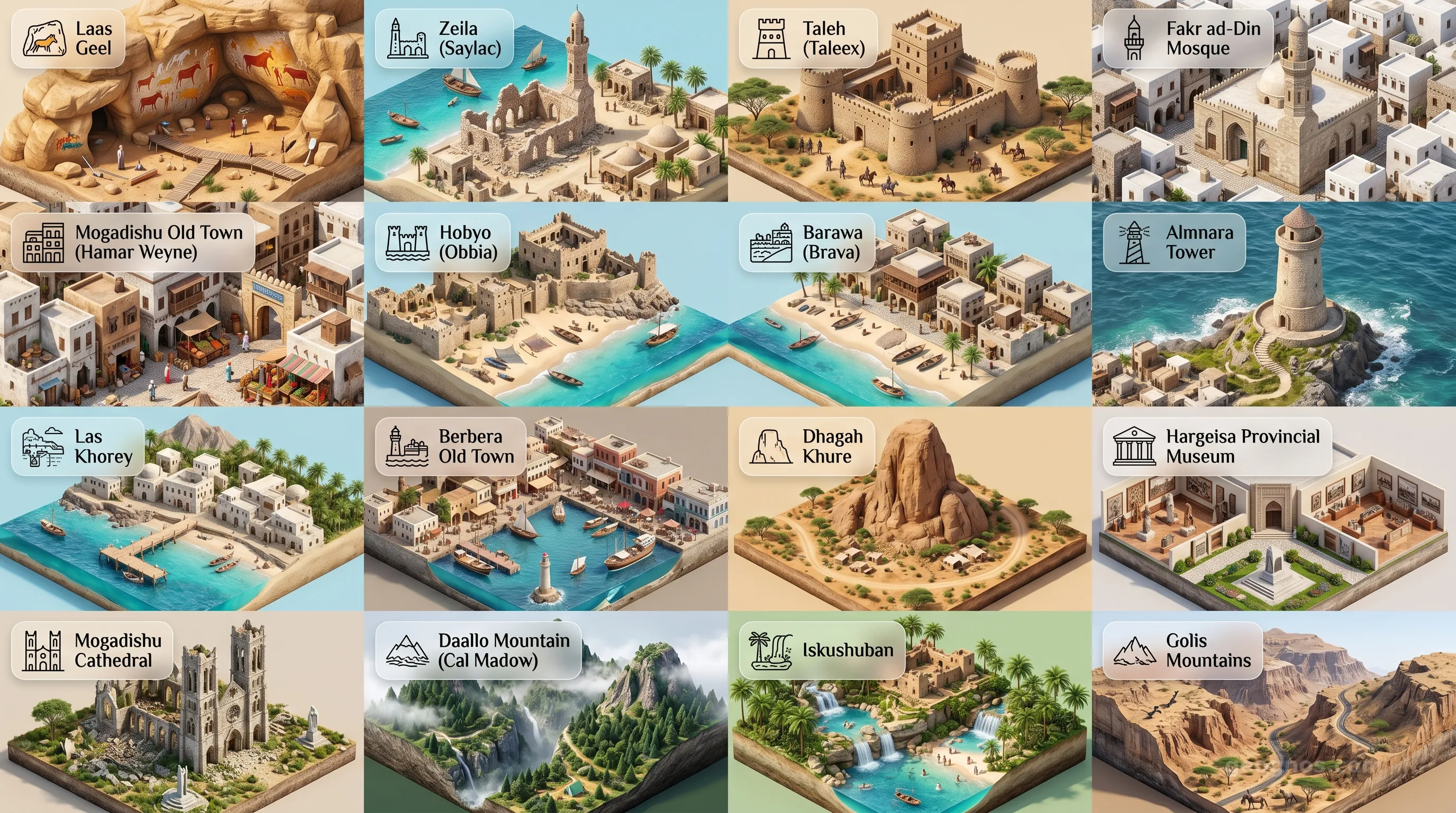
Laas Geel contains some of the earliest and most beautifully preserved cave paintings in the Horn of Africa, dating back to 9,000–3,000 BCE. Studying these vibrant depictions of pastoralist life, wild animals, and ceremonial rituals offers profound insights into Neolithic societies. It holds immense historical importance as a testament to the region's ancient indigenous cultures. The best time to visit is between November and March when the weather is cooler. Tourist tip: Located in the internationally unrecognized but relatively stable Republic of Somaliland, visitors must secure a permit from the Ministry of Tourism in Hargeisa and hire a local armed guard for the trip.
Ancient Coastal Trade Hub
Zeila is a historic port city and was the capital of the formidable Adal Sultanate. It is home to the ruins of Masjid al-Qiblatayn, one of the oldest mosques in Africa, built shortly after the Hijrah. For historians and students of Islamic history, Zeila is a crucial site for understanding early Muslim migration and the Red Sea trade networks. The best season to explore is the cooler winter months (December to February). Tourist tip: The coastal heat can be intense. Travel from Djibouti or Hargeisa requires a sturdy 4x4 vehicle due to rough desert terrain.
Dervish Fortress City
Taleh is famous as the former capital of the Dervish State, led by Sayid Mohammed Abdullah Hassan in the early 20th century. The site features a complex of remarkable stone forts that stand as monuments to Somali resistance against British, Italian, and Ethiopian empires. It is an exceptional study site for African anti-colonial history and indigenous military architecture. The ideal visiting season is during the dry Gu' season (April to June) or Deyr season (October to November). Tourist tip: Taleh is located in a disputed region between Somaliland and Puntland; travelers must rigorously check local security advisories and travel with local fixers.
Oldest Mosque in Mogadishu
Built in 1269, the Fakr ad-Din Mosque is the oldest mosque in Mogadishu, renowned for its unique rectangular shape and walls made of coral stone and Indian marble. It represents the pinnacle of medieval Somali-Islamic architecture and the prosperity of the Mogadishu Sultanate. Architecture students will marvel at its intricate mihrab and use of coastal materials. The dry seasons (December to March) are the best times to visit. Tourist tip: Accessing sites in Mogadishu requires a highly organized security detail. Always arrange your visit through reputable local security and travel agencies.
Heart of Medieval Mogadishu
Hamar Weyne is the ancient core of Mogadishu, surviving centuries of trade, colonial rule, and civil war. Narrow alleys, traditional coral stone houses, and bustling markets tell the story of a city that was once the most prominent port on the East African coast. It offers an unparalleled immersive experience for sociologists and cultural historians studying urban resilience. December to March offers the most pleasant climate. Tourist tip: Explore the Gold Market and traditional weavers, but strictly adhere to the guidance of your local security detail.
Capital of the Hobyo Sultanate
Hobyo is an ancient port town in the Mudug region that served as the center of the Sultanate of Hobyo in the 19th century. The ruins of old forts and administrative buildings dot the landscape, offering a tangible connection to Somalia's complex clan and maritime history. It is a compelling destination for researchers investigating pre-colonial Somali governance and Indian Ocean trade. Visit between December and February for manageable temperatures. Tourist tip: The area's infrastructure is limited; travel requires self-sufficiency, a 4x4, and coordination with local elders.
Ancient Swahili-Somali Port
Barawa is one of the oldest coastal cities in Somalia, culturally unique due to its traditional inhabitants who speak a distinct Swahili dialect called Chimwiini. Known for its distinct traditional architecture, exquisite hats (koofiyad), and a history of resisting Portuguese incursions, the town is a goldmine for ethnographers and linguists. The best time to visit is the cool, dry winter. Tourist tip: Given its location in the Lower Shabelle region, stringent security measures and local government permissions are absolute prerequisites for any visit.
Medieval Coastal Lighthouse
The Almnara Tower stands as a historic beacon on the Mogadishu coastline, dating back to the medieval period when Mogadishu dominated Indian Ocean commerce. It served as a lighthouse guiding merchant dhows from Arabia, India, and Persia safely to port. It provides historical context to Somalia's maritime supremacy. The winter months are best to avoid the intense tropical heat. Tourist tip: Best viewed as part of a comprehensive, security-escorted tour of Mogadishu's historical coastal strip.
Seat of the Warsangali Sultanate
Las Khorey is an ancient coastal town in the Sanaag region and the historic capital of the powerful Warsangali Sultanate. The town features the ruins of the Sultan's palace, offering a glimpse into the sophisticated political structures of northern Somalia prior to European colonization. It is a fantastic destination for archaeologists and historians. The coolest months from November to February are ideal. Tourist tip: Las Khorey is remote; arranging a knowledgeable local guide and preparing for rugged, off-road driving is essential.
Ottoman and British Heritage Port
The old quarter of Berbera is a captivating blend of Ottoman, Arab, and British colonial architecture. Once the primary port for exporting frankincense and livestock, the town's decaying yet beautiful merchant houses and mosques tell a story of global trade interconnectivity. Architecture and history students will find the crumbling coral-stone buildings fascinating. Visit between November and March to avoid the extreme summer heat. Tourist tip: Walk the old town early in the morning for the best photography light and to beat the intense midday sun.
Shelters of Ancient Art
Located near Hargeisa, Dhagah Khure features a series of striking granite outcrops that harbor numerous rock art shelters. The ancient paintings depict cows with prominent udders, hunters, and wild animals, making it an excellent secondary site for studying prehistoric pastoralism in the region, complementing Laas Geel. The cooler months (December to February) provide the best trekking conditions. Tourist tip: The terrain is rocky and requires a short hike; wear sturdy hiking boots and bring plenty of water.
Guardian of Somaliland's Heritage
The Hargeisa Provincial Museum is an essential stop for anyone wanting to understand the history, culture, and resilience of the Somali people, particularly in Somaliland. It houses traditional artifacts, weaponry, and exhibits detailing the region's fight for independence. For sociology and history students, it acts as a cultural anchor. Open year-round, though the cooler winter months make city exploration more pleasant. Tourist tip: Pair your visit with a trip to the nearby central market to see modern Somali culture in action.
Relic of Italian Somaliland
Constructed in 1928, the Mogadishu Cathedral was once the largest Catholic church in the Horn of Africa, modeled after the Cefalù Cathedral in Sicily. Today, its hauntingly beautiful ruins serve as a stark reminder of the city's cosmopolitan past and the devastating impact of the civil war. It is a poignant site for students of colonial history and post-conflict studies. Best visited from December to March. Tourist tip: The ruins are spectacular for photography, but do not climb the fragile remaining structures.
Ancient Forest in the Clouds
Daallo Mountain is part of the Cal Madow range, featuring a lush, mist-covered escarpment that drops dramatically toward the Gulf of Aden. This biodiversity hotspot is home to endemic wildlife and ancient frankincense and myrrh trees, deeply linking natural wonders with historical trade routes dating back to the Pharaohs. Botany and ecology students will find the endemic flora unparalleled. The best time to visit is September to March. Tourist tip: Camp near the escarpment edge for breathtaking sunrises, but hire a local guide as the trails are unmarked.
Desert Oasis and Waterfalls
Iskushuban is a historic settlement in Puntland famous for its striking seasonal waterfalls that cascade through an arid desert landscape. Historically, it served as a vital watering hole and trade stop. The contrast of gushing water against dry canyon walls makes it a geographical marvel and an important study in desert hydrology and historical geography. Visit just after the Gu' rains (May to June) to see the waterfalls at their peak. Tourist tip: The roads to Iskushuban are rough dirt tracks; a reliable 4x4 and a knowledgeable local driver are mandatory.
The Great Northern Barrier
The Golis Mountains stretch across northern Somalia, acting as a dramatic natural boundary between the coastal plains and the interior plateau. The rugged terrain has historically provided sanctuary for various clans and movements, shaping the region's human geography. Geological and anthropological students can study the deep ravines and the pastoralist cultures that navigate them. December to February offers the best climate for trekking. Tourist tip: Infrastructure is minimal; expeditions must be fully self-catered and guided by locals.