🇵🇭

Philippines

East & Southeast Asia • Countries •
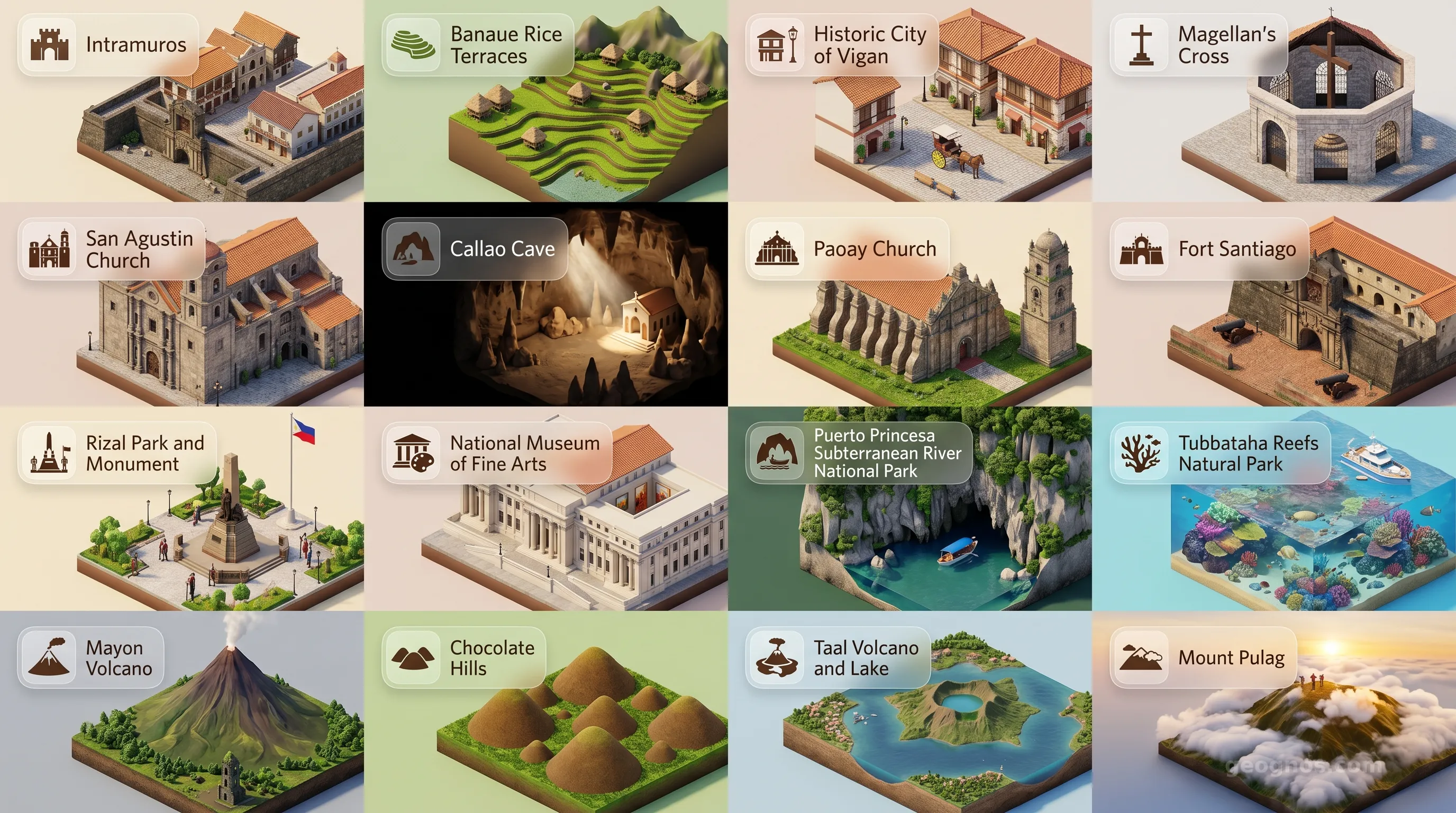
Philippines - Panoramic Places of Interest Atlas including Intramuros, Banaue Rice Terraces, Historic City of Vigan, Magellan's Cross, San Agustin Church, Callao Cave, Paoay Church, Fort Santiago, Rizal Park and Monument, National Museum of Fine Arts, Puerto Princesa Subterranean River National Park, Tubbataha Reefs Natural Park, Mayon Volcano, Chocolate Hills, Taal Volcano and Lake, Mount Pulag

Top Sights & Landmarks

01

Intramuros

The Walled City of Manila

02

Banaue Rice Terraces

The Eighth Wonder of the World

03

Historic City of Vigan

Asia's Finest Spanish Colonial City

04

Magellan's Cross

The Birthplace of Christianity in the Philippines

05

San Agustin Church

The Oldest Stone Church in the Philippines

06

Callao Cave

Home of Homo luzonensis

07

Paoay Church

The Earthquake Baroque Masterpiece

08

Fort Santiago

The Citadel of the Walled City

09

Rizal Park and Monument

The Ground Zero of Philippine Independence

10

National Museum of Fine Arts

Repository of the Filipino Soul

11

Puerto Princesa Subterranean River National Park

The Underground River Wonder

12

Tubbataha Reefs Natural Park

The Crown Jewel of Philippine Seas

13

Mayon Volcano

The World's Most Perfect Cone

14

Chocolate Hills

Bohol's Geological Mystery

15

Taal Volcano and Lake

The Complex Volcano within a Lake

16

Mount Pulag

The Playground of the Gods

Background

The Philippine Islands became a Spanish colony during the 16th century; they were ceded to the US in 1898 following the Spanish-American War. Led by Emilio AGUINALDO, the Filipinos conducted an insurgency against US rule from 1899-1902, although some fighting continued in outlying islands as late as 1913. In 1935, the Philippines became a self-governing commonwealth. Manuel QUEZON was elected president and was tasked with preparing the country for independence after a 10-year transition. The islands fell under Japanese occupation during World War II, and US forces and Filipinos fought together during 1944-45 to regain control. On 4 July 1946 the Republic of the Philippines attained its independence. Twenty-one years of authoritarian rule under Ferdinand MARCOS ended in 1986, when a "people power" movement in Manila ("EDSA 1") forced him into exile and installed Corazon AQUINO as president. Several coup attempts hampered her presidency, and progress on political stability and economic development faltered until Fidel RAMOS was elected president in 1992. The US closed its last military bases on the islands the same year. Joseph ESTRADA was elected president in 1998. His vice-president, Gloria MACAPAGAL-ARROYO, succeded him in 2001 after ESTRADA's stormy impeachment trial on corruption charges broke down and another "people power" movement ("EDSA 2") demanded his resignation. MACAPAGAL-ARROYO was elected president in 2004. Corruption allegations marred her presidency, but the Philippine economy was one of the few to avoid contraction after the 2008 global financial crisis. Benigno AQUINO III was elected as president in 2010, followed by Rodrigo DUTERTE in 2016. During his term, DUTERTE pursued a controversial drug war that garnered international criticism for alleged human rights abuses. Ferdinand MARCOS, Jr. was elected president in 2022 with the largest popular vote in a presidential election since his father's ouster. For decades, the country has been challenged by armed ethnic separatists, communist rebels, and Islamic terrorist groups, particularly in the southern islands and remote areas of Luzon.

Location

Latitude
13° N
Longitude
122° E
N S W E
World Map Location
Geographic Location

Southeastern Asia, archipelago between the Philippine Sea and the South China Sea, east of Vietnam

Map Reference
Southeast Asia

Area

Total Area
300,000 sq km
Land (99%)
Land: 298,170 sq km
Water: 1,830 sq km

Elevation

Highest Point
Mount Apo
Mount Apo 2,954 m
Lowest Point
Philippine Sea
Philippine Sea 0 m
Mean Elevation
442 m

Detailed Geography Information

Coastline

36,289 km

Geography - note

note 1: for decades, the Philippine archipelago was reported as having 7,107 islands; in 2016, the national mapping authority reported that hundreds of new islands had been discovered and increased the number of islands to 7,641, though not all of the new islands have been verified note 2: the Philippines is one of the countries along the Ring of Fire, which is a belt bordering the Pacific Ocean that contains about 75% of the world's volcanoes and up to 90% of the world's earthquakes note 3: the Philippines sits on the Pacific typhoon belt, and an average of 9 typhoons make landfall on the islands each year, with about 5 being destructive; the country is the most exposed in the world to tropical storms

Irrigated land

16,270 sq km (2012)

Land boundaries

total: 0 km

Major lakes (area sq km)

salt water lake(s): Laguna de Bay - 890 sq km

Maritime claims

territorial sea: irregular polygon extending up to 100 nm from coastline as defined by 1898 treaty; since late 1970s has also claimed polygonal-shaped area in South China Sea as wide as 285 nm exclusive economic zone: 200 nm continental shelf: to the depth of exploitation

Natural hazards

astride typhoon belt, usually affected by several cyclonic storms each year; landslides; active volcanoes; destructive earthquakes; tsunamis volcanism: significant volcanic activity; Taal (311 m) has been deemed a Decade Volcano by the International Association of Volcanology and Chemistry of the Earth's Interior, worthy of study due to its explosive history and close proximity to human populations; Mayon (2,462 m), the country's most active volcano, erupted in 2009 and forced over 33,000 to be evacuated; other historically active volcanoes include Biliran, Babuyan Claro, Bulusan, Camiguin, Camiguin de Babuyanes, Didicas, Iraya, Jolo, Kanlaon, Makaturing, Musuan, Parker, Pinatubo, and Ragang; see note 2 under "Geography - note"

Natural resources

timberpetroleumnickelcobaltsilvergoldsaltcopper

Terrain

mostly mountains with narrow to extensive coastal lowlands

Population & Growth

+0.70% Growth
112,904,458
Total inhabitants (2025 est.)
Male: 50.3% (56,846,416) Female: 49.7% (56,058,042)

Age Distribution

0-14 years
30.2%
~34,097,146
15-64 years
64.3%
~72,597,566
65 years
5.6%
~6,322,650
Note: 2024 est.

Demographic Longevity

Median Age
27.1 years
Male
25.1 yrs
Female
26.3 yrs
Life Expectancy
70.8 years
Male
67.3 yrs
Female
74.5 yrs

Vital Dynamics

Birth Rate
16.02
births per 1,000 people
Death Rate
5.8
deaths per 1,000 people
Net Migration
-2.82
migrants per 1,000 people
Fertility Rate
1.94
children born per woman

Detailed People & Society Information

Alcohol consumption per capita

4.85 liters of pure alcohol (2019 est.)

Children under the age of 5 years underweight

16.7% (2021 est.)

Currently married women (ages 15-49)

55.6% (2022 est.)

Dependency ratios

total dependency ratio: 48 (2025 est.) youth dependency ratio: 39.4 (2025 est.) elderly dependency ratio: 8.6 (2025 est.) potential support ratio: 11.6 (2025 est.)

Education expenditure

3.6%

3.6% of GDP (2023 est.) 15.2% national budget (2025 est.)

Ethnic groups

Tagalog
26%
Bisaya/Binisaya
14.3%
Ilocano
8%
Cebuano
8%
Illonggo
7.9%
Bikol/Bicol
6.5%
Waray
3.8%
Kapampangan
3%
Maguindanao
1.9%
Pangasinan
1.9%
other local ethnicities
18.5%
foreign ethnicities
0.2%

Gross reproduction rate

0.94 (2025 est.)

Health expenditure

5.1%

5.1% of GDP (2022) 9% of national budget (2022 est.)

Hospital bed density

1 beds/1,000 population (2021 est.)

Infant mortality rate

total: 18.5 deaths/1,000 live births (2025 est.) male: 24.4 deaths/1,000 live births female: 19.6 deaths/1,000 live births

Languages

Tagalog
39.9%
Bisaya/Binisaya
16%
Hiligaynon/Ilonggo
7.3%
Ilocano
7.1%
Cebuano
6.5%
Bikol/Bicol
3.9%
Waray
2.6%
Kapampangan
2.4%
Maguindanao
1.4%
Pangasinan/Panggalato
1.3%
other languages/dialects
11.2%
unspecified
0.4%

Literacy

total population: 98.5% (2020 est.) male: 98.4% (2020 est.) female: 97% (2022 est.)

Major urban areas - population

14.667 million MANILA (capital), 1.949 million Davao, 1.025 million Cebu City, 931,000 Zamboanga, 960,000 Antipolo, 803,000 Cagayan de Oro City, 803,000 Dasmarinas (2023)

Maternal mortality ratio

84 deaths/100,000 live births (2023 est.)

Mother's mean age at first birth

23.6 years (2022 est.) note: data represents median age at first birth among women 25-49

Nationality

noun: Filipino(s) adjective: Philippine

Obesity - adult prevalence rate

6.4% (2016)

People - note

one of only two predominantly Christian nations in Southeast Asia, the other being Timor-Leste

Physician density

0.79 physicians/1,000 population (2021)

Population distribution

population concentrated in areas with good farmland; highest concentrations are northwest and south-central Luzon, the southeastern extension of Luzon, and the islands of the Visayan Sea, particularly Cebu and Negros; Manila is home to one eighth of the national population

Refugees and internally displaced persons

Total Displaced & Vulnerable Persons
1,161,015 individuals
Refugees
0.2%
2,342
2,342 (2024 est.)
Internally Displaced Persons (IDPs)
99.8%
1,158,643
1,158,643 (2024 est.)
Stateless Persons
0.0%
30
30 (2024 est.)

Religions

Roman Catholic
78.8%
Muslim
6.4%
Iglesia ni Cristo
2.6%
other Christian
3.9%
other
8.2%

School life expectancy (primary to tertiary education)

total: 12 years (2021 est.) male: 12 years (2021 est.) female: 13 years (2021 est.)

Sex ratio

at birth: 1.05 male(s)/female 0-14 years: 1.04 male(s)/female 15-64 years: 1.02 male(s)/female 65 years and over: 0.66 male(s)/female total population: 1 male(s)/female (2024 est.)

Tobacco use

total: 19.2% (2025 est.) male: 34.4% (2025 est.) female: 3.7% (2025 est.)

Climate & Issues

Climate Profile

tropical marine; northeast monsoon (November to April); southwest monsoon (May to October)

Key Environmental Issues
deforestation, especially in watershed areas illegal mining and logging soil erosion air and water pollution in major urban centers coral reef degradation increasing pollution of coastal mangrove swamps coastal erosion dynamite fishing wildlife extinction

Land Cover

Coverage Distribution
Agri (43%)
Forest (25%)
Other (33%)
Arable: 18.7%
Crops: 18.9%
Pasture: 5.0%
Forest: 24.7%

Air & Carbon Emissions

Annual CO2 Output 2023 est.
156.228 million
Coal (57%) Oil (39%) Gas (4%)
PM2.5 Exposure 25.4 µg/m³
0 5 (WHO Limit) 15 25 35+
Methane Emissions
energy: 230.7 kt (2022-2024 est.)

Water Resources & Use

Renewable Water Resources 479 billion cubic meters (2022 est.)
Annual Water Withdrawal
municipal: 9.498 billion cubic meters (2022)
Municipal (10%) Ind (15%) Agri (75%)

Detailed Environmental Information

Geoparks

total global geoparks and regional networks: 1 global geoparks and regional networks: Bohol Island (2023)

International environmental agreements

BiodiversityClimate ChangeClimate Change-Kyoto ProtocolClimate Change-Paris AgreementComprehensive Nuclear Test BanDesertificationEndangered SpeciesHazardous WastesLaw of the SeaMarine Dumping-London ConventionMarine Dumping-London ProtocolNuclear Test BanOzone Layer ProtectionShip PollutionTropical Timber 2006Wetlands

Urbanization

urban population: 48.3% of total population (2023) rate of urbanization: 2.04% annual rate of change (2020-25 est.)

Waste and recycling

municipal solid waste generated annually: 14.632 million tons (2024 est.) percent of municipal solid waste recycled: 49.9% (2022 est.)

Capital & State Profile

Capital City
Manila
14.6° N, 120.9667° E
Timezone UTC+8
Government Type
presidential republic
Independence 1946-07-04
National Holiday 06-12

Executive Branch

Chief of State
President Ferdinand "BongBong" MARCOS, Jr. (since 30 June 2022)
Head of Government
President Ferdinand "BongBong" MARCOS, Jr. (since 30 June 2022)
Last Election 9 May 2022
Next Election 9 May 2028
Cabinet Cabinet appointed by the president with the consent of the Commission of Appointments, an independent body of 25 Congressional members that includes the Senate president (ex officio chairman) and is appointed by the president

Legislative Branch

bicameral
Legislature Name Congress (Kongreso)
Lower Chamber House of Representatives (Kapulungan Ng Mga Kinatawan)
Seats 317 (all directly elected)
Term 3 years
% Women 28.3%
Parties Composition
Lakas-CMD party (103), National Unity Party (NUP) (32), Nationalist People's Coalition (NPC) 31, Partido Federal ng Pilipinas (PFP) (27), Nacionalista Party (NP) (22), Liberal Party (LP) (6), others (28), independents 11
Upper Chamber Senate (Senado)
Seats 24 (all directly elected)
Term 6 years
% Women 20.8%
Parties Composition
Nationalist People's Coalition (NPC) 2Nacionalista Party (NP) 3Partido Demokratiko Pilipino-Laban (PDP-Laban) 2Lakas- CMD party 1Katipunan ng Nagkakaisang Pilipino (KANP) 1Liberal Party 1Independents 2

National Identity & Symbols

National Flag Description

two equal horizontal bands of blue (top) and red; a white equilateral triangle is based on the left side; the center of the triangle has a yellow sun with eight rays, each split into smaller rays; the triangle's corners each have a small five-pointed yellow star

Symbolic Meaning blue stands for peace and justice, red for courage, and the triangle for equality; the rays represent the first eight provinces that sought independence from Spain, and the stars represent the country's three parts: Luzon, Visayas, and Mindanao
National Symbol three stars and sun, Philippine eagle
National Colors red, white, blue, yellow
National Anthem Lupang Hinirang (Chosen Land)

Detailed Government Information

Administrative divisions

81 provinces and 38 chartered cities provinces: Abra, Agusan del Norte, Agusan del Sur, Aklan, Albay, Antique, Apayao, Aurora, Basilan, Bataan, Batanes, Batangas, Biliran, Benguet, Bohol, Bukidnon, Bulacan, Cagayan, Camarines Norte, Camarines Sur, Camiguin, Capiz, Catanduanes, Cavite, Cebu, Cotabato, Davao del Norte, Davao del Sur, Davao de Oro, Davao Occidental, Davao Oriental, Dinagat Islands, Eastern Samar, Guimaras, Ifugao, Ilocos Norte, Ilocos Sur, Iloilo, Isabela, Kalinga, Laguna, Lanao del Norte, Lanao del Sur, La Union, Leyte, Maguindanao, Marinduque, Masbate, Mindoro Occidental, Mindoro Oriental, Misamis Occidental, Misamis Oriental, Mountain, Negros Occidental, Negros Oriental, Northern Samar, Nueva Ecija, Nueva Vizcaya, Palawan, Pampanga, Pangasinan, Quezon, Quirino, Rizal, Romblon, Samar, Sarangani, Siquijor, Sorsogon, South Cotabato, Southern Leyte, Sultan Kudarat, Sulu, Surigao del Norte, Surigao del Sur, Tarlac, Tawi-Tawi, Zambales, Zamboanga del Norte, Zamboanga del Sur, Zamboanga Sibugay chartered cities: Angeles, Bacolod, Baguio, Butuan, Cagayan de Oro, Caloocan, Cebu, Cotabato, Dagupan, Davao, General Santos, Iligan, Iloilo, Lapu-Lapu, Las Pinas, Lucena, Makati, Malabon, Mandaluyong, Mandaue, Manila, Marikina, Muntinlupa, Naga, Navotas, Olongapo, Ormoc, Paranaque, Pasay, Pasig, Puerto Princesa, Quezon, San Juan, Santiago, Tacloban, Taguig, Valenzuela, Zamboanga

Citizenship

citizenship by birth: no citizenship by descent only: at least one parent must be a citizen of the Philippines dual citizenship recognized: no residency requirement for naturalization: 10 years

Constitution

history: several previous; latest ratified 2 February 1987, effective 11 February 1987 amendment process: proposed by Congress if supported by three fourths of the membership, by a constitutional convention called by Congress, or by public petition; passage by either of the three proposal methods requires a majority vote in a national referendum

Country name

conventional long form: Republic of the Philippines conventional short form: Philippines local long form: Republika ng Pilipinas local short form: Pilipinas etymology: named in honor of King PHILLIP II of Spain by Spanish explorer Ruy LOPEZ de VILLALOBOS, who visited the islands in 1543

International law organization participation

accepts compulsory ICJ jurisdiction with reservations; withdrew from the ICCt in March 2019

International organization participation

Judicial branch

highest court(s): Supreme Court (consists of a chief justice and 14 associate justices) judge selection and term of office: justices are appointed by the president on the recommendation of the Judicial and Bar Council, a constitutionally created, 6-member body that recommends Supreme Court nominees; justices serve until age 70 subordinate courts: Court of Appeals; Sandiganbayan (special court for corruption cases of government officials); Court of Tax Appeals; regional, metropolitan, and municipal trial courts; sharia courts

Legal system

mixed system of civil, common, Islamic (sharia), and customary law

National heritage

total World Heritage Sites: 6 (3 cultural, 3 natural) selected World Heritage Site locales: Baroque Churches of the Philippines (c); Tubbataha Reefs Natural Park (n); Rice Terraces of the Philippine Cordilleras (c); Historic Vigan (c); Puerto-Princesa Subterranean River National Park (n); Mount Hamiguitan Range Wildlife Sanctuary (n)

Political parties

Democratic Action (Aksyon Demokratiko) Alliance for Change (Hugpong ng Pagbabago or HNP) Katipunan ng Nagkakaisang Pilipino (KANP) Lakas ng EDSA-Christian Muslim Democrats or Lakas-CMD Liberal Party or LP Nacionalista Party or NP Nationalist People's Coalition or NPC National Unity Party or NUP Partido Demokratiko Pilipino-Lakas ng Bayan or PDP-Laban Partido Federal ng Pilipinas or PFP

Suffrage

18 years of age; universal

Economic Overview

growing Southeast Asian economy; commercial rebound led by transportation, construction and financial services; electronics exports recovering from sector slowdown; significant remittances; interest rate rises following heightened inflation; uncertainties due to increased regional tensions with China

Size & Performance

Real GDP (PPP)
$1.202 trillion
Latest available estimate (2024)
2023: $1.137 trillion2022: $1.078 trillion
Real GDP Growth
5.7% (2024 est.)
+5.7%
GDP Per Capita (PPP)
$10,400
2023: $9,9002022: $9,500

GDP Sector Breakdown

Agriculture: 9.1%Industry: 27.7%Services: 63.2%
Origin GDP %
Agriculture 9.1%
Industry 27.7%
Services 63.2%

Trade Balance

Trade Position
Trade Deficit
$54.16 billion
Total Exports
$106.99 billion (2024 est.)
Total Imports
$161.154 billion (2024 est.)
Exports (40%) Imports (60%)

Budget Balance

Budget Position
Budget Deficit
-$28.80 billion
Revenues
$65.069 billion (2022 est.)
Expenditures
$93.871 billion (2022 est.)
Revenues (41%) Expenditures (59%)

Export Profile

Top Export Partners

19.0%
13.0%
11.0%
Note: 2023; top five export partners based on percentage share of exports

Major Export Commodities

integrated circuitsmachine partsgoldinsulated wiresemiconductors

Import Profile

Top Import Partners

Note: 2023; top five import partners based on percentage share of imports

Major Import Commodities

integrated circuitsrefined petroleumcarscrude petroleumcoal

Labor & Employment

Total Labor Force 50.979 million (2024 est.)
General Unemployment Rate 2.2%
Youth Unemployment (Ages 15-24) 6.6%
Population Below Poverty Line 15.5% (2023 est.)

Income Inequality

Gini Coefficient (Family Income) 39.3
0 (Perfect Equality) Moderate Inequality 100 (Perfect Inequality)

Family Income / Consumption Share

Lowest 10%: 2.9% (2023 est.) Highest 10%: 31.6% (2023 est.)
Inequality Gap: Top 10% holds 10.9x the share of the bottom 10%.

Detailed Economic Data

Agricultural products

sugarcanericecoconutsmaizebananasvegetablestropical fruitsplantainspineapplescassava

Current account balance

-$17.514 billion (2024 est.) -$12.387 billion (2023 est.) -$18.261 billion (2022 est.) note: balance of payments - net trade and primary/secondary income in current dollars

Debt - external

$63.241 billion (2023 est.) note: present value of external debt in current US dollars

Exchange rates

Philippine pesos (PHP) per US dollar - Exchange rates: 57.291 (2024 est.) 55.63 (2023 est.) 54.478 (2022 est.) 49.255 (2021 est.) 49.624 (2020 est.)

GDP - composition, by end use

Industrial production growth rate

5.6% (2024 est.) note: annual % change in industrial value added based on constant local currency

Industries

semiconductors and electronics assemblybusiness process outsourcingfood and beverage manufacturingconstructionelectric/gas/water supplychemical productsradio/television/communications equipment and apparatuspetroleum and fueltextile and garmentsnon-metallic mineralsbasic metal industriestransport equipment

Inflation rate (consumer prices)

3.2% (2024 est.) 6% (2023 est.) 5.8% (2022 est.) note: annual % change based on consumer prices

Public debt

39.9% of GDP (2017 est.) note: central government debt as a % of GDP

Remittances

8.7% of GDP (2024 est.) 8.9% of GDP (2023 est.) 9.4% of GDP (2022 est.) note: personal transfers and compensation between resident and non-resident individuals/households/entities

Reserves of foreign exchange and gold

$106.195 billion (2024 est.) $103.742 billion (2023 est.) $96.04 billion (2022 est.) note: holdings of gold (year-end prices)/foreign exchange/special drawing rights in current dollars

Taxes and other revenues

14.1% (of GDP) (2023 est.) note: central government tax revenue as a % of GDP

Grid Infrastructure

Electricity Access 94.8%
Urban: 98% Rural: 91.1%
Capacity 29.174 million kW (2023 est.)
Consumption 100.824 billion kWh (2023 est.)
Grid Losses: 10.693 billion kWh (2023 est.)

Generation Mix

Percentage Share of Production
fossil fuels 77.9%
geothermal 9.3%
hydroelectricity 9%
solar 1.6%
biomass and waste 1.2%
wind 0.9%

Fossil Fuels Production

Petroleum
Production 10,000 bbl/day (2023 est.)
Consumption 457,000 bbl/day (2023 est.)
Proven Reserves 138.5 million barrels (2021 est.)
Natural Gas
Production 2.325 billion cubic meters (2023 est.)
Consumption 3.12 billion cubic meters (2023 est.)
Imports 794.289 million cubic meters (2023 est.)
Proven Reserves 98.543 billion cubic meters (2021 est.)
Coal
Production 14.457 million metric tons (2023 est.)
Consumption 42.859 million metric tons (2023 est.)
Exports 8.151 million metric tons (2023 est.)
Imports 36.542 million metric tons (2023 est.)
Proven Reserves 361 million metric tons (2023 est.)

Intensity & Nuclear

Energy Consumption Per Capita 17.654 million Btu/person (2023 est.)
No nuclear energy infrastructure or reactor operations reported in this country dossier.

Digital Access

.ph
Internet Usage 84%

Active internet users as a percentage of the total population.

Fixed Broadband

Penetration Rate 7 / 100
Total Subscriptions 7.51 million (2023 est.)

Mobile Cellular

Penetration Rate 115 / 100
Total Subscriptions 134 million (2024 est.)

Broadcast Media

multiple national private TV and radio networks; multi-channel satellite and cable TV systems available; more than 400 TV stations; about 1,500 cable TV providers with more than 2 million subscribers; over 1,400 radio stations; was scheduled to move to digital by the end of 2023 (2019)

Aviation

RP
Airports
256
As of 2025
Heliports
416
As of 2025

Railways

Total Track Length
77 km
National Network Data from 2017

Ports & Harbors

Ports Count 70
Hover for breakdown & key ports As of 2024

Merchant Marine

Commercial Fleet
2,203 ships
Hover for vessel types breakdown As of 2023

Military Expenditures

GDP Allocation 1.7%
1.7% of GDP (2024 est.) 1.5% of GDP (2023 est.) 1.4% of GDP (2022 est.) 1.2% of GDP (2021 est.) 1.1% of GDP (2020 est.)

Active Duty Strengths

approximately 145,000 active Armed Forces (105,000 Army; 25,000 Navy, including about 8,000 Marine Corps; 15,000 Air Force) (2025)

Refers to active military personnel.

Service & Defense Details

Military and security forces

Armed Forces of the Philippines (AFP): Army, Navy (includes Marine Corps), Air Force Department of Transportation: Philippine Coast Guard (PCG); Department of the Interior: Philippine National Police Force (PNP) (2025) note 1: the PCG is an armed and uniformed service that would be attached to the AFP during a conflict note 2: the Philippine Government also arms and supports civilian militias; the AFP controls the Civilian Armed Force Geographical Units, while the Civilian Volunteer Organizations fall under PNP command

Military equipment inventories and acquisitions

the AFP is equipped with a mix of imported weapons systems from more than a dozen countries, including Brazil, Israel, South Korea, and the US (2025)

Military - note

the Armed Forces of the Philippines (AFP) are responsible for territorial defense and assisting with internal security; much of the AFP's operational focus is on internal security alongside the Philippines National Police, particularly in the south, where several separatist insurgent, terrorist, and criminal groups operate and a considerable portion of the AFP is typically deployed; additional combat operations are conducted against the Communist People’s Party/New People’s Army, which is active mostly on Luzon, as well as the Visayas and areas of Mindanao; prior to a peace deal in 2014, the AFP fought a decades-long conflict against the Moro Islamic Liberation Front (MILF), a separatist organization based mostly on the island of Mindanao, which had up to 40,000 fighters under arms maritime security is also a priority; the AFP's naval forces conduct naval interdiction missions in support of security operations on the southern islands, including joint maritime patrols with Indonesia and Malaysia; rising tensions with China over disputed waters and land features in the South China Sea since 2012 have spurred the AFP to place more emphasis on blue-water naval capabilities, including acquiring larger warships such as guided missile frigates, corvettes, offshore patrol vessels, and landing platform dock (LPD) amphibious assault ships the Philippine military was formally organized during the American colonial period as the Philippine Army; they were established by the National Defense Act of 1935 and comprised of both Filipinos and Americans; the US and Philippines agreed to a mutual defense treaty in 1951; based on agreements signed in 2014 and 2023, the Philippine Government allows the rotational presence of US military forces, aircraft, and ships at up to nine bases in the Philippines; also in 2023, the US agreed to assist in modernizing Philippine defense capabilities, deepen interoperability, enhance bilateral planning and information-sharing, and combat transnational and nonconventional threats (2025)

Military service age and obligation

some variations in age based on the branch of service, but generally 18-27 years of age for voluntary military service for men and women; no conscription (2025) note: as of 2023, women made up about 8% of the active military; women have attended the Philippine Military Academy and trained as combat soldiers since 1993

Space Agency

Philippine Space Agency (PhilSA; established 2019) (2025)

Program Overview

has a small space program focused on acquiring satellites and related technologies, largely for climate studies, national security, and risk management; also prioritizing development of space expertise and industry; manufactures and operates satellites (mostly micro- and nano-sized), including remote sensing and scientific/experimental; has relations with a variety of foreign space agencies and industries, including those of China, the ESA (and some of its member states), India, Japan, Russia, and the US (2025)

Program Milestones

1994 formed a consortium of companies to acquire and operate satellites
1996 acquired first communications satellite (Agila-1) from Indonesia after it was already in orbit
2014 initiated a scientific remote sensing (RS) microsatellite development program in collaboration with Japan, resulting in first RS microsatellite (Diwata-1) being deployed from the International Space Station (ISS) in 2016
2018 first domestically designed and built scientific/technology-demonstrator cube satellite (Maya-1) deployed from ISS; second RS microsatellite (Diwata-2) developed with assistance from and launched by Japan
2023 signed agreement with the ESA and EU to expand cooperation on Earth observation/RS data sharing
2025 signed US-led Artemis Accords for space exploration