South Sudan
Top Sights & Landmarks
Site of the Fashoda Incident
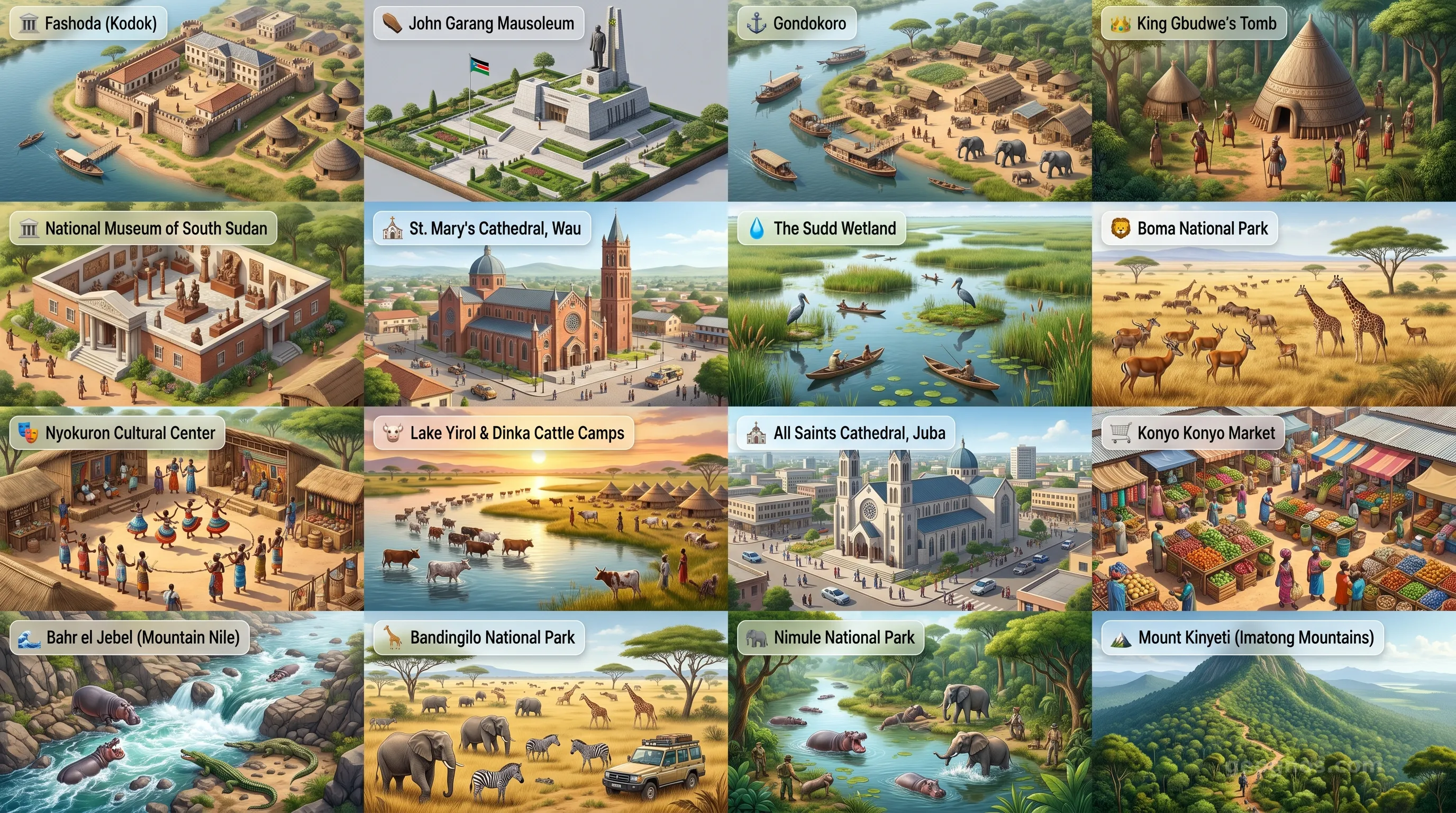
Fashoda, now known as Kodok, is a site of immense global historical significance. It was the epicenter of the 1898 'Fashoda Incident,' the climax of imperial territorial disputes between Britain and France in East Africa. For students of political science and history, exploring Fashoda offers profound insights into the Scramble for Africa. Culturally, it is also the historic capital of the Shilluk Kingdom. The best time to visit is during the dry season (December to March) when roads are passable. Tourist tip: Access can be logistically challenging, so arranging a guided tour through local authorities in Malakal is highly recommended.
Resting Place of the Founding Father
Located in the capital city of Juba, the John Garang Mausoleum serves as the final resting place of Dr. John Garang de Mabior, the iconic leader of the Sudan People's Liberation Movement. It is a site of profound cultural and national importance, symbolizing the struggle for South Sudanese independence. Visitors and researchers come here to study the modern political history of the world's youngest nation. The site is best visited year-round, though attending during national holidays like Independence Day (July 9th) provides a vibrant cultural experience. Tourist tip: Always ask for permission from the guards before taking photographs.
Historic 19th-Century Trading Post
Situated on the east bank of the White Nile near Juba, Gondokoro was a pivotal 19th-century trading station, mission outpost, and staging point for early European explorers like Samuel Baker and Charles Gordon trying to find the source of the Nile. Today, it remains an important archaeological zone for studying the region's colonial and pre-colonial trade history, including the devastating ivory and slave trades. The dry season (November to April) is optimal for exploring the remnants of the area. Tourist tip: Hire a local historian or guide in Juba to provide context, as physical ruins are scarce but the historical narrative is rich.
Monument of Azande Resistance
Located in Yambio, this tomb is dedicated to King Gbudwe, the revered monarch of the Azande kingdom who fiercely resisted British colonial rule until his death in 1905. It is a critical site for ethnographers and historians studying indigenous African resistance movements and the rich heritage of the Azande people. The site features traditional shrines and modern commemorative structures. The area is lush and green, making the shoulder months of November and May pleasant for visits. Tourist tip: Engage with the local Azande community leaders who often share captivating oral histories about King Gbudwe's reign.
Repository of National Heritage
The National Museum in Juba is the premier institution dedicated to preserving the diverse cultural tapestry of South Sudan's 64 ethnic groups. It houses traditional crafts, musical instruments, historic photographs, and artifacts that tell the story of the nation's indigenous heritage and long journey to independence. For students of anthropology and African studies, this is a must-visit. The museum is indoors and accessible year-round. Tourist tip: Facilities are modest; consider making a small donation to aid the ongoing preservation efforts of the curators.
Architectural Marvel of Bahr el Ghazal
Constructed in 1956 by Catholic missionaries, St. Mary's Cathedral in Wau is one of the largest and most architecturally impressive churches in South Sudan. It stands as a beacon of resilience, having survived decades of civil conflict. The cathedral is vital for studying the history of Christianity and missionary work in the region. Its striking brickwork and vaulted ceilings offer a rare glimpse of mid-20th-century religious architecture in the country. It is accessible year-round. Tourist tip: Attend a Sunday mass to experience the incredible vibrancy of South Sudanese choral music.
One of the World's Largest Wetlands
The Sudd is a vast swamp formed by the White Nile, recognized globally as a Ramsar site of immense ecological importance. Historically, its impenetrable floating vegetation blocked Roman centurions and Victorian explorers searching for the Nile's source. Today, it is an unparalleled living laboratory for ecologists studying unique avian life (including the Shoebill stork) and hydrology. The best time to visit is from December to February. Tourist tip: Access is typically via boat from Bor; hiring a trusted local guide and a sturdy motorized canoe is essential for navigating the maze of papyrus reeds.
Home to the Great Mammal Migration
Boma National Park is a massive protected area in eastern South Sudan, renowned for hosting one of the largest mammal migrations on earth—primarily the white-eared kob, tiang, and Mongalla gazelle. For wildlife biologists and eco-tourists, it rivals the Serengeti but remains completely untamed and rarely visited. The park is also culturally significant, surrounded by the Murle, Anyuak, and Jie tribes. Visit during the dry season (January to May) to witness the migration. Tourist tip: Infrastructure is practically non-existent; visitors must arrange expensive fly-in safaris through specialized adventure companies.
The Beating Heart of Juba's Arts
Nyokuron Cultural Center is the epicenter of artistic and cultural expression in Juba. Built to foster unity among South Sudan's diverse ethnic groups, it frequently hosts traditional dance performances, music festivals, theatrical plays, and peace conferences. Studying the performances here provides immediate insight into the oral traditions and social fabrics of the nation's tribes. It is an excellent year-round destination. Tourist tip: Check local listings or ask hotel concierges for the schedule of weekend cultural dances, which provide fantastic photography opportunities.
Epicenter of Traditional Pastoralism
The region around Lake Yirol is famous for its massive Dinka cattle camps. Cattle are deeply intertwined with the spiritual, economic, and social life of the Dinka people. Visiting these camps offers an immersive look into an ancient agro-pastoralist lifestyle that has remained largely unchanged for centuries—a phenomenal opportunity for cultural anthropologists. The dry season (December to March) is the best time to see the largest gatherings of herds. Tourist tip: Always travel with a local facilitator who can mediate introductions; showing respect and asking permission before taking photos is absolutely mandatory.
Historic Episcopal Landmark
Located in the heart of Juba, All Saints Cathedral is a central religious and historical institution. During the long civil wars, it served as a vital sanctuary for displaced persons and a hub for peace-building initiatives spearheaded by religious leaders. It stands as a testament to the resilient faith of the South Sudanese people. The cathedral features distinctive red-brick architecture and is active year-round. Tourist tip: The Sunday services are incredibly welcoming and feature powerful, uplifting East African Anglican choir music.
Juba's Vibrant Commercial Hub
Konyo Konyo is the largest and most chaotic market in Juba, representing the economic and cultural melting pot of the nation. Here, South Sudanese merchants mingle with traders from Uganda, Kenya, and beyond. For students of economics and sociology, the market is a live study in informal economies and post-conflict recovery. Visitors can find everything from vibrant kitenge fabrics to exotic spices. The market operates year-round. Tourist tip: Keep your valuables secure, bargain politely but firmly, and refrain from pointing your camera directly at stalls without asking first.
The Lifeline of South Sudan
The Bahr el Jebel, meaning 'River of the Mountains', is the main stretch of the White Nile flowing through South Sudan. It has been the primary artery for trade, transport, and sustenance for millennia. Studying the river is essential for understanding the country's settlement patterns and agricultural practices. The riverbanks in Juba are lined with lively restaurants and cafes. The best experience is taking a sunset boat tour, accessible year-round. Tourist tip: Book a private riverboat late in the afternoon to watch the sunset over the water while spotting local birdlife.
Crucial Migration Corridor
Spanning the Equatoria region, Bandingilo National Park is a critical habitat for the extraordinary East African animal migration. It offers biologists and ecologists an unparalleled view of undisturbed savannah ecosystems, hosting large populations of giraffes, buffaloes, and elephants. Established in 1992, the park is raw and undeveloped. The dry season (December to April) provides the best wildlife viewing as animals congregate near water sources. Tourist tip: Because it lacks formal lodges or paved roads, all expeditions must be fully self-sustained and organized through professional tour operators in Juba.
South Sudan's Most Accessible Park
Situated on the Ugandan border, Nimule National Park is one of the most picturesque and accessible parks in South Sudan. It is historically significant as an elephant sanctuary and was frequented by colonial administrators. The park encompasses the lush riverine landscapes of the Nile and is ideal for studying conservation in post-conflict zones. It is open year-round, though the dry season makes trekking easier. Tourist tip: Hire a ranger to guide you on foot; they can safely navigate you close to the resident hippos and elephants.
The Highest Peak in South Sudan
Rising to 3,187 meters in the Imatong Mountains, Mount Kinyeti is the highest point in South Sudan. The surrounding alpine and montane forests are a biodiversity hotspot, home to rare endemic plant and bird species, making it a prime location for botanical and zoological research. Historically, these dense forests served as a refuge during the civil wars. Trekking is best attempted in the dry months of December to February. Tourist tip: This is a challenging trek requiring physical fitness, specialized gear, and local military/police clearance before starting the hike from Torit or Katire.