Luxembourg
Top Sights & Landmarks
The Gibraltar of the North
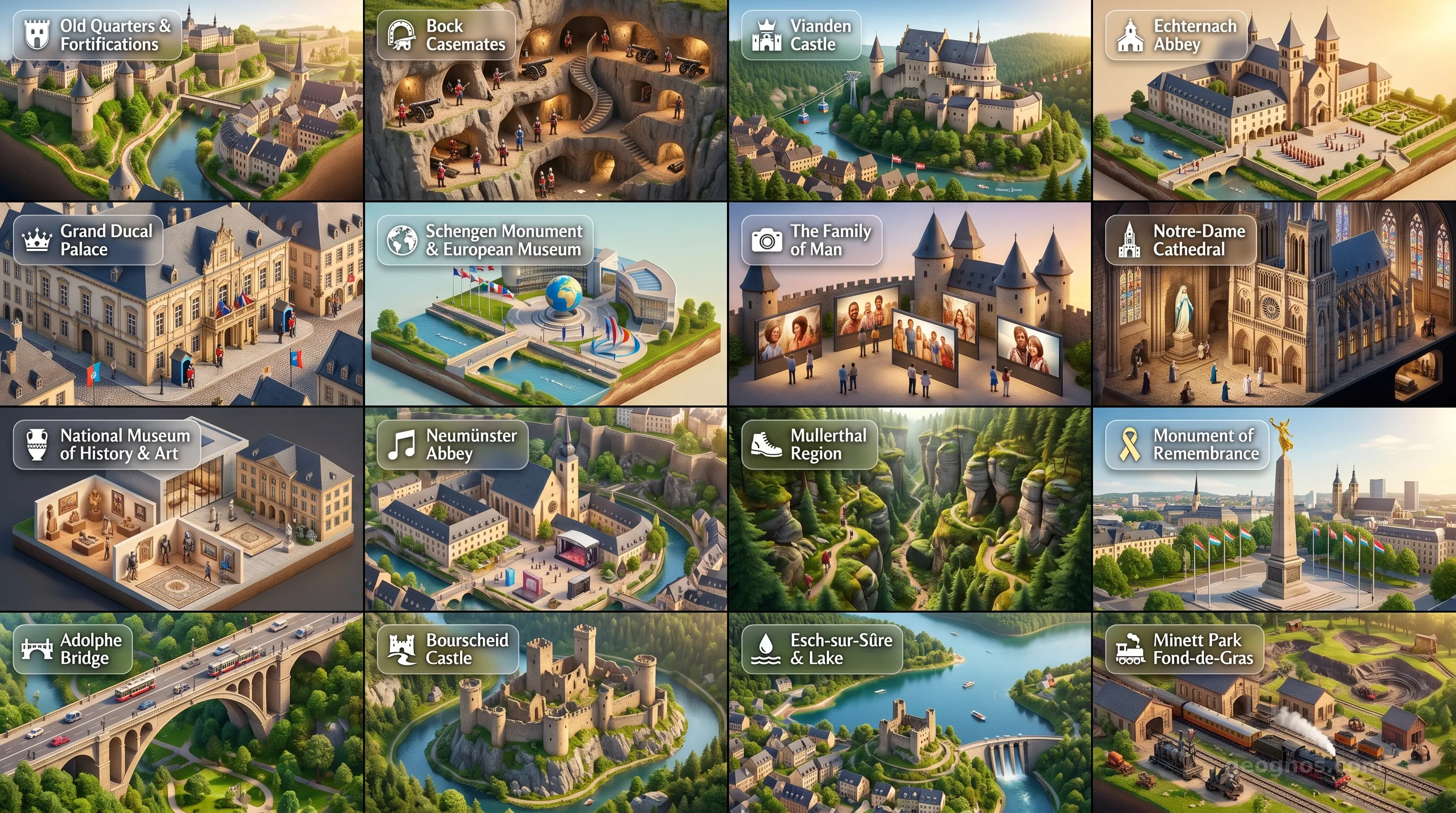
Luxembourg's Old City is a breathtaking tapestry of ancient military architecture and winding medieval streets. Historically, it served as one of Europe's most impregnable fortresses from the 16th to the 19th centuries, earning it the nickname 'Gibraltar of the North'. For students of European history and urban planning, it offers a fascinating study of how a city evolves alongside its fortifications. The best time to visit is during the late spring to early autumn when the weather is mild enough for extensive walking. Tourist tip: Do not miss the Chemin de la Corniche, often dubbed 'Europe's most beautiful balcony', which offers unparalleled panoramic views of the lower city (Grund).
Subterranean Military Marvel
Carved deep into the rocky cliffs, the Bock Casemates are a vast network of underground tunnels initially built by the Spanish in 1644 and later expanded by renowned military engineer Vauban. Historically, they sheltered thousands of soldiers, bakeries, and workshops during sieges, and later served as bomb shelters during WWII. They are vital for military history enthusiasts studying early modern siege warfare. Summer is the most comfortable season to visit, offering a cool respite from the heat, though they are accessible from spring to autumn. Tourist tip: Wear sturdy walking shoes, as the uneven rock floors and steep, narrow staircases can be slippery and challenging to navigate.
Majestic Romanesque-Gothic Fortress
Dominating the town of Vianden from a rocky promontory, Vianden Castle is one of the largest and most beautiful feudal residences of the Romanesque and Gothic periods in Europe. Built between the 11th and 14th centuries, it belonged to the powerful Grand Ducal family before falling into ruin and undergoing a massive 20th-century restoration. It is an exceptional site for studying medieval architectural transitions. Autumn is highly recommended for a visit, as the surrounding forests explode with vibrant colors. Tourist tip: Visit in late July or early August to experience the spectacular Medieval Festival, featuring jousting, traditional crafts, and period-accurate music.
Cradle of Luxembourgish Christianity
Founded in 698 AD by St. Willibrord, an Anglo-Saxon missionary, Echternach Abbey is situated in Luxembourg's oldest town. The basilica houses the tomb of the saint and boasts stunning stained glass and crypts. It was historically a prominent scriptorium in the Middle Ages, making it essential for students of medieval illuminated manuscripts and early Christian expansion in Europe. The quintessential time to visit is Whit Tuesday (spring), during which the town hosts the famous Dancing Procession, a UNESCO Intangible Cultural Heritage event. Tourist tip: Explore the adjacent abbey museum to see exquisite facsimiles of the illuminated manuscripts produced here centuries ago.
Seat of the Grand Duchy
Located in the heart of Luxembourg City, the Grand Ducal Palace is the official residence of the Grand Duke. Originally built as the city hall in the 16th century, its exquisite Flemish Renaissance facade stands as a testament to the country's affluent history and architectural prowess under Spanish rule. It offers a rare glimpse into the functioning of a modern constitutional monarchy. The palace is only open to the public during the summer months (mid-July to early September). Tourist tip: Book your guided tour well in advance, as tickets sell out quickly. Be sure to witness the ceremonial changing of the guard outside.
Birthplace of a Borderless Europe
Schengen, a small wine-making village on the Moselle River where Luxembourg, Germany, and France meet, is historically monumental. In 1985, the Schengen Agreement was signed here, effectively abolishing internal borders in much of Europe. The European Museum and the riverside monuments make this an indispensable destination for students of political science, European Union history, and international relations. Summer and early autumn (during the grape harvest) are ideal times to visit. Tourist tip: Rent a bicycle to ride along the scenic Moselle cycle path and effortlessly cross between three countries in a single afternoon.
Iconic Global Photography Exhibition
Housed within the restored 12th-century Clervaux Castle, 'The Family of Man' is a legendary photography exhibition curated by Edward Steichen for the MoMA in 1955. Added to the UNESCO Memory of the World Register, it features 503 photographs from 273 artists representing 68 countries, offering a profound post-WWII manifesto on human solidarity and universal experiences. It is a masterclass for art and sociology students alike. The indoor exhibition is a great year-round destination. Tourist tip: The castle also hosts a museum of the Battle of the Bulge; allocate at least half a day to fully absorb the emotional weight of both historical collections.
Jesuit Masterpiece with Royal Crypts
Luxembourg's only cathedral was originally a Jesuit church built in the early 17th century. It serves as a striking example of late Gothic architecture infused with Renaissance elements and ornamentation. Historically, it is the resting place of John the Blind, King of Bohemia, and members of the Grand Ducal family. Architectural and religious studies scholars will appreciate its evolution and the exquisite 19th-century stained glass windows. Spring and summer offer the best natural lighting to appreciate the stained glass. Tourist tip: Do not miss the bronze gates of the crypt, guarded by fierce, beautifully sculpted lions.
Journey Through Luxembourg's Timeline
Located in the historic Fishmarket area, the MNHA seamlessly blends modern architecture with historic buildings, plunging multiple underground floors into solid rock. It houses a staggering collection of artifacts ranging from Celtic and Roman archaeology—including the stunning Vichten Mosaic—to fine arts and numismatics. It is a required visit for anyone studying the Gallo-Roman period or Luxembourg's national evolution. It is a fantastic year-round destination, particularly on rainy days. Tourist tip: General admission to the permanent collections is entirely free, making it an excellent budget-friendly educational stop.
From Monastery to Prison to Cultural Hub
Located deep in the Grund valley below the Bock cliffs, Neumünster Abbey has lived many lives: originally a Benedictine monastery, it served as a military hospital, a devastating political prison during WWII, and is now a vibrant cultural center. Its rich, often dark history provides a compelling narrative of Luxembourg's resilience. The architecture perfectly complements the dramatic natural backdrop of the sheer cliff faces. Summer is ideal, as the courtyard frequently hosts open-air concerts and jazz festivals. Tourist tip: Take the glass elevator from the Ville Haute (Saint-Esprit Plateau) down to the Grund for spectacular views during your descent.
Luxembourg's Little Switzerland
The Mullerthal Region is characterized by its enchanting, dense forests, winding creeks, and surreal sandstone rock formations carved by millennia of water erosion. It offers tremendous value for geological study and ecological observation. The Mullerthal Trail, spanning over 112 kilometers, passes through narrow rock crevices and mystical moss-covered gorges. Spring and autumn are the prime seasons to visit for comfortable hiking temperatures and stunning foliage. Tourist tip: Bring a flashlight and rugged hiking boots; some trails take you through dark, narrow cave-like formations like the Kohlscheuer.
The Golden Lady
The Gëlle Fra, or Golden Lady, is a striking obelisk topped with a gilded bronze statue of the goddess of victory holding a laurel wreath. Originally erected to honor the Luxembourgish soldiers who volunteered in the French army during WWI, it was controversially dismantled by Nazi occupiers in 1940 and hidden away until its rediscovery and restoration in the 1980s. It stands today as a powerful symbol of Luxembourg's freedom and national identity. It is an open-air monument, accessible year-round. Tourist tip: Visit during the winter holiday season when the plaza surrounding the monument transforms into a bustling, festive Christmas market.
Iconic Stone Arch over the Pétrusse
Constructed between 1900 and 1903 during the rule of Grand Duke Adolphe, this bridge was once the largest stone arch bridge in the world. Spanning the dramatic Pétrusse Valley, it unified the modern train station district with the historic city center, representing a leap into industrial modernity for the nation. Engineering and architectural students will marvel at its proportions and recent renovations. It is stunning year-round, especially when the valley below is in autumn bloom. Tourist tip: Walk or cycle through the recently added suspended pathway hidden directly beneath the bridge's main deck for a unique architectural perspective.
Triangular Fortress in the Sky
Perched 150 meters above the winding Sûre River, Bourscheid Castle is a magnificent triangular fortification enclosed by an impressive wall featuring 11 watchtowers. Dating back to the 11th century with significant expansions in the 14th century, the site offers deep insights into medieval strategic defense planning and feudal expansion. Summer is the optimal time to visit, taking advantage of the extended daylight hours. Tourist tip: In the summer, the castle is beautifully illuminated at night, creating a fairytale atmosphere. Audio guides are highly recommended for detailed historical context.
Medieval Hamlet and Emerald Waters
Esch-sur-Sûre is a tiny, picturesque village wrapped almost entirely by a sharp meander of the Sûre River and dominated by a ruined 10th-century castle. Just upstream lies the Upper Sûre Lake, a reservoir created by a 1950s dam that provides the country's drinking water. The area perfectly juxtaposes ancient medieval settlement patterns with 20th-century hydro-engineering. Summer is heavily favored for swimming, sailing, and diving in the lake's pristine waters. Tourist tip: Motorboats are banned on the lake, making it incredibly peaceful; rent a canoe or a solar-powered boat for a serene exploration.
The Iron Heart of Luxembourg
Located in the south, Fond-de-Gras is an open-air museum dedicated to Luxembourg's vital iron ore mining history—an industry that transformed the nation from a poor agrarian state into a wealthy industrial powerhouse in the late 19th century. Students of industrial heritage, economics, and engineering will find the preserved trains, mines, and worker settlements deeply educational. The park is best visited between May and September when the historical steam train (Train 1900) and the 'Minièresbunn' narrow-gauge mine trains are operational. Tourist tip: Ride the train deep into the old mine shafts; dress warmly, as it is cold underground even in high summer.