Jordan
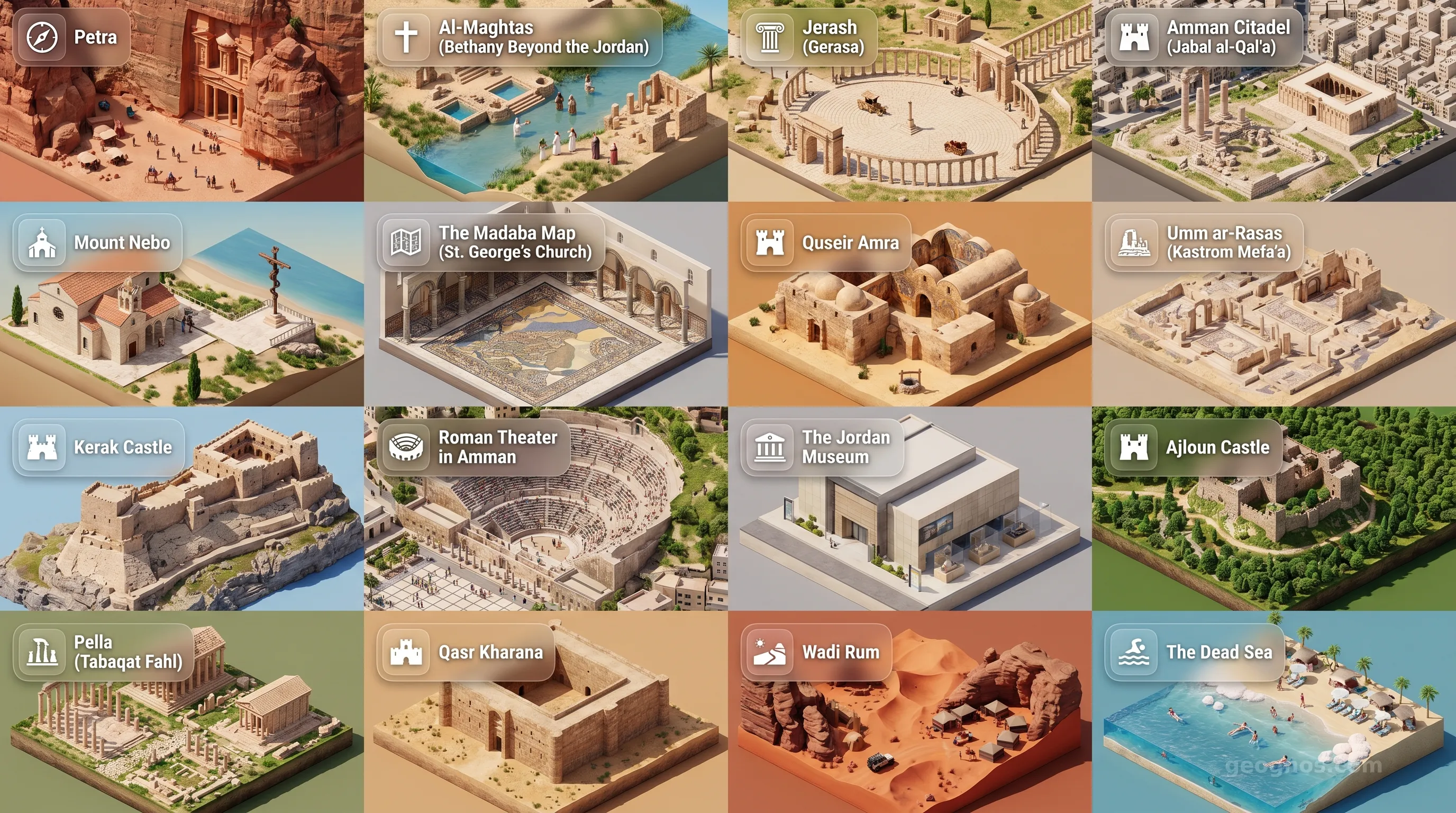
Top Sights & Landmarks
The Rose-Red City of the Nabataeans
A masterpiece of ancient engineering and architecture, Petra is essential for studying the Nabataean civilization, rock-cut architecture, and advanced ancient hydrology. Historically significant as a major crossroads for the incense, silk, and spice trades, its majestic facades like the Treasury (Al-Khazneh) and the Monastery (Ad-Deir) are globally iconic. The best season to visit is Spring (March to May) or Autumn (September to November) to avoid extreme desert temperatures. Tourist tip: Arrive at the gates by 6:00 AM to experience the mystical walk through the Siq without the heavy crowds.
The Baptism Site of Jesus Christ
An invaluable site for religious studies and late antiquity archaeology, Al-Maghtas is historically revered as the original location of Jesus' baptism by John the Baptist. It features Roman and Byzantine remains, including churches, chapels, and ancient baptismal pools. This sacred environment offers a profound look into early Christian pilgrimage traditions. The best time to visit is Spring, when the Jordan Valley is blooming and temperatures are mild. Tourist tip: Carry your passport as the site is located strictly on the border with the West Bank, and respect the solemnity of the active religious ceremonies taking place.
One of the Best-Preserved Roman Provincial Cities
Scholars of classical antiquity will find Jerash indispensable for studying Roman urban planning, grand colonnaded streets, and monumental public architecture. Historically, it was a prominent city of the Decapolis, boasting an extraordinary blend of Greco-Roman and Oriental influences. Key landmarks include the Oval Plaza, the Temple of Artemis, and two massive amphitheatres. The ideal time to visit is April, coinciding with comfortable weather and lush surrounding hills. Tourist tip: Wear highly comfortable walking shoes, as the ancient paving stones are uneven, and bring plenty of water.
An Ancient Vantage Point Overlooking Amman
The Amman Citadel is a prime educational destination for understanding the stratigraphy of human settlement in the Levant, with ruins spanning the Bronze Age, Roman, Byzantine, and Umayyad periods. Key historical structures include the Temple of Hercules and the beautifully restored Umayyad Palace, highlighting the city's historical evolution. Spring and Autumn provide the most pleasant weather for exploring this exposed hilltop. Tourist tip: Visit in the late afternoon to capture the golden hour illuminating the ancient pillars, and stay to hear the evocative call to prayer echoing from the mosques in the sprawling city below.
The Final Vantage Point of Moses
Mount Nebo is steeped in biblical history as the site where Moses was granted a view of the Promised Land before his death. For students of theology and art history, the site offers breathtaking 6th-century Byzantine mosaics preserved within the Memorial Church of Moses. The panoramic views stretching over the Jordan Valley, the Dead Sea, and to Jerusalem are truly inspiring. Spring is the best time to visit due to clear skies and pleasant temperatures. Tourist tip: Do not miss the Brazen Serpent monument created by Italian artist Giovanni Fantoni, which frames the sweeping valley views beautifully.
The Oldest Mosaic Map of the Holy Land
Located inside the 19th-century Greek Orthodox Church of St. George, this incredible floor mosaic from the 6th century is a vital primary source for scholars of historical geography and Byzantine art. The Madaba Map provides the oldest known geographic floor mosaic in art history, depicting the Middle East and providing crucial details about ancient Jerusalem's layout. It can be visited year-round, though weekdays are generally less crowded. Tourist tip: The mosaic is partially covered during church services, so time your visit outside of mass hours. Combine this with a trip to nearby Mount Nebo.
Early Islamic Desert Castle and Frescoes
Quseir Amra is a remarkable study in early Islamic secular art and architecture. Built in the 8th century by the Umayyad caliph Walid II, it functioned as both a fortress and an opulent bathhouse. It is renowned for its extensive, vibrant frescoes depicting hunting scenes, zodiac signs, and rulers, which challenge the misconception that early Islamic art strictly forbade figurative representations. Winter and early Spring are the best seasons to visit this desert location. Tourist tip: This site is quite remote; hire a driver to visit Quseir Amra along with Qasr Azraq and Qasr Kharana as part of an Eastern Desert Castles loop.
Ruins of Roman, Byzantine, and Early Muslim Roots
Umm ar-Rasas is an outstanding site for studying the transition between the Roman, Byzantine, and early Islamic periods in the Levant. Historically a Roman military camp, it evolved into a prosperous town featuring 16 churches. It is most famous for the exceptionally preserved mosaic floor in the Church of St. Stephen, which details illustrations of cities across Palestine, Jordan, and Egypt. Autumn is highly recommended for visiting. Tourist tip: Look out for the stylite tower, one of the few surviving structures where ascetic monks once lived in isolation atop a pillar.
A Colossal Crusader Stronghold
A prominent example of Crusader military architecture, Kerak Castle offers a fascinating case study in medieval siege warfare and the clash between European Crusaders and Islamic forces led by Saladin. Its dark, maze-like vaults and robust walls showcase a blend of European, Byzantine, and Arab architectural styles. Spring and Autumn provide the ideal climate for exploring its extensive open-air battlements. Tourist tip: Bring a flashlight to safely explore the poorly lit subterranean passageways, vaulted kitchens, and dungeons.
A 6,000-Seat Centerpiece of Ancient Philadelphia
This impressively restored 2nd-century Roman theater is a must-visit for students of classical architecture and ancient civic life. Cut directly into the northern side of a hill to keep spectators shielded from the sun, it once served as the vibrant cultural heart of the Roman city of Philadelphia. Today, it still hosts cultural events, demonstrating its lasting acoustic perfection. Summer evenings are the best time to catch a live performance here. Tourist tip: Climb the steep steps to the very top tier for a commanding view of downtown Amman, but descend carefully as the steps are quite narrow.
The Vault of Jordan's Heritage
For any student or cultural traveler, The Jordan Museum is the definitive starting point to understand the nation's immense historical timeline. It houses some of the most critical archaeological discoveries in the Middle East, including the Copper Scroll from the Dead Sea Scrolls and the haunting 'Ain Ghazal statues, which are among the oldest human statues ever made (c. 7500 BC). It can be comfortably visited year-round. Tourist tip: Allocate at least three hours for your visit to fully appreciate the interactive exhibits; note that the museum is usually closed on Tuesdays.
The Islamic Sentinel of the North
Unlike many castles in the region built by Crusaders, Ajloun Castle (Qal'at ar-Rabad) was constructed by the Ayyubids in 1184 to thwart Crusader expansion and protect regional iron mines. It provides a phenomenal study in medieval Islamic military strategy and architecture. Situated on a commanding hill, it offers stunning views over the Jordan Valley. Spring is the absolute best time to visit, as the surrounding Ajloun hills are remarkably green and covered in wildflowers. Tourist tip: Combine this visit with a hike in the nearby Ajloun Forest Reserve to experience Jordan's surprisingly lush northern environment.
A Decapolis City Spanning Millennia
Pella is an incredibly rich archaeological site showing evidence of continuous human habitation from the Chalcolithic period right through to the Islamic eras. Scholars of antiquity visit to study its transition from a Hellenistic and Roman Decapolis city into a thriving Byzantine and Umayyad settlement. The ruins are set against a dramatic backdrop of rolling hills dropping into the Jordan Valley. Spring is the best time to visit, avoiding the fierce summer heat of the valley. Tourist tip: As the site is less developed for tourism than Jerash, hire a local guide to help interpret the somewhat scattered, unlabelled ruins.
A Formidable Umayyad Desert Outpost
Qasr Kharana is one of the best-preserved early Islamic desert castles, featuring distinct Sassanian architectural influences. Despite its fortress-like appearance, it was likely used as an elite meeting place or caravanserai rather than a military stronghold, making it a fascinating subject for architectural historians. Winter and Spring are the best seasons to traverse the eastern desert. Tourist tip: Notice the slits in the walls; they were designed for ventilation and light rather than for shooting arrows, a detail that hints at the building's true diplomatic purpose.
The Valley of the Moon
Wadi Rum is a mixed UNESCO site offering immense value to geologists studying dramatic desert landscapes and historians tracing millennia of human habitation through 25,000 petroglyphs and 20,000 inscriptions left by Nabataeans and Thamudic tribes. It is also famous for its association with T.E. Lawrence (Lawrence of Arabia). The prime seasons to visit are March to May and September to November. Tourist tip: To truly absorb the majesty of the landscape, book an overnight stay in a Bedouin camp, and take a 4x4 sunset tour.
The Lowest Point on Earth
At over 430 meters below sea level, the Dead Sea is a geological marvel and an important site for ecological and hydrological studies due to its extreme hypersalinity. Historically, it served as a place of refuge for King David and was one of the world's first health resorts for Herod the Great. The mineral-rich mud is globally renowned for its therapeutic properties. Late Autumn to Spring is ideal to visit, as summer temperatures can be oppressive. Tourist tip: Do not shave a day prior to entering the water, as the high salt content will sting powerfully, and avoid splashing water near your eyes.