Syria
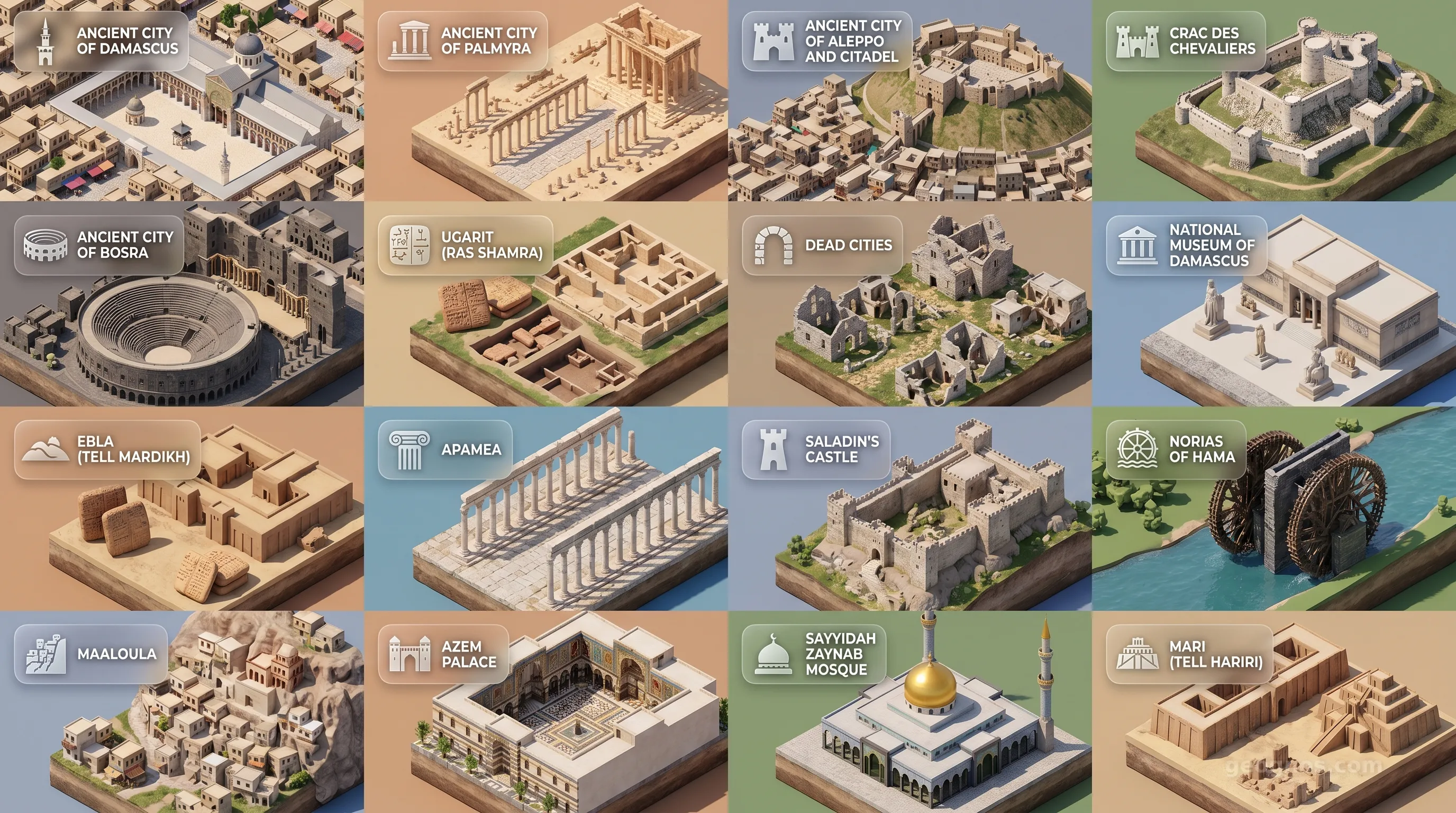
Top Sights & Landmarks
The Oldest Continuously Inhabited City
Damascus is often considered the oldest continuously inhabited city in the world, serving as a living museum of Middle Eastern history. The Old City is enclosed by Roman-era walls and features the breathtaking Umayyad Mosque—one of the largest and oldest mosques in the world, built on the site of a former Jupiter temple and Christian basilica. Students of history and architecture will be captivated by the layering of Aramean, Roman, Byzantine, and Islamic influences. The bustling Al-Hamidiyah Souq offers a sensory overload of spices, textiles, and traditional crafts. The best time to visit is during spring (March to May) or autumn (September to November) when the weather is mild. Tip: Modest dress is strictly required for entering religious sites, and taking a guided walking tour is highly recommended to uncover the hidden courtyards of traditional Damascene homes.
The Bride of the Desert
Emerging like a mirage from the Syrian Desert, Palmyra was one of the most important cultural centers of the ancient world. Standing at the crossroads of several civilizations, its monumental ruins reveal a unique blend of Greco-Roman techniques with local traditions and Persian influences. Once ruled by the legendary Queen Zenobia, who famously defied the Roman Empire, the site includes the iconic Temple of Bel, the Great Colonnade, and hauntingly beautiful tower tombs. Despite damage sustained during recent conflicts, ongoing restoration makes it a profound site of study for heritage conservation and classical archaeology. Spring is the optimal season to visit to avoid the harsh desert heat. Tourists should travel with an authorized guide and check current travel advisories regarding access to the desert regions.
Crossroads of the Silk Road
Aleppo's history spans over five millennia, making it a critical hub for global trade along the ancient Silk Road. At its heart lies the monumental Citadel of Aleppo, an architectural masterpiece of medieval military engineering that dominates the city's skyline from its imposing natural mound. The Old City is characterized by its sprawling historic souqs, khans (caravanserais), and the Great Umayyad Mosque of Aleppo. For students of urban planning and medieval Islamic history, Aleppo provides an unparalleled case study in historic resilience and post-conflict reconstruction. The ideal time to visit is October or April. While exploring, take time to engage with the resilient locals who are diligently restoring their beloved city, and support the local economy by purchasing authentic Aleppian laurel soap.
The Ultimate Crusader Fortress
Described by T.E. Lawrence (Lawrence of Arabia) as 'perhaps the best preserved and most wholly admirable castle in the world,' Crac des Chevaliers is the quintessential medieval fortress. Built by the Hospitaller Order of Saint John of Jerusalem between 1142 and 1271, it showcases the pinnacle of Crusader military architecture. The castle's concentric design, massive sloping glacis, and elegant Gothic loggia make it an essential destination for anyone studying military history or medieval architecture. Perched on a 650-meter-high hill, it offers sweeping views of the surrounding Orontes valley. Spring visits are highly recommended as the surrounding hills burst into vibrant greenery. Tip: Wear sturdy walking shoes to navigate the uneven stone stairs and explore the intricate network of underground vaulted halls.
Roman Marvel of Black Basalt
Located in southern Syria, Bosra was once the capital of the Roman province of Arabia and an important stopover on the ancient caravan route to Mecca. The city's crown jewel is its magnificent 2nd-century Roman theatre, constructed entirely of local black basalt. Strikingly, the theatre was later fortified by the Ayyubids, which inadvertently protected it, resulting in one of the largest and most intact Roman theatres in the world today. The site also holds early Christian ruins and some of the oldest surviving mosques, illustrating a seamless architectural transition between pagan, Christian, and Islamic eras. The weather is best in spring and autumn. Visitors should take time to wander the ancient basalt street grids, which offer incredible acoustic experiences and a profound sense of antiquity.
Birthplace of the First Alphabet
The ancient port city of Ugarit, located just north of Latakia, holds a paramount place in the history of human communication. It was here that archaeologists discovered clay tablets inscribed with the world's first widely recognized alphabetic script, dating back to the 14th century BC. This Ugaritic alphabet drastically simplified writing and laid the groundwork for the Phoenician, Greek, and ultimately, Latin alphabets. Students of linguistics, anthropology, and ancient Near Eastern history will find this site incredibly significant. Though the ruins (including the royal palace and temples to Baal and Dagon) are largely foundational, their historical weight is immense. Coastal breezes make it a pleasant visit during late spring or early summer. Be sure to visit the National Museum in Damascus or Latakia Museum to see the actual Ugaritic tablets.
Frozen Byzantine Landscapes
The 'Dead Cities' form a remarkable group of over 700 abandoned settlements situated in the limestone massifs of northwest Syria. Dating from the 1st to the 7th centuries AD, these beautifully preserved ruins offer a hauntingly vivid picture of rural life in late Antiquity and the Byzantine period. Notable sites include Serjilla, famous for its Roman baths and olive presses, and the Church of Saint Simeon Stylites, where the famous ascetic monk lived atop a pillar for 37 years. These villages highlight the transition from the pagan Roman world to Byzantine Christianity. The dramatic, rocky landscapes are best photographed during the 'golden hour' at sunrise or sunset. Note that this region requires careful planning to visit; always travel with a vetted local guide familiar with the current regional security situation.
The Guardian of Syrian Antiquities
The National Museum of Damascus is the premier institution for understanding the staggering depth of Syria's historical timeline. From prehistoric artifacts to stunning Islamic art, the museum houses treasures rescued from across the country. Key highlights include the stunningly reconstructed frescoes of the Dura-Europos Synagogue, the underground tomb of Yarhai from Palmyra, and the original alphabet tablets from Ugarit. For researchers and students, this museum serves as the definitive starting point before heading out to the physical archaeological sites. Visiting is ideal year-round, offering an excellent, air-conditioned refuge during hot summer afternoons. Tip: Set aside at least three hours for a thorough visit, and hire a specialized museum guide to fully grasp the context of the rarer Mesopotamian and Levantine artifacts.
The Lost Bronze Age Kingdom
Ebla was one of the most powerful kingdoms in the ancient Levant, thriving in the 3rd millennium BC. The site gained global fame in 1975 when Italian archaeologists unearthed the royal archives, containing over 15,000 cuneiform clay tablets. These tablets revolutionized the understanding of the ancient Near East, detailing the politics, economy, and religion of a civilization that rivaled Egypt and Mesopotamia. While much of the site consists of excavated earth mounds (tells) and foundations, standing where history was rewritten is a powerful experience for archaeology and history enthusiasts. Spring offers mild temperatures for exploring the vast site. Visitors should mentally prepare for a heavily ruined landscape; reading about the Ebla tablets prior to arrival significantly enhances the experience.
The Grand Colonnade of the Orontes
Founded by the Seleucid kings and later expanded by the Romans, Apamea was a bustling metropolis and a strategic military base housing thousands of war elephants. Its most famous feature is the Great Colonnade, one of the longest and most spectacular Roman avenues in the world, stretching nearly 2 kilometers. The twisting (spiraled) columns found along this cardo maximus are an architectural rarity that fascinate structural historians and photographers alike. Though it has suffered from illegal excavations during the war, the sheer scale of the remaining colonnade remains a testament to ancient Roman imperial power. Best visited in the late afternoon, the setting sun casts a golden glow over the massive stones. Combine a visit here with nearby Hama or Serjilla.
The Impregnable Mountain Fortress
Nestled in dense forests on a high ridge flanked by deep ravines, Saladin's Castle is an architectural marvel of medieval military strategy. Originally a Byzantine stronghold, it was expanded by Crusaders and eventually conquered by the legendary Sultan Saladin in 1188. Its most jaw-dropping feature is a massive 28-meter-deep moat carved entirely by hand out of solid rock, leaving an iconic rock needle that once supported a drawbridge. The castle’s isolation and rugged beauty make it an exceptional site for studying siege warfare and medieval engineering. Autumn and spring are perfect for hiking the steep approaches. Wear comfortable hiking boots, and be prepared for a physically demanding but incredibly rewarding exploration of the citadel's secret passages and ruined chapels.
The Groaning Wheels of the Orontes
The Norias of Hama are gigantic, wooden water wheels located along the Orontes River in the central Syrian city of Hama. Dating back to the Byzantine era (and potentially earlier), these incredible feats of traditional hydraulic engineering were designed to lift water from the river into aqueducts to irrigate nearby agricultural lands. Although no longer used for farming, several of the 17 remaining wheels still turn, emitting a distinct, mournful groaning sound caused by wooden friction. They provide an excellent study in pre-industrial sustainable engineering and water management. Visiting in the spring and early summer is ideal, as the river flow is robust, making the wheels turn steadily. Enjoy a traditional Syrian coffee at one of the riverside cafes while listening to their historic song.
The Village Where Aramaic Lives
Clinging dramatically to a rugged mountainside, the village of Maaloula is a living cultural treasure. It is one of the last places on Earth where Western Neo-Aramaic—the language spoken by Jesus Christ—is still used as a daily vernacular. The town is famous for two ancient Christian monasteries: Mar Sarkis (Saint Sergius), built in the 4th century atop a pagan temple, and the Convent of Saint Thecla (Mar Taqla), which houses the shrine of Saint Thecla and features a miraculous narrow canyon that supposedly split open to save her. Anthropologists, linguists, and theology students will find Maaloula an unparalleled site of study. The September festival of the Holy Cross is a spectacular time to visit, as the mountain is illuminated by hundreds of bonfires.
Masterpiece of Damascene Architecture
Located south of the Umayyad Mosque in Damascus, the Azem Palace was built in the 18th century as the opulent residence of the Ottoman governor of Damascus, As'ad Pasha al-Azm. It is the ultimate expression of traditional Damascene domestic architecture, featuring alternating bands of black basalt and white limestone (ablaq), tranquil courtyards shaded by citrus trees, and intricately carved wooden ceilings. Today, it serves as the Museum of Arts and Popular Traditions, offering vibrant dioramas of historic Syrian life. It provides architectural students with a perfect layout of the 'Haramlek' (family quarters) and 'Salamlek' (guest quarters). The palace is a serene escape from the bustling souqs; spring is wonderful when the jasmine blossoms are in full bloom.
A Masterpiece of Islamic Glazed Tilework
Located in the southern suburbs of Damascus, the Sayyidah Zaynab Mosque is one of the most important Shia pilgrimage sites in the world. It contains the tomb of Zaynab, the granddaughter of the Prophet Muhammad. Beyond its deep religious significance, the shrine is an absolute marvel of Persian-influenced Islamic architecture. The complex features a massive golden dome, soaring minarets, and courtyards completely covered in dazzling blue majolica tiles and intricate mirror-work that reflects light into a thousand dazzling shards. For students of Islamic art and theology, it is a profoundly moving site. It can be visited year-round, but be aware of the somber and crowded atmosphere during the holy month of Muharram. Strict conservative dress is required; women must wear a full chador (often provided at the entrance).
The Flourishing Sumerian City of the Euphrates
Located near the Iraqi border on the western bank of the Euphrates, Mari was a flourishing Bronze Age metropolis that connected the Levant, Mesopotamia, and Anatolia. Discovered in the 1930s, the site yielded the monumental Palace of Zimri-Lim, containing over 300 rooms, and an archive of 25,000 cuneiform tablets that shed light on statecraft, diplomacy, and society in the 2nd millennium BC. It is an indispensable site for studying the geopolitical landscape of the ancient Near East and the development of early urban planning. Due to its remote desert location, temperatures soar in the summer, making late autumn or winter the best time for expeditions. Note: Access to Mari relies heavily on the current security situation in the Deir ez-Zor governorate; always consult local authorities.