Zambia
Top Sights & Landmarks
Zambia's Oldest and Largest Museum
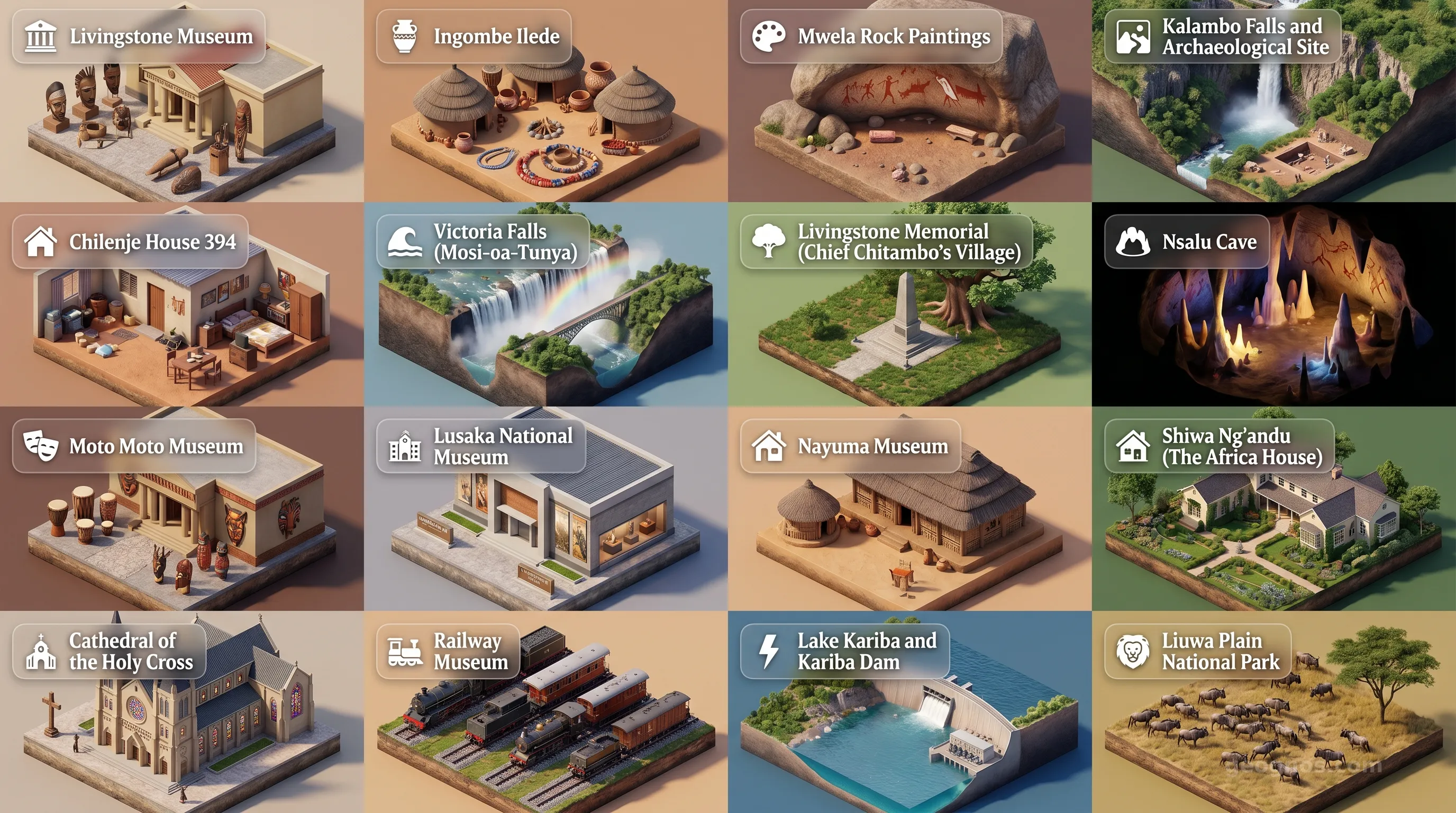
As the oldest and largest museum in Zambia, the Livingstone Museum is essential for students of African history, anthropology, and archaeology. It houses a vast collection exploring over 250,000 years of cultural and natural history, alongside an unparalleled archive of Dr. David Livingstone's letters and personal memorabilia. Studying its exhibits provides profound context on pre-colonial life and the complex impacts of European exploration. The museum is a perfect year-round destination. Tourist tip: Allocate at least three hours to fully appreciate the extensive archaeological, ethnographic, and historical galleries.
Ancient Trade Hub of the Zambezi
Translating to 'The Sleeping Cow' due to the shape of a local baobab tree, Ingombe Ilede is a pivotal archaeological site for understanding pre-colonial African trade. Flourishing between the 7th and 16th centuries, excavations here unearthed gold, copper, and evidence of globalized trade involving glass beads and cloth from the Indian Ocean coast. It is a fascinating study site for archaeologists and historians analyzing early commercial networks. Best visited during the dry season (May to October). Tourist tip: The site is quite remote in the Siavonga district, so hire a local guide and a 4x4 vehicle to navigate the rugged terrain safely.
Extensive Stone Age Rock Art
Located near Kasama, the Mwela Rock Paintings feature over 700 rock art sites created by Late Stone Age hunter-gatherers. This area offers one of the highest concentrations of rock art in Central Africa, providing invaluable insights into prehistoric symbolic behavior, spiritual beliefs, and daily life. It is highly recommended for anthropology and history students. The dry season (May to October) is the best time to explore the rocky outcrops. Tourist tip: Wear sturdy hiking shoes, as exploring the caves and boulders requires some scrambling, and hire an onsite guide to help spot the faded red and white pigments.
Ancient Habitation and Towering Falls
Kalambo Falls is Africa's second-highest uninterrupted waterfall, plunging 221 meters, but its true significance lies in the adjacent archaeological site. Excavations have revealed over 300,000 years of continuous human tool usage, showcasing one of the longest continuous records of human occupation in Sub-Saharan Africa. It is a goldmine for paleoanthropology students. The best season to visit is just after the rains (April to June) when the falls are spectacular. Tourist tip: Accessing the site requires a rugged 4x4 drive from Mbala; pack a picnic to enjoy at the breathtaking clifftop viewpoints.
Birthplace of Zambian Independence
This modest house in Lusaka is where Dr. Kenneth Kaunda, Zambia's first president, lived and directed the struggle for independence from British rule during the late 1950s and early 1960s. Now a museum, it offers a deeply personal look into the political history of Southern Africa and the anti-colonial movement. It is an inspiring study site for students of political science and history. It can be visited year-round. Tourist tip: Combine this with a visit to the nearby Lusaka National Museum for a comprehensive understanding of Zambia's journey to sovereignty.
The Smoke That Thunders
Victoria Falls is an iconic symbol of Zambia, carrying profound cultural significance for the local Toka-Leya people and major historical weight regarding European exploration (famously 'discovered' and renamed by David Livingstone in 1855). As the world's largest sheet of falling water, it is an unparalleled geographical study. Peak flow occurs from February to May. Tourist tip: For a thrilling historical and natural experience, visit in October during the dry season to swim in the Devil's Pool right on the edge of the falls.
Resting Place of Livingstone's Heart
Deep in the Bangweulu Swamps region marks the spot where Scottish explorer David Livingstone died in 1873. While his body was embalmed and sent back to Westminster Abbey, his heart was buried here under an Mpundu tree by his loyal attendants, Chuma and Susi. This monument stands as a poignant symbol of the complex colonial-era exploration of Africa. The site is best visited in the dry season due to road conditions. Tourist tip: The journey is a pilgrimage for history buffs; ensure you have offline maps and a sturdy 4x4, as the location is far off the standard tourist trail.
Ancient Geometric Rock Art
Located in the Serenje district, Nsalu Cave contains abstract, schematic, and geometric rock art dating back over 12,000 years. Unlike the naturalistic animal and human figures found in typical San rock art, Nsalu's abstract patterns are believed to be the work of early Pygmy hunter-gatherers, offering unique insights into ancient spiritual and abstract concepts. It's a critical site for prehistoric art students. The dry season (May to November) is optimal. Tourist tip: The site is managed by a local caretaker who will unlock the protective gate; a small tip is customary and appreciated.
Cultural Hub of the Bemba People
Situated in Mbala, the Moto Moto Museum is named after French Catholic Bishop Joseph Dupont, nicknamed 'Moto Moto' (Fire Fire). It houses a spectacular collection of artifacts related to the Bemba and Mambwe tribes, including initiation ceremony relics, anti-slavery movement artifacts, and traditional crafts. It is one of the best ethnographic study centers in the country. Open year-round, it is an excellent indoor activity. Tourist tip: Take time to speak with the curators; their unwritten knowledge of local folklore and initiation rites vastly enhances the exhibits.
Zambia's National History and Art
Located in the heart of the capital, this museum is divided into two sections: an art gallery showcasing contemporary Zambian painting and sculpture, and historical galleries focusing on ethnography, urban culture, and the country's path to independence. It serves as an excellent starting point for students and tourists seeking to understand modern Zambia's socio-political fabric. Visit any time of the year. Tourist tip: Don't miss the witchcraft and traditional medicine exhibit on the upper floor, which offers fascinating anthropological insights.
Preserving the Lozi Heritage
Located in Mongu, the Nayuma Museum is dedicated to preserving and promoting the rich cultural heritage of the Lozi people of Barotseland. It provides crucial background on the traditional leadership structure, crafts, and the world-famous Kuomboka ceremony, where the Litunga (King) moves from the floodplains to higher ground. Essential for cultural anthropology enthusiasts. Best visited just before or during the Kuomboka (typically April). Tourist tip: Check locally for the museum's opening hours, which can sometimes be irregular, and browse the traditional Lozi crafts available for purchase.
A Slice of England in the African Bush
Shiwa Ng'andu is a sprawling English-style manor built in the 1920s by eccentric British aristocrat Sir Stewart Gore-Browne. The estate represents a fascinating and controversial chapter of colonial-era settlement and architecture, functioning as a fully operational farm and historical estate. It offers a gripping case study of colonial ambitions, local integration, and agricultural history. Open during the dry season. Tourist tip: Read 'The Africa House' by Christina Lamb before visiting to fully grasp the dramatic and complex history of Gore-Browne and his legacy.
Icon of Modernist Unity
Overlooking Lusaka, the Cathedral of the Holy Cross was completed in 1962 just before Zambia's independence. Its elegant, sweeping modernist architecture and magnificent stained-glass windows stand as an iconic symbol of national faith and post-colonial unity. The building often hosts important state funerals and national events, making it a key historical and architectural landmark. Accessible year-round. Tourist tip: Visit on a Sunday morning to hear the incredible local choir, which adds a deeply moving, acoustic dimension to the architectural experience.
Industrial History of Livingstone
Located in Livingstone, the Railway Museum details the impact of the Zambezi Sawmills Railway, once reputed to be the longest privately owned railway in the world. It provides a unique lens into the industrialization of the region, the early 20th-century colonial economy, and the history of Jewish pioneers who settled in Livingstone. A great study for engineering and economic history. Best visited year-round. Tourist tip: Climb aboard the vintage steam locomotives and explore the historical carriages for excellent photo opportunities.
World's Largest Man-Made Reservoir
Constructed in the 1950s, the Kariba Dam is a marvel of mid-century engineering, creating the world's largest human-made reservoir by volume. Its creation displaced thousands of the indigenous Tonga people, giving rise to local legends of the angry river god, Nyami Nyami. The lake offers crucial lessons in engineering, ecology, and socio-economic history. The dry season is ideal for viewing the dam wall. Tourist tip: Take a sunset boat cruise on the lake to witness its massive scale, and purchase a carved walking stick of Nyami Nyami from local artisans.
Historic Conservation and Vast Plains
Liuwa Plain has one of the oldest conservation histories in Africa; King Lewanika of Barotseland decreed it a protected hunting ground for his people in the 1880s. Today, it hosts the continent's second-largest wildebeest migration. The park offers profound insights into early African conservation models and features spectacular, dramatic stormy landscapes. Best visited in November and December during the migration. Tourist tip: Access is incredibly challenging due to seasonal flooding; it is highly advised to book with a specialized safari operator for fly-in or 4x4 access.