Zimbabwe
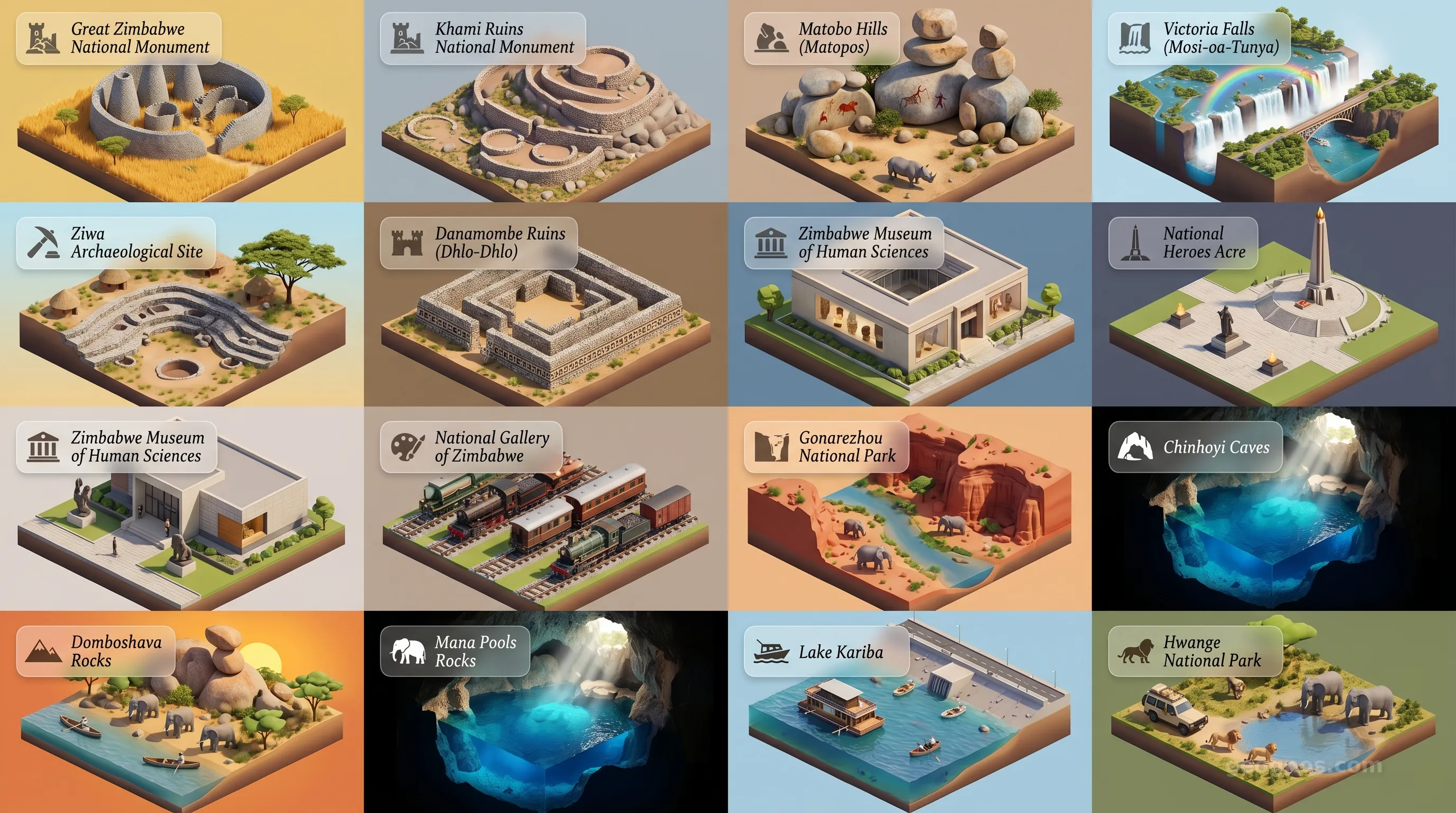
Top Sights & Landmarks
Ancient Capital of the Shona Ancestors
Great Zimbabwe is arguably the most significant historical site in sub-Saharan Africa and the namesake of the modern nation. Constructed between the 11th and 15th centuries by the ancestral Shona people, it features mortarless stone architecture, notably the Great Enclosure with its towering walls. For students of history and archaeology, it represents the heart of a vast trading empire that linked the African interior with the Indian Ocean. The site is a profound testament to indigenous African civilization. The best season to visit is the cooler, dry period from May to August. Tourist Tip: Hire an official site guide at the entrance to fully appreciate the complex history of the Hill Complex, the Great Enclosure, and the Valley Ruins.
Capital of the Torwa Dynasty
Following the decline of Great Zimbabwe, Khami became the capital of the powerful Torwa dynasty between the mid-15th and 17th centuries. Unlike Great Zimbabwe's freestanding walls, Khami is characterized by highly decorated retaining walls built into a terraced hill. It holds immense educational value regarding the evolution of Zimbabwean dry-stone architectural styles and the socio-political shifts in pre-colonial Southern Africa. The presence of European and Chinese trade goods found here illustrates extensive historical global trade networks. Best visited during the dry winter months (May to September). Tourist Tip: Khami is located just 22 kilometers from Bulawayo, making it an excellent half-day trip; bring water and comfortable walking shoes.
Sacred Granite Domes and Ancient Rock Art
The Matobo Hills feature a mesmerizing landscape of granite kopjes and balancing rocks, formed over 2 billion years ago. Beyond its geological intrigue, it boasts one of the highest concentrations of rock art in Southern Africa, painted by San hunter-gatherers over millennia. Historically, it is a spiritual heartland for the Ndebele and Shona people, and the site of controversial colonial figure Cecil John Rhodes' grave (World's View). For students, it provides a vivid intersection of ecology, ancient anthropology, and complex colonial history. Visit between April and October for prime wildlife viewing (including rhinos). Tourist Tip: Book a specialized rhino-tracking walking safari to safely observe endangered white and black rhinos in their natural habitat.
The Smoke That Thunders
Victoria Falls is one of the Seven Natural Wonders of the World and the largest sheet of falling water globally. Culturally known as 'Mosi-oa-Tunya' (The Smoke That Thunders) by the Kololo tribe, the falls have profound historical significance, representing a historic geographical barrier and later a pivotal focal point for European exploration via David Livingstone. Students of geology and hydrology will marvel at the basalt gorge formations shaped over 100,000 years. The highest water volume is from February to May. Tourist Tip: Prepare to get soaked during peak flow—rent a raincoat at the entrance, and protect your camera gear with waterproof bags.
Ancient Agricultural Terraces of Nyanga
Situated in the Eastern Highlands, Ziwa offers a fascinating look into Zimbabwe's late Iron Age. The site features extensive stone-walled agricultural terraces, pathways, pit structures, and iron-smelting furnaces dating back to the 15th century. It is an outstanding open-air laboratory for studying ancient agricultural engineering, soil conservation, and early settlement patterns of indigenous societies adapting to mountainous terrains. The lush, cooler climate makes it visitable year-round, though the dry season (August to October) ensures better road access. Tourist Tip: The site is expansive; a guided tour from the local museum will help contextualize the layout of the pit structures and their historical use.
Fortress of the Rozvi Empire
Formerly known as Dhlo-Dhlo, Danamombe was a paramount regional center for the Rozvi Empire in the 17th and 18th centuries. Known for its sophisticated dry-stone masonry incorporating striking chevron, checkerboard, and herringbone patterns, the site demonstrates the pinnacle of late Zimbabwean architectural tradition. It is vital for students studying the resistance against early Portuguese incursions and the socio-economic organization of the Rozvi state before its collapse in the 1830s. Best visited in the cooler months from May to August. Tourist Tip: Danamombe is off the beaten path near Gweru; a 4x4 vehicle is recommended to navigate the rural access roads.
Custodian of the Ngoma Lungundu
Located in Harare, this museum is a treasure trove of anthropological and archaeological history. Its most famous artifact is the Ngoma Lungundu, a 700-year-old wooden drum believed by the Lemba people to be the biblical Ark of the Covenant, representing a fascinating link between African and Middle Eastern histories. For researchers and cultural students, the museum offers comprehensive exhibits on traditional crafts, indigenous spiritual practices, and human evolution in Southern Africa. Open year-round. Tourist Tip: Allocate at least two hours to thoroughly explore the ethnographic galleries, and check with the reception for any temporary exhibits on contemporary Zimbabwean culture.
Monument to the Liberation Struggle
Perched on a ridge outside Harare, the National Heroes Acre is a somber, striking monument and burial ground honoring the guerrilla fighters and political leaders of the Rhodesian Bush War (Second Chimurenga). Its architecture, featuring a massive bronze mural, an eternal flame, and two giant AK-47 assault rifle sculptures, was built with North Korean assistance, highlighting Cold War-era geopolitical ties. It provides an essential perspective on Zimbabwe's modern political history, nationalism, and state-building. Accessible year-round. Tourist Tip: A deep understanding of Zimbabwe's colonial and post-colonial history enhances the experience here; consider reading up on the 1970s liberation war before your visit.
The Heart of Contemporary Zimbabwean Art
Since its establishment in 1957 in Harare, the National Gallery has been pivotal in the global promotion of Shona stone sculpture—one of Africa's most acclaimed modern art movements. It houses a permanent collection of traditional and contemporary African art, alongside dynamic temporary exhibitions that tackle current socio-political themes. Art students and cultural tourists will find immense value in exploring how Zimbabwean artists synthesize ancestral beliefs with modern aesthetics. Best visited year-round. Tourist Tip: Visit the gallery's outdoor sculpture garden and the on-site craft market where you can purchase authentic, ethically sourced art directly from emerging artists.
A Journey Through the Age of Steam
This museum preserves the extensive history of the railway network that catalyzed the colonial expansion and industrialization of Southern Africa. Its remarkable collection includes vintage steam locomotives dating back to 1897 and the luxurious personal railway carriage of Cecil John Rhodes. It offers a tangible study of colonial logistics, engineering, and the economic shifts of the early 20th century. Ideal for a visit at any time of the year. Tourist Tip: You are allowed to climb into many of the locomotive cabs and passenger carriages; it is an incredibly tactile and photogenic experience, perfect for families and history enthusiasts.
Untamed Wilderness on the Lower Zambezi
Mana Pools is synonymous with raw, untouched wilderness. The park features a series of ox-bow lakes ('Mana' means 'four' in Shona) formed by the meandering Zambezi River. Historically and ecologically, it is vital as one of the last remaining frontiers where natural wildlife migration continues unhindered. For zoology and ecology students, the behavior of elephants here—standing on their hind legs to reach acacia pods—is an incredible study of adaptation. The prime time to visit is during the late dry season (August to October) when wildlife congregates around the shrinking pools. Tourist Tip: Mana Pools is famous for unguided walking safaris, but for safety and the best educational experience, always hire an experienced armed professional guide.
The Mystical Sleeping Pool
The Chinhoyi Caves are a spectacular network of limestone and dolomite caves containing the 'Sleeping Pool', known for its surreal, crystal-clear cobalt blue water. Historically, these caves served as a refuge for the Shona people resisting Ndebele raiders in the 19th century. Today, they are a premier site for technical scuba divers who plunge into depths exceeding 100 meters, and a site of geological interest due to its subterranean karst topography. The temperature inside the cave is stable year-round. Tourist Tip: Even if you are not diving, the descent into the main cavern offers breathtaking photography opportunities; try visiting around midday when the sun shines directly into the pool.
Granite Monoliths and Ancient Art
Located just outside Harare, Domboshava is a massive granite batholith characterized by its stunning red and yellow lichen-covered slopes. The site is highly significant for its accessible San rock art caves, depicting ancient hunting scenes and spiritual ceremonies. It is a brilliant micro-study site for geology students examining exfoliation weathering and botany students studying unique flora that survive on bare rock. Best visited year-round, particularly in the late afternoon. Tourist Tip: The hike to the summit is short but steep; time your ascent for late afternoon—the panoramic 360-degree sunset views from the top are spectacular.
The Kingdom of the Elephant
As Zimbabwe's largest national park, Hwange is historically rooted as the 19th-century royal hunting grounds of the Ndebele warrior-king Mzilikazi. Today, it is globally renowned for its massive elephant population and the presence of the endangered African painted dog. It is an open textbook for environmental science students studying the effects of artificial waterholes on wildlife conservation and habitat management. The best wildlife viewing occurs from July to October when animals gather around pumped waterholes. Tourist Tip: Spend an afternoon at the Nyamandhlovu Pan viewing platform; you can watch continuous streams of elephants and other wildlife coming to drink in relative safety.
The Ocean of Zimbabwe
Created by the damming of the Zambezi River in the late 1950s, Lake Kariba is the world's largest man-made reservoir by volume. The historical creation of the lake displaced the indigenous Tonga people and necessitated 'Operation Noah', a massive wildlife rescue effort. Today, the lake's haunting landscape of drowned, petrified trees provides a unique study in ecological transformation and hydro-engineering. It is an exceptional tourist destination for tiger fishing and houseboat safaris. Best visited from April to August when temperatures are milder. Tourist Tip: Charter a houseboat for two to three days; navigating the lake by water allows for unparalleled sunset views and up-close sightings of crocodiles and hippos.
The Place of Elephants and Red Cliffs
Gonarezhou is Zimbabwe’s second-largest park and part of the Great Limpopo Transfrontier Park. Its crowning geological marvel is the Chilojo Cliffs, towering 170 meters of spectacular red sandstone carved by the Runde River. Historically marginalized due to border conflicts, it remains one of the most pristine and undisturbed wildernesses in Africa, ideal for advanced students of conservation biology and transboundary ecology. The best time to visit is during the dry season (June to October) when river crossings are manageable. Tourist Tip: A rugged 4x4 vehicle is absolutely mandatory as the park has minimal infrastructure, offering a truly wild and off-the-grid safari experience.