Angola
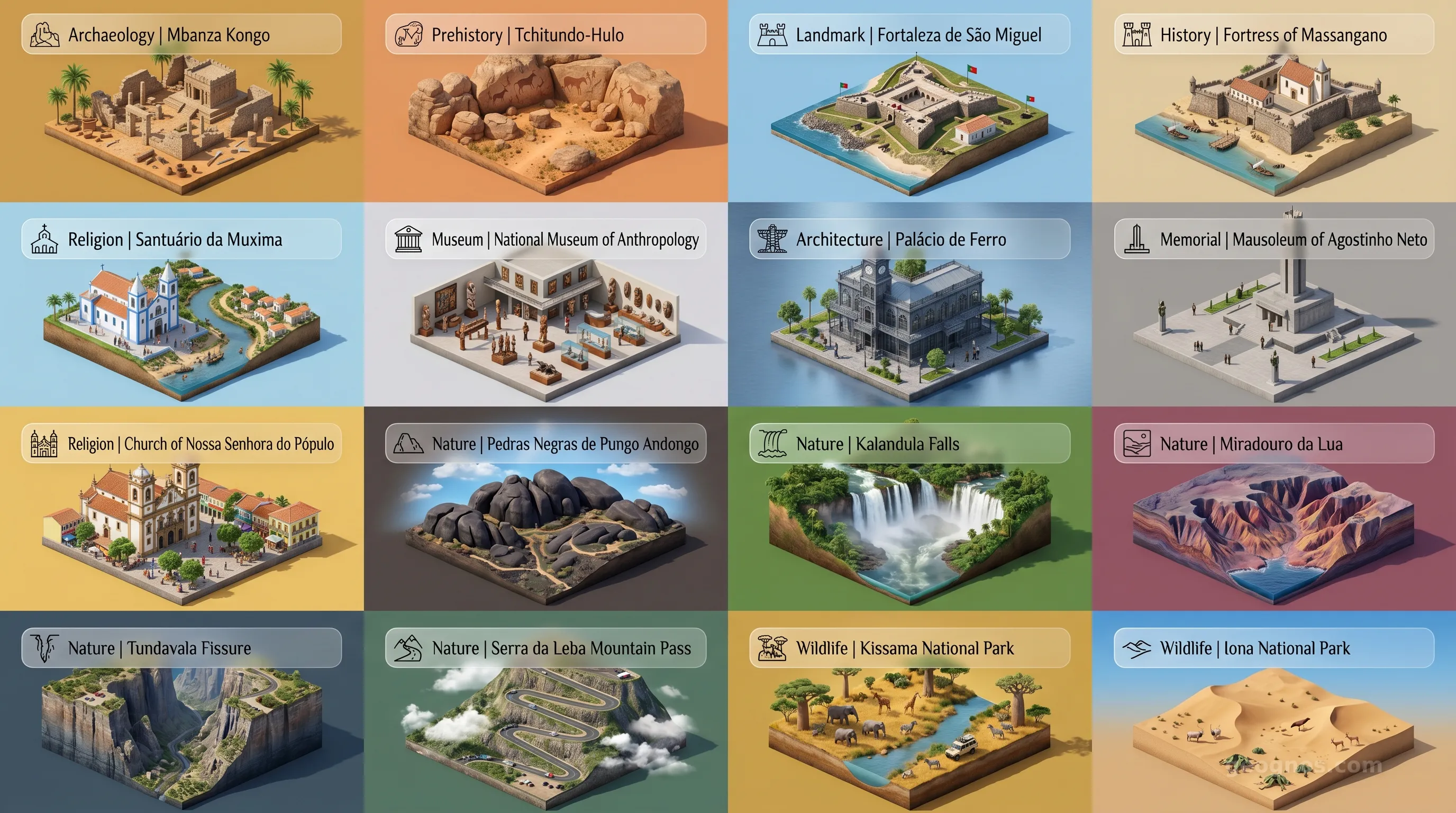
Top Sights & Landmarks
Vestiges of the Capital of the former Kingdom of Kongo
Historically profound, Mbanza Kongo served as the political and spiritual capital of the Kingdom of Kongo, one of the largest pre-colonial African states from the 14th to 19th centuries. Essential for students of African history, it displays a fascinating intersection of indigenous traditions and the arrival of Christianity via Portuguese explorers. Must-sees include the ruins of the 16th-century Cathedral of the Holy Savior of Congo (Kulumbimbi), built in 1549, and the royal cemetery. The best time to visit is during the dry season (May to September) when navigating the northern province of Zaire is easiest.
Ancient Prehistoric Rock Art Complex
A vital site for students of paleoanthropology and history, Tchitundo-Hulo boasts an impressive collection of rock paintings and engravings that are estimated to be over 20,000 years old. Located in the arid Namibe desert, the petroglyphs cover a vast granite hill, depicting intricate cosmological and geometric designs created by indigenous Khoisan populations long before Bantu migrations. Reaching the site requires a sturdy 4x4 vehicle and a local guide. The dry and cooler months of June through August are the most comfortable times to explore this remote, open-air gallery.
Angola's Oldest Surviving Portuguese Fortress
Built in 1576 by Paulo Dias de Novais, this imposing star-shaped fortress is the oldest surviving architectural structure in Luanda and historically served as an administrative center, a major slave trade depot, and a military garrison. Today, it houses the National Museum of Military History, making it an indispensable educational stop to understand Angola's colonial past and its long struggle for independence. The fort's ramparts offer tourists unparalleled panoramic views of Luanda Bay. Visit in the late afternoon for a spectacular sunset over the Atlantic.
Ruins of the Colonial Inland Advance
Located on the banks of the Kwanza River, the Fortress of Massangano was constructed in 1583 to secure Portugal's inland expansion against the powerful Ndongo Kingdom. This site was central to the famous Battle of Massangano, an important event in early resistance against colonial occupation. The ruins, including stone walls and old colonial buildings, offer a hauntingly beautiful backdrop for history enthusiasts. It's an excellent day trip from Luanda; hiring a local guide is highly recommended to fully contextualize the ruins and the nearby 16th-century church.
Angola's Most Revered Spiritual Center
The Church of Nossa Senhora da Conceição da Muxima, established in 1599 along the Kwanza River, is the spiritual heart of Angola. It serves as a stark reminder of colonial-era missionary work intertwined with the local slave trade. Today, it is arguably the most visited pilgrimage destination in sub-Saharan Africa. The annual pilgrimage in late August or early September draws over a million worshippers, offering tourists a chance to witness an incredible display of faith, culture, and community. Outside festival times, the village remains a serene and deeply historic place to study religious syncretism.
Repository of Indigenous Angolan Culture
Situated in Luanda, this museum is paramount for anyone seeking to understand the rich, diverse ethnolinguistic tapestry of Angola. Founded in 1976 shortly after independence, it holds over 6,000 traditional artifacts, including tribal masks, musical instruments, weaponry, and jewelry from the Khoisan, Bakongo, Mbundu, and Lunda-Chokwe peoples. It is a fantastic educational resource. Tourist tip: Request an English-speaking guide at the front desk for an enriched, narrated experience, as many exhibit labels are primarily in Portuguese.
Luanda's Yellow Eiffel Masterpiece
The Palácio de Ferro is a strikingly beautiful, bright yellow metallic structure in the heart of Luanda. Widely believed to have been designed by Gustave Eiffel, the building was supposedly destined for Madagascar but ended up in Angola due to a shipwreck in the late 19th century. Having survived the civil war, it has been meticulously restored and now serves as an active cultural center hosting art exhibitions and musical performances. Check local listings for evening jazz events; it's a great spot to mingle with Luanda's artistic community.
Monument to the Founding Father
Dominating Luanda's skyline, this towering, Soviet-inspired obelisk is the final resting place of Dr. António Agostinho Neto, Angola's first president and a revered poet. The architecture is a bold statement of post-colonial nation-building, designed to resemble a spaceship or a towering spear. Visitors and students of modern African history can explore the massive interior complex, which includes a museum, exhibition halls, and photographic archives detailing the struggle for independence. Best visited during the morning to avoid the midday heat on its vast, unshaded plaza.
Benguela's Baroque Colonial Gem
Constructed in 1748, this beautiful Baroque church in the coastal city of Benguela is the first stone building erected in southern Angola. It bears witness to the transatlantic slave trade, as enslaved people were historically baptized here before being sent to the Americas. Studying this church provides deep insights into the intersection of faith and colonialism. Recently restored, its beautifully preserved facade and intricate interior woodwork are a photographer's delight. The city of Benguela itself is generally more relaxed than Luanda, making it a pleasant cultural detour.
The Enigmatic Black Rocks
A striking series of giant, dark monolithic rock formations rising abruptly from the African savanna. Beyond its dramatic geology, this site in Malanje Province is steeped in history. It was the capital of the formidable Queen Nzinga of Ndongo and Matamba, who famously resisted Portuguese colonization in the 17th century. Myth claims her footprints can still be seen embedded in the stone. A highly engaging destination for both nature lovers and history buffs. Bring ample water and sturdy shoes to hike up the formations for an endless view of the surrounding plains.
One of Africa's Largest Waterfalls
Plunging 105 meters over a 400-meter-wide horseshoe-shaped edge, Kalandula Falls is second only to Victoria Falls in sheer scale on the continent. Located on the Lucala River in Malanje Province, it is an awe-inspiring natural wonder. The best time to visit to witness the falls at maximum volume is just after the rainy season (April to May). For a closer, mist-filled experience, tourists can hire a local guide to navigate the steep, slippery path down to the plunge pool. It is an unforgettable ecological and geological study site.
The Viewpoint of the Moon
Located just 40km south of Luanda, the 'Viewpoint of the Moon' features spectacular karst topography and tricolor cliffs shaped over millennia by wind and rain erosion. The resulting sharp pinnacles and deep gullies look uncannily like a lunar landscape. This is a must-visit for geology enthusiasts and photographers alike. The site is highly accessible directly from the main highway heading to Cabo Ledo. The ultimate time to visit is during sunset when the dying light sets the red, ochre, and yellow soils ablaze with color.
The Great Escarpment Drop
The Fenda da Tundavala is a breathtaking geological fault near Lubango, where the Huíla plateau drops suddenly into the Namibe Desert basin, creating a near-vertical cliff face over 1,200 meters high. The sheer drop and expansive vistas make it one of Angola's most celebrated natural monuments. Culturally, the site is considered sacred by indigenous groups who believe the souls of their ancestors reside in the gorge. It is accessible via a paved road from Lubango. Early morning visits offer the clearest views before afternoon clouds roll in.
Angola's Most Famous Serpentine Road
A magnificent feat of engineering from the colonial era (built in the 1970s), this spiraling road connects the city of Lubango to the coastal town of Namibe. It features tight hairpin bends descending sharply through verdant mountains into the arid desert below. The viewpoint at the top provides an incredible perspective of the road's snake-like layout. Photographers often stay until dusk to capture stunning long-exposure shots of car headlights tracing the curves. It's a spectacular case study of human infrastructure integrating into wild topography.
The Resurgence of Angolan Wildlife
Just two hours south of Luanda, Kissama (or Quiçama) National Park is Angola's most accessible wildlife reserve. Devastated during the civil war, the park gained international fame through 'Operation Noah's Ark,' an ambitious relocation program bringing elephants and other species from South Africa to repopulate the area. Today, visitors can study successful conservation efforts while enjoying safaris that feature elephants, giraffes, zebras, and ostriches. The dry season (June to October) is ideal for spotting wildlife gathering around the Kwanza River.
Desert Wilderness and Endemic Flora
Angola's largest national park sits in the extreme southwest, blending into the Namib Desert. Iona offers starkly beautiful, harsh landscapes ranging from sand dunes to vast gravel plains. It is a vital area for biological research, home to the ancient, bizarre Welwitschia mirabilis plant, which can live for thousands of years. It also preserves the traditional lifestyle of the nomadic Himba and Mucubal tribes. Due to its extreme remoteness, travelers must be fully self-sufficient with 4x4 vehicles. The desolate beauty here is unmatched.