Burundi
Top Sights & Landmarks
Heartbeat of Burundian Culture
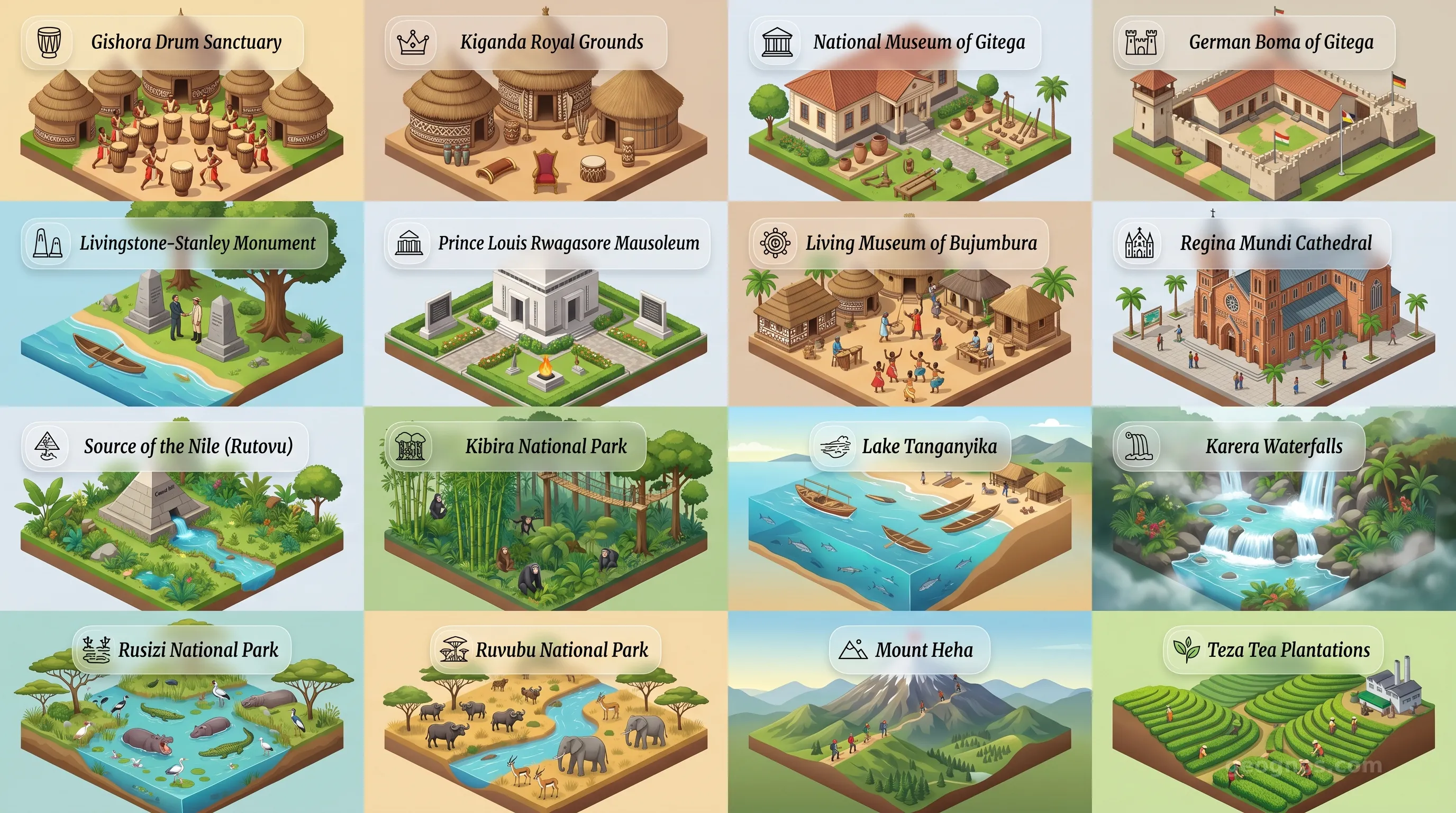
The Gishora Drum Sanctuary is arguably the most culturally significant site in Burundi. Historically, it was founded by King Mwezi Gisabo after a victory over rebellious chiefs, and it remains the primary center for preserving the sacred 'umuvugangoma' (drums that speak). The ritual dance of the royal drum is inscribed on the UNESCO Intangible Cultural Heritage list. For students and tourists, witnessing a live drum performance here provides profound insight into pre-colonial Burundian kingdom structures, where drums symbolized power, virility, and the ruler's connection to agricultural fertility. The best time to visit is during the dry season (June to August) to guarantee outdoor performances. Tip: Hire a local guide to explain the meaning behind the different drum rhythms and dancer formations.
Ancient Capital of Burundian Kings
Located in the Muramvya province, the Kiganda Royal Grounds hold immense historical weight as a traditional coronation site for the 'Mwami' (Kings) of Burundi. Crucially, it is also the site where the 1903 Treaty of Kiganda was signed, marking the moment King Mwezi Gisabo conceded to German colonial rule after years of fierce resistance. Studying this site offers a deep dive into the complex history of East African colonial partition and indigenous sovereignty. Though physical ruins are minimal, the sacred trees and ceremonial stones remain intact. Visitors should pair their trip with a knowledgeable historian to fully appreciate the profound oral histories attached to this landscape.
Custodian of Royal Artifacts
Established in 1955 in the country's current political capital, Gitega, this is the national repository of Burundian history and culture. The museum houses an exceptional collection of artifacts from the royal courts, including historic weaponry, traditional musical instruments, beadwork, and the sacred 'Karyenda' drum—a symbol so vital it was historically intertwined with the spiritual well-being of the nation. It is an indispensable stop for researchers and students studying the ethnographic evolution of the Great Lakes region. Visitors should note that while the exhibits are rich in heritage, the signage is predominantly in French and Kirundi, making a bilingual guide highly recommended.
Colonial Administrative Fortress
The 'Boma' in Gitega serves as a striking architectural remnant of German East Africa. Constructed in the early 20th century, this fortified administrative center was the seat of the German Resident in Urundi. Studying the Boma provides critical insights into the architecture of colonial dominance and the administrative mechanisms used by early European powers in the region. After World War I, it transitioned into Belgian hands. Today, its sturdy brick arches and historic facade stand as a complex monument to Burundi's colonized past. It is best visited in conjunction with the nearby National Museum.
Legendary Explorers' Marker
Situated in Mugere, near the shores of Lake Tanganyika, this massive stone monument marks a spot where the legendary explorers David Livingstone and Henry Morton Stanley allegedly camped in November 1871, shortly after their famous 'Dr. Livingstone, I presume?' meeting in Ujiji (Tanzania). For students of 19th-century European exploration of Africa, this site symbolizes the era's relentless geographical mapping and the opening of the Great Lakes to foreign influence. The site is highly photogenic, set against the backdrop of the lake. It is a brief but culturally fascinating detour when traveling just south of Bujumbura.
Monument to Burundian Independence
Perched on the Vugizo hill overlooking Bujumbura and Lake Tanganyika, this mausoleum is the final resting place of Prince Louis Rwagasore, the hero of Burundian independence. Rwagasore was assassinated in 1961, just before the country achieved sovereignty, making him a unifying nationalist figure akin to Patrice Lumumba in neighboring DRC. The modernist architectural design of the monument features sweeping white arches that dominate the skyline. It is a profound site for studying post-colonial African history and the tragic interruptions of emerging democracies. The panoramic views at sunset make it a highly rewarding visit for tourists.
Interactive Cultural Village
The Living Museum (Musée Vivant) in Bujumbura is a unique open-air institution that blends a traditional craft village, an ethnographic display, and a small zoological garden. It reconstructs a traditional Burundian royal 'rugo' (homestead), allowing visitors to physically step into the domestic architecture of the past. Artisans can be seen actively carving wood, weaving baskets, and crafting pottery, making it a living study of the nation's material culture. For tourists wanting to purchase authentic, high-quality souvenirs while directly supporting local artisans, this is the premier destination. Try to catch a scheduled cultural dance performance if visiting on the weekend.
Spiritual Hub of Bujumbura
As the largest church in Burundi, the Regina Mundi Cathedral is not only a recognizable architectural landmark but also a vital center for the country's predominantly Catholic population. Built in the mid-20th century, its expansive interior and modernist stained-glass windows reflect the deep integration of Christian institutions into Burundian civil life following Belgian colonial rule. Studying the cathedral's ongoing social influence helps one understand the intersections of religion, politics, and community resilience in Burundi. Visitors are welcome to attend Sunday mass, which is highly recommended for experiencing the incredible choral traditions of the local congregation.
The Southernmost Spring of the Nile
Deep in the Bururi province, a modest spring emerges from the earth that is geographically recognized as the southernmost source of the White Nile. Discovered by German explorer Burkhart Waldecker in 1937, the site is marked by a stone pyramid. For geographers and historians, this location signifies the end of a centuries-long global quest to find the origins of the world's longest river. While the spring itself is a quiet trickle, its global geographical significance is staggering. The drive to Rutovu offers stunning views of the countryside, but a 4x4 vehicle is strongly advised due to rough rural roads.
Sacred Forest of the Kings
Spanning the crest of the Congo-Nile divide, Kibira National Park is a majestic expanse of montane rainforest. Historically, it was the sacred hunting ground of Burundian kings, where rituals were performed and access was fiercely restricted, which inadvertently preserved its rich biodiversity. Today, it connects to Rwanda's Nyungwe Forest and is home to chimpanzees, black-and-white colobus monkeys, and over 200 bird species. For researchers, it is a prime site for studying Afromontane ecology and conservation. Guided treks are mandatory, and visitors should bring sturdy hiking gear and rain jackets, as the forest microclimate is notoriously wet year-round.
The Deepest Lake in Africa
Bordering Bujumbura, Lake Tanganyika is the world's second-oldest freshwater lake, the second-largest by volume, and the second-deepest. It holds immense historical significance as a vital trade waterway linking Central and East Africa. Biologists and students of evolution flock here to study its hundreds of endemic cichlid fish species, which present a spectacular example of adaptive radiation. For tourists, the lake offers breathtaking sunset boat cruises, sport fishing, and swimming in certain protected areas. The lake's socio-economic impact on the surrounding nations makes it a crucial subject for geopolitical and environmental study.
Spectacular Four-Tiered Cascades
Currently on the UNESCO tentative list, the Chutes de la Karera are a magnificent series of four waterfalls located in the Rutana province. Local mythology often attributes spiritual significance to these falls, which are enveloped by a dense gallery forest. The site is a geological marvel, demonstrating the erosive power of water through the ancient fault lines of the region. The best time to visit is just after the rainy season (May to June) when the water volume is dramatic, yet the surrounding trails are accessible. It is an ideal location for photography and nature walks, offering an incredibly peaceful retreat from urban centers.
Delta of Hippos and Crocodiles
Located just a short drive from Bujumbura, Rusizi National Park encompasses the wetlands and floodplains where the Rusizi River empties into Lake Tanganyika. This accessible natural wonder is vital for studying wetland ecology and migratory bird patterns; it serves as a wintering ground for numerous Palearctic bird species. Tourists primarily visit to take boat safaris, which guarantee close-up sightings of large pods of hippopotamuses and basking Gustave-sized Nile crocodiles. Early morning visits are highly recommended for the best birdwatching and to capture the misty atmospheric beauty of the river delta.
Burundi's Largest Protected Wilderness
Ruvubu National Park is the largest protected area in Burundi, sprawling across the eastern part of the country along the Ruvubu River. Unlike the densely populated highlands, this park preserves the natural savanna and riverine landscapes that once dominated the region. It is a critical sanctuary for Cape buffalo, waterbuck, and various primate species. Historically, human settlements were relocated from this area in the 1980s to create the park, making it a compelling case study for the socio-political dynamics of African conservation. It remains relatively off the beaten path, rewarding adventurous travelers with unspoiled wilderness and profound solitude.
The Roof of Burundi
At an elevation of 2,670 meters (8,760 feet), Mount Heha is the highest peak in Burundi, located in the Bujumbura Rural province. Part of the Mitumba mountain range on the edge of the Great Rift Valley, its geological formation is a testament to the tectonic forces that shaped East Africa. The mountain lacks heavy tourist infrastructure, making it an excellent, rugged challenge for hikers and mountaineers. Studying the altitudinal zonation of flora from the base to the summit offers fascinating insights for botanists. Ensure you hire a local guide in the nearby village, as trails are unmarked and weather conditions can change rapidly.
Emerald Hills of Agriculture
Nestled on the edge of the Kibira Forest, the Teza Tea Plantations offer one of the most visually stunning landscapes in Burundi. The rolling, meticulously manicured emerald hills produce some of the highest-quality tea in the world, serving as a pillar of Burundi's agricultural economy. A visit here is an excellent educational opportunity to understand the post-colonial economic development of the country and the labor-intensive process of tea harvesting. The cool, crisp highland air provides a refreshing contrast to the heat of the capital. Photography enthusiasts will find the morning mist rolling over the green terraces absolutely breathtaking.