Turkmenistan
Top Sights & Landmarks
The Pearl of the Silk Road
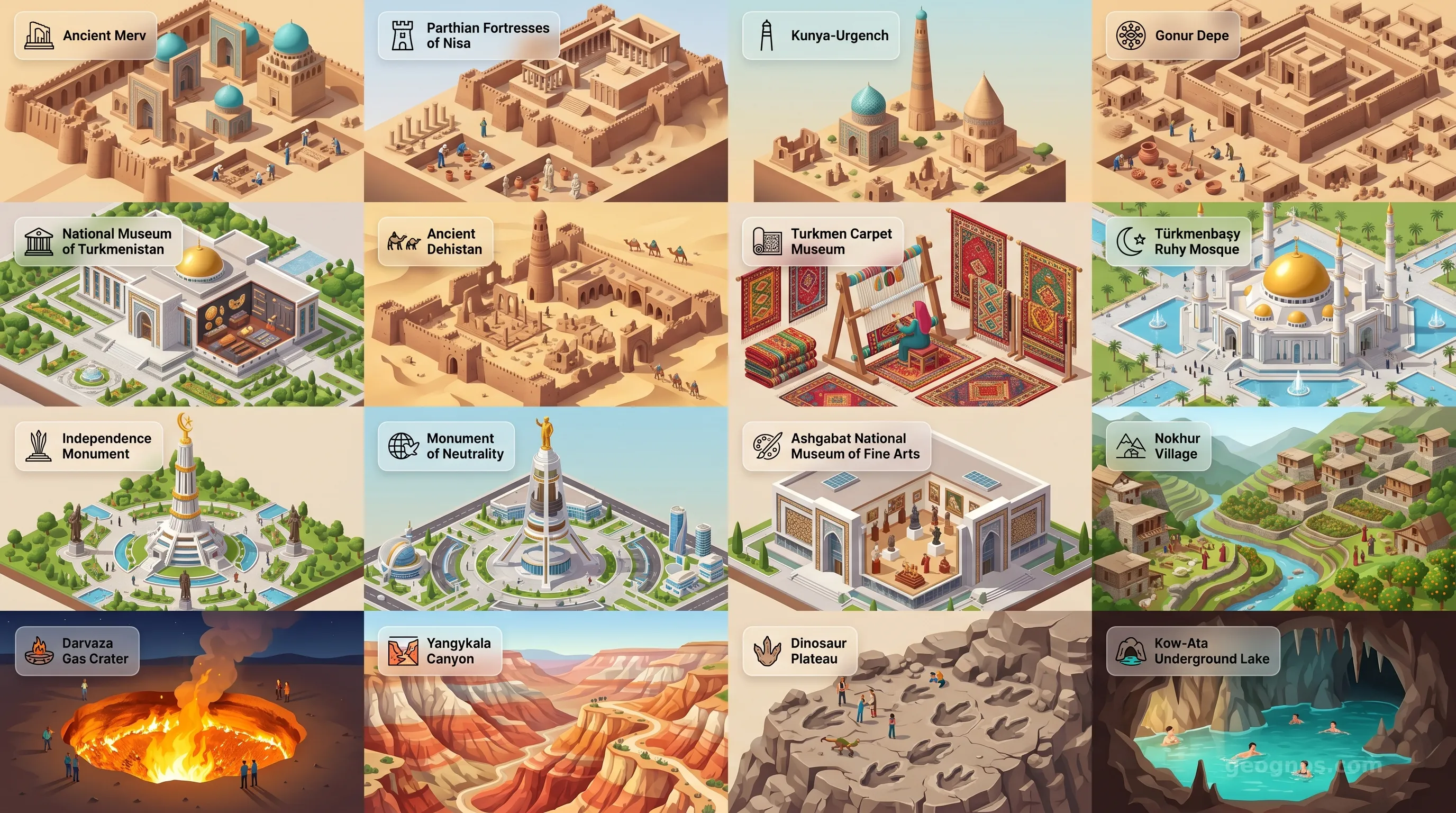
Once one of the largest and most prosperous cities in the world during the 12th century, Ancient Merv is a sprawling oasis city that served as a major melting pot of cultures, religions, and trade on the Silk Road. For students of history and archaeology, Merv offers an unparalleled look into urban development across millennia, comprising five distinct ancient cities built adjacent to one another. The historical significance is immense, marking the rise and fall of the Seljuk Empire and its devastating destruction by the Mongols. The best season to visit is spring (March to May) or autumn (September to November) to avoid the extreme summer heat. Tourist Tip: The site is massive, spanning over 1,200 hectares. Hire a knowledgeable local driver and guide to fully comprehend the scale and significance of ruins like the Sultan Sanjar Mausoleum.
Royal Seat of the Parthian Empire
Nisa served as the first capital of the mighty Parthian Empire, which rivaled ancient Rome and controlled vast territories in the Middle East and Central Asia from the 3rd century BC to the 3rd century AD. Visiting this site allows students and tourists to explore the foundations of ancient fortresses, palaces, and temples that represent a unique synthesis of Hellenistic and local traditional architectural styles. Many incredible artifacts, including famous ivory rhytons, were unearthed here. The best times to visit are spring and autumn, offering mild weather for walking the ruins. Tourist Tip: Nisa is located just 18 kilometers from Ashgabat, making it an easy half-day trip. Be sure to visit the National Museum in Ashgabat afterward to see the actual artifacts excavated from the site.
Capital of the Khorezmian Empire
Kunya-Urgench is the site of the ancient town of Urgench, the illustrious capital of the Khorezmian Empire in the 12th and 13th centuries. The ruins feature magnificent examples of Islamic architecture, including the towering 60-meter Kutlug Timur Minaret and the brilliantly tiled Turabek Khanum Mausoleum. It is an essential study destination for understanding medieval Islamic architecture, tile work, and the devastating impact of Genghis Khan's invasions. The recommended visiting seasons are spring and autumn. Tourist Tip: The site is located in the northern Dashoguz region, quite far from Ashgabat. Combine your visit to Kunya-Urgench with a trip to the Darvaza Gas Crater to maximize your time in the northern desert.
The Bronze Age Metropolis of Margiana
Gonur Depe is the archaeological heart of the Bactria-Margiana Archaeological Complex (BMAC), an advanced Bronze Age civilization dating back to 2300 BC. Discovered by Soviet archaeologist Viktor Sarianidi, this massive necropolis and city complex is believed to be one of the earliest centers of Zoroastrianism. It is an extraordinary study site for ancient history enthusiasts looking to uncover an often-overlooked cradle of civilization with complex urban planning and elaborate burial rituals. Visit during the cooler months of spring or fall. Tourist Tip: The site is extremely remote, located deep within the Karakum Desert. Access requires a sturdy 4x4 vehicle and a local guide who knows the unmarked desert routes.
Keeper of Turkmen Antiquity
Located in Ashgabat, this museum is the definitive repository for the country's most precious historical and cultural artifacts. It houses over 500,000 exhibits, including the breathtaking ivory rhytons from Nisa, Bronze Age amulets from Margiana, and exquisite traditional Turkmen carpets. It is an indispensable stop for students and tourists seeking a chronological understanding of Turkmenistan's history, from prehistoric times to modern independence. The museum is indoors and climate-controlled, making it an excellent visit year-round. Tourist Tip: Photography is strictly regulated inside the museum; expect to pay an additional fee if you wish to take photos, or rely on buying a guidebook in the gift shop.
The Isolated Medieval Oasis
Also known as Mishrian, Ancient Dehistan was a vital medieval city on the Silk Road, flourishing between the 10th and 14th centuries before being abandoned due to a shifting climate and water scarcity. Today, visitors can see the striking remnants of the Shir Kabir mosque and several towering minarets standing alone against a stark desert backdrop. It is a hauntingly beautiful study of environmental change and medieval Islamic architecture. The best time to visit is early spring before the desert temperatures rise. Tourist Tip: Located in the remote Balkan Province, Dehistan is completely off the beaten path. You will need special border zone permits to visit this area, so plan well in advance with a tour agency.
The Woven Soul of the Nation
Carpet weaving is not just an art in Turkmenistan; it is a profound expression of national identity and tribal heritage. This museum in Ashgabat is dedicated to the history and craft of the Turkmen carpet, featuring centuries-old antique pieces alongside the Guinness World Record-holding largest hand-woven carpet. It is a fantastic educational resource for studying nomadic artistry, regional 'gul' patterns, and local textiles. Suitable for visiting year-round. Tourist Tip: If you plan to purchase a carpet in Turkmenistan to take home, visiting this museum first is highly recommended to educate your eye. Furthermore, all exported carpets require an official certificate, which can be arranged through the museum's experts.
Central Asia's Majestic Mosque
Located in the village of Kipchak, this is one of the largest mosques in Central Asia, built by the country's first President, Saparmurat Niyazov (Türkmenbaşy). Architecturally striking with its massive golden dome and four towering minarets, the complex also houses the mausoleum where the former president and his family are buried. It offers fascinating insights into modern state-building, personality cults, and post-Soviet Islamic revival in Turkmenistan. Year-round accessibility makes it an easy visit. Tourist Tip: As with all active religious and state sites in Turkmenistan, visitors must dress modestly (shoulders and knees covered) and display respectful behavior. Photography may be restricted in certain areas.
The Golden Spire of Ashgabat
Surrounded by lavish fountains and imposing statues of Turkmen historical heroes, the Independence Monument is a towering 91-meter structure designed to mimic traditional Turkmen tents and the headgear of national hero Oguz Khan. Built to commemorate Turkmenistan's independence from the Soviet Union in 1991, it is a crucial site for understanding the architectural narrative of modern Ashgabat and the state's official historical narrative. Best viewed in the late afternoon or evening when the white marble and golden spire catch the sunset. Tourist Tip: Take time to walk the surrounding Independence Park to admire the meticulously clean landscaping and the dozens of bronze statues depicting ancient rulers and poets.
The Arch of Permanent Neutrality
A striking three-legged arch originally located in the city center and later moved to the suburbs, this monument celebrates Turkmenistan's official UN-recognized status of permanent neutrality. Atop the monument stands a 12-meter golden statue of former President Niyazov, which originally rotated to always face the sun. The monument provides a unique study of post-Soviet autocratic aesthetics and foreign policy symbolization. Open year-round. Tourist Tip: Visitors can take a funicular or elevator to the viewing platforms halfway up the monument, offering breathtaking panoramic views of the stark white marble city of Ashgabat against the Kopet Dag mountains.
The Heart of Turkmen Visual Arts
This grand museum houses an impressive collection of Soviet-era Turkmen paintings, contemporary local art, traditional jewelry, and nomadic clothing. For art students and cultural travelers, it provides a vivid visual evolution of the nation—from rustic tribal life to Socialist Realism, and finally to modern nationalistic expressions. The grand interior architecture is an attraction in itself. Recommended for any time of year. Tourist Tip: Look out for the works of Byashim Nurali, a pioneer of modern Turkmen painting who beautifully blended European techniques with traditional Central Asian motifs.
The Mountain Tribe Oasis
Nestled in the Kopet Dag Mountains, Nokhur is a secluded village distinct from the rest of Turkmenistan. The Nokhurli people have preserved their unique dialect, distinct architecture (houses built with mountain stones), and syncretic religious beliefs blending Islam with ancient animism. The village is most famous for its mesmerizing cemetery, where every grave is adorned with the sweeping horns of mountain goats to ward off evil spirits. It is a phenomenal anthropological study. Best visited in spring or early autumn. Tourist Tip: Nokhur is conservative and highly traditional. Dress modestly, ask for permission before taking photographs of locals, and embrace the opportunity to purchase unique local silk and craftwork.
The Gates of Hell
Arguably Turkmenistan's most famous tourist site, the Darvaza Gas Crater is a fiery pit in the middle of the Karakum Desert that has been burning for over 50 years. Created by a Soviet drilling accident in 1971, engineers lit the escaping methane gas on fire, expecting it to burn out in a few weeks. Today, it stands as a mesmerizing geological marvel and a testament to human impact on the environment. It is best visited in spring or autumn, specifically at dusk or nighttime when the flames contrast brilliantly against the dark desert sky. Tourist Tip: Book an overnight camping tour. Sleeping in a yurt or tent near the crater under a canopy of stars is an unforgettable experience.
The Fiery Fortresses of Stone
Once submerged under the ancient Paratethys Sea, Yangykala Canyon now showcases dramatic, wind-carved rock formations with spectacular bands of pink, red, and yellow limestone. Translating to 'Fire Fortresses', the canyon offers geology students and nature lovers a breathtaking landscape that rivals the Grand Canyon in color and isolation. The sheer scale and untouched nature make it a profound natural wonder. Spring and autumn are best for mild hiking weather. Tourist Tip: The canyon is far from major cities, typically accessed via Balkanabat or Turkmenbashi. There are no facilities, so bring all necessary food, water, and camping gear. A 4x4 vehicle is absolutely mandatory.
Footprints of the Jurassic Giants
Located in the remote Koytendag Nature Reserve near the border with Uzbekistan and Afghanistan, the Dinosaur Plateau preserves over 400 perfectly fossilized dinosaur footprints dating back roughly 150 million years to the Upper Jurassic period. It is one of the largest repositories of Megalosaur tracks in the world. Paleontology students and adventurous tourists will find this deeply historical geological marvel fascinating. Visit in spring or autumn. Tourist Tip: The Koytendag region requires extensive travel time from Ashgabat and specific border permits. Combine this trip with visits to the nearby Umbar-Dere gorge and the Kyrk Gyz caves for a complete natural expedition.
The Healing Thermal Cave
Situated 60 meters underground inside a massive limestone cave, Kow-Ata is a naturally heated sulfur lake that remains a constant 33°C (91°F) year-round. Revered locally for its purported healing properties, the site offers a fascinating mix of geological wonder and local folklore. The cave is also home to the largest colony of bats in Central Asia. Because the water is heated, you can visit and swim comfortably in any season, even the dead of winter. Tourist Tip: The descent involves a long, steep set of stairs that can be slippery, so wear proper footwear. Bring your own towel and swimwear, and be prepared for the strong smell of sulfur.