🇦🇫

Afghanistan

South Asia Countries
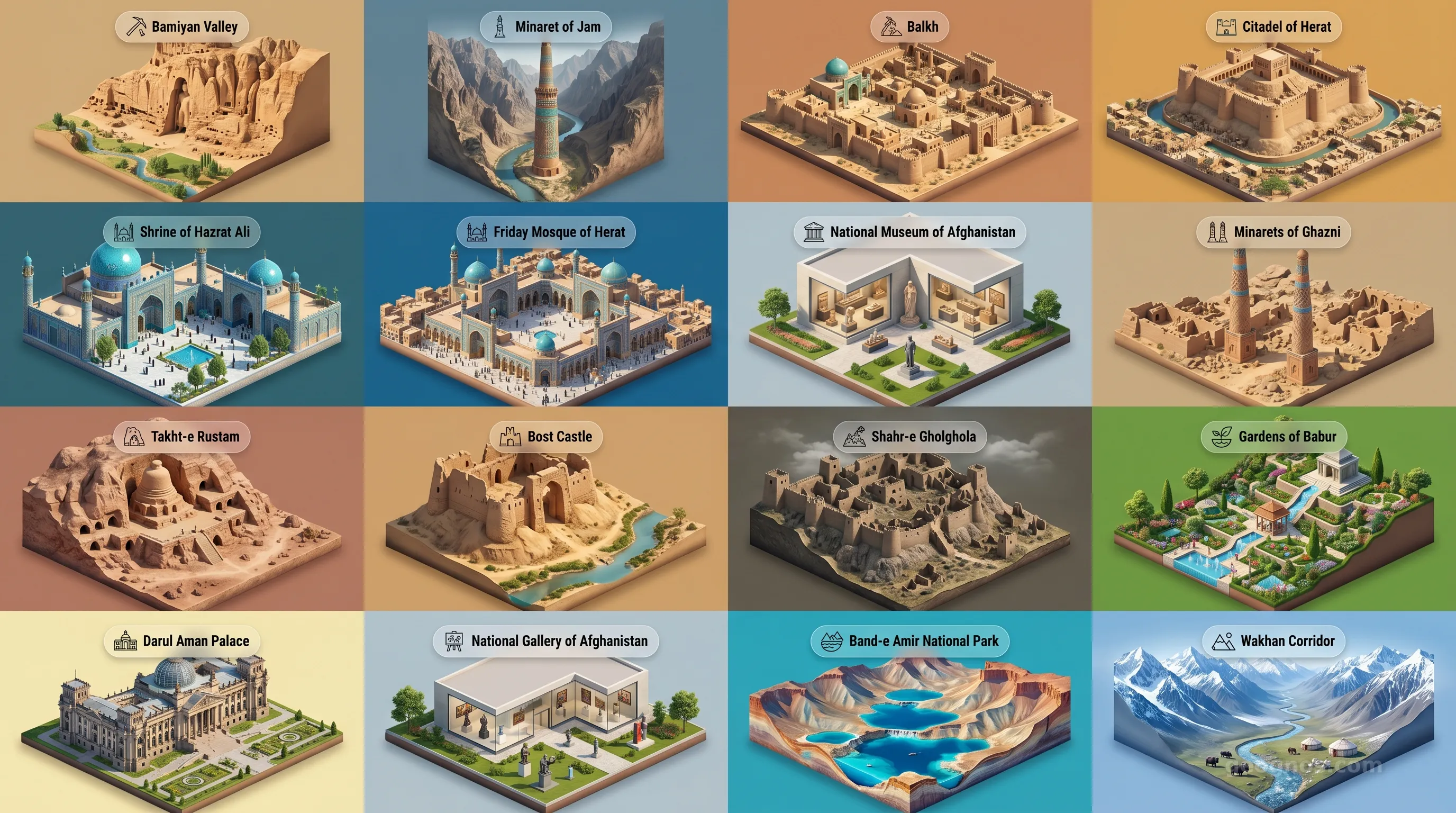
Afghanistan - Panoramic Places of Interest Atlas including Bamiyan Valley, Minaret of Jam, Balkh, Citadel of Herat, Shrine of Hazrat Ali, Friday Mosque of Herat, National Museum of Afghanistan, Minarets of Ghazni, Takht-e Rustam, Bost Castle, Shahr-e Gholghola, Gardens of Babur, Darul Aman Palace, National Gallery of Afghanistan, Band-e Amir National Park, Wakhan Corridor

Top Sights & Landmarks

01

Bamiyan Valley

The Ancient Buddhas' Landscape

02

Minaret of Jam

The Solitary Ghurid Tower

03

Balkh

The Mother of Cities

04

Citadel of Herat

Alexander's Great Fortress

05

Shrine of Hazrat Ali

The Luminous Blue Mosque

06

Friday Mosque of Herat

The Great Mosque of Timurid Art

07

National Museum of Afghanistan

The Guardian of Afghan Heritage

08

Minarets of Ghazni

The Star-Shaped Towers

09

Takht-e Rustam

The Subterranean Stupa

10

Bost Castle

The Arch of Lashkargah

11

Shahr-e Gholghola

The City of Screams

12

Gardens of Babur

The First Mughal Garden

13

Darul Aman Palace

The Neoclassical Royal Estate

14

National Gallery of Afghanistan

The House of Afghan Art

15

Band-e Amir National Park

The Lapis Lazuli Lakes

16

Wakhan Corridor

The Roof of the World

Background

Ahmad Shah DURRANI unified the Pashtun tribes and founded Afghanistan in 1747. The country served as a buffer between the British and Russian Empires until it won independence from notional British control in 1919. A brief experiment in increased democracy ended in a 1973 coup and a 1978 communist countercoup. The Soviet Union invaded in 1979 to support the tottering Afghan communist regime, touching off a long and destructive war. Internationally supported anti-communist mujahidin rebels forced the USSR to withdraw in 1989. A series of subsequent civil wars saw Kabul finally fall in 1996 to the Taliban, a hardline Pakistani-sponsored movement. Following the 11 September 2001 terrorist attacks, a US and Allied military action toppled the Taliban for sheltering Usama BIN LADIN. A UN-sponsored Bonn Conference in 2001 established a process for political reconstruction that included the adoption of a new constitution, a presidential election in 2004, and National Assembly elections in 2005. In 2004, Hamid KARZAI became the first democratically elected president of Afghanistan, and he was reelected in 2009. Ashraf Ghani AHMADZAI succeeded him as president in 2014 following a disputed election. The Taliban conducted an insurgency for two decades against the Afghan Government and forces from the United States and other countries. In February 2020, the US and the Taliban signed an agreement that led to the withdrawal of international forces in exchange for commitments on counterterrorism and other assurances. The Taliban took over Afghanistan on 15 August 2021. The Taliban established an all-male interim leadership structure dominated by Pashtun clerics under the leadership of Haivatrullah AKHUNDZADA. The Taliban issued numerous edicts that constrained women's mobility, ability to study and work, and access to education beyond primary school. To date, no country has recognized the Taliban as the government of Afghanistan.

Location

Latitude
33° N
Longitude
65° E
N S W E
World Map Location
Geographic Location

Southern Asia, north and west of Pakistan, east of Iran

Map Reference
Asia

Area

Total Area
652,230 sq km
Land (100%)
Land: 652,230 sq km
Water: 0 sq km

Elevation

Highest Point
Noshak
Noshak 7,492 m
Lowest Point
Amu Darya
Amu Darya 258 m
Mean Elevation
1,884 m

Detailed Geography Information

Coastline

0 km (landlocked)

Geography - note

landlocked; the Hindu Kush mountains that run northeast to southwest divide the northern provinces from the rest of the country; the highest peaks are in the northern Vakhan (Wakhan Corridor)

Irrigated land

24,930 sq km (2022)

Land boundaries

Total boundary: 5,987 km
China 91 km
Iran 921 km
Pakistan 2670 km
Tajikistan 1357 km
Uzbekistan 144 km

Major lakes (area sq km)

salt water lake(s): Ab-e Istadah-ye Muqur (endorheic basin) - 520 sq km

Major rivers (by length in km)

Amu Darya (shared with Tajikistan [s], Turkmenistan, and Uzbekistan [m]) - 2,620 km; Helmand river source (shared with Iran) - 1,130 km note: [s] after country name indicates river source; [m] after country name indicates river mouth

Major watersheds (area sq km)

Indian Ocean drainage: Indus (1,081,718 sq km) Internal (endorheic basin) drainage: Amu Darya (534,739 sq km); Tarim Basin (1,152,448 sq km)

Maritime claims

none (landlocked)

Natural hazards

damaging earthquakes occur in Hindu Kush mountains; flooding; droughts

Natural resources

natural gaspetroleumcoalcopperchromitetalcbaritessulfurleadzinciron oresaltprecious and semiprecious stonesarable land

Terrain

mostly rugged mountains; plains in north and southwest

Population & Growth

+2.90% Growth
49,474,805
Total inhabitants (2025 est.)
Male: 50.6% (25,051,967) Female: 49.4% (24,422,838)

Age Distribution

0-14 years
39.6%
~19,592,023
15-64 years
57.5%
~28,448,013
65 years
2.9%
~1,434,769
Note: 2024 est.

Demographic Longevity

Median Age
18.4 years
Male
20 yrs
Female
20.1 yrs
Life Expectancy
54.4 years
Male
52.8 yrs
Female
56.1 yrs

Vital Dynamics

Birth Rate
35.99
births per 1,000 people
Death Rate
5.79
deaths per 1,000 people
Net Migration
-1.62
migrants per 1,000 people
Fertility Rate
4.89
children born per woman

Detailed People & Society Information

Alcohol consumption per capita

0.01 liters of pure alcohol (2019 est.)

Children under the age of 5 years underweight

18.4% (2022 est.)

Currently married women (ages 15-49)

65.9% (2023 est.)

Dependency ratios

total dependency ratio: 82.2 (2025 est.) youth dependency ratio: 77 (2025 est.) elderly dependency ratio: 5.2 (2025 est.) potential support ratio: 19 (2025 est.)

Education expenditure

4.3%

4.3% of GDP (2017 est.) 15.7% national budget (2017 est.)

Ethnic groups

Gross reproduction rate

2.39 (2025 est.)

Health expenditure

21.8%

21.8% of GDP (2021) 1.1% of national budget (2022 est.)

Hospital bed density

0.4 beds/1,000 population (2021 est.)

Infant mortality rate

total: 42 deaths/1,000 live births (2025 est.) male: 109.7 deaths/1,000 live births female: 92.5 deaths/1,000 live births

Languages

lingua franca
77%
Pashto
48%
Uzbeki
11%
English
6%
Turkmani
3%
Urdu
3%
Pashaie
1%
Nuristani
1%
Arabic
1%
Balochi
1%
other <
1%
note 1: percentages sum to more than because many people are multilingual
100%

Literacy

total population: 37.3% (2021 est.) male: 52.1% (2021 est.) female: 26.6% (2022 est.)

Major urban areas - population

4.589 million KABUL (capital) (2023)

Maternal mortality ratio

521 deaths/100,000 live births (2023 est.)

Mother's mean age at first birth

19.9 years (2015 est.) note: data represents median age at first birth among women 25-49

Nationality

noun: Afghan(s) adjective: Afghan

Obesity - adult prevalence rate

5.5% (2016)

Physician density

0.32 physicians/1,000 population (2023)

Population distribution

populations tend to cluster in the foothills and periphery of the rugged Hindu Kush range; smaller groups are found in many of the country's interior valleys; in general, the east is more densely settled, while the south is sparsely populated

Refugees and internally displaced persons

Total Displaced & Vulnerable Persons
5,478,419 individuals
Refugees
0.4%
21,236
21,236 (2024 est.)
Internally Displaced Persons (IDPs)
99.6%
5,457,183
5,457,183 (2024 est.)

Religions

Muslim (Sunni 84.7
99.7%
Shia 10
15%
other <
0.3%

School life expectancy (primary to tertiary education)

total: 11 years (2018 est.) male: 13 years (2018 est.) female: 8 years (2018 est.)

Sex ratio

at birth: 1.05 male(s)/female 0-14 years: 1.03 male(s)/female 15-64 years: 1.03 male(s)/female 65 years and over: 0.85 male(s)/female total population: 1.02 male(s)/female (2024 est.)

Tobacco use

total: 20.8% (2025 est.) male: 36.5% (2025 est.) female: 5.2% (2025 est.)

Climate & Issues

Climate Profile

arid to semiarid; cold winters and hot summers

Key Environmental Issues
limited natural freshwater resources inadequate potable water soil degradation overgrazing deforestation (cut down for fuel and building materials) desertification air and water pollution in urban areas

Land Cover

Coverage Distribution
Agri (58%)
Other (40%)
Arable: 12.0%
Crops: 0.4%
Pasture: 46.0%
Forest: 1.9%

Air & Carbon Emissions

Annual CO2 Output 2023 est.
7.757 million
Coal (100%) Oil (0%) Gas (0%)
PM2.5 Exposure 84 µg/m³
0 5 (WHO Limit) 15 25 35+

Water Resources & Use

Renewable Water Resources 65.33 billion cubic meters (2022 est.)
Annual Water Withdrawal
municipal: 203.4 million cubic meters (2022 est.)
Municipal (1%) Ind (1%) Agri (98%)

Detailed Environmental Information

International environmental agreements

BiodiversityClimate ChangeClimate Change-Kyoto ProtocolClimate Change-Paris AgreementComprehensive Nuclear Test BanDesertificationEndangered SpeciesEnvironmental ModificationHazardous WastesMarine Dumping-London ConventionNuclear Test BanOzone Layer Protection

Urbanization

urban population: 26.9% of total population (2023) rate of urbanization: 3.34% annual rate of change (2020-25 est.)

Waste and recycling

municipal solid waste generated annually: 5.629 million tons (2024 est.) percent of municipal solid waste recycled: 11.1% (2022 est.)

Capital & State Profile

Capital City
Kabul
34.5167° N, 69.1833° E
Timezone UTC+4.5
Daylight Saving does not observe daylight savings time
Government Type
theocratic; the United States does not recognize the Taliban Government
Independence 1919-08-19
National Holiday 08-19

Executive Branch

Chief of State
Taliban Leader HAYBATULLAH Akhundzada (since 15 August 2021)
Head of Government
overall Taliban Leader HAYBATULLAH Akhundzada is the [so-called] Amir-ul Momineen of the Taliban and is effectively the head of government
Last Election 28 September 2019
Cabinet the Taliban have announced a “cabinet” for the “caretaker government,” including the “acting prime minister,” “acting deputy prime ministers,” and “ministers” who claim to represent 26 ministries

Legislative Branch

Seats & Term
N/A seats / N/A
Electoral System N/A

National Identity & Symbols

National Flag Description

three equal vertical bands of black (left), red, and green, with the national emblem in white centered on the red band and slightly overlapping the other bands; the emblem shows a mosque with a pulpit and flags on either side; below the mosque are Eastern Arabic numerals for the solar year 1298 (1919 in the Gregorian calendar, the year of Afghan independence from the UK); a border of wheat sheaves circles the mosque; above the mosque is an Arabic inscription of the Shahada (Muslim creed), with rays of the rising sun over the Takbir (Arabic expression meaning "God is great"); under the mosque is a scroll with the name Afghanistan

Symbolic Meaning black stands for the past, and red for the blood shed for independence; green can represent hope for the future, agricultural prosperity, or Islam
National Symbol lion
National Colors red, green, black
National Anthem Milli Surood (National Anthem)

Detailed Government Information

Administrative divisions

34 provinces (welayat, singular - welayat); Badakhshan, Badghis, Baghlan, Balkh, Bamyan, Daykundi, Farah, Faryab, Ghazni, Ghor, Helmand, Herat, Jowzjan, Kabul, Kandahar, Kapisa, Khost, Kunar, Kunduz, Laghman, Logar, Nangarhar, Nimroz, Nuristan, Paktika, Paktiya, Panjshir, Parwan, Samangan, Sar-e Pul, Takhar, Uruzgan, Wardak, Zabul

Citizenship

citizenship by birth: no citizenship by descent only: at least one parent must have been born in - and continuously lived in - Afghanistan dual citizenship recognized: no residency requirement for naturalization: 5 years

Constitution

history: several previous; latest ratified in 2004, but not currently enforced by the Taliban

Country name

conventional long form: Islamic Republic of Afghanistan (prior to 15 August 2021); current country name disputed conventional short form: Afghanistan local long form: Jamhuri-ye Islami-ye Afghanistan (prior to 15 August 2021; current country name is disputed) local short form: Afghanistan etymology: the name "Afghan" originally referred to the Pashtun people, but today it is understood to include all the country's ethnic groups; the suffix "-stan" means "place of" or "country," so Afghanistan literally means the "Land of the Afghans"

International law organization participation

has not submitted an ICJ jurisdiction declaration; formerly accepted ICCt jurisdiction

International organization participation

Judicial branch

highest court(s): the Taliban are purported to have appointed clerics, including a "Chief Justice," to Afghanistan's Supreme Court subordinate courts: provincial courts, religious courts, and specialty courts

Legal system

the Taliban is implementing its own interpretation of Islamic law, which is partially based on the Hanifi school of Islamic jurisprudence and have enforced strict punishments; before the Taliban takeover, Afghanistan had a mixed legal system of civil, customary, and Islamic law (2021)

National heritage

total World Heritage Sites: 2 (both cultural) selected World Heritage Site locales: Minaret of Jam; Buddhas of Bamyan note: the monumental 6th- and 7th-century Buddha statues at Bamyan were destroyed by the Taliban in 2001

Political parties

the Taliban Government enforces an authoritarian state and has banned other political parties the Taliban have banned other political parties but have allowed some party leaders, including the head of Hezb-e-Islami, Gulbuddin Hekmatyar, to continue to live and work in Afghanistan; Hekmatyar likely continues to enjoy some political support from loyalists; leaders of other parties, including Jamiat-e-Islami’s Salahuddin Rabbani and Jumbesh’s Rashid Dostum, operate from abroad but likely also command some following within Afghanistan note: before 15 August 2021, the Ministry of Justice had licensed 72 political parties as of April 2019

Suffrage

18 years of age; universal

Economic Overview

low-income South Asian economy; economy stable after major contraction due to Taliban takeover, but recovery remains fragile; widespread poverty and obstacles to human development; import-reliant for food, fuel, and machinery; ongoing sanctions, suspended development aid, and frozen reserve assets

Size & Performance

Real GDP (PPP)
$82.238 billion
Latest available estimate (2023)
2022: $80.416 billion2021: $85.768 billion
Real GDP Growth
2.3% (2023 est.)
+2.3%
GDP Per Capita (PPP)
$2,000
2022: $2,0002021: $2,100

GDP Sector Breakdown

Agriculture: 34.7%Industry: 13.4%Services: 46.4%
Origin GDP %
Agriculture 34.7%
Industry 13.4%
Services 46.4%

Trade Balance

Trade Position
Trade Deficit
$5.51 billion
Total Exports
$1.476 billion (2020 est.)
Total Imports
$6.983 billion (2020 est.)
Exports (17%) Imports (83%)

Budget Balance

Budget Position
Budget Surplus
+$1.68 billion
Revenues
$9.093 billion (2017 est.)
Expenditures
$7.411 billion (2017 est.)
Revenues (55%) Expenditures (45%)

Export Profile

Top Export Partners

40.0%
4.0%
2.0%
Note: 2023; top five export partners based on percentage share of exports

Major Export Commodities

coalgrapestropical fruitsgum resinsother nuts

Import Profile

Top Import Partners

Note: 2023; top five import partners based on percentage share of imports

Major Import Commodities

wheat flourstobaccopalm oilbroadcasting equipmentsynthetic fabric

Labor & Employment

Total Labor Force 9.133 million (2024 est.)
General Unemployment Rate 13.3%
Youth Unemployment (Ages 15-24) 16.7%
Population Below Poverty Line 54.5% (2016 est.)

Income Inequality

Detailed Economic Data

Agricultural products

wheatmilkgrapeswatermelonspotatoesmelonsvegetablesriceonionsmaize

Current account balance

-$3.137 billion (2020 est.) -$3.792 billion (2019 est.) -$3.897 billion (2018 est.) note: balance of payments - net trade and primary/secondary income in current dollars

Debt - external

$2.717 billion (2023 est.) note: present value of external debt in current US dollars

Exchange rates

afghanis (AFA) per US dollar - Exchange rates: 76.814 (2020 est.) 77.738 (2019 est.) 72.083 (2018 est.) 68.027 (2017 est.) 67.866 (2016 est.)

GDP - composition, by end use

Industrial production growth rate

1.8% (2023 est.) note: annual % change in industrial value added based on constant local currency

Industries

small-scale production of brickstextilessoapfurnitureshoesfertilizerapparelfood productsnon-alcoholic beveragesmineral watercementhandwoven carpetsnatural gascoalcopper

Inflation rate (consumer prices)

-6.6% (2024 est.) -4.6% (2023 est.) 13.7% (2022 est.) note: annual % change based on consumer prices

Remittances

1.9% of GDP (2023 est.) 2.2% of GDP (2022 est.) 2.2% of GDP (2021 est.) note: personal transfers and compensation between resident and non-resident individuals/households/entities

Reserves of foreign exchange and gold

$9.749 billion (2020 est.) $8.498 billion (2019 est.) $8.207 billion (2018 est.) note: holdings of gold (year-end prices)/foreign exchange/special drawing rights in current dollars

Taxes and other revenues

9.9% (of GDP) (2017 est.) note: central government tax revenue as a % of GDP

Grid Infrastructure

Electricity Access 85.3%
Urban: 95.9% Rural: 81.7%
Capacity 627,000 kW (2023 est.)
Consumption 6.468 billion kWh (2023 est.)
Imports 6.221 billion kWh (2023 est.)
Grid Losses: 725.652 million kWh (2023 est.)

Generation Mix

Percentage Share of Production
hydroelectricity 77%
fossil fuels 13.3%
solar 9.7%

Fossil Fuels Production

Petroleum
Consumption 58,000 bbl/day (2023 est.)
Natural Gas
Production 80.2 million cubic meters (2020 est.)
Consumption 80.2 million cubic meters (2020 est.)
Proven Reserves 49.554 billion cubic meters (2021 est.)
Coal
Production 767,000 metric tons (2023 est.)
Consumption 503,000 metric tons (2023 est.)
Exports 265,000 metric tons (2023 est.)
Imports 2,000 metric tons (2023 est.)
Proven Reserves 66 million metric tons (2023 est.)

Intensity & Nuclear

Energy Consumption Per Capita 3.38 million Btu/person (2023 est.)
No nuclear energy infrastructure or reactor operations reported in this country dossier.

Digital Access

.af
Internet Usage 18%

Active internet users as a percentage of the total population.

Fixed Broadband

Penetration Rate 0 / 100
Total Subscriptions 33,000 (2023 est.)

Mobile Cellular

Penetration Rate 60 / 100
Total Subscriptions 25.6 million (2024 est.)

Broadcast Media

under the Taliban, independent media outlets have decreased and are probably self-censoring; the Ministry of Information and Culture monitors all mass media; television and radio are key media platforms; only about a fifth of Afghans use the internet, mostly through smartphones (2023)

Aviation

YA
Airports
68
As of 2025
Heliports
8
As of 2025

Military Expenditures

GDP Allocation 3.3%
3.3% of GDP (2019) 3.2% of GDP (2018) 3.3% of GDP (2017) 3.1% of GDP (2016) 2.9% of GDP (2015)

Active Duty Strengths

the Taliban claims to have 190,000 under the Ministry of Defense and 215,000 under the Ministry of Interior (2025)

Refers to active military personnel.

Service & Defense Details

Military and security forces

the Taliban has formed a Ministry of Defense and a National Army (aka Army of the Islamic Emirate of Afghanistan, Islamic Emirate Army, or Afghan Army); it has also formed police forces under a Ministry of Interior (2025)

Military equipment inventories and acquisitions

the Taliban military and security forces are equipped with armaments captured in 2021 from the Afghan National Defense and Security Forces, which were largely equipped with Russian/Soviet-era and US material (2025)

Military - note

the Taliban’s key security priorities are border and internal security; specific issues have included tensions with Pakistan along their shared border, armed anti-Taliban resistance elements, and the Islamic State of Iraq and ash-Sham - Khorasan (ISIS-K) terrorist group (2025)

Military service age and obligation

service is voluntary; there are reports indicating that the Taliban has been involved in the forced recruitment of children for use in armed conflict (2024) note: the Taliban dismissed nearly all women from the former Afghan National Defense and Security Forces, except those serving in detention facilities and assisting with body searches