Kazakhstan
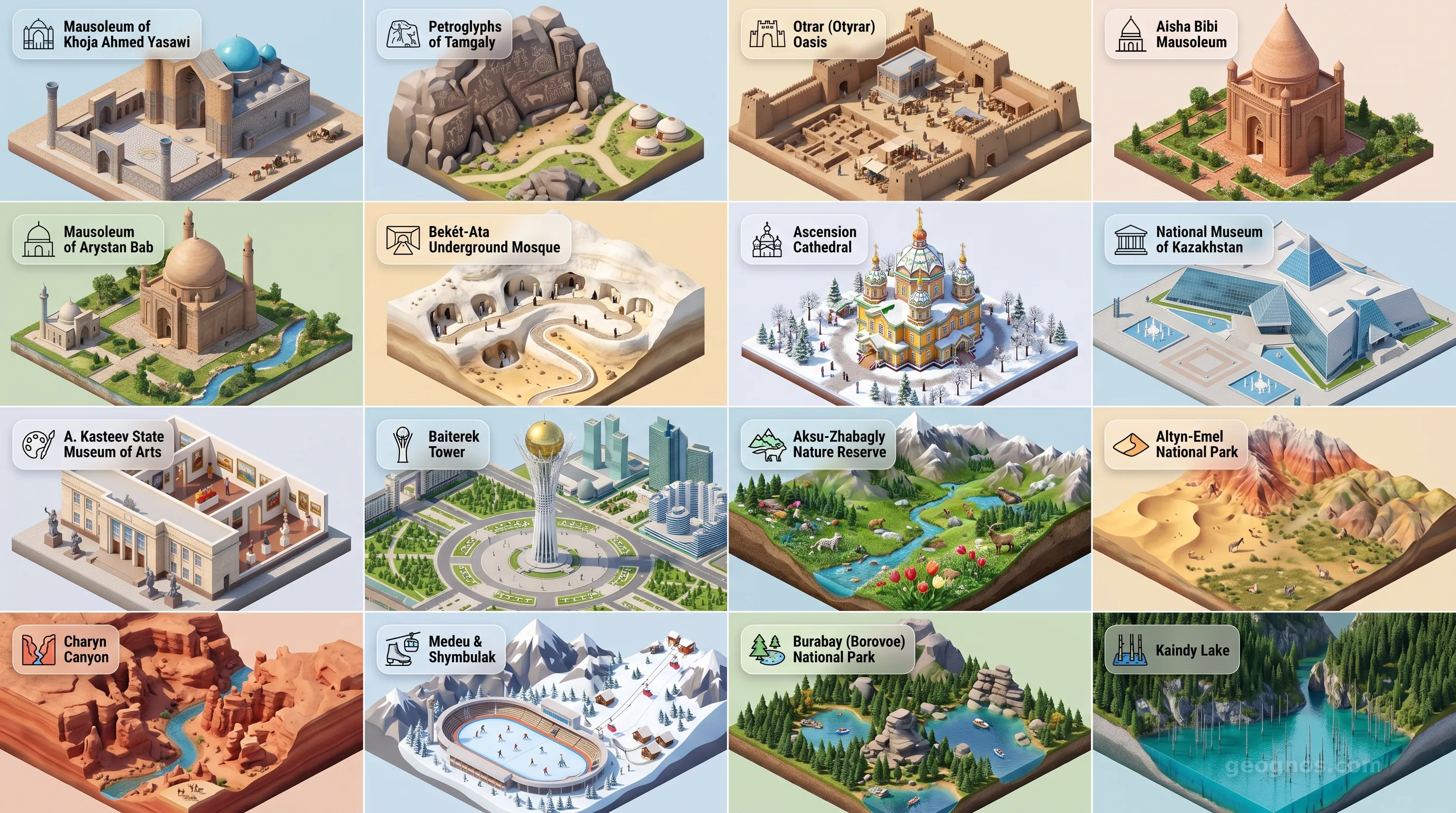
Top Sights & Landmarks
Timurid Architectural Masterpiece
Commissioned in 1389 by Timur (Tamerlane), this unfinished mausoleum is one of the best-preserved and most significant Timurid structures in the world. It is essential for students of Islamic architecture and Central Asian history, pioneering structural techniques later used in Samarkand. It remains a major pilgrimage site honoring the 12th-century Sufi mystic Khoja Ahmed Yasawi. The best time to visit is during spring (April-May) or autumn (September-October) to avoid the extreme summer heat. Tourist tip: Visitors must observe a respectful dress code; women should bring a headscarf.
Ancient Bronze Age Rock Art
Nestled in the Chu-Ili Mountains, Tamgaly boasts over 5,000 petroglyphs detailing the spiritual, social, and daily lives of ancient steppe communities from the Bronze Age through the Turkic periods. It is a world-class destination for archaeology and anthropology students. The rock carvings of 'sun-headed' deities are particularly mesmerizing. The optimal time to visit is in the spring or early autumn. Tourist tip: The site offers little shade, so bring plenty of water, a wide-brimmed hat, and sunscreen.
Ruins of a Legendary Silk Road City
Otrar was a major commercial hub on the Silk Road and the birthplace of the renowned medieval philosopher Al-Farabi. Historically, it is famous for its siege by Genghis Khan in 1219, which precipitated the Mongol conquest of Central Asia. Today, students and tourists can explore the excavated ruins of its citadel, baths, and irrigation systems. Visit during the milder months of spring and autumn. Tourist tip: Hire a local guide to fully grasp the historical context of the layered excavations.
12th-Century Karakhanid Monument
Located near Taraz, the Aisha Bibi Mausoleum is a 12th-century monument celebrated for its completely terracotta-tiled exterior, which features over 60 different floral and geometric patterns. It is the only monument in Kazakhstan completely covered with carved terracotta. Steeped in a tragic legend of love and loss, it offers deep insights into Karakhanid-era art and architecture. Spring and autumn are the best seasons to visit. Tourist tip: Combine this with a visit to the nearby Babaji Khatun Mausoleum for a complete historical excursion.
Resting Place of a Sufi Mystic
Arystan Bab was the mentor of Khoja Ahmed Yasawi, and traditional pilgrimage etiquette dictates visiting his tomb before proceeding to Yasawi's mausoleum in Turkestan. Originally dating back to the 14th century but rebuilt over time, the structure reflects a blend of ancient and relatively modern Central Asian brickwork and historic facades. It's a living spiritual center perfect for cultural anthropology studies. Spring and autumn offer the most pleasant weather. Tourist tip: Be prepared for crowds of pilgrims, especially on weekends and religious holidays.
Sacred Subterranean Sanctuary
Carved into the dramatic chalk cliffs of the Ustyurt Plateau in the Mangistau region, this underground mosque was built by the revered 18th-century Sufi mystic Bekét-Ata. It serves as both an architectural marvel and a significant spiritual sanctuary, attracting thousands of pilgrims. The stark, otherworldly landscape makes it a profound site for both geologists and religious scholars. Late spring or early autumn is best to avoid lethal summer heat. Tourist tip: The journey requires a robust 4x4 vehicle and considerable travel time; an overnight stay at the pilgrim guesthouse is highly recommended.
Earthquake-Resistant Wooden Cathedral
Located in Panfilov Park in Almaty, this stunning Russian Orthodox cathedral was completed in 1907. Designed by engineer Andrei Zenkov, it is constructed entirely of wood—reportedly without a single nail—and uniquely survived the devastating 1911 Almaty earthquake. Its vividly painted facades and golden domes make it a fascinating study in early 20th-century anti-seismic engineering and imperial architecture. It is beautiful to visit year-round. Tourist tip: Listen for the choir during weekend services for an immersive cultural experience.
Chronicle of the Kazakh Steppe
Situated in Astana, this massive, ultra-modern museum is the ultimate repository of Kazakhstan's heritage. Its collections span from ancient paleontology to modern independence, with the crowning jewel being the replica of the 'Golden Man' (an ancient Scythian warrior). It is an absolute must-visit for students wanting a comprehensive overview of Central Asian history. Accessible and comfortable year-round. Tourist tip: Allocate at least 3-4 hours to properly explore the extensive exhibitions, and don't miss the multimedia hall.
Premier Central Asian Art Collection
Located in Almaty, this is the largest art museum in the country, named after pioneering Kazakh painter Abilkhan Kasteev. It holds an unparalleled collection of Kazakh visual arts, Soviet-era masterpieces, and traditional applied arts like felt-making and weaving. It serves as a vital resource for art history students studying the transition from nomadic traditions to modern fine arts. Visit any time of the year. Tourist tip: The museum often hosts temporary exhibitions; check their schedule in advance. Audio guides provide excellent context.
Symbol of Modern Astana
This 97-meter-tall monument embodies a Kazakh legend about a mythical tree of life and a magic bird, Samruk, who laid her golden egg between its branches. Built to commemorate the transfer of the capital to Astana in 1997, it stands as the ultimate symbol of post-Soviet, independent Kazakhstan. Urban planning students will appreciate its role in the city's futuristic skyline. It is a year-round destination. Tourist tip: Head to the observation deck near sunset for spectacular panoramic views of the city's illuminated architecture.
Central Asia's Oldest Nature Reserve
Established in 1926, this UNESCO biosphere reserve in the western Tien Shan mountains protects rich biodiversity, including the elusive snow leopard and native Greig's tulips. It offers phenomenal opportunities for botany, zoology, and ecology students to study undisturbed alpine and steppe ecosystems. The best time to visit is spring (April-May) for the tulip blooming season. Tourist tip: Access is strictly regulated; you must hire an official guide or ranger to hike or horseback ride through the reserve.
Singing Dunes and Ancient Kurgans
Altyn-Emel is a remarkable convergence of natural wonder and ancient history. It features the famous 'Singing Dune'—which emits a deep, organ-like rumble when the wind blows—and the Besshatyr burial mounds (kurgans) of ancient Saka warriors. The surreal Aktau and Katutau mountains offer striking geological formations. Spring and autumn are ideal, as summer temperatures soar. Tourist tip: The park is vast and roads are unpaved; traveling with an experienced 4x4 tour operator is essential.
The Grand Canyon of Kazakhstan
Carved by the Charyn River over 12 million years, this dramatic canyon features the 'Valley of Castles', an area of towering, wind-sculpted red rock formations. It is a living laboratory for geology and physical geography students. The colorful strata reveal millions of years of earth's history. The best seasons are spring and early autumn to avoid extreme summer heat and winter snow. Tourist tip: Pack plenty of water, wear sturdy hiking boots, and stay for sunset when the rocks glow intensely red.
High-Altitude Sports Legacy
Just outside Almaty lies Medeu, the highest Olympic-sized skating rink in the world, renowned for shattering Soviet-era speed skating records due to its high-altitude pure water ice. A cable car connects it to Shymbulak, a premier ski resort. This area bridges sports history with spectacular alpine geography. Winter is ideal for skiing and skating, while summer offers magnificent hiking. Tourist tip: Take the cable car all the way to Talgar Pass (3,200m) for breathtaking views of the surrounding glaciers.
The Pearl of Kazakhstan
Often called the 'Switzerland of Kazakhstan', Burabay is an oasis of pine forests, peculiar rock formations, and clear lakes rising dramatically from the endless northern steppes. Historically, it was a retreat for Kazakh Khans, notably Khan Ablai, whose legendary seat is marked by a prominent rock. It is superb for studying the contrast in Kazakh biomes. Summer is the prime season for swimming and hiking. Tourist tip: Rent a bicycle to ride along the well-paved paths circling Lake Borovoe.
The Sunken Forest
Formed by a massive limestone landslide triggered by the 1911 Kebin earthquake, Kaindy Lake is famous for the dead spruce trees poking out of its vivid turquoise waters. The freezing temperatures preserve the underwater trunks, creating a surreal landscape for scuba divers and a fascinating case study for ecology and geology students. Summer to early autumn is the most accessible time. Tourist tip: The last stretch of the road requires a 4x4 or a hike. The water is freezing, so swimming is prohibited unless you are on an organized dry-suit dive.