Kyrgyzstan
Top Sights & Landmarks
Ancient Silk Road Beacon
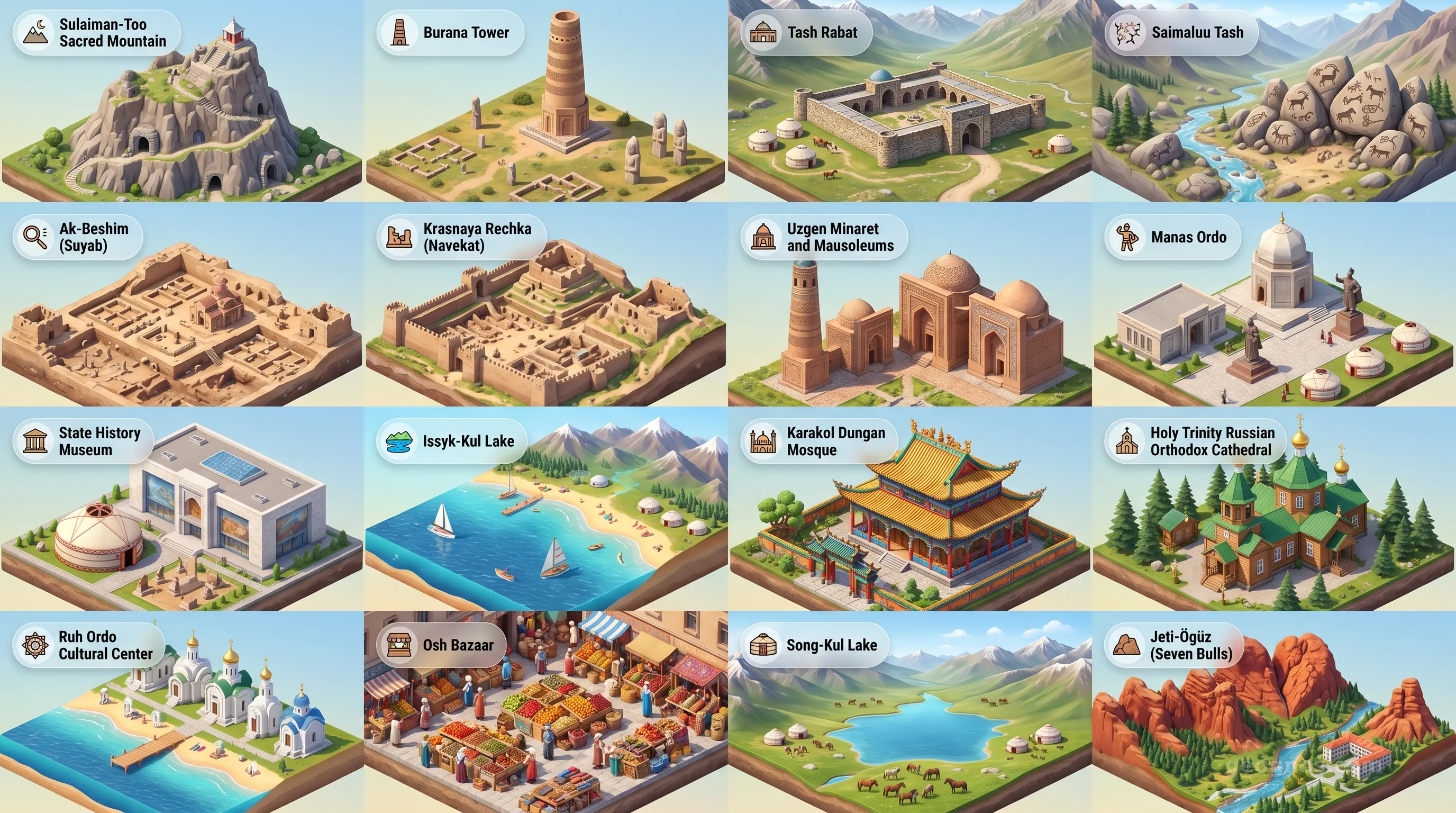
Rising abruptly from the Fergana Valley in the city of Osh, Sulaiman-Too Sacred Mountain is Kyrgyzstan's first UNESCO World Heritage site. Revered for over 3,000 years, this five-peaked limestone massif served as a major beacon for travelers on the Silk Road and remains a highly significant place of Islamic and pre-Islamic pilgrimage. Studying its ancient petroglyphs, cult sites, and 16th-century mosques offers profound insights into Central Asian spiritual history. The best time to visit is during spring (April to May) or early autumn (September to October) when the weather is mild. Tourist Tip: Don't miss the National Historical and Archaeological Museum Complex carved directly into the mountain's main cave, and wear sturdy walking shoes for the rocky paths.
Remnants of the Karakhanid Empire
Located in the Chuy Valley, the Burana Tower is one of the few remaining physical testaments to the ancient city of Balasagun, a thriving Silk Road capital of the Karakhanid Empire in the 9th century. Once standing at 45 meters before earthquakes reduced it to 25 meters, this architectural marvel is surrounded by earthworks, ancient mausoleums, and a remarkable collection of 'balbals' (ancient Turkic stone grave markers). It is essential for students of medieval Central Asian history. Late spring through early autumn is ideal for visiting. Tourist Tip: Climb the narrow, dark internal staircase of the tower to enjoy panoramic views of the surrounding mountains, but be prepared for a tight squeeze.
15th-Century Stone Caravanserai
Nestled in a picturesque gorge of the Tian Shan mountains at an altitude of 3,200 meters, Tash Rabat is an impeccably preserved 15th-century stone caravanserai. Originally built as an ancient monastery, it later served as a vital fortress and inn for merchants traversing the punishing terrain of the Great Silk Road. The site offers an unparalleled glimpse into the logistics of ancient global trade. Due to its high altitude, the best time to visit is during the summer months (June to August). Tourist Tip: The region gets remarkably cold at night even in summer, so pack warm layers. Horseback riding tours in the surrounding valley are highly recommended.
Gallery of Ancient Petroglyphs
Saimaluu Tash, meaning 'Embroidered Stone', is an extraordinary archaeological sanctuary located high in the Fergana Range. It houses an estimated 10,000 to 90,000 individual petroglyphs dating from the Bronze Age to the Middle Ages. The carvings depict scenes of hunting, dancing, and religious rituals, making it a goldmine for anthropologists and art historians studying ancient nomadic cultures. It is only accessible for a brief window during mid-summer (July and August) when the snow melts. Tourist Tip: The site requires a strenuous hike or a specialized 4x4 off-road vehicle to reach. Hire a knowledgeable local guide to help spot and interpret the most fascinating carvings.
Ruins of an Ancient Cosmopolitan Capital
Part of the Chang'an-Tianshan Corridor of the Silk Roads, Ak-Beshim contains the ruins of the ancient city of Suyab. Founded by Sogdian merchants in the 5th century, it became an incredibly diverse cultural melting pot featuring Buddhist temples, Christian churches, and Zoroastrian shrines side-by-side. Studying this site reveals the profound religious tolerance and cultural exchange of early Central Asia. The ruins are best visited from April to October. Tourist Tip: Since it is an active archaeological site with limited towering monuments, reading up on its history beforehand or hiring an expert guide is crucial to fully appreciate the ground foundations you will see.
Silk Road Settlement of Navekat
Another crucial node on the Silk Road's Tian Shan corridor, Krasnaya Rechka contains the remnants of the ancient city of Navekat. Flourishing between the 6th and 12th centuries, excavations here have uncovered a massive 12-meter clay Buddha, highlighting the spread of Buddhism across Asia before the Islamic conquests. The site is a treasure trove for historians interested in pre-Islamic Central Asia. Visit between May and September for the best weather. Tourist Tip: Combine a trip to Krasnaya Rechka with nearby Burana Tower and Ak-Beshim to create a comprehensive full-day Silk Road historical tour.
Masterpiece of Karakhanid Brickwork
Located in the historic town of Uzgen, one of the oldest cities in Kyrgyzstan, this architectural complex dates back to the 11th and 12th centuries when Uzgen was a capital of the Karakhanid Khanate. It features a stunning 27.5-meter tall minaret and three connected mausoleums containing the remains of Karakhanid leaders. The intricate terracotta brickwork and carved floral and geometric motifs are masterpieces of early Islamic architecture in the region. Spring and autumn offer the most pleasant weather for exploring. Tourist Tip: The town of Uzgen is also famous for its locally grown red rice (devzira); be sure to try an authentic local plov (pilaf) while visiting.
Memorial to the Epic Hero Manas
Situated in the Talas Valley, Manas Ordo is a vast memorial complex dedicated to Manas, the legendary hero of the Kyrgyz people whose epic poem is one of the longest in the world. The site features a 14th-century brick mausoleum, traditionally believed to be the resting place of Manas, though historically it belongs to a Chagatai princess. The complex serves as the spiritual heart of Kyrgyz national identity, making it a critical destination for anyone studying the country's cultural DNA. The site is accessible year-round, but summer is ideal. Tourist Tip: Hire a guide to tell you the stories of the Manas Epic as you explore the park, and visit the on-site museum detailing the oral traditions of the 'Manaschi' (epic reciters).
Chronicle of Kyrgyz Heritage
Located in Ala-Too Square in the capital city of Bishkek, the State History Museum is the largest and most comprehensive museum in Kyrgyzstan. After extensive renovations, it now offers beautifully curated exhibits spanning from the Bronze Age petroglyphs and nomadic armor to Soviet-era relics and the modern independence movement. It is an absolute must-visit for students looking to contextualize the country's complex history before venturing out into the regions. It operates year-round. Tourist Tip: Allocate at least two to three hours to fully digest the exhibits. The ceiling murals on the upper floors detailing the Soviet perspective of world history are a fascinating cultural artifact in themselves.
The Pearl of the Tian Shan
Issyk-Kul is the world's second-largest alpine lake, situated at an elevation of 1,607 meters. Historically, it was an essential oasis on the Silk Road, and underwater archaeological expeditions have discovered ruins of ancient sunken cities beneath its waves. The lake never freezes, hence its name 'Warm Lake' in Kyrgyz, due to extreme depth and mild salinity. It is a brilliant destination for both historical intrigue and natural beauty. Summer (July to August) is the best time for swimming and beach resorts. Tourist Tip: The northern shore is highly developed with resorts, while the southern shore is much wilder and traditional, offering a more authentic Kyrgyz cultural experience.
Sino-Islamic Architectural Fusion
Constructed in 1910 by a Chinese architect and 20 artisans, this remarkable mosque in the city of Karakol was built to serve the Dungan community (Chinese Muslims who fled persecution in the 1880s). Built entirely of wood without a single metal nail, it resembles a Buddhist temple with its brightly painted dragons, phoenixes, and tiered roof, representing a beautiful fusion of Chinese architectural style with Islamic function. It is a fantastic site to study regional migration and cultural synthesis. Visit year-round. Tourist Tip: Visitors must dress modestly; women are provided with cloaks and headscarves at the entrance. Photography is generally allowed outside, but be respectful during prayer times.
Wooden Relic of the Tsarist Era
Completed in 1895 in Karakol, this striking wooden cathedral stands as a testament to the expansion of the Russian Empire into Central Asia. With its green roofs and golden onion domes, the building miraculously survived the Soviet anti-religious campaigns, having been repurposed as a school and a coal store before being restored to a place of worship. The interior houses beautiful religious icons, including a copy of the Andrei Rublev Trinity. It offers great historical value regarding the Russian imperial era in Kyrgyzstan. Accessible year-round. Tourist Tip: The church is particularly atmospheric during Sunday morning services or Orthodox holidays, though visitors should remain quiet and respectful.
Spiritual Sanctuary on Issyk-Kul
Located on the northern shore of Issyk-Kul in Cholpon-Ata, Ruh Ordo ('Spiritual Center') is a unique outdoor museum and park dedicated to the harmony of world religions and Kyrgyz culture. The complex features five identically designed white chapels representing Islam, Catholicism, Orthodoxy, Buddhism, and Judaism, aiming to promote tolerance and spiritual unity. It also celebrates the works of famous Kyrgyz writer Chingiz Aitmatov. It provides an interesting modern perspective on Kyrgyzstan's post-Soviet cultural revival. Best visited from May to September. Tourist Tip: The entrance fee includes a guided tour, which is highly recommended to understand the deep symbolism behind the sculptures and architecture.
The Pulsing Heart of Bishkek
Osh Bazaar is one of the largest and most vibrant markets in Bishkek, serving as a living museum of Central Asian trade and daily life. Walking through its labyrinthine alleys offers a sensory overload of spices, fresh produce, traditional Kyrgyz clothing (like the kalpak), intricate textiles, and local street food. It is an unmatched environment for sociology students and cultural travelers to witness the authentic hustle and bustle of urban Kyrgyz society. The market operates year-round. Tourist Tip: Watch out for pickpockets in crowded areas. Be sure to visit the traditional bread section and try fresh lepeshka (flatbread) straight from the tandoor oven.
Heartland of Nomadic Pastoralism
Sitting at an altitude of 3,016 meters in the inner Tian Shan mountains, Song-Kul is a stunning alpine lake surrounded by lush summer pastures (jailoos). It is the quintessential location to study and experience the ancient nomadic lifestyle of the Kyrgyz people. During the summer months, local herders set up their yurt camps here to graze their livestock, welcoming travelers with traditional hospitality, kumis (fermented mare's milk), and horseback riding. The visiting window is strictly mid-June to mid-September due to heavy snows the rest of the year. Tourist Tip: There is no cell service or internet at Song-Kul. Bring warm clothes for the freezing nights and embrace the profound silence and digital detox.
Mythological Red Rock Formations
Jeti-Ögüz is a famous geological formation of red sandstone cliffs located near the city of Karakol. The name translates to 'Seven Bulls', referring to the seven distinct bluffs that dominate the valley, which are steeped in local folklore and tragic legends of love and betrayal. The site also features the 'Broken Heart' rock formation. Geologists and nature lovers will find the sedimentary history and striking contrast against the green alpine forests mesmerizing. Late spring to early autumn is the best time to visit. Tourist Tip: A short, steep hike up the hill opposite the formations provides the classic panoramic viewpoint perfect for photography.