Uzbekistan
Top Sights & Landmarks
The Crown Jewel of the Timurid Empire
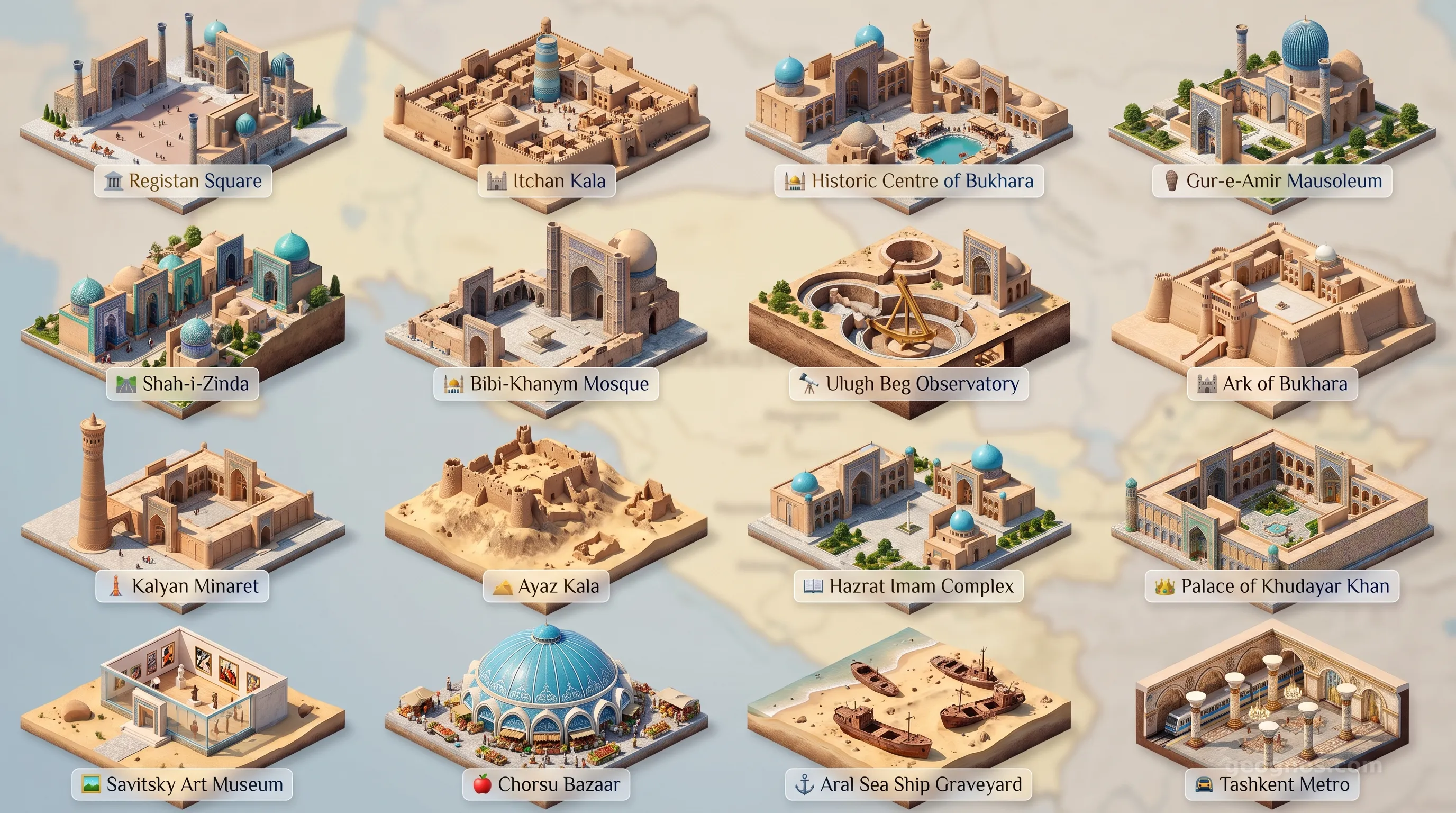
Registan Square was the medieval commercial and public center of Samarkand. Framed by three spectacular, majolica-covered madrasas (Ulugh Beg, Sher-Dor, and Tilya-Kori), it is arguably the most famous architectural ensemble in Central Asia. For students of Islamic architecture and history, it offers unparalleled insight into 15th and 17th-century Timurid design, featuring intricate tilework, ribbed domes, and grand pishtaqs (portals). Historically, it was the site of royal proclamations and public executions. The best season to visit is during the mild spring (April-May) or early autumn (September-October). Tourist tip: Purchase a multi-day ticket to see the square at sunrise for crowd-free photography, and return at night for the spectacular illumination and occasional light shows.
The Intact Medieval Walled City of Khiva
Itchan Kala is the inner walled town of the ancient oasis of Khiva, acting as a breathtaking open-air museum. Preserving more than 50 historic monuments and 250 old houses dating primarily from the 18th and 19th centuries, it is an essential study destination for urban historians examining traditional Silk Road city planning. The mud-brick defensive walls, winding alleys, and the striking turquoise Kalta Minor Minaret transport visitors back to the era of the Khiva Khanate. Autumn (September to November) provides the most comfortable weather for exploring the arid region. Tourist tip: Climb the Islam Khodja Minaret just before sunset for sweeping panoramic views of the entire walled city bathed in golden light.
The Holy City of the Silk Road
With a history spanning over two millennia, the Historic Centre of Bukhara is the most complete example of a medieval city in Central Asia, with an urban fabric that has remained largely intact. Once a major center of Islamic theology and culture, it boasts hundreds of mosques, madrasas, and caravanserais. Scholars and tourists alike are drawn to the Po-i-Kalyan complex and the trading domes that highlight ancient economic and religious synergy. Spring is highly recommended to enjoy walking between the scattered monuments. Tourist tip: Spend time relaxing by the Lyabi-Hauz pool at the center of the old city, a perfect spot to sip green tea and observe local life beneath ancient mulberry trees.
The Tomb of the Great Conqueror, Amir Timur
Gur-e-Amir is the architectural marvel that serves as the final resting place of the Asian conqueror Amir Timur (Tamerlane), his sons, and grandsons, including the astronomer Ulugh Beg. It holds immense historical significance as the precursor and model for later Mughal architecture, including the Taj Mahal. Students of art history will marvel at the azure fluted dome and the lavish interior decorated with gold leaf, onyx, and jade. May and September offer the best lighting for observing the intricate exterior tilework. Tourist tip: The interior is relatively small, so visit early in the morning to fully appreciate the solemn atmosphere and the famous dark green jade tombstone of Timur before large tour groups arrive.
The Avenue of Mausoleums
Shah-i-Zinda, meaning 'The Living King', is a mesmerizing necropolis located in Samarkand. It features a continuous street of richly decorated mausoleums dating from the 11th to the 19th centuries. The site is a masterclass in the evolution of medieval ceramic art, displaying virtually every type of tilework used in the Islamic world. It centers around the supposed grave of Qusam ibn-Abbas, a cousin of the Prophet Muhammad. Spring and autumn are the best times for a visit. Tourist tip: The narrow alleyway acts as a wind tunnel and can be surprisingly cool, so bring a light layer. Respect the local pilgrims, as this remains a highly revered active religious site.
Timur's Colossal Monument to His Wife
Built in the early 15th century using wealth plundered during Timur's campaigns in India, the Bibi-Khanym Mosque was designed to be the grandest mosque in the Islamic world. Its sheer scale pushed the architectural and engineering limits of its time, causing sections to crumble shortly after completion. Today, partially restored, its gigantic ruined portals and colossal domes remain an awe-inspiring study in imperial ambition and architectural hubris. Late spring is ideal for clear skies that contrast beautifully with the blue domes. Tourist tip: Check out the massive marble Quran stand in the center of the courtyard; local legend claims that women who crawl under it will be blessed with many children.
A 15th-Century Center of Astronomy
Built in the 1420s by the Timurid ruler and astronomer Ulugh Beg, this observatory was once the most advanced astronomical center in the Islamic world. Scholars determined the length of the stellar year and plotted the coordinates of over 1,000 stars with astonishing accuracy, decades before the invention of the telescope. Today, visitors can see the remains of the massive subterranean Fakhri sextant and study the adjoining museum. This site is highly recommended for students of the history of science. Visit during spring or fall for comfortable exploration. Tourist tip: Combine this visit with the nearby Afrasiyab Museum to understand the pre-Mongol history of the region.
The Ancient Fortress of the Emirs
The Ark is a massive, 5th-century fortress that essentially functioned as a city within a city, housing the Emirs of Bukhara until the early 20th century. With its imposing, sloped, mud-brick walls, it was the epicenter of Bukharan political and military power. Inside, the surviving structures now house museums detailing the history, numismatics, and royal life of the Emirate. It is a vital site to study the socio-political structure of Central Asian khanates. September is a particularly pleasant time to explore its vast courtyards. Tourist tip: Don't miss the Zindan (ancient prison) located just behind the Ark, which features the infamous 'Bug Pit' where British officers Stoddart and Conolly were imprisoned.
The Tower of Death That Spared Genghis Khan
Standing at nearly 47 meters tall, the Kalyan Minaret was built in 1127 and was so magnificent that it reportedly prompted Genghis Khan to spare it when he destroyed the rest of Bukhara. It is a masterpiece of Karakhanid architecture, featuring fourteen ornamental bands of intricate brickwork. Historically used for the call to prayer, as a watchtower, and allegedly as a site of execution, it dominates the Bukhara skyline. The golden hour in October provides perfect lighting for capturing the deep terracotta textures. Tourist tip: While you cannot climb the minaret anymore, the adjacent Kalyan Mosque offers the best vantage point for photographing the tower's staggering height against the courtyard arches.
The Desert Fortresses of Ancient Khorezm
Rising dramatically from the Kyzylkum Desert, Ayaz Kala is a complex of three ancient mud-brick fortresses dating from the 4th century BC to the 7th century AD. Built by the ancient Khorezmian civilization to protect against nomadic raids, these haunting ruins offer archaeologists and adventurous tourists a glimpse into pre-Islamic Central Asia. The surrounding arid landscape provides a stark, evocative backdrop. Spring is the best time to visit, as summer desert temperatures are dangerous and winter can be brutally cold. Tourist tip: Stay overnight in the nearby yurt camp to experience traditional Karakalpak hospitality, and wake up early to watch the sunrise illuminate the desert ruins.
Keeper of the World's Oldest Quran
Situated in the old town of Tashkent, the Hazrat Imam Complex is the religious heart of Uzbekistan. The site's primary draw for historians and religious scholars is the Muyi Mubarak Madrasa, which houses the Uthman Quran. Believed to date back to the 8th century, it is considered one of the oldest surviving copies of the Quran in the world, stained with the blood of Caliph Uthman. The complex features beautifully reconstructed madrasas and mosques with wide, peaceful courtyards. Visit in the spring or early summer. Tourist tip: Dress modestly (shoulders and knees covered) out of respect, and consider hiring a local guide to explain the intricate history of Islamic scholarship in Tashkent.
The Last Great Palace of the Kokand Khanate
Located in the Fergana Valley, the Palace of Khudayar Khan is a striking monument of 19th-century Central Asian architecture. Originally boasting 114 rooms across seven courtyards, only a fraction of the palace survives today, but its brilliantly tiled exterior remains highly impressive. It provides crucial context for the history of the Kokand Khanate right before the Russian imperial conquest. The Fergana Valley is exceptionally beautiful in late spring and early autumn during harvest time. Tourist tip: The museum inside contains a fascinating array of artifacts from the khanate era; don't miss the beautifully carved wooden ceilings and doors.
The Louvre of the Steppes
Located in Nukus, the capital of the autonomous Republic of Karakalpakstan, the Savitsky Museum holds the world's second-largest collection of Russian avant-garde art. During the Soviet era, curator Igor Savitsky secretly rescued thousands of banned artworks from destruction by hiding them in this remote desert outpost. For art historians and culture enthusiasts, this museum is an absolute must-visit. The best time to visit is during the shoulder seasons (April or October) to avoid extreme desert climates. Tourist tip: Take the overnight train from Tashkent to Nukus for an authentic travel experience, and dedicate at least half a day to properly view both the art and the Karakalpak ethnography exhibits.
The Beating Heart of Old Tashkent
Underneath a massive, brutalist-style blue dome lies Chorsu Bazaar, one of the oldest and most vibrant markets in Central Asia. Historically, this area was a key crossroad for the Silk Road. Today, it is an immersive sensory experience where farmers sell spices, dried fruits, fresh produce, and traditional bread (non). It offers a phenomenal opportunity for cultural anthropologists and tourists to interact with locals. It is bustling year-round, but late summer brings an incredible bounty of melons and peaches. Tourist tip: Visit the outdoor 'glutton row' to sample authentic, freshly cooked street food like shashlik, plov, and somsa directly from the vendors.
A Stark Monument to Ecological Disaster
Located near the former port city of Moynaq, the Aral Sea Ship Graveyard consists of rusting fishing trawlers sitting on miles of arid desert sand—a seabed where water once flowed. The shrinking of the Aral Sea due to Soviet agricultural policies is one of the world's worst man-made environmental disasters. Environmental science students and eco-tourists visit here to comprehend the staggering scale of ecological mismanagement. Spring and early autumn are best for visiting. Tourist tip: Start at the local museum in Moynaq to view historical photographs of the once-thriving port before walking down the escarpment to touch the rusted hulls of the stranded ships.
The Subterranean Art Galleries of the Cold War
Opened in 1977, the Tashkent Metro was the first underground transit system in Central Asia and remains one of the most ornate in the world. Originally designed to double as a nuclear fallout shelter, each station is a unique architectural masterpiece featuring marble, granite, chandeliers, and mosaics that depict Soviet and Uzbek cultural themes. Architecture and history buffs will be mesmerized by stations like Kosmonavtlar (celebrating space exploration) and Alisher Navoi. Open year-round. Tourist tip: The ban on photographing the metro was lifted in 2018, so you can freely take pictures. Ride during non-peak hours (mid-morning or early afternoon) to admire the artwork without the commuter crowds.