Azerbaijan
Top Sights & Landmarks
Prehistoric Petroglyph Reserve
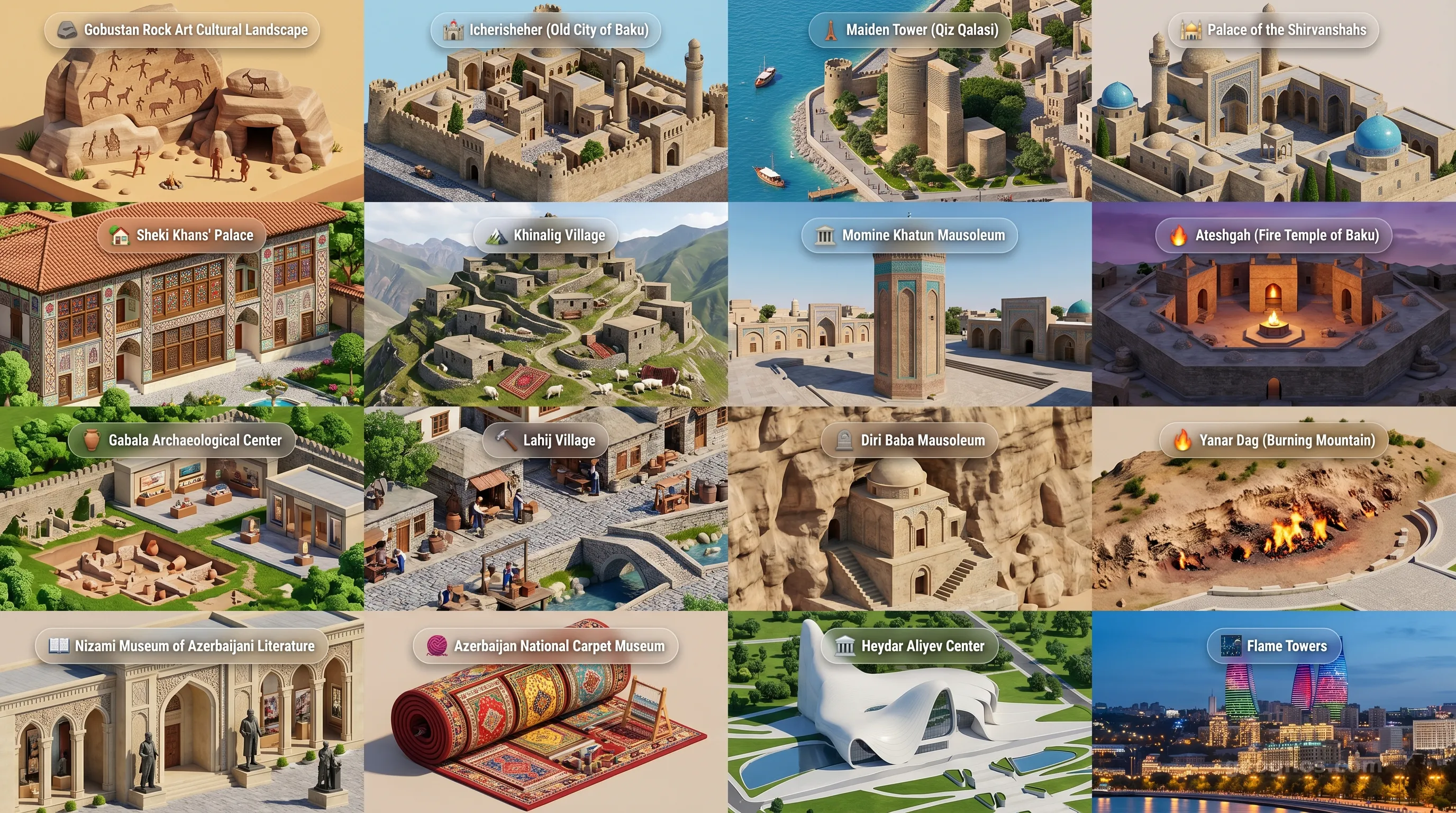
Gobustan offers a profound window into early human history with over 6,000 rock engravings dating back 40,000 years. For students of anthropology and history, it provides unparalleled insight into prehistoric hunting practices, flora, fauna, and early human lifestyles in the Caucasus. Its historical significance is monumental, tracing the evolution of humanity from the Upper Paleolithic era to the Middle Ages. The best seasons to visit are Spring and Autumn to avoid extreme heat. Tourist Tip: Hire a local guide at the high-tech interactive museum before walking the trails to fully contextualize the cryptic rock carvings.
Baku's Medieval Core
Icherisheher is the ancient, walled heart of modern Baku, offering a labyrinth of narrow cobblestone streets, caravanserais, and historical mosques. It is essential for studying medieval urban planning and the cross-cultural influences of the Silk Road. The site showcases the integration of Arabic, Persian, and Shirvan architectural styles. Spring is the best time to visit when the weather is mild and courtyard cafes are blooming. Tourist Tip: Wander aimlessly to discover hidden rooftop tea houses, but ensure you wear comfortable walking shoes for the uneven ancient stones.
Enigmatic Ancient Watchtower
Rising majestically on the edge of the Old City, the Maiden Tower is a 12th-century monument whose original purpose—whether a Zoroastrian fire temple, astronomical observatory, or defense tower—remains a tantalizing mystery for historians and archaeologists. It is highly culturally significant, acting as the national symbol of Azerbaijan. Visitors and students can study its unique cylindrical architecture and thick stone walls. Visit in Spring or Autumn for pleasant weather. Tourist Tip: Climb to the observation deck just before dusk for a spectacular, panoramic sunset view over the Caspian Sea.
Masterpiece of Medieval Islamic Architecture
Described by UNESCO as one of the pearls of Azerbaijani architecture, this 15th-century palace complex was the seat of the Shirvanshah dynasty. The complex includes a mosque, burial vaults, and a mausoleum. It is an extraordinary site for architectural and historical studies, representing the peak of the Shirvan-Absheron architectural school. The best time to visit is Spring. Tourist Tip: The palace features intricate stone carvings; take your time examining the portal of the mausoleum, which is mathematically precise and spiritually symbolic.
18th-Century Royal Summer Residence
Nestled in the forested Caucasus Mountains, this spectacular 18th-century palace is famed for its vibrant miniature frescoes and 'shebeke'—intricate wooden window frames filled with colorful stained glass, constructed entirely without nails. It is a vital study subject for traditional Caucasian craftsmanship, aesthetics, and the history of the Sheki Khanate. Summer and early Autumn are ideal for visiting the lush surrounding region. Tourist Tip: Photography is strictly prohibited inside to protect the delicate pigments, so bring a sketchbook or simply absorb the visual splendor.
Ancient Alpine Settlement
Perched at an altitude of 2,350 meters, Khinalig is one of the highest and oldest continuously inhabited villages in Europe, dating back over 5,000 years. Recently inscribed by UNESCO, it is a living laboratory for ethnographers and linguists, as the locals speak a unique language isolate (Khinalug) and maintain ancient semi-nomadic traditions. Summer is the best and safest season to visit due to harsh alpine winters. Tourist Tip: The road is incredibly scenic but steep; hire an experienced local driver with a 4x4 vehicle from the nearby city of Quba.
Jewel of the Nakhchivan Architectural School
Located in the Nakhchivan Autonomous Republic, this 12th-century decagonal brick tower was built by the renowned architect Ajami Nakhchivani. It is decorated with complex geometric patterns and Kufic script. For students of Islamic architecture, it is a masterclass in proportion and brickwork artistry, marking a golden age of the Seljuk Empire. Spring and Autumn offer the most comfortable climate for exploring the exclave. Tourist Tip: Look closely at the turquoise glazed tiles that spell out profound philosophical messages in Arabic.
Historic Zoroastrian and Hindu Temple
Built in the 17th and 18th centuries on the site of an unextinguishable natural gas vent, Ateshgah was a place of worship for Zoroastrians, Hindus, and Sikhs traveling the Silk Road. It offers fascinating insights into religious syncretism, historical trade routes, and the region's ancient identity as the 'Land of Fire'. The museum displays are highly educational. Autumn is a great time to visit. Tourist Tip: Combine your trip here with a visit to the nearby Yanar Dag for a complete 'fire heritage' day tour.
Ancient Capital of Caucasian Albania
The ruins of Chukhur Gabala represent the ancient capital of Caucasian Albania, a vital kingdom that existed from the 4th century BC to the Middle Ages. The site features excavated city gates, ancient plumbing systems, and medieval artifacts. It is an indispensable site for scholars researching ancient Transcaucasian history and early Christianity in the region. Summer provides the best weather for walking the extensive outdoor excavation sites. Tourist Tip: Visit the on-site museum first to understand the layout and scale of the buried city before walking the grounds.
Medieval Village of Coppersmiths
Isolated in the Greater Caucasus, Lahij is a remarkably preserved medieval settlement renowned for its authentic copper-smithing and cobblestone streets. It is an excellent destination to study the preservation of traditional intangible cultural heritage and localized guild systems that have survived for centuries. Late Spring through Early Autumn is ideal, as winter roads can be treacherous. Tourist Tip: Purchase handcrafted copperware directly from the artisans' workshops, where you can watch them hammer the metals using centuries-old techniques.
Cliffside Sufi Shrine
Built in 1402, this two-story mausoleum is carved directly into a rocky cliff face in Maraza. It is a stunning example of the Shirvan architectural school and is steeped in local legends of a holy Sufi mystic whose body allegedly never decayed. It is highly valuable for students of Islamic mysticism and medieval rock-cut architecture. Best visited in Spring when the surrounding plains are green. Tourist Tip: The staircase leading up to the shrine is steep and narrow; proceed with caution and enjoy the serene, acoustic stillness inside the dome.
Everlasting Natural Fire
Yanar Dag is a continuously burning hillside on the Absheron Peninsula, fueled by natural gas seeping through the porous sandstone. This striking geological phenomenon inspired the ancient Zoroastrian fire-worship that shaped early regional culture. It is an excellent, accessible spot to study geology and fossil fuel outcroppings. Winter and late evenings are the best times to visit for maximum visual impact. Tourist Tip: Arrive at dusk; the contrast of the flames against the darkening sky makes for spectacular photography and a mystical atmosphere.
Shrine to Eastern Literature
Located in central Baku, this museum honors Nizami Ganjavi and other great Azerbaijani poets. The building itself is a masterpiece, featuring brilliant blue majolica tiles and statues of famous writers on its facade. It is a treasure trove for students of Persian and Turkic literature, housing rare manuscripts and beautiful miniatures. It is a great year-round indoor destination. Tourist Tip: The museum is very thorough; utilize the English-speaking guides or audio guides to truly grasp the profound metaphors of classical Eastern poetry.
Architectural and Cultural Textile Hub
Housed in a striking modern building designed to look like a rolled-up carpet, this museum contains the world's largest collection of Azerbaijani carpets. It provides a comprehensive study of the seven distinct regional weaving schools, decoding the symbology, natural dyeing processes, and social importance of rug making in Azerbaijani history. Open year-round. Tourist Tip: Do not miss the live weaving demonstrations on the lower floors, where artisans meticulously knot rugs using traditional looms.
Icon of Modern Parametric Design
Designed by the legendary architect Zaha Hadid, this flowing, futuristic building features almost no straight lines. It symbolizes Azerbaijan's departure from rigid Soviet architecture into a modern, dynamic future. Architecture and design students must visit to study its innovative structural engineering. Inside, it hosts rotating art and cultural exhibits. Perfect year-round. Tourist Tip: Walk the entire perimeter of the building; the structure completely changes shape depending on your vantage point, offering endless photographic opportunities.
Baku's Flaming Skyline
A trio of towering skyscrapers shaped like tongues of fire, these buildings are the modern symbol of Baku's oil wealth and ancient fire-worshipping heritage. They dominate the city skyline and represent a fascinating study in modern urban development, LED facade integration, and nation-branding. Accessible year-round. Tourist Tip: You do not need to go inside; the best way to experience them is from Baku Boulevard after dark when over 10,000 LED lights project animations of fire, water, and the national flag across their surfaces.